
RADIO CONTROL AEROBATICS
Eric Henderson 303 Shady Ln., Marlton, NJ 08053 E-mail: [email protected]
2005 Masters Schedule (AMA event 404)
- Takeoff (U) K=1
- Stall Turn, 1-1/4 Rolls Up, 3/4 Roll Down, Exit Inverted (U) K=4
- Half Outside Loop, 2/4 Roll on Exit K=2
- Reverse Avalanche from Top with 1 Positive Snap at Bottom (D) K=4
- Half Loop with Full Roll Out K=2
- 45 Degree Pyramid Loop with Half Rolls on Up and Down Legs (U) K=3
- Humpty Bump, Push or Pull on Top, 1/4 Roll Up, 3/4 Roll Down K=3
- Quarter, Half, Quarter Roll (D) K=4
- Half Inside Loop, 2/4 Roll on Exit K=2
- Vertical Square Eight from the Middle, Pilot’s Option (U) K=4
- Mid-Entry Figure Nine — Pull 3/4 Loop First, Half Roll Down K=3
- Slow Roll (D) K=3
- Humpty Bump with Pilot’s Option K=2
- Square Loop with 2/4 Point Rolls on All Sides. First 2/4 on Up-Line (U) K=5
- Stall Turn with 1/2 Rolls K=2
- Inside-Outside Diamond Eight with 1/1 Full Rolls on Center 45s (D) K=5
- Immelmann Turn K=1
- 45 Degree Down, One Positive Snap Roll (U) K=3
- Top Hat with 3/4 Roll Up, 1/4 Roll Down, Exit Upright K=3
- Reverse Knife-Edge (D) K=4
- Half Square Loop with 1/2 Roll Up K=2
- 2-1/2 Turn Spin, with 1/2 Roll on Horizontal Exit Line (U) K=4
- Landing (U) K=1
Total K-Factor = 66
Official Descriptions of New Maneuvers (2005)
- Stall Turn, 1-1/4 Rolls Up, 3/4 Roll Down, Exit Inverted (Item 2)
- Model pulls through one-quarter (1/4) loop to vertical flight, pauses, performs one-and-one-quarter (1-1/4) rolls, pauses, performs a 180-degree stall turn in the direction of the maneuver to a vertical dive, pauses, performs a three-quarter (3/4) roll in the opposite rotation, pauses, then pushes through one-quarter (1/4) loop to recover in inverted level flight.
- Half Outside Loop, 2/4 Roll on Exit (Item 3)
- Model pushes from inverted level flight and executes a half (1/2) outside loop, immediately followed by two of four (2/4) point roll, and finishes flying straight and level exactly 180 degrees from heading at entry.
- Reverse Avalanche from Top with 1 Positive Snap at Bottom (Item 4)
- Model pulls down into a loop. At the bottom it executes one positive snap roll, recovers to complete the loop, and finishes at top to level inverted flight.
- 45 Degree Pyramid Loop with Half Rolls on Up and Down (Item 6)
- Model passes through center and pulls 135 degrees, climbs, hesitates, executes one-half (1/2) roll, hesitates, then pushes through a 90-degree loop, hesitates, executes one-half (1/2) roll, hesitates, then pulls through 135 degrees to level flight.
- Vertical Square Eight from the Middle, Pilot’s Option (Item 10)
- Model passes through center and pulls or pushes to commence a square loop. When the first square loop is complete, the model passes through center again and performs a second square loop exactly below or above, opposite to the first loop.
- Mid-Entry Figure Nine — Pull 3/4 Loop First, Half Roll Down (Item 11)
- Model pulls a 3/4 loop, hesitates, performs a one-half (1/2) roll on the down-line, hesitates, then pulls one-quarter (1/4) loop. (Note: loop entry point does not have to dissect the down-line.)
- Square Loop with 2/4 Point Rolls on All Sides. First 2/4 on Up-Line (Item 14)
- Model passes through center and pulls through one-quarter (1/4) loop and executes a square loop with corner segments of equal radius. In each leg, the model hesitates, performs a two-of-four (2/4) point roll, hesitates again before performing the next loop segment.
- Inside-Outside Diamond Eight with 1/1 Full Rolls on Center 45s (Item 16)
- Model passes through center and pulls one-eighth (1/8) loop to a 45-degree up-line, draws another straight line then pulls one-quarter (1/4) loop, draws a straight line, and pulls one-quarter (1/4) loop. Model hesitates and performs one full roll (1/1), hesitates and pushes one-quarter (1/4) loop to a 45-degree up-line, draws a line and then pushes one-quarter (1/4) loop, draws straight line, pushes one-quarter (1/4), hesitates and performs one full roll (1/1), hesitates and pulls one-eighth (1/8) loop to level flight.
Notes on the Reverse Avalanche and Execution
I expect that the Reverse Avalanche (Item 4) will initially catch the Masters pilots' attention because it includes the snap at the bottom of the loop. On closer inspection, the maneuver is designed so the model will be almost level and upright just before the snap component. The snap will be a single snap and will be performed into the wind. These design decisions were calculated to make the maneuver more executable.
AMA Contest Board Vote and NSRCA Proposals
What would our sport be without something to debate? In this rules-change cycle, the AMA Contest Board did not pass all of the National Society of Radio Controlled Aerobatics (NSRCA) proposals. A total of 12 NSRCA proposals were submitted; six passed and six were turned down.
The AMA Contest Board chairman also submitted five proposals. All of those passed, and unfortunately some contradicted the NSRCA 2004 survey vote. The most controversial change will probably be the Contest Board's removal of scoring landings and takeoffs for accuracy and execution.
All of the NSRCA survey results showed that pilots wanted those two maneuvers to remain scored as they are today. It is possible to conclude that the Contest Board members appear to be out of touch with the NSRCA membership. The counter to that claim is that the NSRCA does not represent all aerobatics pilots in the AMA. That is probably what needs to be fixed rather than who submits what proposal.
The NSRCA is dedicated to the promotion of precision aerobatics, and the organization's U.S. membership is approximately 600. (Only U.S./AMA members are eligible to vote on AMA rules changes.) When not all AMA members in the USA are included in rules-change surveys, it causes a problem for AMA Contest Board members. They can't be sure that NSRCA voting data are representative of the AMA pattern fliers in their AMA districts.
In several instances, AMA Contest Board members have taken responsible steps and polled their AMA district members who were known to fly pattern. That was because the NSRCA survey neither went to all pattern pilots nor were the results grouped by AMA districts.
To represent the pattern community as a whole, the NSRCA needs to reach out to all pattern pilots and "register" them in the NSRCA database. This information could easily be captured at local contests. Then, when an AMA rules cycle is upon us, the NSRCA could send its latest survey to all AMA members in the database—not just fee-paying NSRCA members.
The voting results could then be tabulated by AMA district while being totaled. This would provide each AMA Contest Board member a fully representative picture of what the pattern pilots in the district would like him or her to approve or not approve.
One NSRCA proposal that has failed two times in a row was to have a snap roll in the Intermediate class (AMA event 402). The AMA Contest Board has maintained that a snap roll is too much for this class to perform in contest conditions. This leaves the class with a downwind exit and still short of two maneuvers. This is a case in which an AMA district vote tally could well have changed the vote of the board members.
Focus II Airplane and Mixture Carburetor
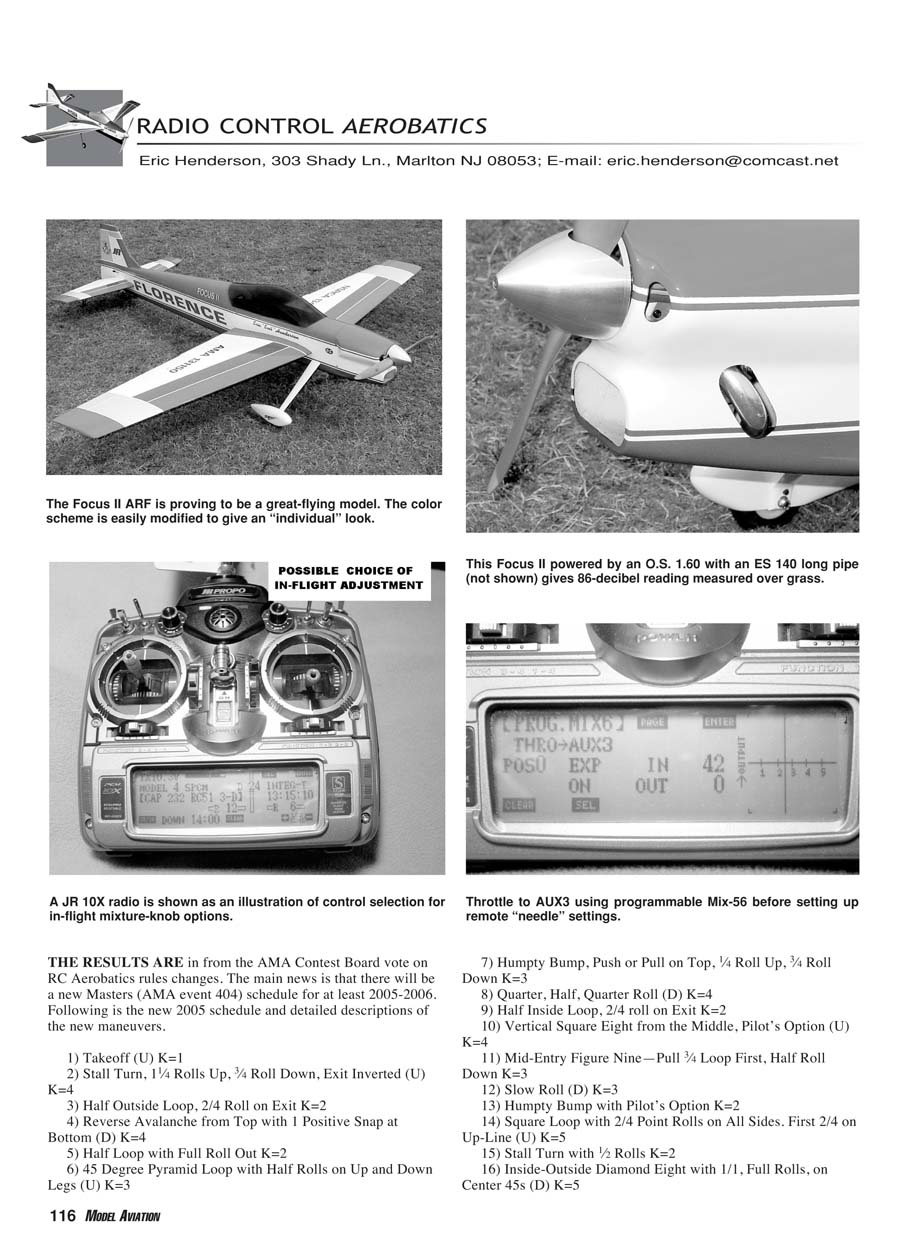
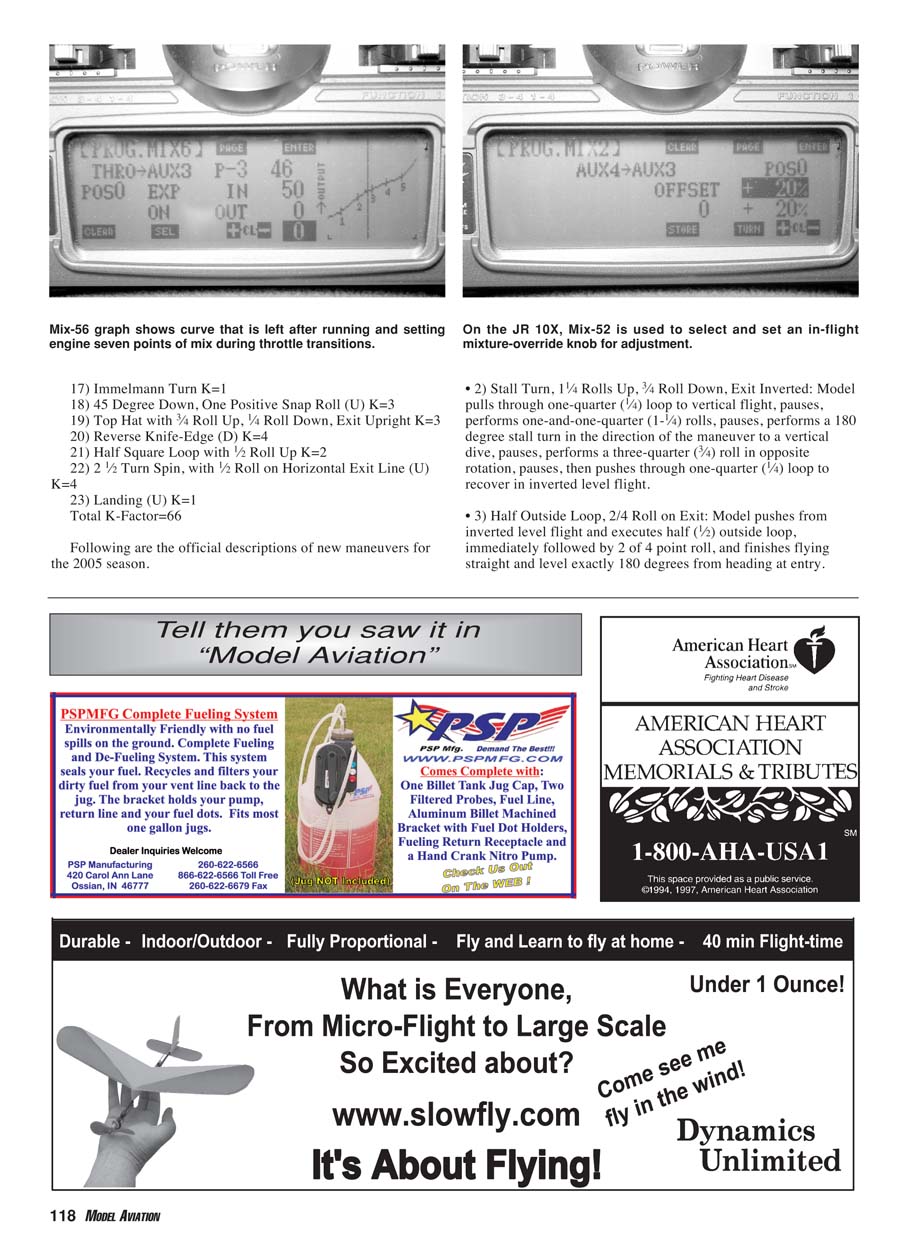
The new Focus II is proving to be an excellent-flying airplane. In most cases it requires no roll-couple mixing or other transmitter tricks. The accompanying picture is of my Focus II powered by an O.S. 1.60 engine with an ES 140 long pipe. This setup gives outstanding vertical performance with quiet sub-90-decibel readings.
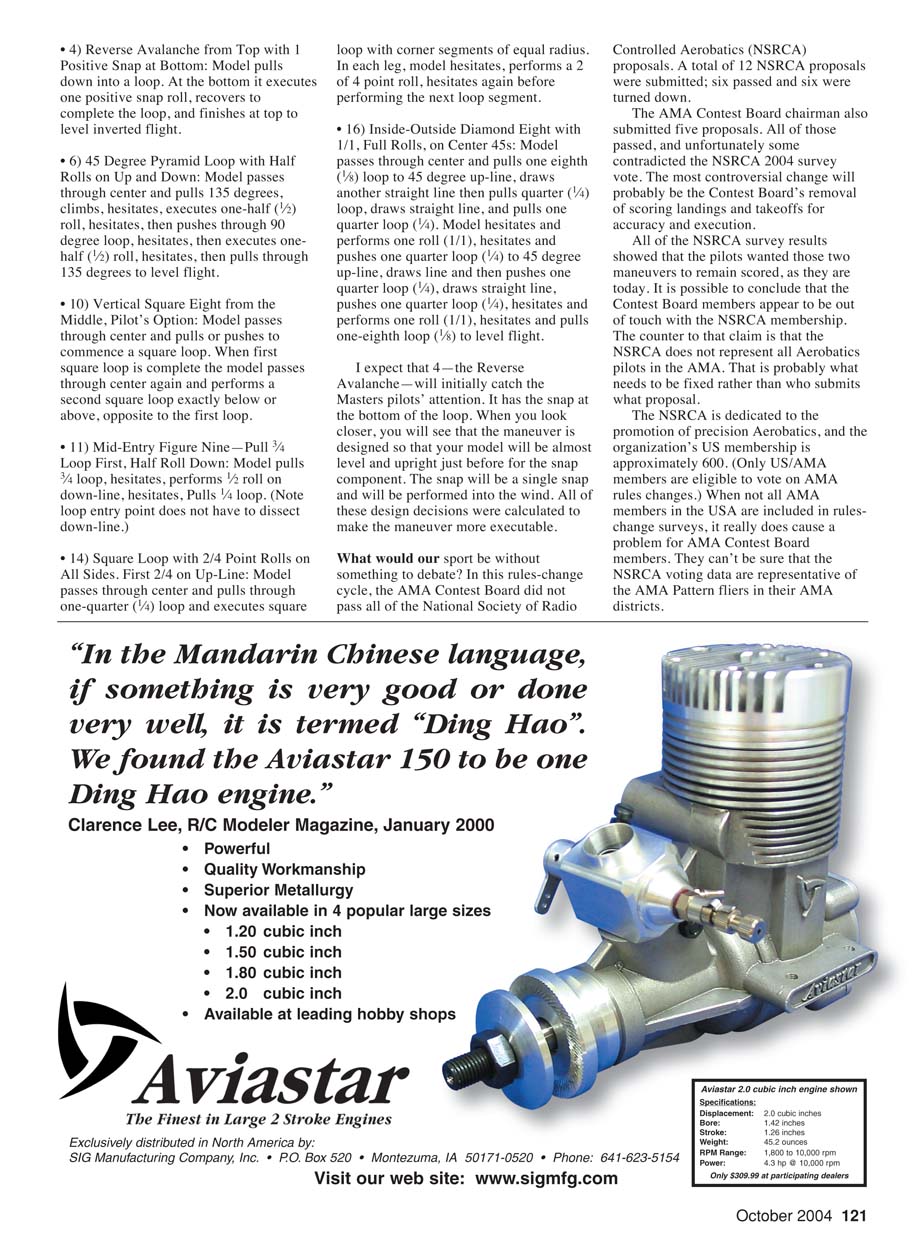
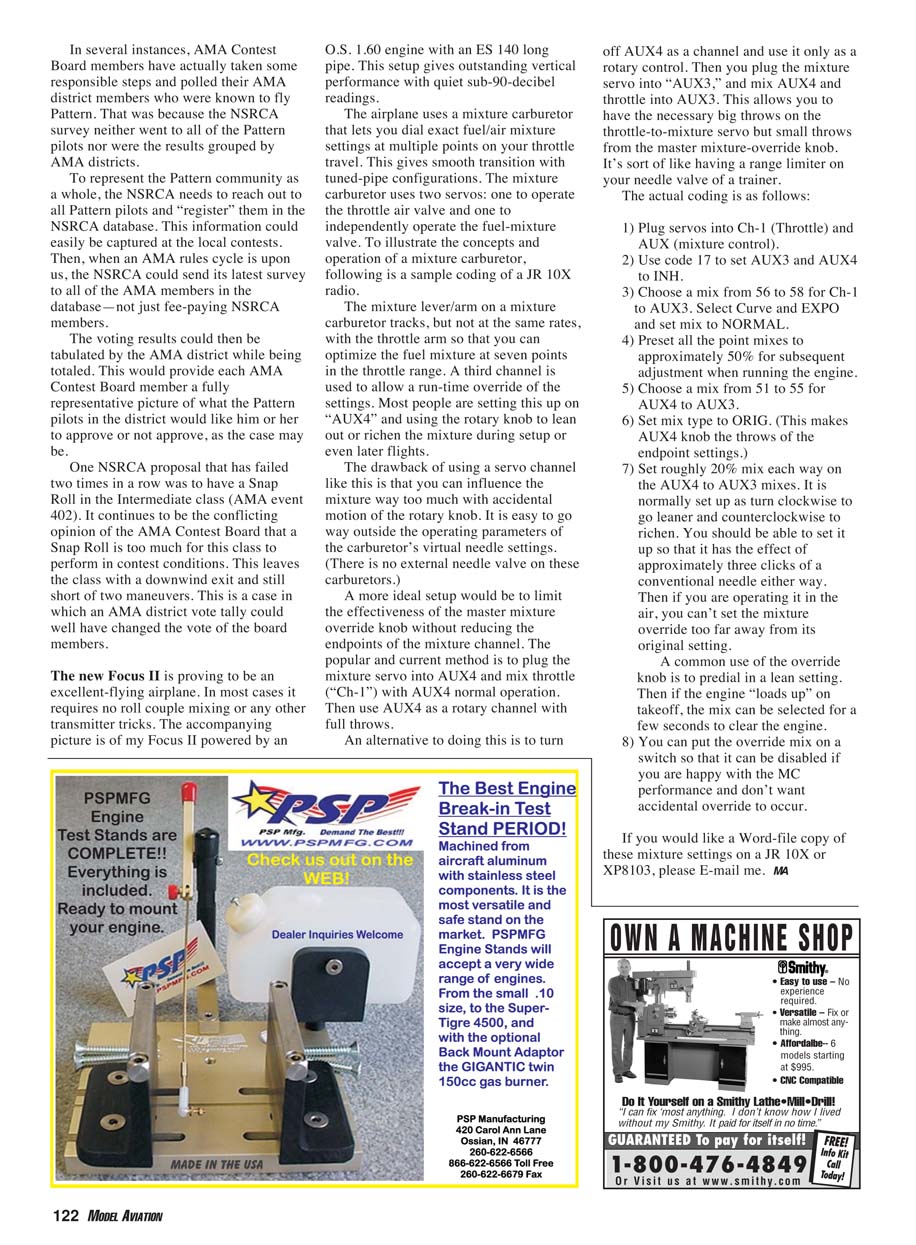
The airplane uses a mixture carburetor that lets you dial exact fuel/air mixture settings at multiple points on your throttle travel. This gives smooth transition with tuned-pipe configurations. The mixture carburetor uses two servos: one to operate the throttle air valve and one to independently operate the fuel-mixture valve. To illustrate the concepts and operation of a mixture carburetor, the following is a sample coding for a JR 10X radio (also applicable to an XP8103).
The mixture lever/arm on a mixture carburetor tracks, but not at the same rates, with the throttle arm so that you can optimize the fuel mixture at seven points in the throttle range. A third channel is used to allow a run-time override of the settings. Most people set this up on "AUX4" and use the rotary knob to lean out or enrich the mixture during setup or later flights.
The drawback of using a servo channel like this is that you can influence the mixture too much with accidental motion of the rotary knob. It is easy to go outside the operating parameters of the carburetor's virtual needle settings (there is no external needle valve on these carburetors).
A more ideal setup would be to limit the effectiveness of the master mixture override knob without reducing the endpoints of the mixture channel. The common method is to plug the mixture servo into AUX4 and mix throttle (Ch-1) with AUX4 normal operation, then use AUX4 as a rotary channel with full throws.
An alternative is to turn off AUX4 as a channel and use it only as a rotary control. Then plug the mixture servo into AUX3, and mix AUX4 and throttle into AUX3. This allows large throws from the throttle-to-mixture servo but small throws from the master mixture-override knob—like having a range limiter on your needle valve.
Sample Coding for JR 10X / XP8103
- Plug servos into Ch-1 (Throttle) and AUX (mixture control).
- Use code 17 to set AUX3 and AUX4 to INH.
- Choose a mix from 56 to 58 for Ch-1 to AUX3. Select Curve and EXPO and set mix to NORMAL.
- Preset all the point mixes to approximately 50% for subsequent adjustment when running the engine.
- Choose a mix from 51 to 55 for AUX4 to AUX3.
- Set mix type to ORIG. (This makes the AUX4 knob control the throws of the endpoint settings.)
- Set roughly 20% mix each way on the AUX4 to AUX3 mixes. It is normally set so that turning clockwise goes leaner and counterclockwise goes richer. You should be able to set it so that it has the effect of approximately three clicks of a conventional needle either way. Then, if operating in the air, you can't set the mixture override too far away from its original setting.
- A common use of the override knob is to predial in a lean setting. If the engine "loads up" on takeoff, the mix can be adjusted for a few seconds to clear the engine.
- You can put the override mix on a switch so it can be disabled if you are happy with carburetor performance and don't want accidental override to occur.
If you would like a Word-file copy of these mixture settings for a JR 10X or XP8103, please e-mail me.
MA
Transcribed from original scans by AI. Minor OCR errors may remain.

