
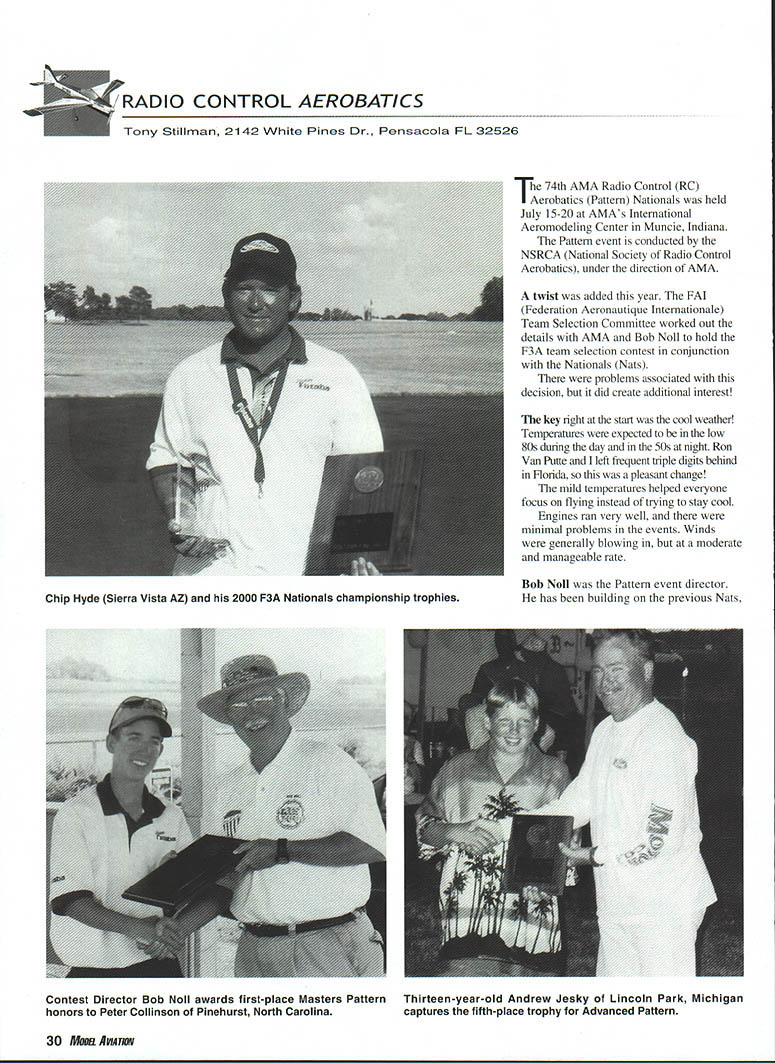
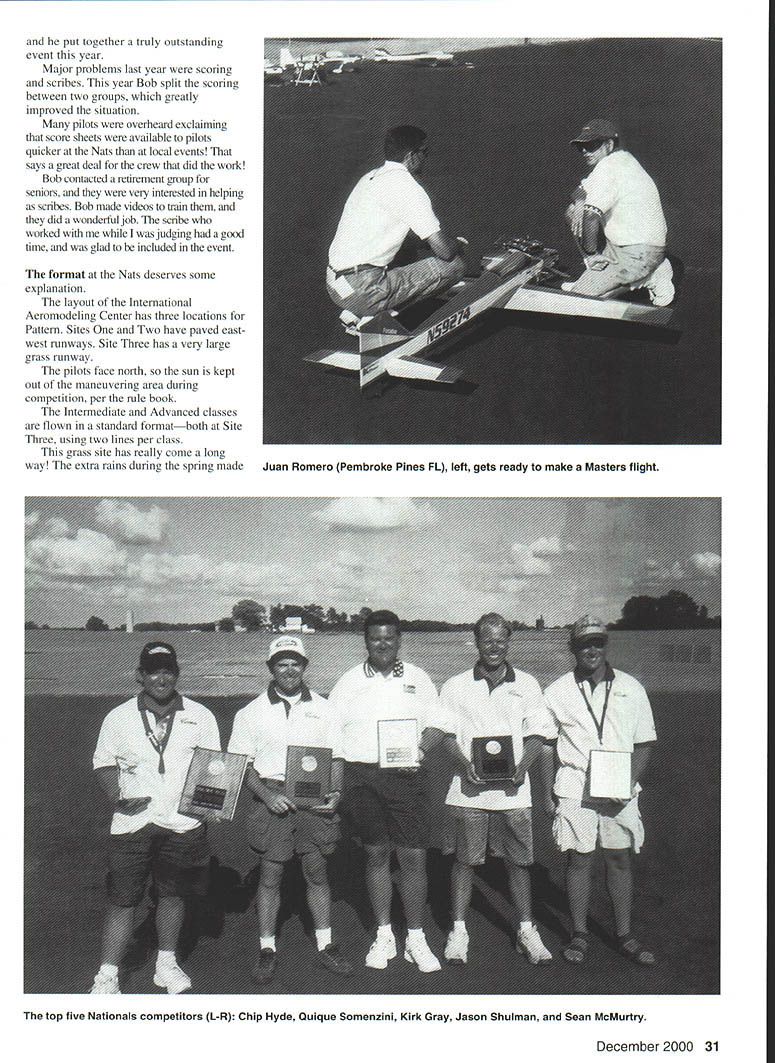
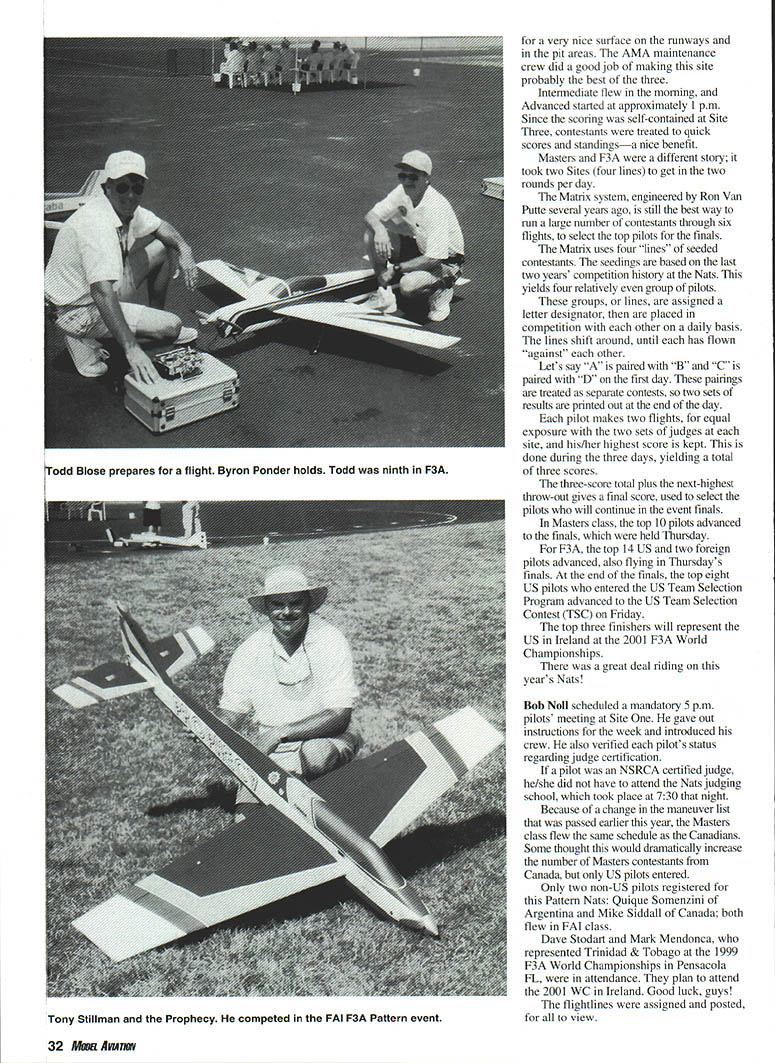
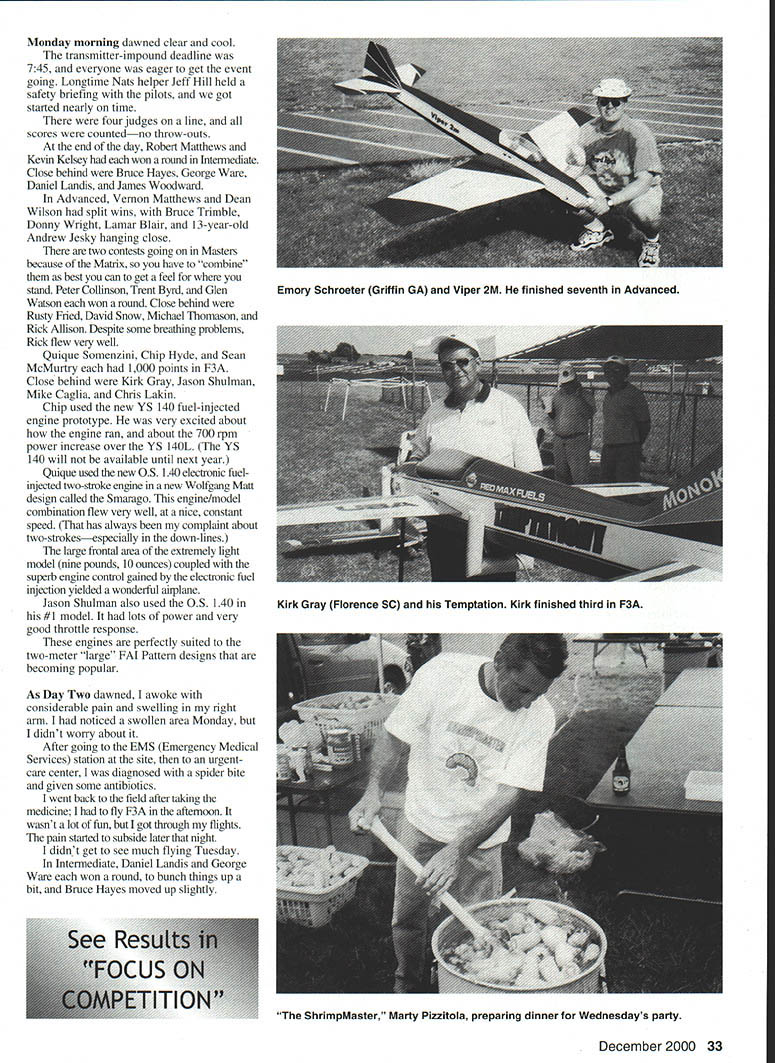
RC Aerobatics
Tony Stillman, 2142 White Pines Dr., Pensacola FL 32526
Event overview
The 74th AMA Radio Control (RC) Aerobatics (Pattern) Nationals was held July 15–20 at AMA's International Aeromodeling Center in Muncie, Indiana. The Pattern event is conducted by the NSRCA (National Society of Radio Control Aerobatics), under the direction of AMA.
A twist was added this year. The FAI (Federation Aeronautique Internationale) Team Selection Committee worked out the details with AMA and Bob Noll to hold the F3A team selection contest in conjunction with the Nationals (Nats). There were problems associated with this decision, but it did create additional interest.
Bob Noll was the Pattern event director. He has been building on the previous Nats and he put together a truly outstanding event this year.
Weather and conditions
The key right at the start was the cool weather. Temperatures were expected to be in the low 80s during the day and in the 50s at night. Ron Van Putte and I left frequent triple digits behind in Florida, so this was a pleasant change! The mild temperatures helped everyone focus on flying instead of trying to stay cool.
Engines ran very well, and there were minimal problems in the events. Winds were generally blowing in, but at a moderate and manageable rate.
Scoring, scribes, and organization
Major problems last year were scoring and scribes. This year Bob split the scoring between two groups, which greatly improved the situation. Many pilots were overheard exclaiming that score sheets were available to pilots quicker at the Nats than at local events — that says a great deal for the crew that did the work!
Bob contacted a retirement group for seniors, and they were very interested in helping as scribes. Bob made videos to train them, and they did a wonderful job. The scribe who worked with me while I was judging had a good time and was glad to be included in the event.
Field layout and format
The layout of the International Aeromodeling Center has three locations for Pattern. Sites One and Two have paved east-west runways. Site Three has a very large grass runway. The pilots face north, so the sun is kept out of the maneuvering area during competition, per the rule book.
The Intermediate and Advanced classes are flown in a standard format — both at Site Three, using two lines per class. This grass site has really come a long way! The extra rains during the spring made for a very nice surface on the runways and in the pit areas. The AMA maintenance crew did a good job of making this site probably the best of the three.
Intermediate flew in the morning, and Advanced started at approximately 1 p.m. Since the scoring was self-contained at Site Three, contestants were treated to quick scores and standings — a nice benefit.
Masters and F3A were a different story; it took two Sites (four lines) to get in the two rounds per day.
The Matrix system, engineered by Ron Van Putte several years ago, is still the best way to run a large number of contestants through six flights, to select the top pilots for the finals. The Matrix uses four "lines" of seeded contestants. The seedings are based on the last two years' competition history at the Nats. This yields four relatively even groups of pilots.
These groups, or lines, are assigned a letter designator, then are placed in competition with each other on a daily basis. The lines shift around until each has flown against each other.
Example pairing: "A" paired with "B" and "C" paired with "D" on the first day. These pairings are treated as separate contests, so two sets of results are printed out at the end of the day. Each pilot makes two flights, for equal exposure with the two sets of judges at each site, and his/her highest score is kept. This is done during the three days, yielding a total of three scores. The three-score total plus the next-highest throw-out gives a final score, used to select the pilots who will continue in the event finals.
In Masters class, the top 10 pilots advanced to the finals, which were held Thursday. For F3A, the top 14 US and two foreign pilots advanced, also flying in Thursday's finals. At the end of the finals, the top eight US pilots who entered the US Team Selection Program advanced to the US Team Selection Contest (TSC) on Friday. The top three finishers will represent the US in Ireland at the 2001 F3A World Championships.
There was a great deal riding on this year's Nats!
Meetings and judge certification
Bob Noll scheduled a mandatory 5 p.m. pilots' meeting at Site One. He gave out instructions for the week and introduced his crew. He also verified each pilot's status regarding judge certification. If a pilot was an NSRCA certified judge, he/she did not have to attend the Nats judging school, which took place at 7:30 that night.
Because of a change in the maneuver list that was passed earlier this year, the Masters class flew the same schedule as the Canadians. Some thought this would dramatically increase the number of Masters contestants from Canada, but only US pilots entered.
Only two non-US pilots registered for the Pattern Nats: Quique Somenzini of Argentina and Mike Siddall of Canada; both flew in FAI class.
Dave Stoddart and Mark Mendonca, who represented Trinidad & Tobago at the 1999 F3A World Championships in Pensacola FL, were in attendance. They plan to attend the 2001 WC in Ireland.
Competition: Day 1 (Monday)
The flightlines were assigned and posted for all to view. Monday morning dawned clear and cool. The transmitter-impound deadline was 7:45, and everyone was eager to get the event going. Longtime Nats helper Jeff Hill held a safety briefing with the pilots, and we got started early and on time.
There were four judges on a line, and all scores were counted — no throw-outs.
Intermediate
- Winners: Robert Matthews and Kevin Kelsey each won a round.
- Close behind: Bruce Hayes, George Ware, Daniel Landis, and James Woodward.
Advanced
- Winners: Vernon Matthews and Dean Wilson split wins.
- Close behind: Bruce Trimble, Donny Wright, Lamar Blair, and 13-year-old Andrew Jesky.
Masters (two contests because of the Matrix)
- Round winners: Peter Collinson, Trent Byrd, and Glen Watson.
- Close behind: Rusty Fried, David Snow, Michael Thomason, and Rick Allison. Despite some breathing problems, Rick flew very well.
F3A
- Pilots with 1,000 points: Quique Somenzini, Chip Hyde, and Sean McMurtry.
- Close behind: Kirk Gray, Jason Shulman, Mike Caglia, and Chris Lakin.
Engine and model notes
- Chip Hyde flew a new YS 140 fuel-injected engine prototype and reported about a 700 rpm power increase over the YS 140L. (The YS 140 will not be available until next year.)
- Quique Somenzini used the new O.S. 140 electronic fuel-injected two-stroke engine in a new Wolfgang Matt design called the Smaragd. The combination flew very well at a nice, constant speed. The extremely light model (nine pounds, 10 ounces) and the electronic fuel injection yielded a wonderful airplane.
- Jason Shulman also used the O.S. .140 in his #1 model; it had lots of power and very good throttle response.
- These engines are well suited to the two-meter “large” FAI Pattern designs that are becoming popular.
Competition: Day 2 (Tuesday)
As Day Two dawned, I awoke with considerable pain and swelling in my right arm. I had noticed a swollen area Monday but didn't worry about it. After going to the EMS station at the site, then to an urgent-care center, I was diagnosed with a spider bite and given antibiotics. I returned to the field after taking the medicine and flew F3A in the afternoon.
Results and activities
- Intermediate: Daniel Landis and George Ware each won a round, bunching things up a bit; Bruce Hayes moved up slightly.
- The NSRCA held its annual membership meeting Tuesday evening. Because of the change in format, only approximately 50 members attended; most pilots stayed out and practiced.
Thanks to Ron Van Putte and Donnie Wright for helping me get pictures — especially on Tuesday and Wednesday.
Competition: Day 3 (Wednesday)
Wednesday morning we awoke to the sounds of rain. It was light but steady, and we had to wait until 11 a.m. to start. It was determined that we could get all the flights in as long as we stayed late. We did, and the last pilot landed at roughly 6:45 p.m.
Wednesday night: the “Beachless Party”
- Organized by Maureen Dunphy, inspired by the World Championships in Pensacola.
- NSRCA had 100 pounds of Pensacola Bay shrimp FedEx®ed to Muncie. Special thanks to Albert Glenn of Federal Express® for getting the shrimp to Indiana, and to the “ShrimpMaster,” Marty Pizzato, and the gang from Louisiana, who handled cooking the shrimp “Cajun-style.”
- Grilled chicken was also available.
- Music was provided by David Stodart on the steel drums.
- Before the meal, Bob Noll and Al Williamson (AMA RC category director) gave awards for Intermediate and Advanced classes.
Awards announced
- Intermediate: 1st Robert Matthews, 2nd Kevin Kelsey, 3rd Daniel Landis.
- Advanced: 1st Dean Wilson, 2nd Vernon Matthews, 3rd Bruce Trimble.
Masters finalists (top 10)
- Peter Collinson
- Trent Byrd
- Glen Watson
- Bob Hartwig
- Mike Darnold
- David Snow
- Michael Thomason
- Robert Satalino
- Rick Allison
- Kevin Proodian
F3A finalists (16)
- Quique Somenzini
- Chip Hyde
- Sean McMurtry
- Kirk Gray
- Jason Shulman
- Don Szczur
- Mike Caglia
- Chris Lakin
- Todd Blose
- Mike Harrison
- George Asteris
- David Lockhart
- Troy Newman
- Mike Siddall
- Joey Hayes
- John Giezellis
The NSRCA also auctioned donated items to raise funds, with Bob Roe serving as auctioneer. After dinner and awards, someone brought out a limbo pole.
Finals: Masters (Thursday)
The Masters finals were scheduled to begin at 9 a.m. Thursday but started roughly 45 minutes late. The winds were tough, blowing straight in, which made takeoffs and decisions difficult but made mistakes more visible.
Trent Byrd qualified for second going into the finals but had an accident with his #1 model at the hotel Thursday morning and had to fly his backup airplane. He flew solidly after a “get reacquainted” flight during the first round.
Results
- Masters champion: Peter Collinson.
- 2nd place: Rick Allison (moved up from ninth place).
- 3rd place: Trent Byrd.
Finals: FAI (Thursday)
FAI finals began at 10 a.m. Thursday, using Sites Two and Three. Each pilot made four flights — two in front of each set of judges. The total of the best two flights determined the Nats champion.
The F-01 finals sequence was tougher, but everyone seemed up for the challenge. At the end of the day, the top eight US pilots were announced; they moved on to the TSC. They had to attend a meeting later that night to design the Unknown pattern that would be flown — new to FAI this year.
FAI results (top finishers)
- Champion: Chip Hyde.
- 2nd place: Quique Somenzini (2.4 points behind Chip).
- 3rd place: Kirk Gray.
- 4th: Jason Shulman.
- 5th: Sean McMurtry.
FAI Team Selection (Friday)
The US team selection took place Friday. Competitors:
- Todd Blose
- Mike Caglia
- Kirk Gray
- Chip Hyde
- Chris Lakin
- Sean McMurtry
- Jason Shulman
- Don Szczur
They flew the Unknown sequence and F-01 under pressure. Pilots with the most Tournament of Champions experience generally handled the Unknown patterns better and seemed more relaxed.
Mike Caglia flew especially well and will be someone to reckon with in the future.
Final team results
- Top three (will represent the US in Ireland): Chip Hyde, Sean McMurtry, Jason Shulman.
- Team alternate: Kirk Gray (close fourth).
Closing
After lots of pictures, we said our good-byes and started on the 12-hour journey back to Florida. As always, the people at AMA did a wonderful job at the Nats, and it was a lot of fun.
Special thanks to Bob Noll for being the Nats Contest Director for the past three years. He really put in a superhuman effort to get everything to work as smoothly as possible.
If you have not attended a Nationals, make plans to do it next year. It doesn't get any better than this! MA
Transcribed from original scans by AI. Minor OCR errors may remain.

