
RC Aerobatics
Eric Henderson, <REDACTED>
I have been receiving a steady flow of really enjoyable letters. So far, I have been able to reply to all of them. If you did not get a response, most likely the Internet ate it. Please resend your letter if you have not had a reply.
Letters of encouragement or complaint help any author decide what to write next. A recent note pointed out that I had implied that Contest Directors (CDs) should "bend" the rules. It had not been my intention to do that, but the English language often leaves room for ambiguity.
The writer was an experienced CD, and did not like the idea of allowing airplanes into his contest that did not meet the rules. Of course, he was right. Unless deviations are preannounced, it is wrong to make certain rule variations.
When I read what I had originally written, I saw that it could easily have been taken that way. It made me think that a good look at the rules, and what they achieve, would be a worthy subject for this month's column.
It could also be a way to explain the challenge of Precision Aerobatics while sharing the standards we try to meet.
Are rules and regulations restrictions or ratification?
To have a competition, you have to have rules of engagement. As soon as there were two cars, they were raced. It was not long before there was a myriad of rules to create comparable classes of vehicle racing.
Most rules and regulations make sense. Driving on the left, or on the right, is a regulation that makes sense as long as we all use the same side of the road. They ignored that rule for a car race, but they added that all the cars had to go in the same direction!
For some people, the rules are more of a challenge than the event. A classic example is the car or airplane that is just outside the specifications. The lobby that builds up can be quite formidable. Fortunately, most designers, builders, and fliers see the regulations as the goal.
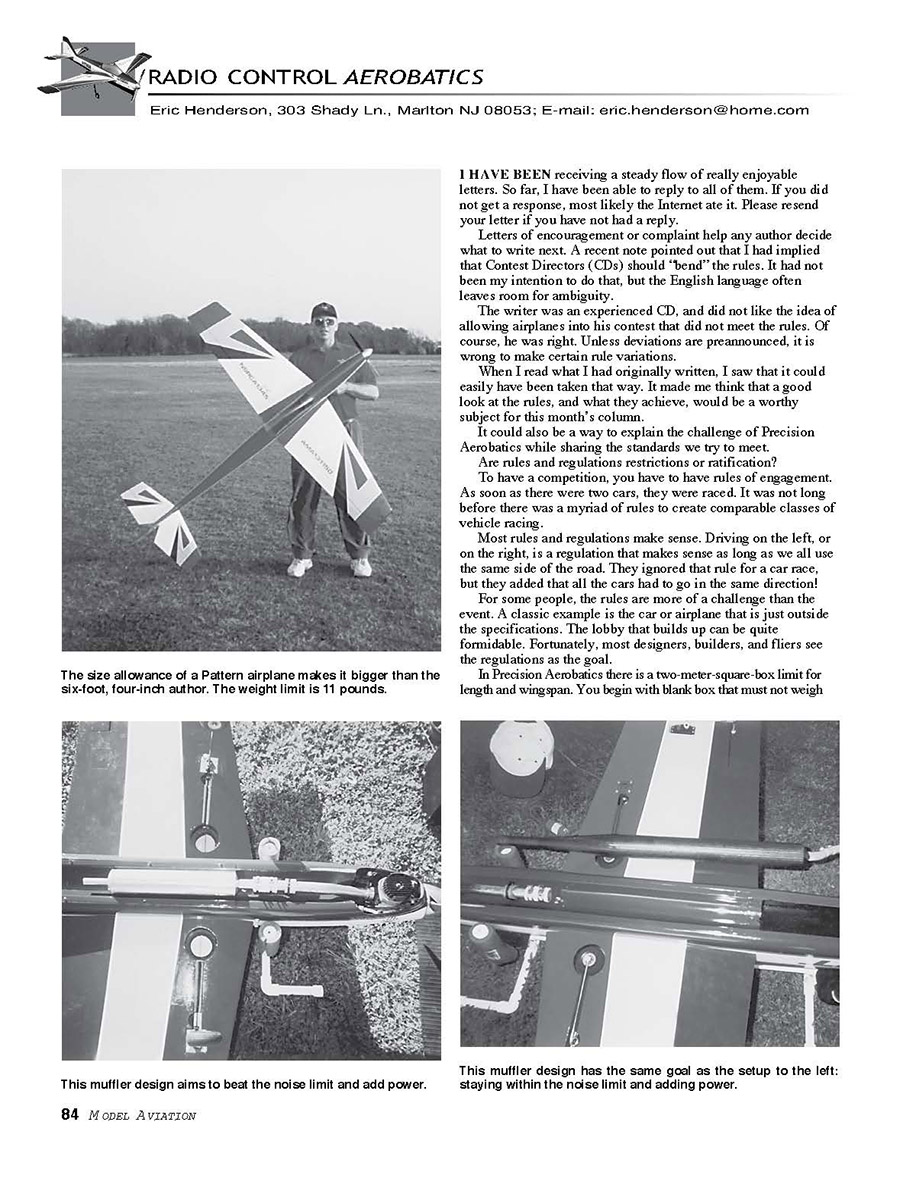
In Precision Aerobatics there is a two-meter-square-box limit for length and wingspan. You begin with a blank box that must not weigh more than 11 pounds or sound louder than the current decibel limit in competition. After that, you can carve it to any shape you want.
Precision Aerobatics gives the designers a lot of room to be creative, but this amount of design room can be more than enough to one person and claustrophobic to another.
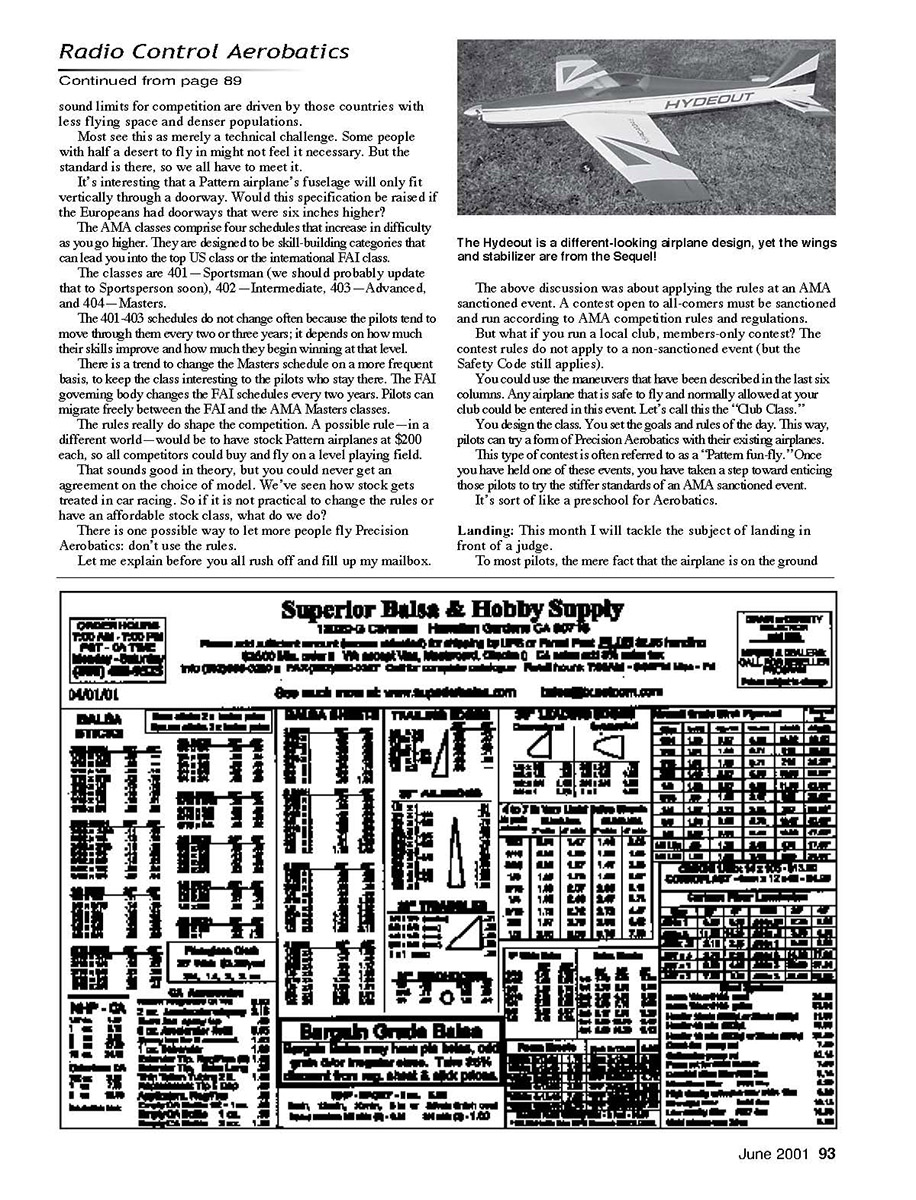
Designers soon learned (in most cases, they already knew) that a "square" 78½-inch x 78½-inch (two meters) airplane did not fly as well as an airplane with a 74-inch wingspan. They made the fuselages as long as possible, but did not use the entire wingspan length available.
As can be seen in the photographs, these airplanes are quite large.
Many design variants are born from the desire to produce an airplane that will go straight up and down, stall turn, spin and snap, etc., with precision. The airplanes may look the same, but the informed eye can see many design differences.
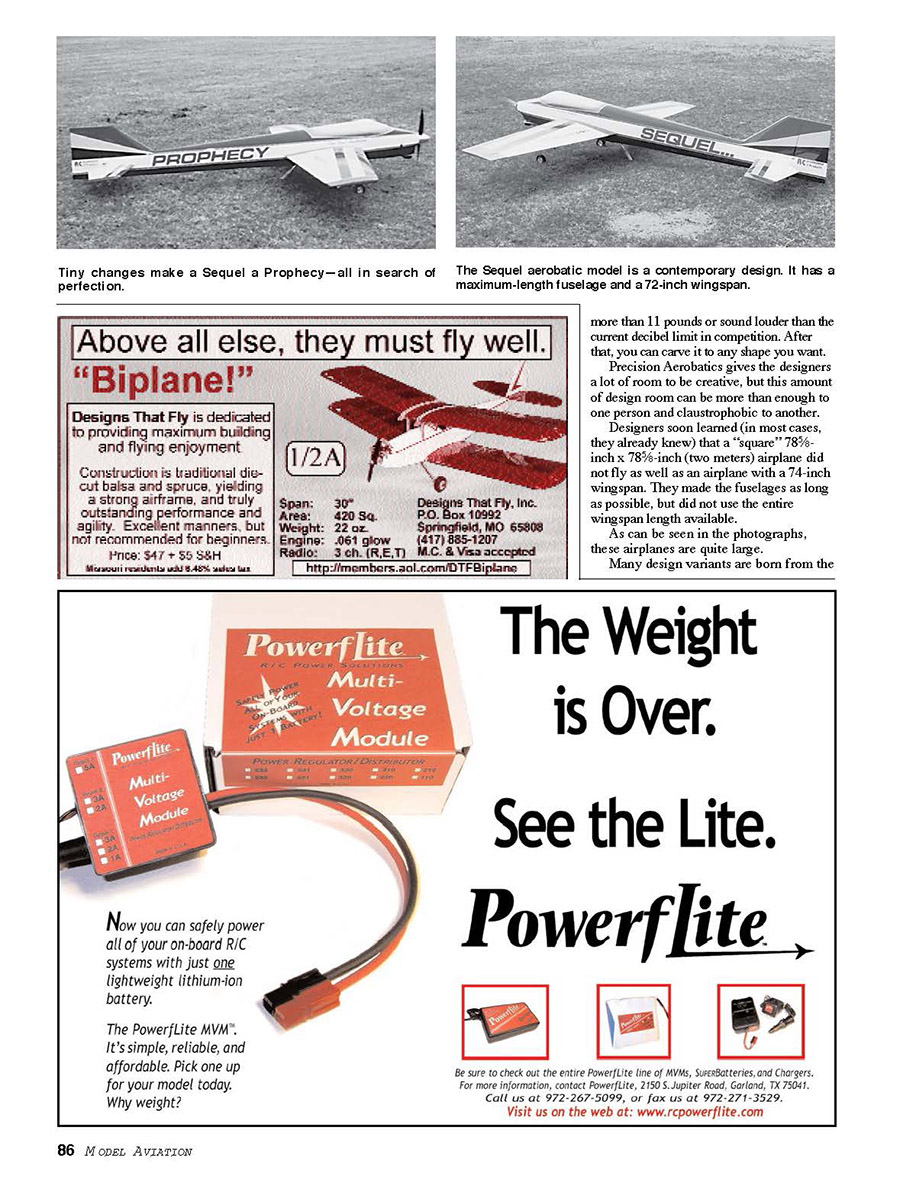
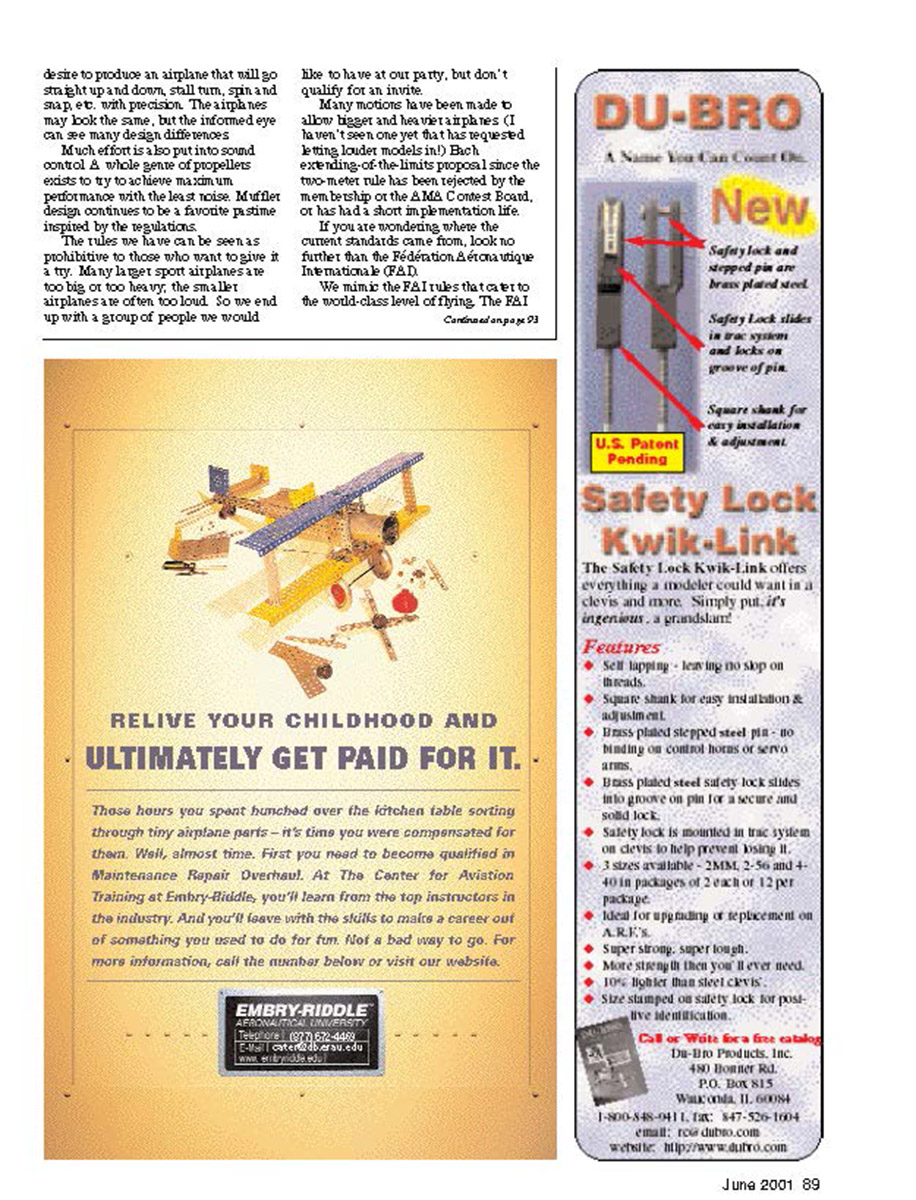
Much effort is also put into sound control and a whole genre of propellers exists to try to achieve maximum performance with the least noise. Muffler design continues to be a favorite pastime inspired by the regulations.
The rules we have can be seen as prohibitive to those who want to give it a try. Many larger sport airplanes are too big or too heavy; the smaller airplanes are often too loud. So we end up with a group of people we would like to have at our party, but don't qualify for an invite.
Many motions have been made to allow bigger and heavier airplanes (I haven't seen one yet that has requested letting louder models in!). But extending-of-the-limits proposals since the two-meter rule has been rejected by the membership of the AMA Contest Board, or has had a short implementation life.
If you are wondering where the current standards came from, look no further than the Fédération Aéronautique Internationale (FAI).
We mimic the FAI rules that cater to the world-class level of flying. The FAI governing body changes the FAI schedules every two years. Pilots can migrate freely between the FAI and the AMA Masters classes.
The rules really do shape the competition. A possible rule—in a different world—would be to have stock Pattern airplanes at $200 each, so all competitors could buy and fly on a level playing field.
That sounds good in theory, but you could never get an agreement on the choice of model. We've seen how stock gets treated in car racing. So if it is not practical to change the rules or have an affordable stock class, what do we do?
There is one possible way to let more people fly Precision Aerobatics: don't use the rules.
Let me explain before you all rush off and fill up my mailbox.
The above discussion was about applying the rules at an AMA sanctioned event. A contest open to all-comers must be sanctioned and run according to AMA competition rules and regulations.
But what if you run a local club, members-only contest? The contest rules do not apply to a non-sanctioned event (but the Safety Code still applies).
You could use the maneuvers that have been described in the last six columns. Any airplane that is safe to fly and normally allowed at your club could be entered in this event. Let's call this the "Club Class."
You design the class. You set the goals and rules of the day. This way, pilots can try a form of Precision Aerobatics with their existing airplanes.
This type of contest is often referred to as a "Pattern fun-fly." Once you have held one of these events, you have taken a step toward enticing those pilots to try the stiffer standards of an AMA sanctioned event.
It's sort of like a preschool for Aerobatics.
Landing
This month I will tackle the subject of landing in front of a judge.
To most pilots, the mere fact that the airplane is on the ground and in one piece is a source of pleasure and satisfaction. The typical landing tends to be: line up on the field, cut the throttle, and flare when near the ground.
The perfect landing is almost an obsession for an AMA Precision Aerobatics flier. The landing requirements are that the model is returned to terra firma in a predetermined area each time and that the final approach meet executing parameters of descent.
The phrase, "You landed that just like a Pattern flier" is well-earned.
The landing is not judged at the international level (FAI), and attempts have been made to have it removed from AMA Precision Aerobatics.
However, the landing persists, and it has proven to be the maneuver that improves skill and safety at the same time. The skill seems to improve radically once the gauntlet has been thrown down.
The perfect landing is described in the AMA Flight Evaluation Procedures handbook or on the AMA website in the "Competition Regulations" section.
The important thing to remember is that the final descent from slightly higher than the spot is the only component being scored. It is more important to get into the right position and set up the right speed than how you get there.
The maneuver begins when the pilot calls "Landing" or "Landing, now!" This is important because it tells the judges to look at your model. There is often a period between your last aerobatic maneuver and the landing maneuver; the judges may be checking score sheets, and they need to be reminded that you are on final.
The old rules required the pilot to land on a centerline. Today the standard is that the wheels should touch down in the area 15 meters on either side of the centerline.
Most pilots will aim for that perfect touchdown on the centerline, and it feels good to put your model down "right on the money!"
From the moment the pilot announces the landing maneuver, the descent should be a smooth line with the wings held steady. You are allowed to correct for turbulence, but wing-wagging and porpoising on final often draw deductions. Controlling the speed is the big challenge.
Following are a few tips on how to do this maneuver.
- Burn off speed before you line the model up on the runway. Your airplane has no brakes, so slowing down while losing height is not easy to do. However, adding speed is available with the throttle.
(If you see a Pattern flier kill his/her throttle during landing, the odds are that he/she is taking care of the propeller.)
- You can control the landing speed by holding in a little up-elevator and a part of throttle.
In reality, the throttle is your airplane's height control if you hold on the elevator. Try this technique at a safe height, and you will learn that there is a great deal you can do to control your model's speed when you are landing it.
- When performing a regular landing, you often learn that the idle of your model's engine has crept up slightly during flight. This could be caused by operating temperatures or just the position of the fuel tank.
As your model approaches the field, there is often a need to lower the idle trim. This is not the best time to try to do this. You don't have time to be beeping or pulling back the throttle trim six feet off the ground. A low-idle switch really helps here.
- If your radio has channel-mixing, but not a high-low idle switch, you can mix the throttle channel with the elevator channel and get the same result.
- At a certain point in the landing approach, you know you are going to make it. This is when you pitch the model's nose up and avoid an overshoot.
- Air brakes can be a godsend, but very few airplanes have that option. The designs are so sleek, they do not want to slow down. A computer radio using two aileron servos will allow you to employ the flap option. Downward deployment of flaps allows steeper angles of descent.
We don't need a steeper angle in our case, so here is something for you to try: make both ailerons go up instead of down. Yes, up! The amount recommended is 5°.
The ailerons are still functional, but now the airplane needs a small amount of up-elevator to remain level. The model's slightly positive attitude will greatly increase its drag configuration. This will slow the model down.
Because both ailerons are up, the washout at the wingtip is actually increased, thus the risk of stall is reduced. The pilot can re-play the throttle to control exactly where the model will touch down.
- A common misunderstanding is that the wing has to be kept level during landing. The rules clearly state that a pilot may side-slip the airplane. To side-slip on landing, you need to dip one wing and add opposite rudder.
It is not possible to keep the wings level if you want to land this way. If you are good enough to side-slip on landing, you should be flying aerobatics!
You must be that "friend" to tell you how well you are performing landings. There is too much size or too close to the ground for you to be analyzing your own performance.
Happy landings.
Transcribed from original scans by AI. Minor OCR errors may remain.

