
Radio Control Aerobatics
Bob Noll, 2317 Acorn Dr., Vestal NY 13850
One hundred seventeen pilots traveled from across the country to compete at this year's Radio Control Aerobatics Nationals, held July 16-20.
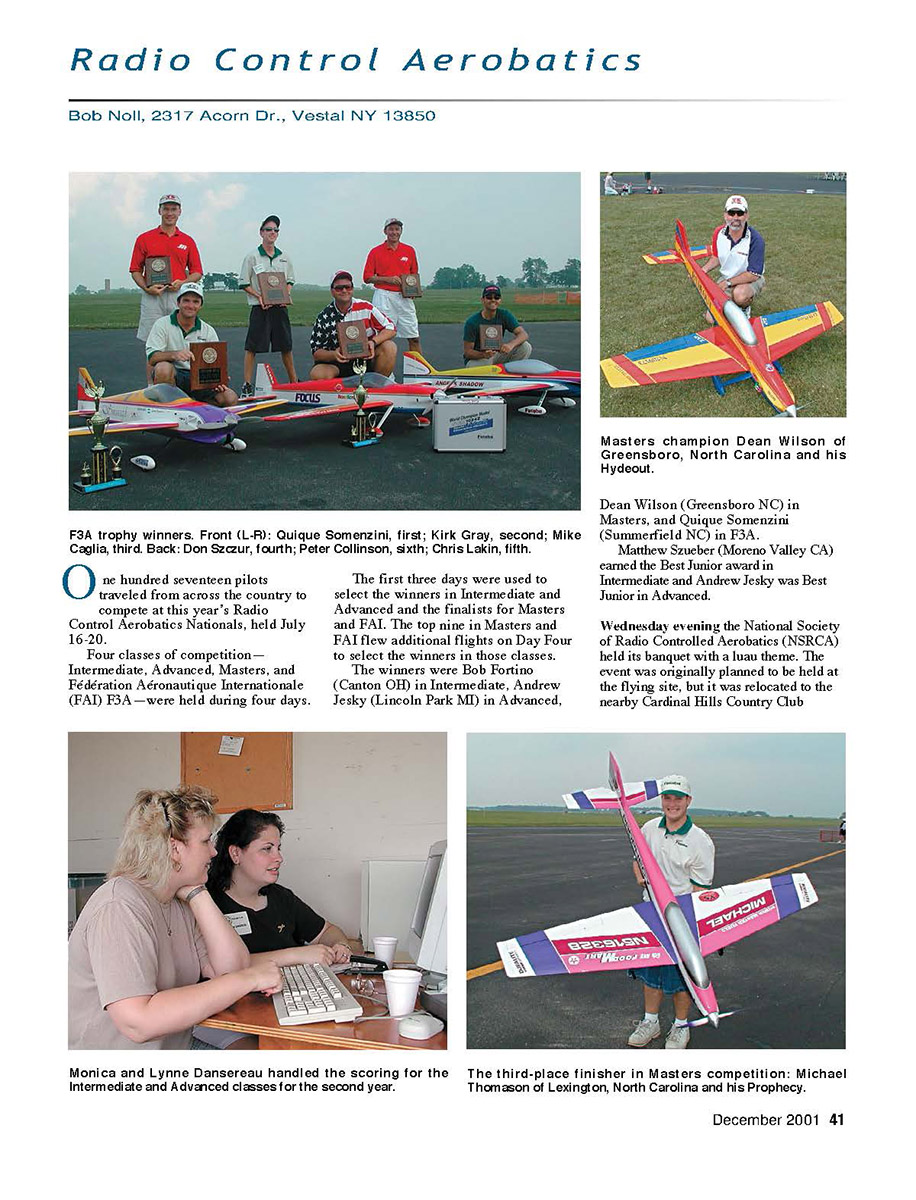
Four classes of competition—Intermediate, Advanced, Masters, and Fédération Aéronautique Internationale (FAI) F3A—were held during four days.
The first three days were used to select the winners in Intermediate and Advanced and the finalists for Masters and FAI. The top nine in Masters and FAI flew additional flights on Day Four to select the winners in those classes.
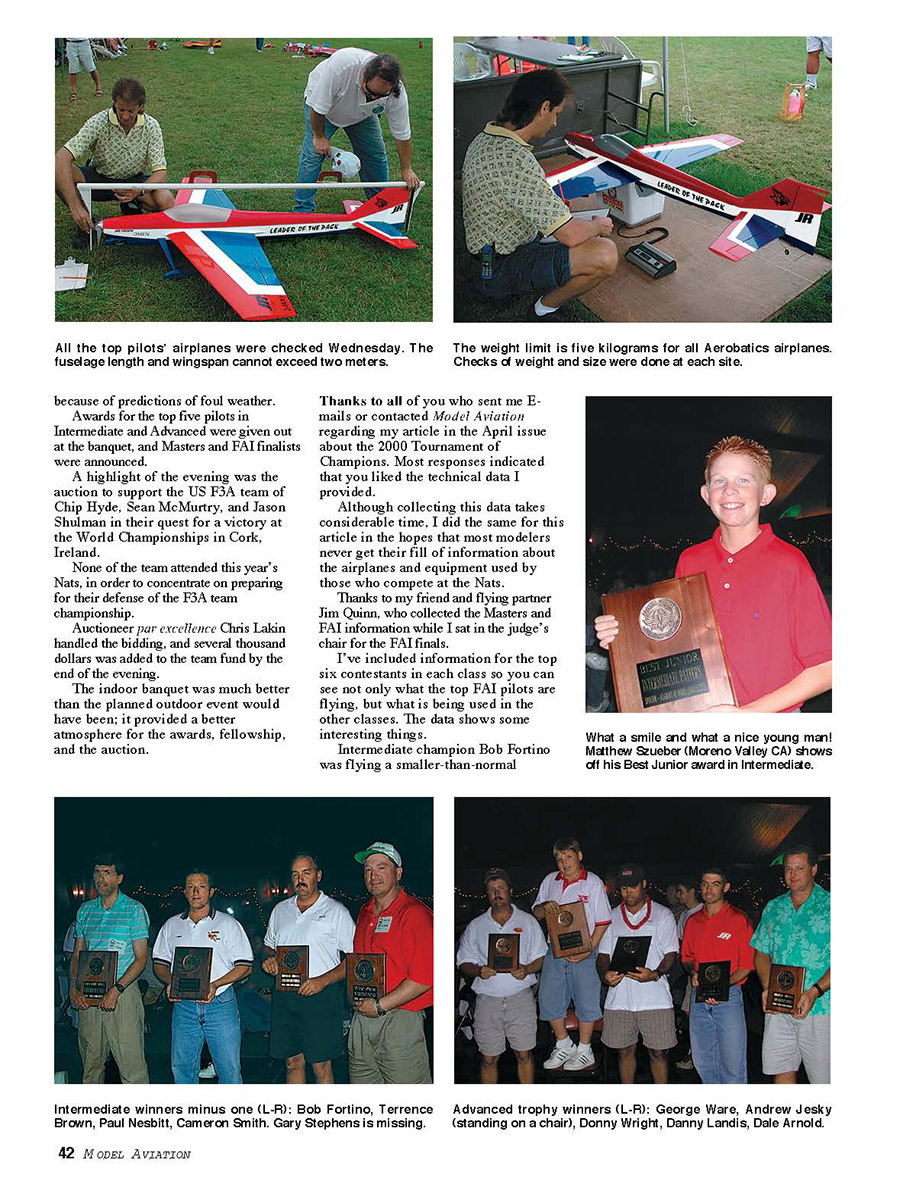
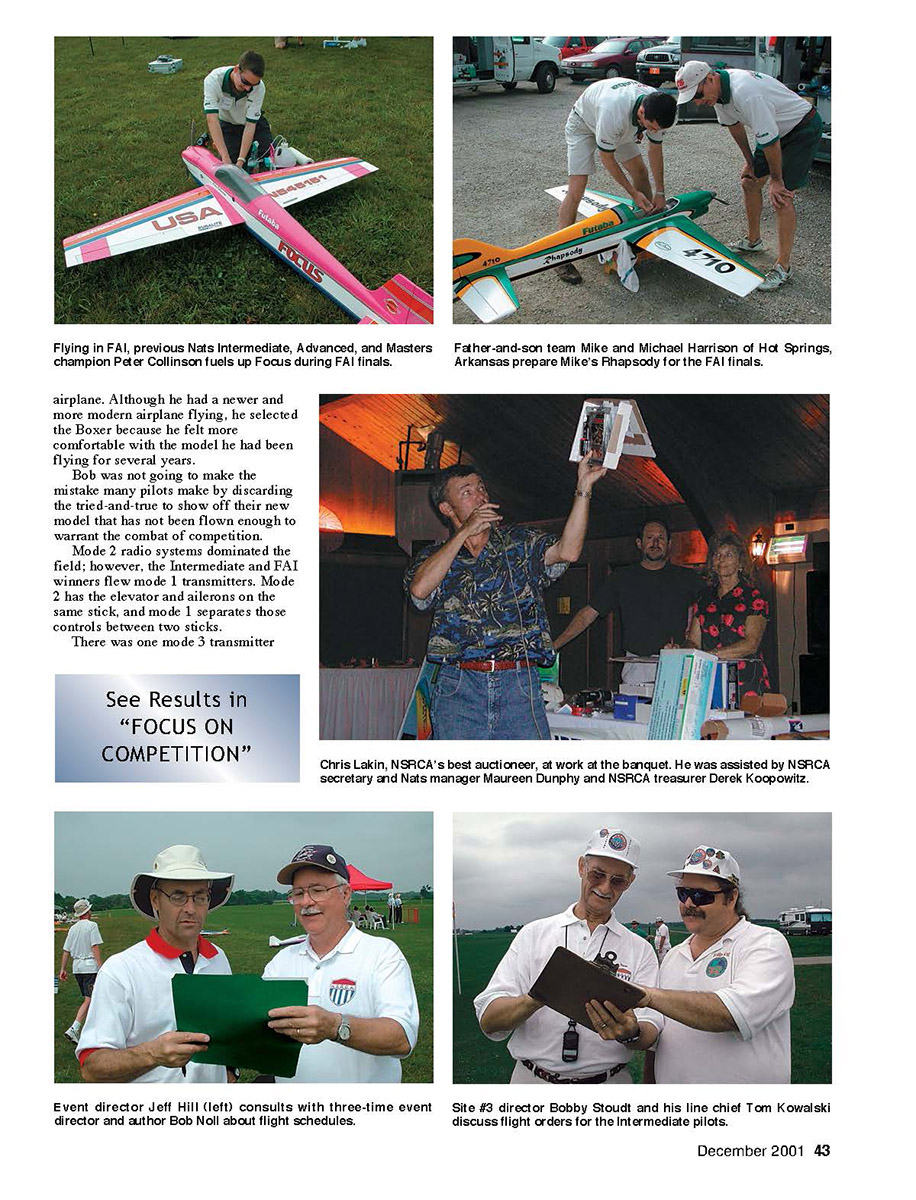
The winners were Bo Forlino (Canton OH) in Intermediate, Andrew Jesky (Lincoln Park MI) in Advanced, Dean Wilson (Greensboro NC) in Masters, and Quique Somenzini (Summerfield NC) in F3A.
Matthew Szueber (Moreno Valley CA) earned the Best Junior award in Intermediate and Andrew Jesky was Best Junior in Advanced.
Wednesday evening the National Society of Radio Controlled Aerobatics (NSRCA) held its banquet with a luau theme. The event was originally planned to be held at the flying site, but it was relocated to the nearby Cardinal Hills Country Club because of predictions of foul weather.
Awards for the top five pilots in Intermediate and Advanced were given out at the banquet, and Masters and FAI finalists were announced.
A highlight of the evening was the auction to support the US F3A team of Chip Hyde, Sean McMurtry, and Jason Shulman in their quest for a victory at the World Championships in Cork, Ireland.
None of the team attended this year's Nats, in order to concentrate on preparing for their defense of the F3A team championship.
Auctioneer par excellence Chris Lakin handled the bidding, and several thousand dollars was added to the team fund by the end of the evening.
The indoor banquet was much better than the planned outdoor event would have been; it provided a better atmosphere for the awards, fellowship, and the auction.
Thanks to all of you who sent me E-mails or contacted Model Aviation regarding my article in the April issue about the 2000 Tournament of Champions. Most responses indicated that you liked the technical data I provided.
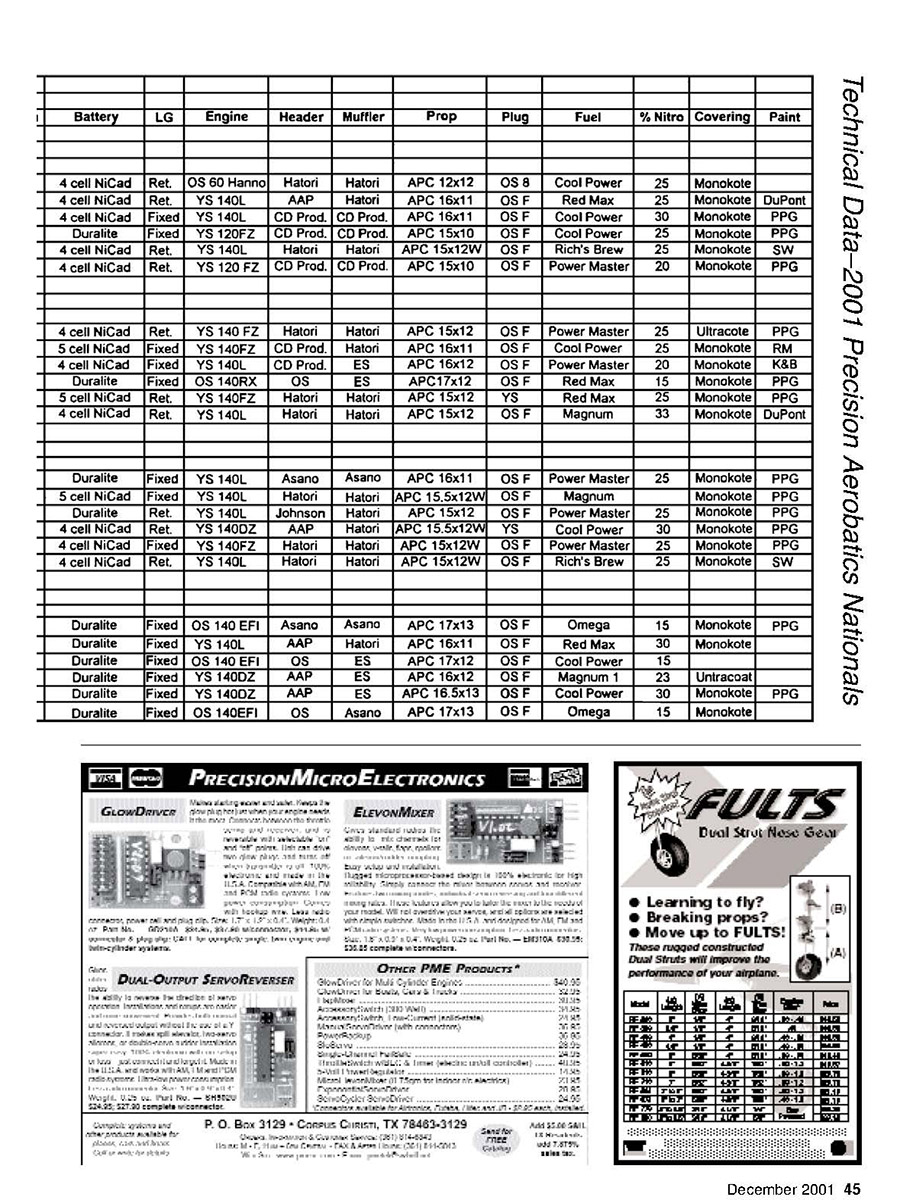
Although collecting this data takes considerable time, I did the same for this article in the hopes that most modelers never get their fill of information about the airplanes and equipment used by those who compete at the Nats.
Thanks to my friend and flying partner Jim Quinn, who collected the Masters and FAI information while I sat in the judge's chair for the FAI finals.
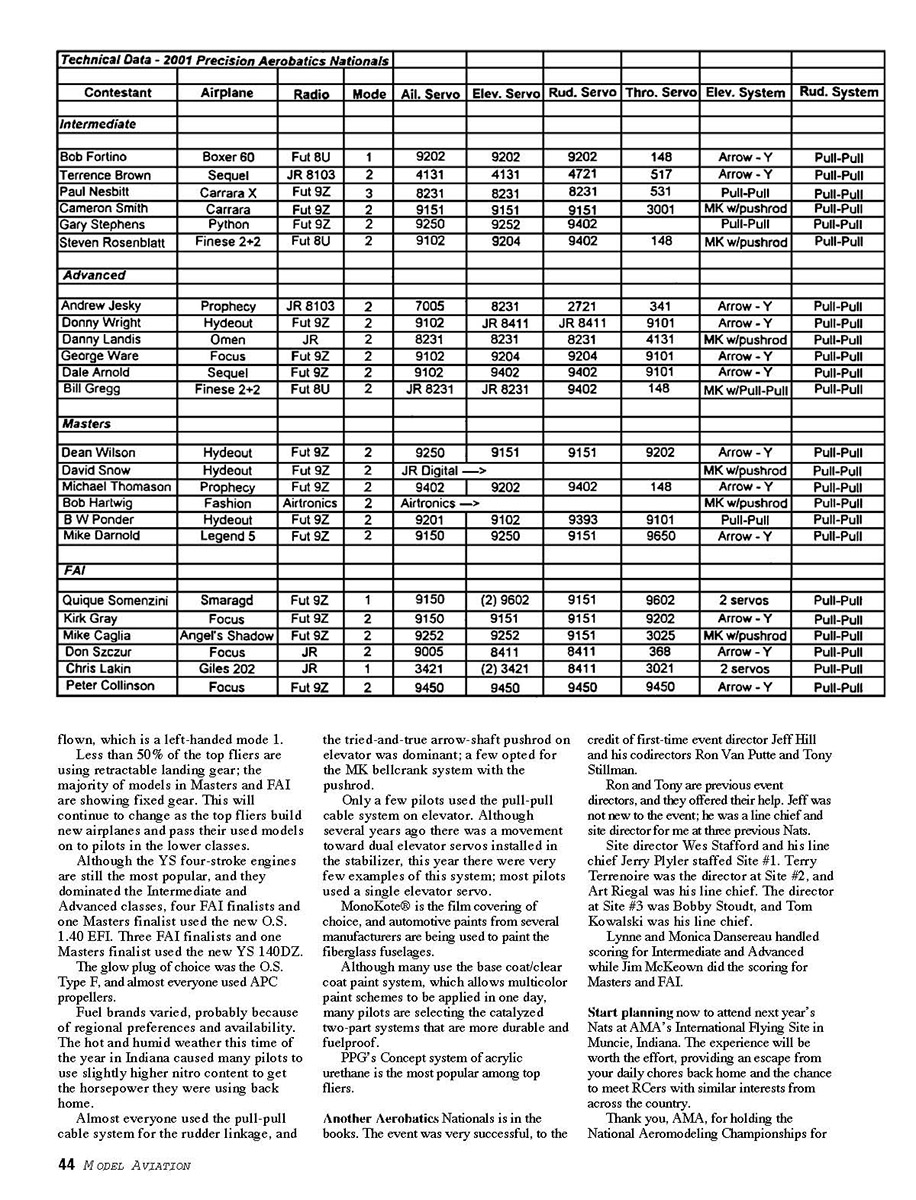
I've included information for the top six contestants in each class so you can see not only what the top FAI pilots are flying, but what is being used in the other classes. The data shows some interesting things.
Intermediate champion Bob Fortino was flying a smaller-than-normal airplane. Although he had a newer and more modern airplane flying, he selected the Boxer because he felt more comfortable with the model he had been flying for several years.
Bob was not going to make the mistake many pilots make by discarding the tried-and-true to show off their new model that has not been flown enough to warrant the combat of competition.
Mode 2 radio systems dominated the field; however, the Intermediate and FAI winners flew mode 1 transmitters. Mode 2 has the elevator and ailerons on the same stick, and mode 1 separates those controls between two sticks.
There was one mode 3 transmitter flown, which is a left-handed mode 1.
Less than 50% of the top fliers are using retractable landing gear; the majority of models in Masters and FAI are showing fixed gear. This will continue to change as the top fliers build new airplanes and pass their used models on to pilots in the lower classes.
Although the YS four-stroke engines are still the most popular, and they dominated the Intermediate and Advanced classes, four FAI finalists and one Masters finalist used the new O.S. 1.40 EFI. Three FAI finalists and one Masters finalist used the new YS 140DZ.
The glow plug of choice was the O.S. Type F, and almost everyone used APC propellers.
Fuel brands varied, probably because of regional preferences and availability. The hot and humid weather this time of the year in Indiana caused many pilots to use slightly higher nitro content to get the horsepower they were used to having.
Almost everyone used the pull-pull cable system for the rudder linkage, and the tried-and-true arrow-shaft pushrod on elevator was dominant; a few opted for the MK bellcrank system with the pushrod.
Only a few pilots used the pull-pull cable system on elevator. Although several years ago there was a movement toward dual elevator servos installed in the stabilizer, this year there were very few examples of this system; most pilots used a single elevator servo.
MonoKote® is the film covering of choice, and automotive paints from several manufacturers are being used to paint the fiberglass fuselages.
Although many use the base coat/clear coat paint system, which allows multicolor paint schemes to be applied in one day, many pilots are selecting the catalyzed two-part systems that are more durable and fuel proof.
PPG's Concept system of acrylic urethane is the most popular among top fliers.
Another Aerobatics Nationals is in the books. The event was very successful, to the credit of first-time event director Jeff Hill and his codirectors Ron Van Putte and Tony Stillman.
Ron and Tony are previous event directors, and they offered their help. Jeff was not new to the event; he was a line chief and site director for three previous Nats.
Site director Wes Stafford and his line chief Jerry Plyler staffed Site #1. Terry Terrenoire was the director at Site #2, and Art Riegel was his line chief. The director at Site #3 was Bobby Stoudt, and Tom Kowalski was his line chief.
Lynne and Monica Dansereau handled scoring for Intermediate and Advanced while Jim McKeown did the scoring for Masters and FAI.
Start planning now to attend next year's Nats at AMA's International Flying Site in Muncie, Indiana. The experience will be worth the airfare and gives you the opportunity to meet the RCers with similar interest from across the country.
Thank you, AMA, for holding the National Aeromodelling Championships for
Transcribed from original scans by AI. Minor OCR errors may remain.

