
RADIO CONTROL SOARING
Mike Garton, 2733 NE 95th Ave., Ankeny IA 50021; E-mail: [email protected]
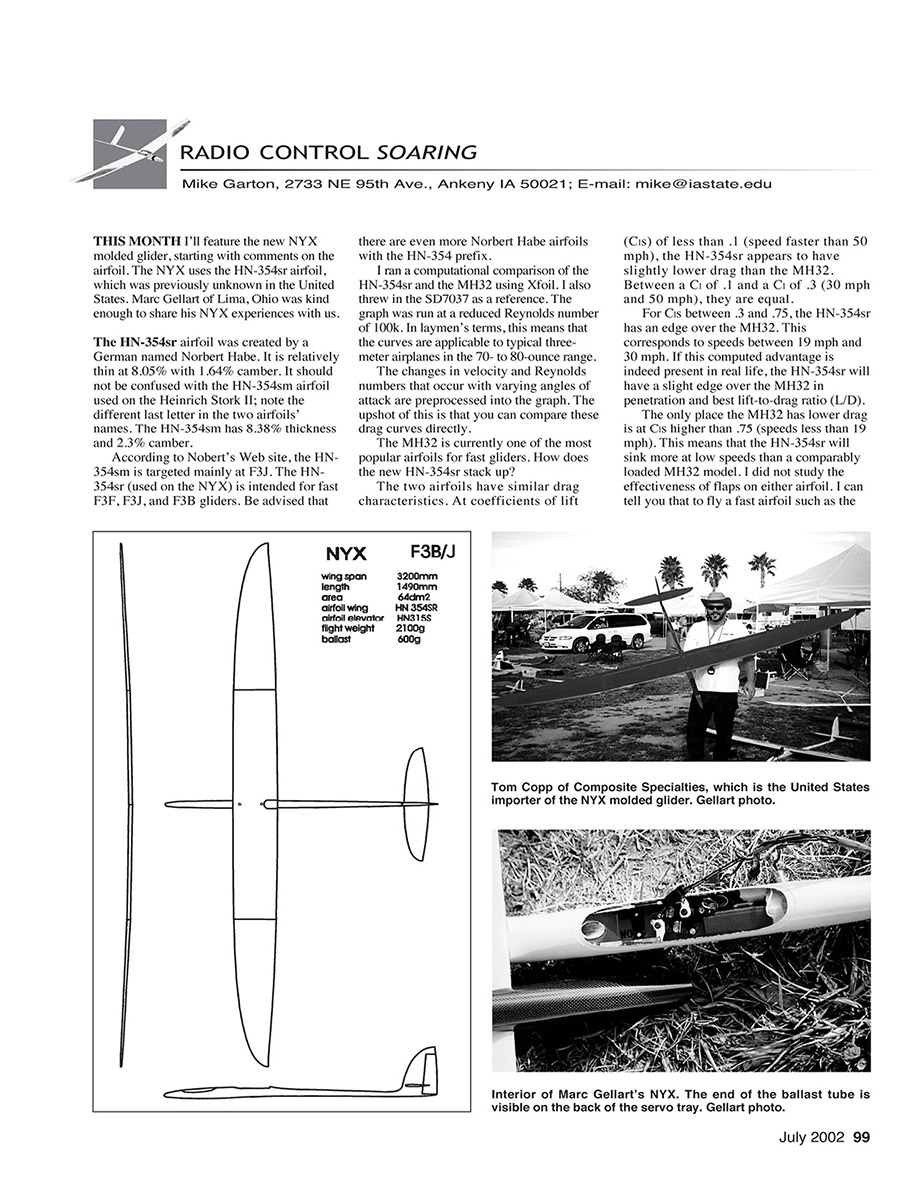
THIS MONTH I'll feature the new NYX molded glider, starting with comments on the airfoil. The NYX uses the HN-354sr airfoil, which was previously unknown in the United States. Marc Gellart of Lima, Ohio was kind enough to share his NYX experiences with us.
The HN-354sr airfoil was created by a German named Norbert Habe. It is relatively thin at 8.05% with 1.64% camber. It should not be confused with the HN-354sm airfoil used on the Heinrich Stork II; note the different last letter in the two airfoils' names. The HN-354sm has 8.38% thickness and 2.3% camber.
According to Norbert's Web site, the HN-354sr is targeted mainly at F3J. The HN-354sr (used on the NYX) is intended for last F3F, F3J, and F3B gliders. Be advised that there are even more Norbert Habe airfoils with the HN-354 prefix.
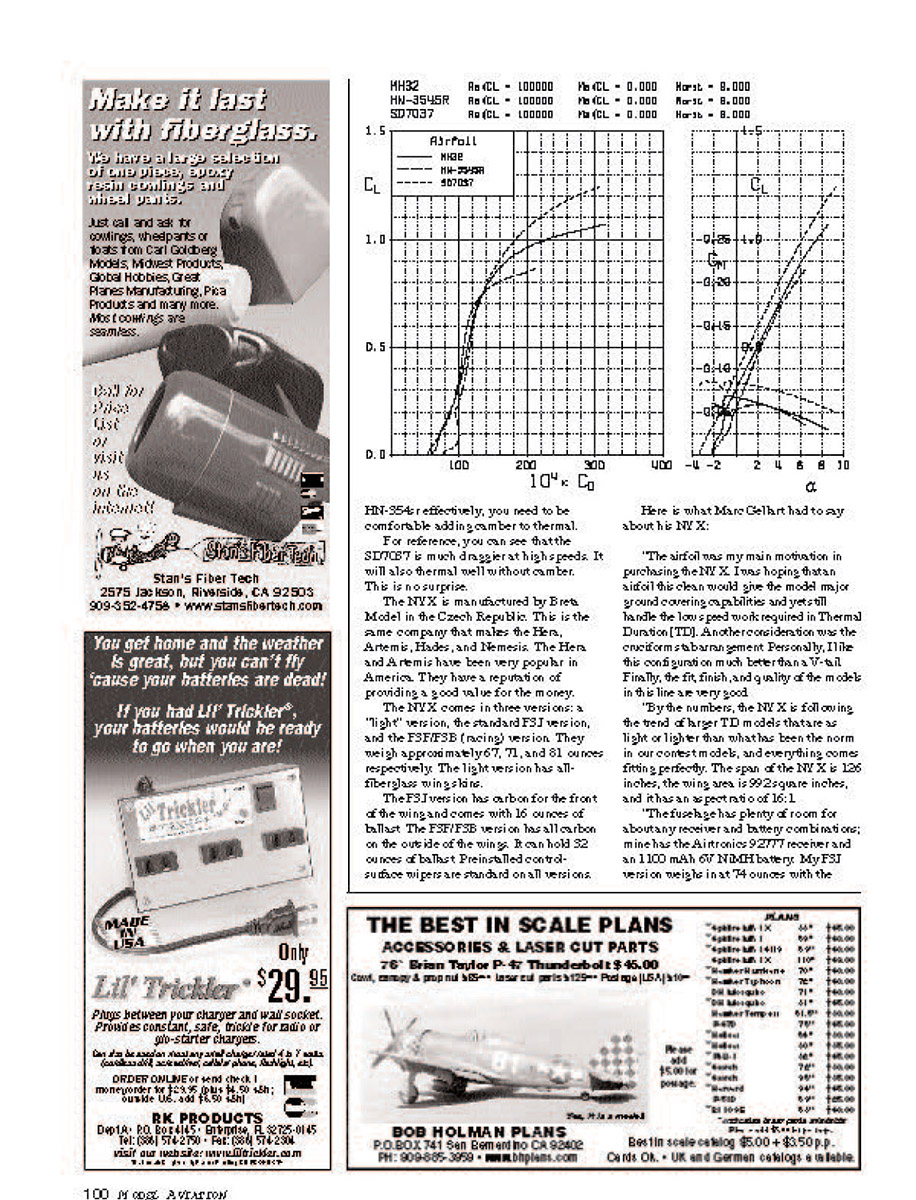
I ran a computational comparison of the HN-354sr and the MH32 using Xfoil. I also threw in the SD7037 as a reference. The graph was run at a reduced Reynolds number of 100k. In laymen's terms, this means that the curves are applicable to typical three-meter airplanes in the 70- to 80-ounce range. The changes in velocity and Reynolds numbers that occur with varying angles of attack are preprocessed into the graph. The upshot of this is that you can compare these drag curves directly.
The MH32 is currently one of the most popular airfoils for fast gliders. How does the new HN-354sr stack up?
The two airfoils have similar drag characteristics. At coefficients of lift (Cls) of less than .1 (speed faster than 50 mph), the HN-354sr appears to have slightly lower drag than the MH32. Between a Cl of .1 and a Cl of .3 (30 mph and 50 mph), they are equal.
For Cls between .3 and .75, the HN-354sr has an edge over the MH32. This corresponds to speeds between 19 mph and 30 mph. If this computed advantage is indeed present in real life, the HN-354sr will have a slight edge over the MH32 in penetration and best lift-to-drag ratio (L/D).
The only place the MH32 has lower drag is at Cls higher than .75 (speeds less than 19 mph). This means that the HN-354sr will sink more at low speeds than a comparably loaded MH32 model. I did not study the effectiveness of flaps on either airfoil. I can tell you that to fly a fast airfoil such as the HN-354 effectively, you need to be comfortable adding camber to thermal.
For reference, you can see that the SD7037 is much dragier at high speeds. It will also thermal well without camber. This is no surprise.
The NYX is manufactured by Beta Model in the Czech Republic. This is the same company that makes the Hera, Artemis, Hades, and Nemesis. The Hera and Artemis have been very popular in America. They have a reputation of providing a good value for the money.
The NYX comes in three versions: a "light" version, the standard F3J version, and the F3F/F3B racing version. They weigh approximately 67, 71, and 81 ounces respectively. The light version has all-fiberglass wingtips.
The F3J version has a carbon spar for the front of the wing and comes with 16 ounces of ballast. The F3F/F3B version has ballast on the outside of the wing. It can hold 82 ounces of ballast. Preinstalled control-surface wires are standard on all versions.
Here is what Marc Colbath had to say about his NYX:
"The airfoil was my main motivation in purchasing the NYX. I was hoping that an airfoil this clean would give the model major speed covering capability and yet still handle the low-speed work required in Thermal Duration (TD). Another consideration was the cruciform stab/fin arrangement. Personally, I like this configuration much better than a V-tail. Finally, the fit, finish, and quality of the model as it came to me was very good.
"By the numbers, the NYX is following the trend of larger TD models that are a little lighter than what has been the norm in our contest models, and everything comes together perfectly. The span of the NYX is 126 inches, the wing area is 992 square inches, and its area is the expected 16:1.
"The fuselage has plenty of room for altimeters, receivers and battery combinations. Mine has the Airtronics 9277 receiver and a 1100 mAh 6V NiMH battery. My F3J version weighs in at 74 ounces with the"
Transcribed from original scans by AI. Minor OCR errors may remain.

