
RC Aerobatics
Eric Henderson, 303 Shady Ln., Marlton NJ 08053; E-mail: [email protected]
FOLLOWING IS a note from Frank Granelli of Rockaway, New Jersey, that I thought you might like to read. He wanted to share his experience with the new Nickel Metal Hydride (NiMH) batteries. I am printing his letter because I have seen the same results that have also saved my airplane. Frank writes:
"In case anyone has ever wondered what happens when the receiver NiMH heads south of Florida, I can tell you exactly. One good thing about NiMHs is that they don't quite fall off the same steep voltage cliff when they die that Nicads do. That, and some great advice from my very first instructor, saved my Prophecy.
"The first indication is one I would never have thought about. The airplane falls off line as it pulls verticals in the corners. Even with an exact wings-level entry, the vertical line would be off 20-30 degrees to the left. Why? Because the battery was so weak, one of the ailerons would deflect upwards in the pull, causing a wing to drop on that side.
"But everything else was fine so far. I just thought I didn't have the wings level each time (more than possible for me), so I just kept practicing. About five minutes later the rolls started to slow down.
"OK, that's it, time to land. My original instructor always told me, if something changes in the air, don't try to figure it out. Don't keep flying to 'test stuff,' just get it on the ground fast. What we found after landing was instructive to me at least. The ailerons would fully deflect just as fast as normal. The ailerons could be pushed half way back to neutral with slight hand pressure. The rudder and elevator were fine and worked normally.
"I tested the voltage with a new test meter that can apply a 500, 1000 or 1500 mA load. Without load, the voltage was 4.77 volts (0.95 v per cell) on a 6-volt pack. When I applied a 500 mA load, the numbers on the screen went away! The battery being tested powers (the digital voltage readout). I nearly faded away almost as fast as did those voltage numbers. Took a few minutes, and some oxygen, to learn to breathe normally again.
"I don't yet know why this happened. The 1650 mAh battery is brand new and has just 11 flights on it. I bought it at the WRAM show. I charged it with the Sirius charger last night and then used the SuperTest. It tested at 1489 mA. Not too bad considering the severe drain it experienced. I usually charged it overnight at 140 mA using an Ace Supercharger. (But it'll be the Sirius from now on.)
"This happened on the third flight, about 40 min. flying time before experiencing any problem followed by 10 min. of stubbornness. Total flying time about 50 minutes. The JR servos were two 8411SAs, two 8231s, a Futaba 136G and a JR 517. I did notice that one of the retractable landing gears was hung up probably stalling the 136G. I'll be a lot more careful about it in the future.
"Anyway, my theory is that the ailerons exhibited failure first because there are 2 of them on one channel. Is it possible that the low voltage was sort of 'shared,' reducing it even further to the ailerons? Maybe our electronic experts would know this.
"BTW this was not an NiMH battery failure, but was caused by unusual current drain. Having an NiMH probably saved the airplane because a Nicad would have failed more quickly during my 'stubborn' flying."
Thank you for the very interesting report and for the insights and observations, Frank.
Frank's instructor was right; do not wait to see what happens in the air. Land ASAP if you feel or see a control-response change.
My experiences were that my airplane ... refused to snap roll. Upon landing, the battery would not support a one-amp load test. Operating one channel at a time allowed me to land safely.
Now I have a couple of months flying Lithium ion (Li-ion) batteries. If you push the limits on a Li-ion battery, it behaves in a similar way to a NiMH pack. For more comparative experiences, I am running an 1850 mAh NiMH five-cell pack and a 2000 mAh pack in two similar Pattern airplanes this summer. The models have six identical high-performance JR digital servos in them.
So far the performances are equal. The Li-ion, weighing only 3.5 ounces, is winning my favor. It also gives one more flight than the NiMH. The Li-ion charger is a simple cigar-lighter type and will fully charge the pack in two hours. Intermediate charge boosts take much less time. It was no problem to make 10 flights in one session with either airplane if a field charge was used. Now we are split for choice: the ever-faithful Ni-Cd versus the new kids on the block.
I recently fitted new carbon-fiber (CF) undercarriage legs, that I picked up at the 2001 World Championships in Ireland, to my Hydeout. They were a bit thicker, and I hoped that they would fix a gear-leg-oscillation problem that had been plaguing this model. (More about that later.)
I decided to clear-coat the legs and was totally shocked at the pinhole finish I "achieved" with my airbrush and the clearcoat. It seems that not all CF legs are equal. A coat of clear mixed with microballoons, hand-rubbed in, took care of the problem.
Back to the undercarriage oscillation, it turned out that the real culprit was the rudder servo. I was using a JR 8417. It started to go nuts in all positions. If this starts happening to you, send the servo back to JR; the company can/will reduce the feedback sensitivity and give you a satisfactory servo.
I swapped in a JR 8411SA with the tighter nylon gears, and it behaved very well. It was amazing to see the rudder cause the legs to vibrate in harmonic sympathy—not the other way around! Now I have a spare set of CF legs for the Nationals!
Frequently-Asked Question: Would a Piper Cub or a regular trainer work as a Pattern airplane? If you put a higher-powered engine in it, surely it would perform just as well?
Most trainers can do aerobatics, and it would appear that they would be viable as competition models. I dare say that in the right hands a trainer could be made to do respectable manoeuvres. The right hands would be a very experienced flier.
Trainers, and especially high-winged models such as the Cub, are designed to fly level. The wings have self-righting or semi-self-righting capabilities. These positive features in a trainer are negative features in a Pattern airplane. The wings tend to be flat-bottomed in section and require excessive down-elevator to fly inverted, and may not even be capable of an outside loop.
As much as the idea would work in theory, you'll never be able to overcome the roll coupling of the rudder to the purposely designed dihedral wing. You would do better to build a model that is designed to do aerobatics.
Test Airplane of the Month:
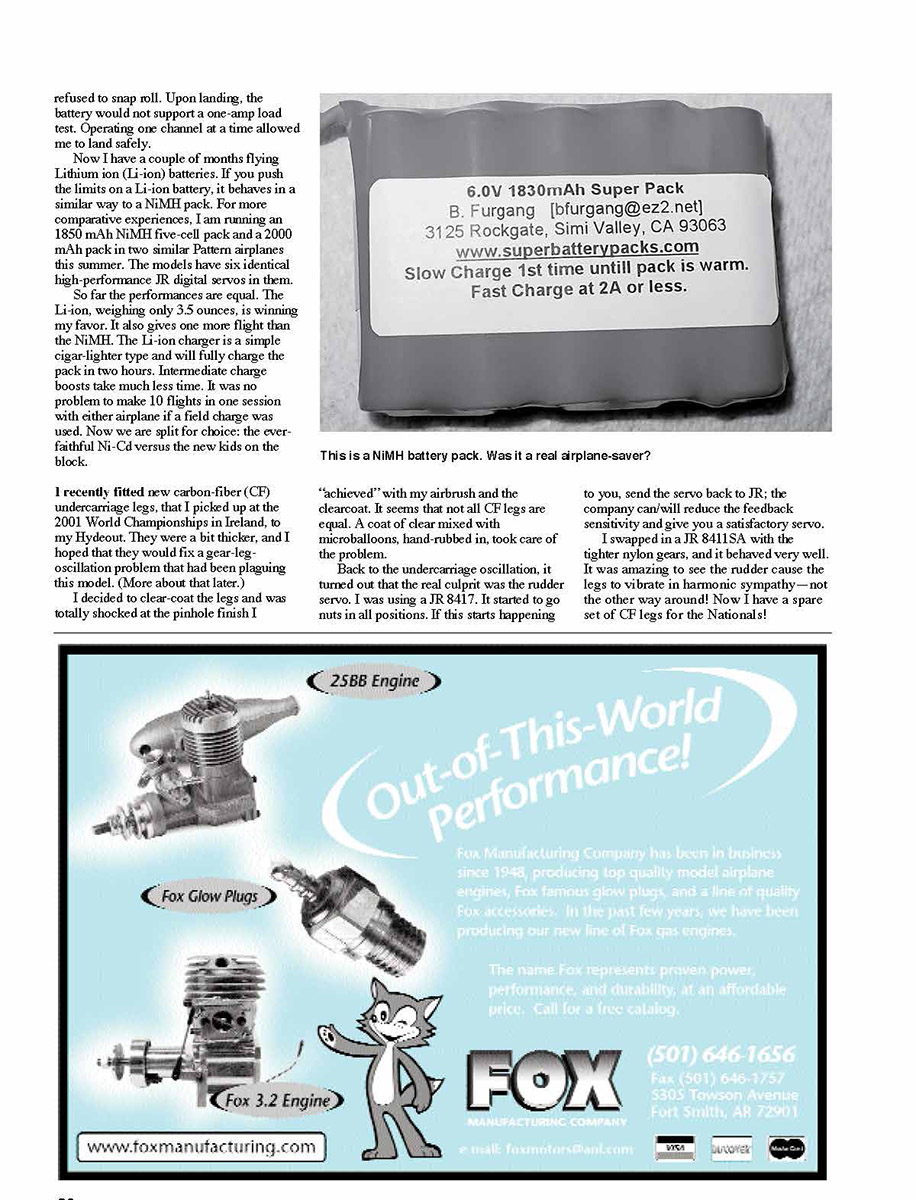
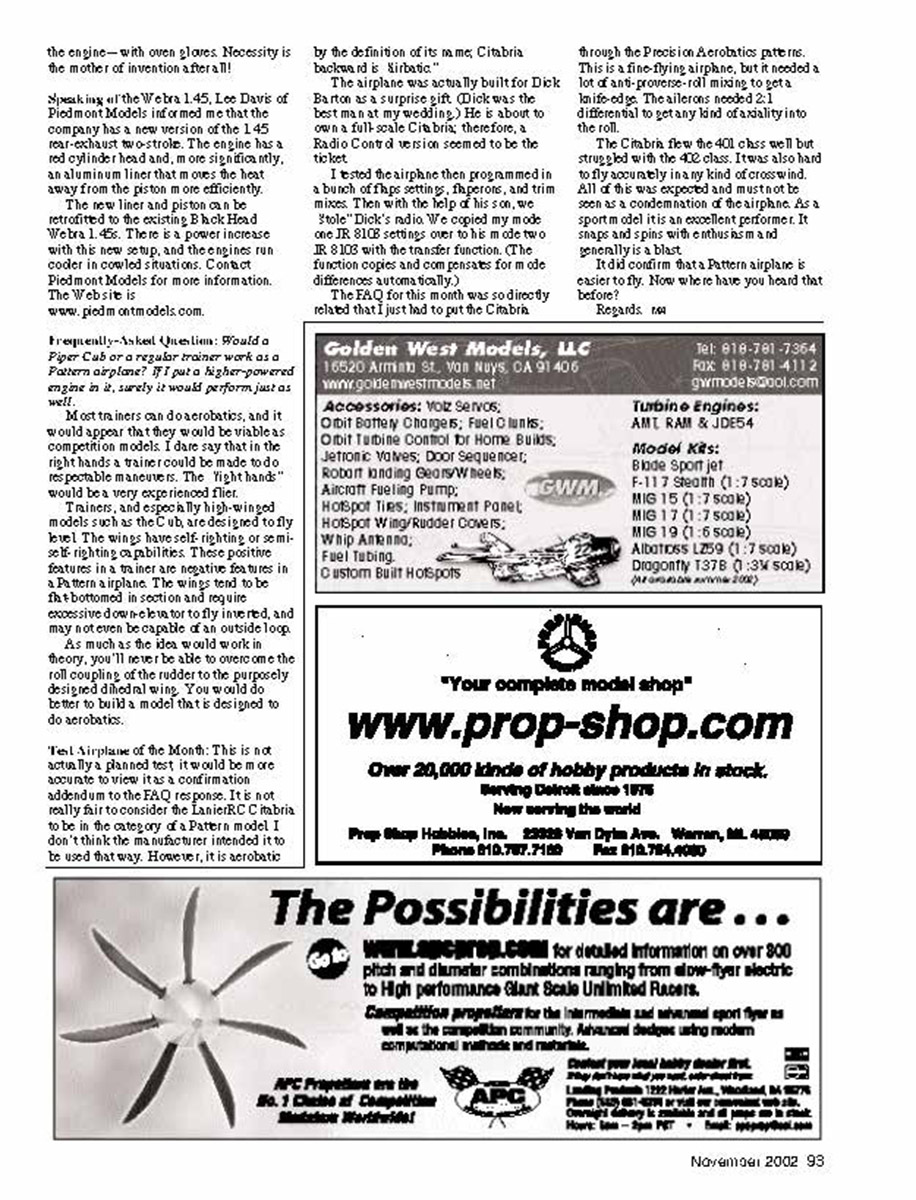
This is not actually a planned test; it would be more accurate to view it as a combination addendum to the FAQ response. It is not really fair to consider the Lanier RC Citabria to be in the category of a Pattern model. I don't think the manufacturer intended it to be used that way. However, it is aerobatic by the definition of its name; Citabria backwards is 'airbatic'.
The airplane was actually built for Dick Barton as a surprise gift. (Dick was the best man at my wedding.) He is about to own a full scale Citabria; therefore, a Radio Control version seemed to be the ticket.
I tested the airplane then programmed in a bunch of settings, throwtrims, and trim mixes. Then with the help of his son, we "stole" Dick's radio. We copied my mode on JR 8108 settings over to his mode two in a JR 8103 with the transfer function. (The function copies and compensates for more differences automatically.)
The FAQ for this month was so directly related that I just had to put the Citabria through the Precision Aerobatics pattern. This is a fine-flying airplane, but it needed a lot of anti-proverse-roll mixing to get a knife-edge. The ailerons needed 2:1 differential to get any kind of axiality into the roll.
The Citabria flew the 40 class well but struggled with the 42 class. It was also hard to fly accurately in any kind of crosswind. All of this was expected and must not be seen as a condemnation of the airplane. As a sport model it is an excellent performer. It snaps and spins with enthusiasm and generally is a blast.
It did confirm that a Pattern airplane is easier to fly. Now where have you heard that before?
Regards, Ian
Transcribed from original scans by AI. Minor OCR errors may remain.

