
Radio Control Aerobatics
Eric Henderson, 303 Shady Ln., Marlton NJ 08053; E-mail: [email protected]
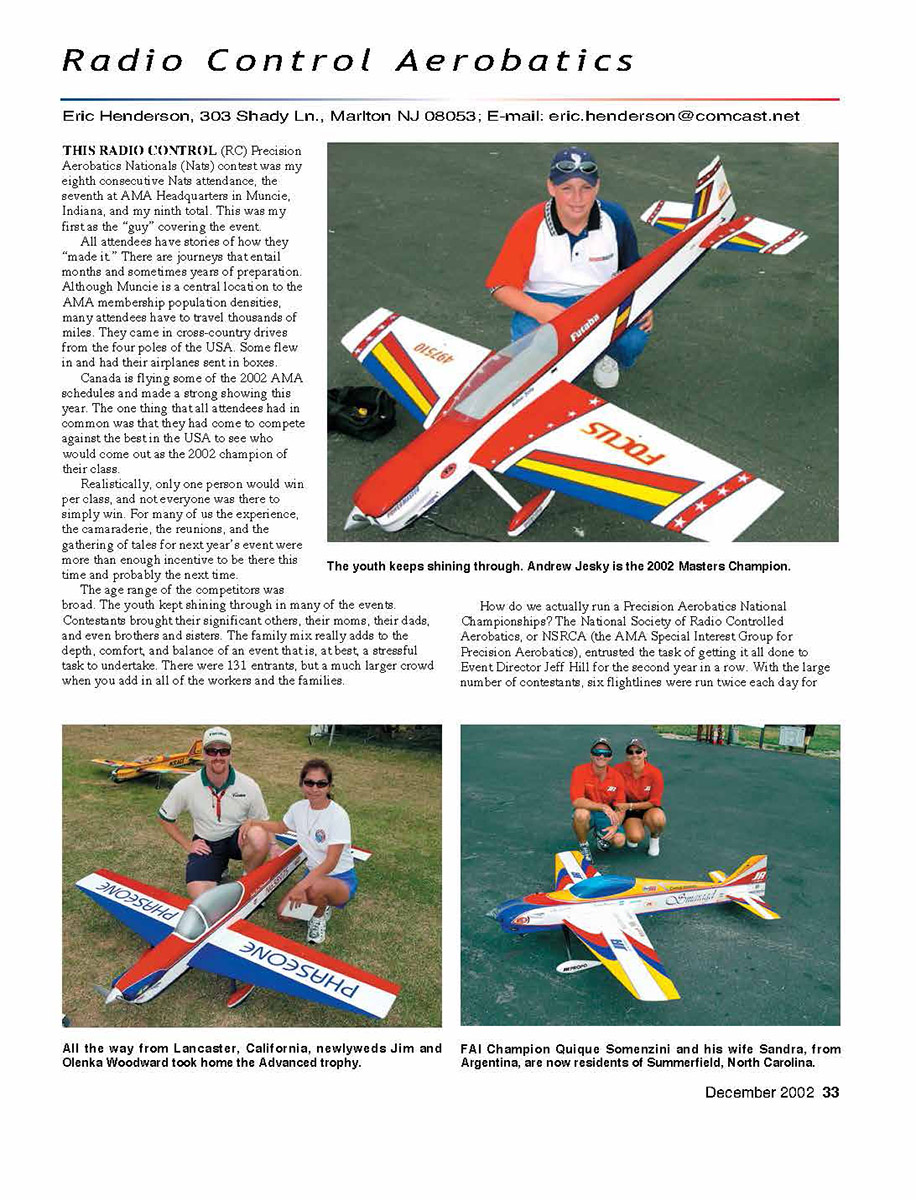
THIS RADIO CONTROL (RC) Precision Aerobatics Nationals (Nats) contest was my eighth consecutive Nats attendance, the seventh at AMA Headquarters in Muncie, Indiana, and my ninth total. This was my first as the "guy" covering the event.
All attendees have stories of how they "made it." There are journeys that can be months and sometimes years of preparation. Although Muncie is a central location to the AMA membership population densities, many attendees have to travel thousands of miles. They came in cross-country drives from the four poles of the USA. Some flew in and had their airplanes sent in boxes.
Canada is flying some of the 2002 AMA schedules and made a strong showing this year. The one thing that all attendees had in common was that they had come to compete against the best in the USA to see who would come out as the 2002 champion of their class.
Realistically, only one person would win per class, and not everyone was there to simply win. For many of us the experience, the camaraderie, the reunion, and the gathering of tales for next year's event were more than enough incentive to be there this time and probably the next time.
The age range of the competitors was broad. The youth kept shining through in many of the events. Contestants brought their significant others, their moms, their dads, and even brothers and sisters. The family mix really adds to the depth, comfort, and balance of an event that is, at best, a stressful task to undertake. There were 131 entrants, but a much larger crowd when you add in all of the workers and the families.
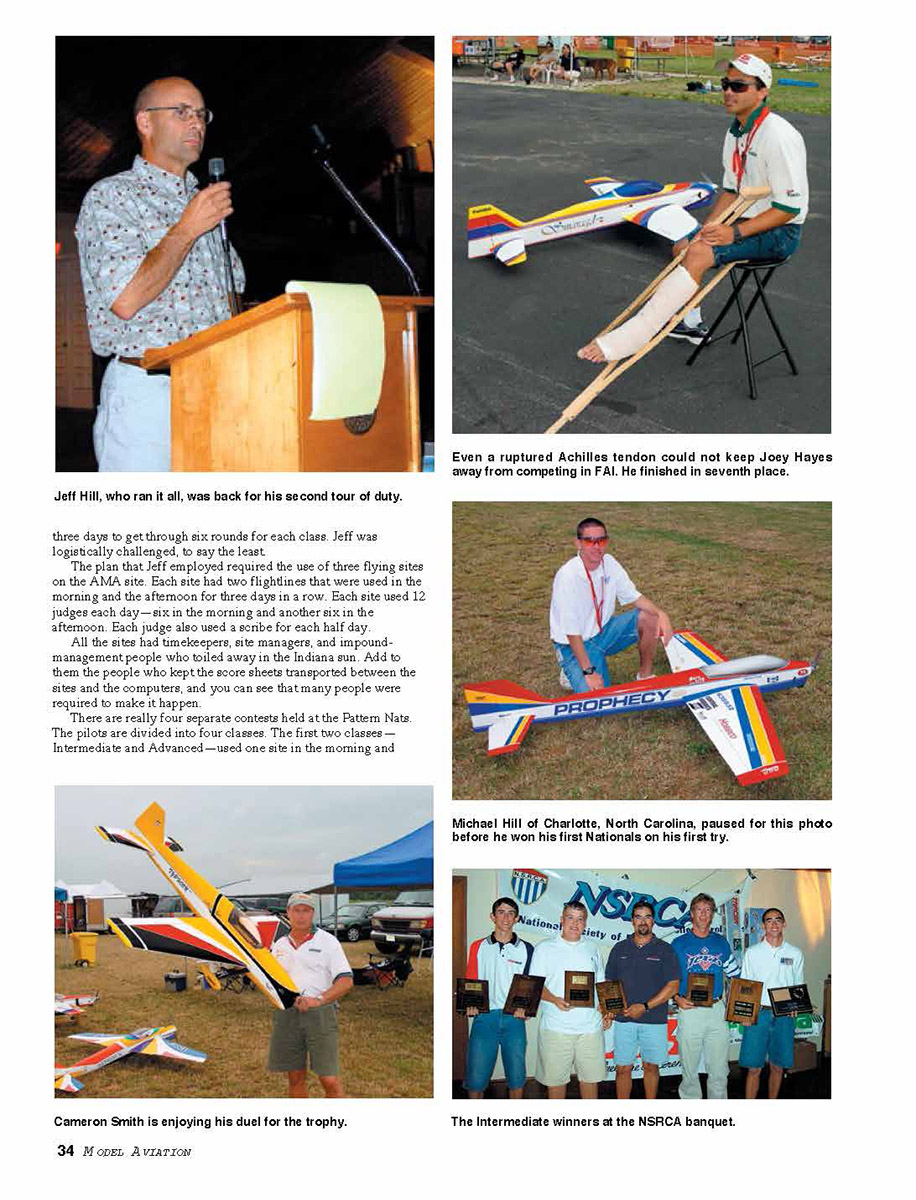
How do we actually run a Precision Aerobatics National Championships? The National Society of Radio Controlled Aerobatics, or NSRCA (the AMA Special Interest Group for Precision Aerobatics), entrusted the task of getting it all done to Event Director Jeff Hill for the second year in a row. With the large number of contestants, six flightlines were run twice each day for three days to get through six rounds for each class. Jeff was logistically challenged, to say the least.
The plan that Jeff employed required the use of three flying sites on the AMA site. Each site had two flightlines that were used in the morning and the afternoon for three days in a row. Each site used 12 judges each day—six in the morning and another six in the afternoon. Each judge also used a scribe for each half day.
All the sites had timekeepers, site managers, and impound-management people who toiled away in the Indiana sun. Add to them the people who kept the score sheets transported between the sites and the computers, and you can see that many people were required to make it happen.
There are really four separate contests held at the Pattern Nats. The pilots are divided into four classes. The first two classes—Intermediate and Advanced—used one site in the morning and one site in the afternoon. The FAI class and the Expert class had the other two sites. The FAI class flew FAI sequences, and the Expert class flew the classic NSRCA-known sequences.
Each class is run by its own chief judge and contest director. In this way, sequence changes and field adjustments for one class did not affect the other classes. It takes meticulous planning and a dedicated group of volunteers to make this sort of schedule work.
What keeps these nationals alive and well is the friendships and healthy rivalries. Some pilots are there to take top honors, while others are content to be part of the camaraderie and to test themselves. The event also showcased some young, upcoming pilots who will be a force to reckon with in the coming years.
The banquet and awards ceremony wrapped up the event with trophies, plaques, and stories of close calls and spectacular flying. The consensus among the competitors was that despite the long workdays and the heat, the event was a success and everyone left looking forward to next year.
Each pilot had the opportunity to fly twice and complete two rounds per day. After three days the winners were selected with the best four scored rounds out of six.
Fédération Aéronautique Internationale (FAI) and Masters used a queue system for three days to select finalists for the fourth day. The formula is that they were divided into four groups each. Masters pilots flew in the morning, and FAI pilots flew in the afternoon. Each group was seeded based on last year’s performances. In Masters there were approximately 13 pilots per group. The top eight pilots were distributed in the four groups so that no group had a large bunch of “dominant” pilots.
Each group was then flown off against the other group. With three days of flying, the pilots all flew against another group for two rounds per day.
After three days, the top 20% flew in a finals of three rounds. In Masters they flew the same routine. In FAI they flew the P-03 schedule in the qualifying rounds and a different finals schedule called F-03. The pilots carried a product of their best scores forward to a finals day on which three flights were flown. The result was a best three out of four rounds final tally.
Sunday, July 21 was an open day for practice with the mandatory 5 p.m. pilots’ meeting. Mickey Losardo sang a terrific rendition of the national anthem that outclassed any that I have ever heard at a Super Bowl.
I am not embarrassed to admit that I could not hold back a tear or two as I stood there thinking about all aviation, the crime of 9/11, the significance of my USA citizenship, and all of the liberty that came with it. That anthem signified the privilege, the freedom, and the ability for us to do something as simple as hold a model-aviation contest—not necessarily earth-shattering in its own right but significant in my life.
To achieve a higher standard of judging, Don Ramsey and Earl Haury took all of the people who would be judges through the new 2002 schedules and clarified stall-turn and roll directions. The judges were mainly contestants with a healthy mix of volunteers who sat out in the Indiana sunshine just for us. A big thank you to all of them.
Day One, July 22: Flying began at 8 a.m., with transmitters required to be in the impound by 7:45 a.m. Masters used the two paved sites known as Sites One and Three. The Intermediate pilots flew the grass runway of Site Four. As in previous years, the grass runway was the better heat-absorbing deal. Trust me on that one! After lunch FAI flew on Sites One and Three, and Advanced flew on Site Four.
The day began with a slight breeze, and the wind was blowing pretty hard by midafternoon. I had FAI-preliminaries judging duty that afternoon and had to hold onto the spare chairs a couple of times to prevent them from blowing out past the pilots.
In AMA classes 402 to 404 you get three minutes to start your engine then you make the flight. In FAI you get 10 minutes to get it all done. The watch is stopped for interruptions, such as sound tests, airplanes landing, etc. A couple of pilots ran out of time and did not get scores for their final maneuvers.
The Masters pilots took from 8 a.m. until 1 p.m. to get their two rounds flown. The rest were well within the time window. Fifty Masters pilots made for a really big group to process.
After a quick shower, I was off to the NSRCA board meeting at 6:30 p.m. at the Ontario Systems headquarters in downtown Muncie, courtesy of Mark Smith who is an avid AMA Pattern supporter. At 11 p.m., I was all done and off to bed for Day Two.
Day Two, July 23: Each day holds its own challenges. Monday was windy and Tuesday, in contrast, was calm with light breezes once in awhile. The big decision was which flight direction to fly. Sometimes a small "hat-sucker" thermal would come through and invalidate any choice a pilot made.
Tuesday-evening tutorial classes were held for those who could not practice in the dark! Some pilots flew so late I thought they had night vision. The seminars were YS Engines with Rusty Fried; Trimming with Peter Collinson; and Health and Maintenance of Radio Control Systems with Tony Stillman.
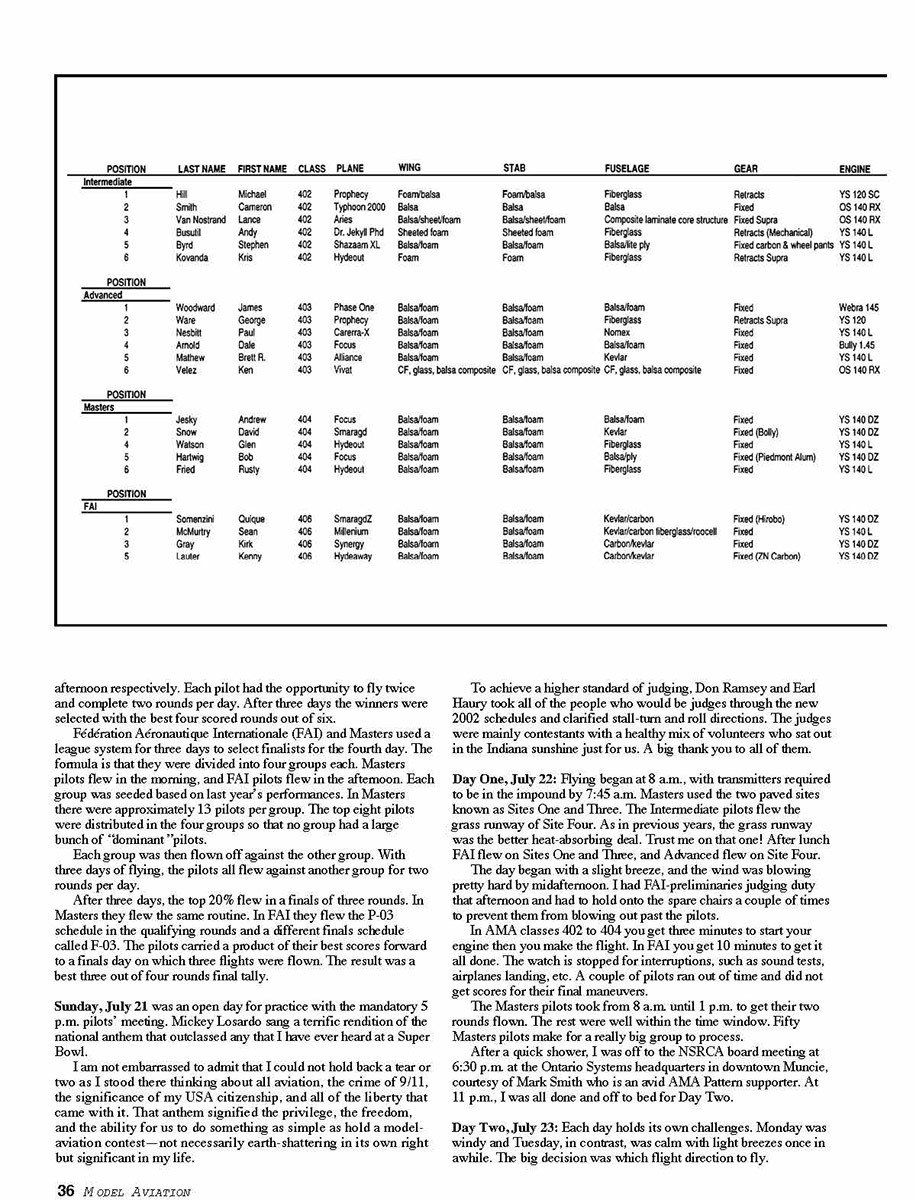
Day 3, July 24: Wednesday was a big day for all of the contestants. Advanced and Intermediate were having close-fought battles for the top places. In Intermediate, Michael Hill and Cameron Smith had won two rounds each. It was all going to be decided in the last two rounds.
In Advanced, two pilots had won a round each and scored high in their other flights. James Woodward was a point or two in the lead. George Ware had not won a round but continued to score consistently high. Paul Nesbitt had won two rounds but needed two more good scores to win after the two throw-away rounds.
The 402- and 403-class pilots' contest was over. The evening banquet, their final results, and awards awaited them. No one knew for sure who had won. The day was going to be long for Masters and FAI contestants. The higher-scoring pilots basically knew who was going to be in the finals. Those on the finals-gauging cusp had to wait to see who would get another day of flying.
There were 11 pilots in Masters and eight in the FAI finals. None of the 404 and 406 pilots would really know until their names were announced at the NSRCA banquet.
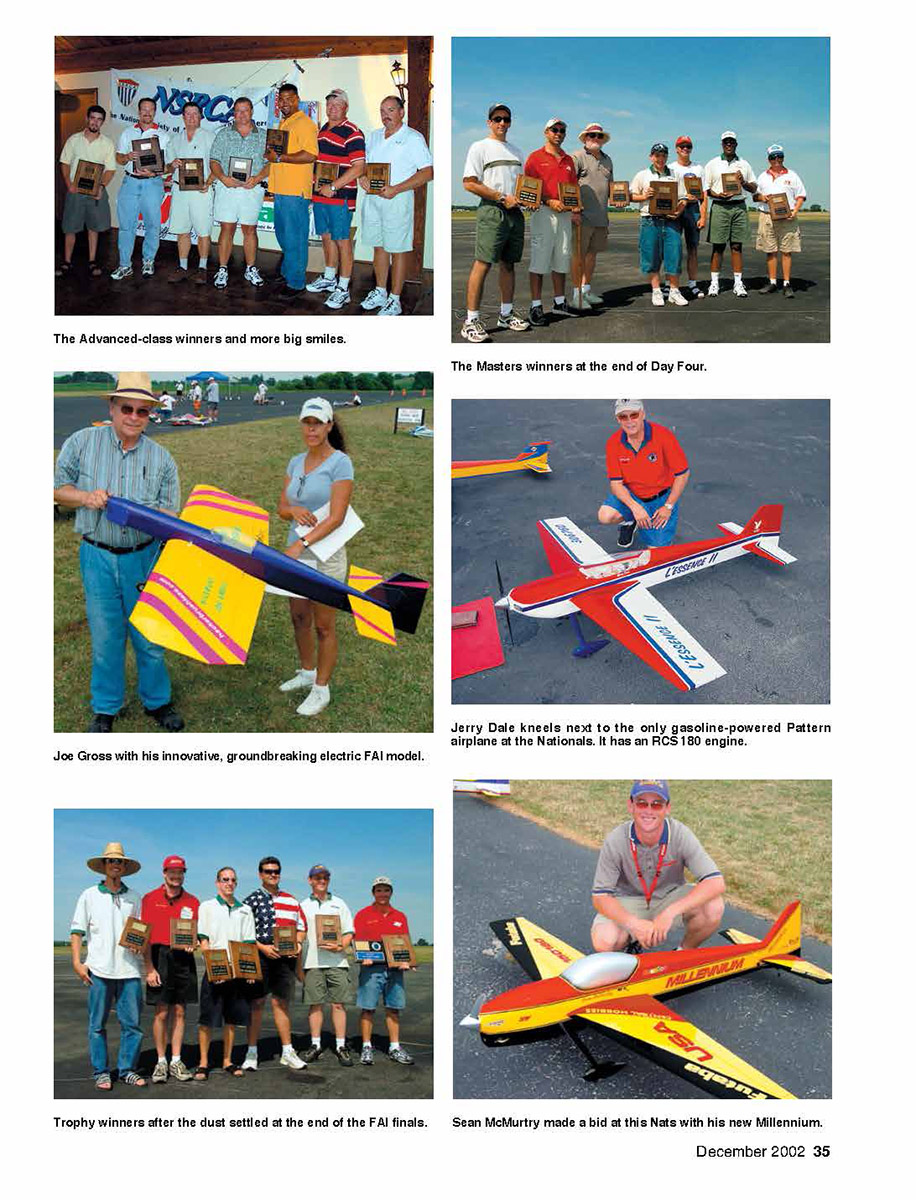
The NSRCA banquet agenda consists of a meal, a short general meeting to report on the Monday-night board meeting, then the real fun. As the NSRCA president, my treasured pleasure is the privilege of giving out awards to the Intermediate and Advanced pilots. Their achievement and potential in the hobby just leaps out at you. I just wish they were not always one-quarter my age!
Michael Hill (no relation to Jeff Hill), in his first Nationals, put in two third-day flights that were just enough to beat Cameron Smith by winning both of the last two rounds. It was a commendable performance under that amount of pressure.
When the dust settled in Advanced, Jim Woodward had won the last two rounds, George Ware grabbed second without winning a round but producing consistently high scores, and Paul Nesbitt took third even though he won two rounds.
The big buzz on banquet night is always who is going to be in the finals. The names are read in alphabetical order with no scores revealed so that the judges do not carry any precognitive notions of who should win the next day. I was not shown the scores for FAI because I had a finals judging job to do the next day.
The meeting closed with a large raffle of goodies and items donated by the NSRCA. Almost everyone won something, and we all went off to bed dreaming of what was to be and what might have been if we had prepared or practiced more!
Finals Day had two events that were run in parallel. I was judging the FAI finals, so I could not track the Masters contest. However, the scores show that a real ding-dong battle took place between veteran David Snow and rookie Andrew Jessky. Andrew was one of those young men who had come up through the ranks, winning each class on his way up.
David Snow carried 1,000 points into the finals versus Andrew's 999 points. Andrew won two rounds, and David won one round that day. The best three scores decided the winner. This was a very tight contest and was finally decided by David's lower score of 995. It was a well-fought battle with many a debate to follow, as always.
Quique Somenzini dominated FAI. Sean McMurtry fought hard to earn his second place after having to abort a flight when the throttle servo kept sticking. This caused some aggressive down-lines but eventually forced Sean to do a re-land.
Before the trophies were awarded, I held an inaugural FAI Artistic Aerobatics demonstration event with welcome help from Steve Kalfut. All of the finals pilots and spectators gathered on Site Three to witness this historic moment.
I'll have more about this in the regular RC Aerobatics column, but Chad Northeast of Canada flew beautifully. Troy Newman put on a show with a regular Pattern airplane that was excellent, and Quique wowed us all. I will never forget his Eight Point Roll right on the deck!
The event could not run without many great people who give up their time to do all the jobs that make an event happen. I would like to recognize score-sheet runners Andrew and Heather Kaluf and Carmen and Torrey Hill. Site One impound, Jenny Newman (afternoon impound) was assigned to nonjudging lines; Line Chief Jerry Plyler; and Site Director Vic Shepherd.
At Site Three: morning impound, Marco Plyler (afternoon impound) was assigned to nonjudging lines; Line Chief Art Reigel; and Site Director Torry Terrencio.
At Site Four: morning impound, Bill Glaze (afternoon impound) was assigned to nonjudging lines; Line Chief Tom Mitchell; Site Director Bobby Stout; and scoring, Monica and Lynne Dansereau. Scoring was done on-site for Intermediate and Advanced.
At Nats Headquarters (at the AMA fairgrounds): scoring, Jim McKeown with Terry Brix on mornings; Contest Directors Steve Kaluf and Ron Morgan; and RC Manager Al Wilkinson.
Score coordinators, Susie Cooper and Wanda Phillips; entries from RSVP Muncie; AMA helpers, Amy Wilson; Road Crews, and Lisa Johnson; volunteer, Jane Morgan; NSRCA Nationals Manager Maureen Dunphy; judging training, Don Ramsey; finals judge selection, Earl Haury; judges and measure crew, Carmen Hill; extra judging help, Raiko Potter, Bill Glaze, Dan Venzies, and Beverley Cowell.
The man of the moment was two-time Event Director Jeff Hill. As you can see from the preceding list, many family names are regularly repeated in the mix of contributions. Here's a big "thank you" to them all.
In this report I listed only the trophy winners because a full list of results is included in the back of this issue. The numbers tell my stories, but you can't beat actually being there. It is well worth the trip, and if you don't want to fly, we will always find something for you to do.
See results in "Focus on Competition"
Transcribed from original scans by AI. Minor OCR errors may remain.

