
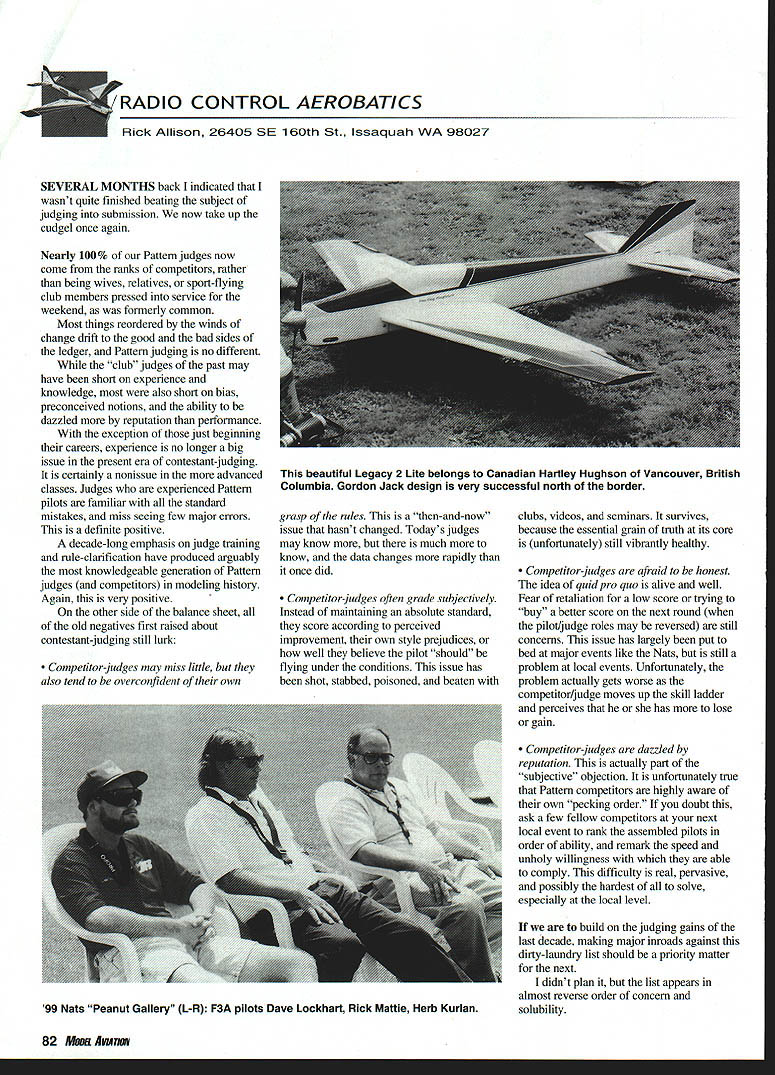

RADIO CONTROL AEROBATICS
Rick Allison, 26405 SE 160th St., Issaquah WA 98027
SEVERAL MONTHS back I indicated that I wasn't quite finished beating the subject of judging into submission. We now take up the cudgel once again.
Nearly 100% of our Pattern judges now come from the ranks of competitors, rather than being wives, relatives, or sport-flying club members pressed into service for the weekend, as was formerly common.
Most things reordered by the winds of change drift to the good and the bad sides of the ledger, and Pattern judging is no different.
While the "club" judges of the past may have been short on experience and knowledge, most were also short on bias, preconceived notions, and the ability to be dazzled more by reputation than performance.
With the exception of those just beginning their careers, experience is no longer a big issue in the present era of contestant-judging. It is certainly a nonissue in the more advanced classes. Judges who are experienced Pattern pilots are familiar with all the standard mistakes, and miss seeing few major errors. This is a definite positive.
A decade-long emphasis on judge training and rule-clarification have produced arguably the most knowledgeable generation of Pattern judges (and competitors) in modeling history. Again, this is very positive.
On the other side of the balance sheet, all of the old negatives first raised about contestant-judging still lurk:
- Competitor-judges may miss little, but they also tend to be overconfident of their own grasp of the rules. This is a "then-and-now" issue that hasn't changed. Today's judges may know more, but there is much more to know, and the data changes more rapidly than it once did.
- Competitor-judges often grade subjectively. Instead of maintaining an absolute standard, they score according to perceived improvement, their own style prejudices, or how well they believe the pilot "should" be flying under the conditions. This issue has been shot, stabbed, poisoned, and beaten with clubs, videos, and seminars. It survives, because the essential grain of truth at its core is (unfortunately) still vibrantly healthy.
- Competitor-judges are afraid to be honest. The idea of quid pro quo is alive and well. Fear of retaliation for a low score or trying to "buy" a better score on the next round (when the pilot/judge roles may be reversed) are still concerns. This issue has largely been put to bed at major events like the Nats, but is still a problem at local events. Unfortunately, the problem actually gets worse as the talent ladder moves up the skill ladder and perceives that he or she has more to lose or gain.
- Competitor-judges are dazzled by reputation. This is actually part of the "subjective" objection. It is unfortunately true that Pattern competitors are highly aware of their own "pecking order." If you doubt this, ask a few fellow competitors at your next local event to rank the assembled pilots in order of ability, and remark the speed and unholy willingness with which they are able to comply. This difficulty is real, pervasive, and possibly the hardest of all to solve, especially at the local level.
If we are to build on the judging gains of the last decade, making major inroads against this dirty-laundry list should be a priority matter for the next. I didn't plan it, but the list appears in almost reverse order of concern and solubility.
Score the airplane, not the pilot
Commitment to always score the airplane, not the pilot. Pattern judges err when they feel sorry for a pilot who is obviously having a bad day and attempt to "help" him or her by awarding a few extra points. Judges must evaluate only what is presented in the air, not what might have been. This is the only sure antidote to the halo effect.
The bottom line is that contestant-judging has many virtues and many faults. If we are to keep the virtues while steadily eliminating the faults, competitors must constantly remind themselves that impartial judging is a duty, not a favor. The future of Pattern depends on it.
Pattern leadership needs to keep bringing the absolute necessity for that commitment to the general attention of all at every opportunity.
Honesty, anonymity, and judge evaluation
The honesty factor is much more amenable to correction. Even with just two judges on the line, if the judge numbers are unknown to the pilots, and the judges and contest management commit to keeping it that way, an amount of uncertainty will exist as to judge identity. And this is an area where TBL judge evaluation can really help, as this sort of bias sticks out like a statistical sore thumb.
Hiding judge identification from the pilots is a matter of applying the methods presently used at the Nationals to local events—and convincing the pilots themselves that it is best for all concerned for them to stifle their natural curiosity and remain uninformed. In this nation, we honor the principle of the secret ballot highly, and this shouldn't be a difficult selling job.
Subjective grading is one of those areas where the only real answer is to keep chipping away at the stone, trying to raise the general consciousness one pilot/judge at a time. We have already come a long way, but there is a long way left to go.
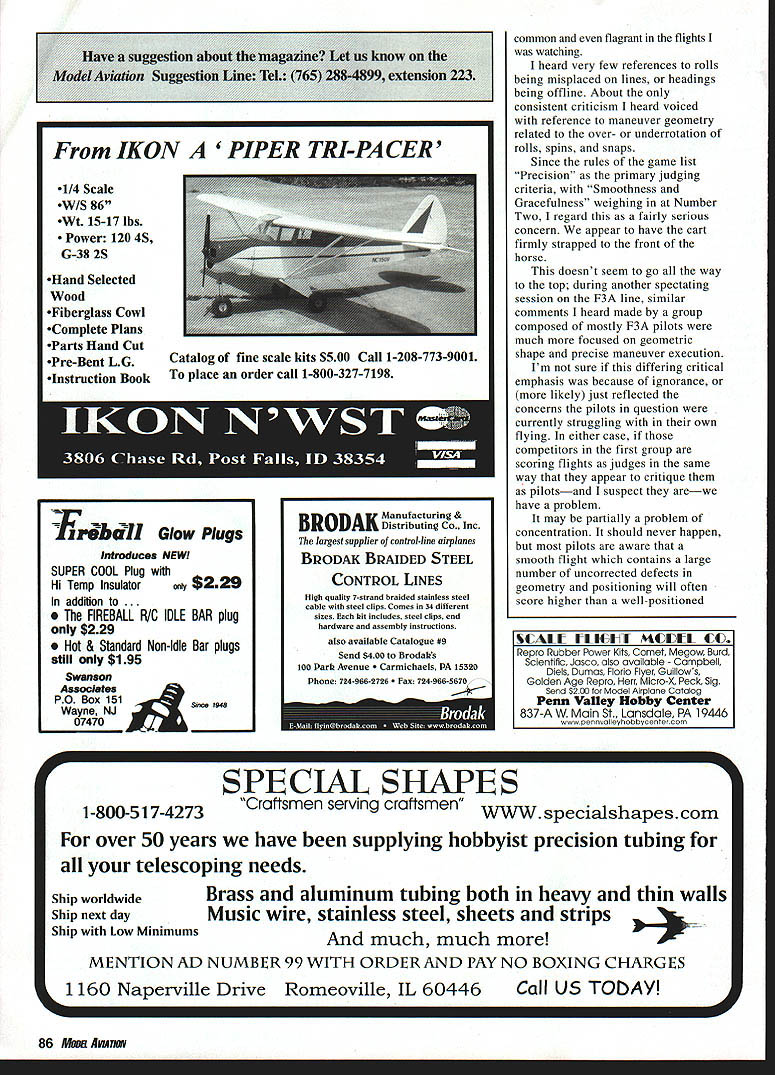
This was brought home to me at the 1999 Nats, as I was sitting and watching some Masters flights with some contest members of the "peanut gallery." This was a largish and representative group of mostly Masters and Advanced fliers. The comments I heard were directed generally at the area of smoothness and gracefulness.
"Pace" was mentioned a great deal, although the term appears nowhere in the rules.
Positioning was mentioned repeatedly; usually in reference to possible box violations. Snaps and spin entries were critiqued to death.
Not once did I hear someone comment that a maneuver was the wrong shape; that a square wasn't square, a true-angle not right, a part-loop not round, or that the two halves of a supposedly symmetrical figure didn't match—even though those mistakes were more objectively measurable and more deserving of remarks. In other words, the conversation was generally aesthetic rather than technical.
A change in attitude is required. We must constantly remind ourselves—and our judges—that the pattern is a set of shapes and lines that should conform to objective geometric standards. We shouldn't be scoring on how pretty something looked or how confident the pilot seemed. The airplane should be assessed strictly on the flying line it produces.
If contestant-judges can maintain their many virtues while eliminating the faults we've discussed—bias, quid pro quo fears, reputation effects, sympathy scoring, and subjective aesthetic grading—Pattern will continue to prosper. The challenge is to keep training, keep clarifying the rules, and keep the focus on scoring the airplane, not the pilot. The future of Pattern depends on it.
Smoothness vs. geometry
A smooth and geometrically correct flight that contains a few obvious "bobbles" which result in easily seen corrections will often be scored more harshly than a flight with poorer geometry but fewer obvious corrections.
The reason that smoothness sells over correct geometry is that an obvious correction is like an alarm bell going off in the judge's mind. It disrupts concentration on the precision and positioning of the maneuver elements and their interrelationship, which is a more-complex, multipart observation. The smoothness defect is seen and scored immediately, and everything else about the maneuver is almost disregarded. The judge thinks, "Aha! I gotcha!" and neglects to watch the rest of the proceedings while totaling up the damage.
Just as straight-and-level flight on a heading parallel to the flightline is the most-important and most-commonly-disregarded Pattern-flying skill, learning to maintain concentration through the whole maneuver before judging it is the most-important and most-commonly-disregarded Pattern-judging skill.
Even if the judge sees the rest of the maneuver, the smoothness defect will often draw a more severe penalty than the precision defect, simply because deviations from the assigned maneuver geometry are harder to see, remember, and score.
Severity of the Defect Trap
When I wrote about this many years ago, I called it the "Severity of the Defect Trap." The problem is still with us—and the name still fits.
The trouble is this: what is noticeable or obvious is not always severe, and what is severe is not always obvious.
Consider that a Figure M with 3/4 Rolls has three partial loops, eight vertical line segments, four rolls, and two stall turns, plus an entry and an exit, for a total of 19 judgeable elements. In AMA scoring, minor errors are supposedly worth a one-point deduction for each occurrence.
In practice, a minor-but-obvious error on just one of those elements will often fetch as much as a three-point downgrade, simply because it is very visible.
The trap springs shut when the next pilot up presents the same maneuver with three minor errors. If one minor error is worth three points, three minor errors must be worth nine points off—right?
Instead, what generally happens is that the first pilot gets a 7; the second pilot gets a 6, and the pilot after them who nearly flops both stall turns and almost crashes gets a 5—when the scores should have been 9, 7 and 1, respectively. The judge has ranked the pilots correctly, but the contest is artificially close because the assigned scores don't truly reflect the quality of the flying.
Worse is an equally common situation where the first pilot comes away with a 7 for the one obvious defect (say, a visible rudder correction of five degrees on a vertical line), while the second pilot smoothly misplaces two of the four rolls by 10 meters and gets a 7 or even an 8. In these cases, the pilots have actually been ranked improperly because the judge confused "obvious" with "severe."
Things like this happen all the time, because far too many of our pilot-judges still haven't done enough real study of the rules to be able to distinguish major errors from minor errors. It's just not the same to 'eyeball' the mistake, or to rely on a few videos and seminars, as it is to thoroughly read the AMA Competition Regulations and the FAI Sporting Code.
Any contest of skill that is subjectively judged—be it gymnastics, platform diving, figure skating, or aerobatics—is heir to almost all the 'fairness' issues I've catalogued, and a few I've probably overlooked. Pattern is not unique in this respect.
Pattern is unique in that it is overwhelmingly contestant-judged. The responsibility for making sure the playing field is level, and our scoring honest and consistent, falls squarely on us.
We may not perform to the hung audiences attracted by those other subjective sports, but we can certainly set a shining example of fairness for them.
MA
Transcribed from original scans by AI. Minor OCR errors may remain.

