
Columnist reflects on flying season
by Mike Riggs [email protected]
Happy holidays! It's the time of year to be thankful and possibly receive a few (Pattern) goodies. I'm not sure how, but one year carbon-fiber wheel pants on my wish list yielded flannel boxer shorts under our tree. The holidays ... what a great time of year!
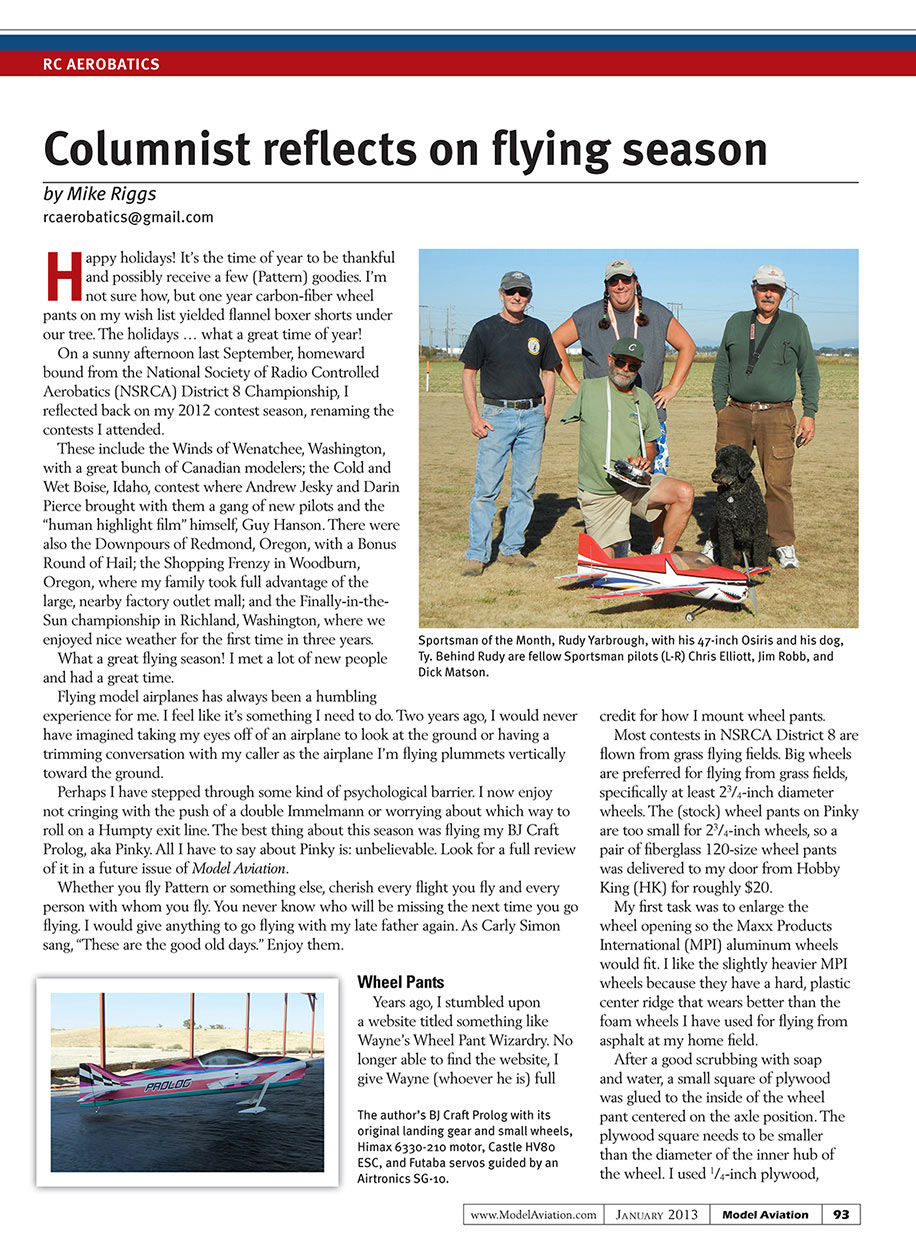
On a sunny afternoon last September, homeward bound from the National Society of Radio Controlled Aerobatics (NSRCA) District 8 Championship, I reflected back on my 2012 contest season, renaming the contests I attended.
These include the Winds of Wenatchee, Washington, with a great bunch of Canadian modelers; the Cold and Wet Boise, Idaho, contest where Andrew Jesky and Darin Pierce brought with them a gang of new pilots and the "human highlight film" himself, Guy Hanson. There were also the Downpours of Redmond, Oregon, with a Bonus Round of Hail; the Shopping Frenzy in Woodburn, Oregon, where my family took full advantage of the large, nearby factory outlet mall; and the Finally-in-the-Sun championship in Richland, Washington, where we enjoyed nice weather for the first time in three years.
What a great flying season! I met a lot of new people and had a great time.
Flying model airplanes has always been a humbling experience for me. I feel like it's something I need to do. Two years ago, I would never have imagined taking my eyes off of an airplane to look at the ground or having a trimming conversation with my caller as the airplane I'm flying plummets vertically toward the ground.
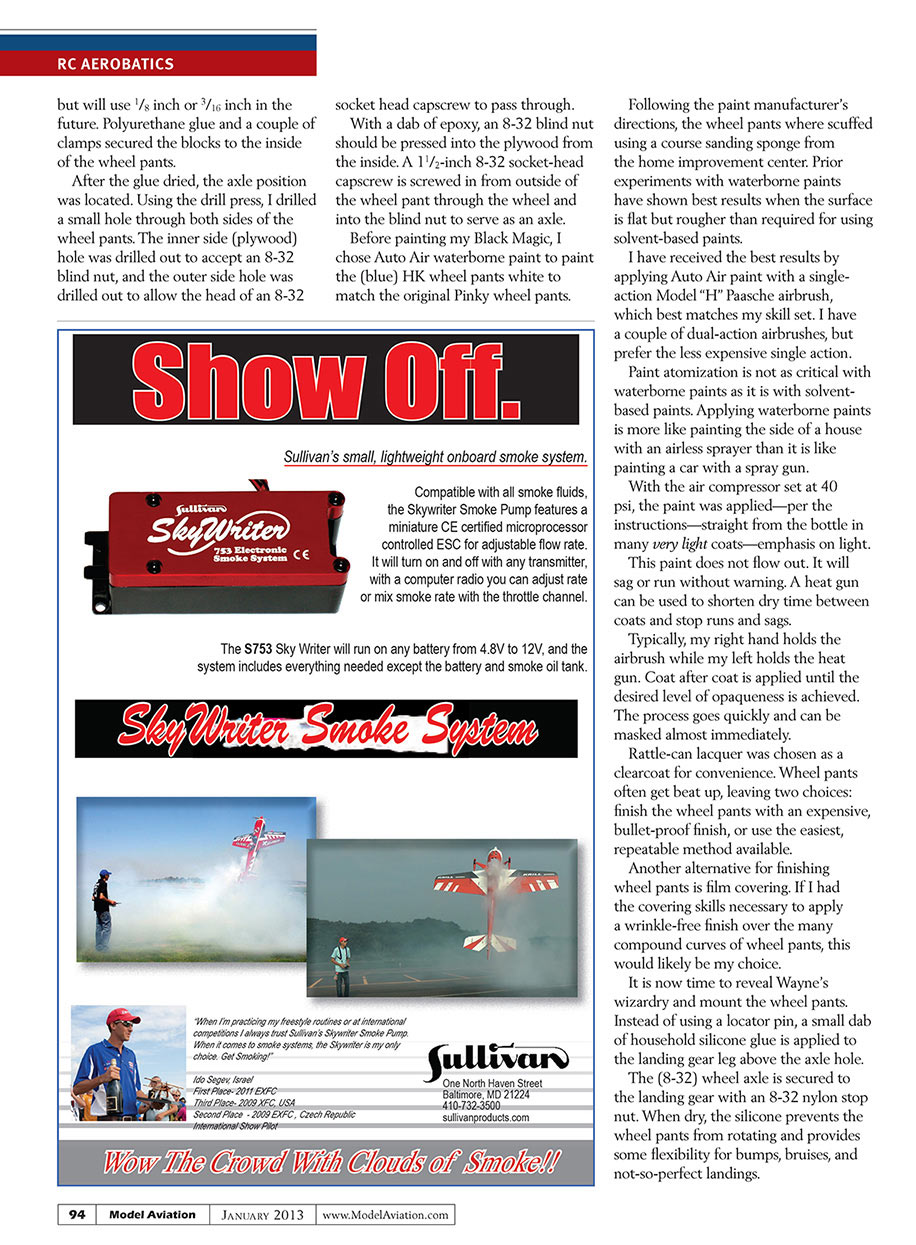
Perhaps I have stepped through some kind of psychological barrier. I now enjoy not cringing with the push of a double Immelmann or worrying about which way to roll on a Humpty exit line. The best thing about this season was flying my BJ Craft Prolog, aka Pinky. All I have to say about Pinky is: unbelievable. Look for a full review of it in a future issue of Model Aviation.
Whether you fly Pattern or something else, cherish every flight you fly and every person with whom you fly. You never know who will be missing the next time you go flying. I would give anything to go flying with my late father again. As Carly Simon sang, "These are the good old days." Enjoy them.
Wheel Pants
Years ago, I stumbled upon a website titled something like Wayne's Wheel Pant Wizardry. No longer able to find the website, I give Wayne (whoever he is) full credit for how I mount wheel pants.
Most contests in NSRCA District 8 are flown from grass flying fields. Big wheels are preferred for flying from grass fields, specifically at least 2 3/4-inch diameter wheels. The (stock) wheel pants on Pinky are too small for 2 3/4-inch wheels, so a pair of fiberglass 120-size wheel pants was delivered to my door from Hobby King (HK) for roughly $20.
My first task was to enlarge the wheel opening so the Maxx Products International (MPI) aluminum wheels would fit. I like the slightly heavier MPI wheels because they have a hard, plastic center ridge that wears better than the foam wheels I've used for flying from asphalt at my home field.
After a good scrubbing with soap and water, a small square of plywood was glued to the inside of the wheel pant centered on the axle position. The plywood square needs to be smaller than the diameter of the inner hub of the wheel. I used 1/4-inch plywood, but will use 1/8 inch or 3/16 inch in the future. Polyurethane glue and a couple of clamps secured the blocks to the inside of the wheel pants.
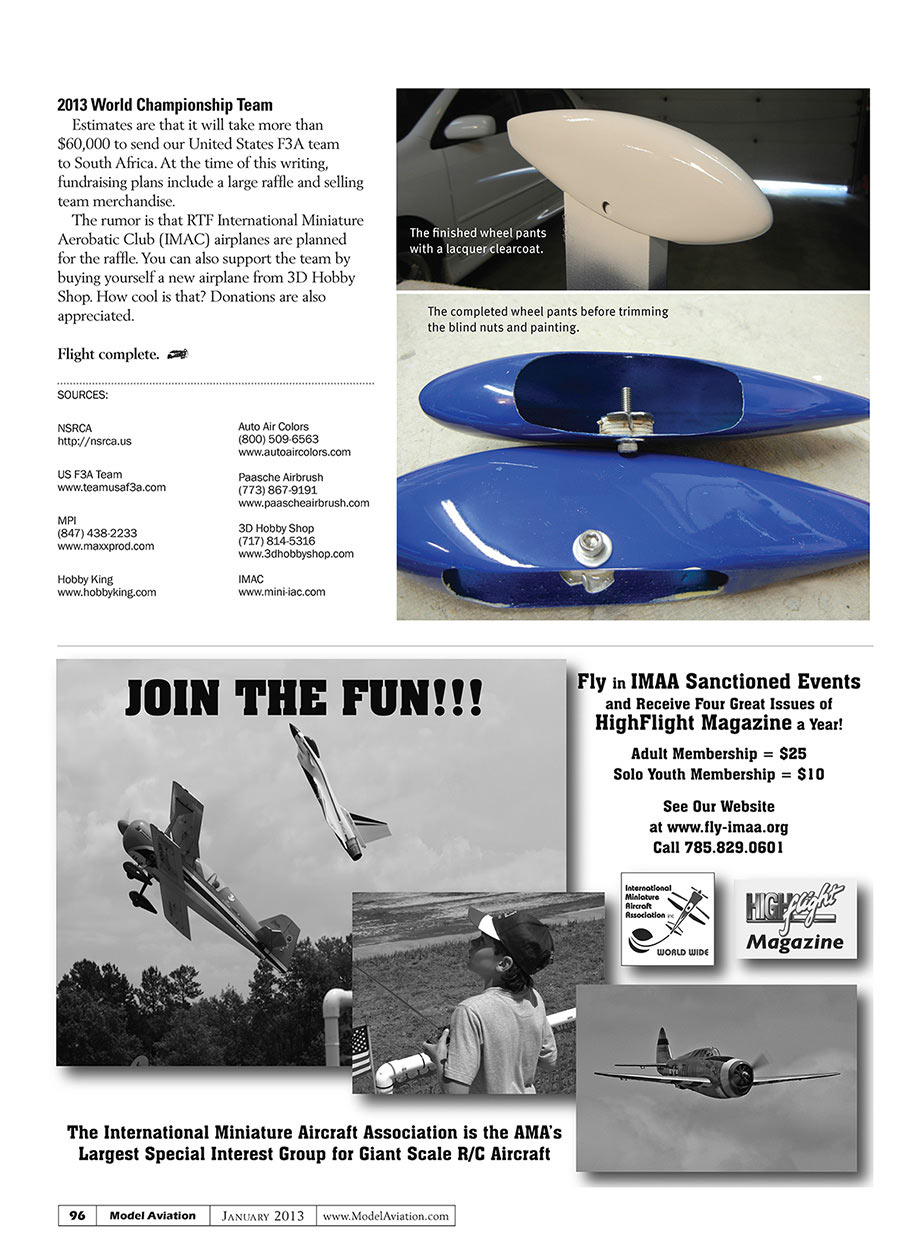
After the glue dried, the axle position was located. Using the drill press, I drilled a small hole through both sides of the wheel pants. The inner side (plywood) hole was drilled out to accept an 8-32 blind nut, and the outer side hole was drilled out to allow the head of an 8-32 socket head capscrew to pass through.
With a dab of epoxy, an 8-32 blind nut should be pressed into the plywood from the inside. A 1 1/2-inch 8-32 socket-head capscrew is screwed in from outside of the wheel pant through the wheel and into the blind nut to serve as an axle.
Before painting my Black Magic, I chose Auto Air waterborne paint to paint the (blue) HK wheel pants white to match the original Pinky wheel pants.
Following the paint manufacturer's directions, the wheel pants were scuffed using a coarse sanding sponge from the home improvement center. Prior experiments with waterborne paints have shown best results when the surface is flat but rougher than required for using solvent-based paints.
I have received the best results by applying Auto Air paint with a single-action Model "H" Paasche airbrush, which best matches my skill set. I have a couple of dual-action airbrushes, but prefer the less expensive single action.
Paint atomization is not as critical with waterborne paints as it is with solvent-based paints. Applying waterborne paints is more like painting the side of a house with an airless sprayer than it is like painting a car with a spray gun.
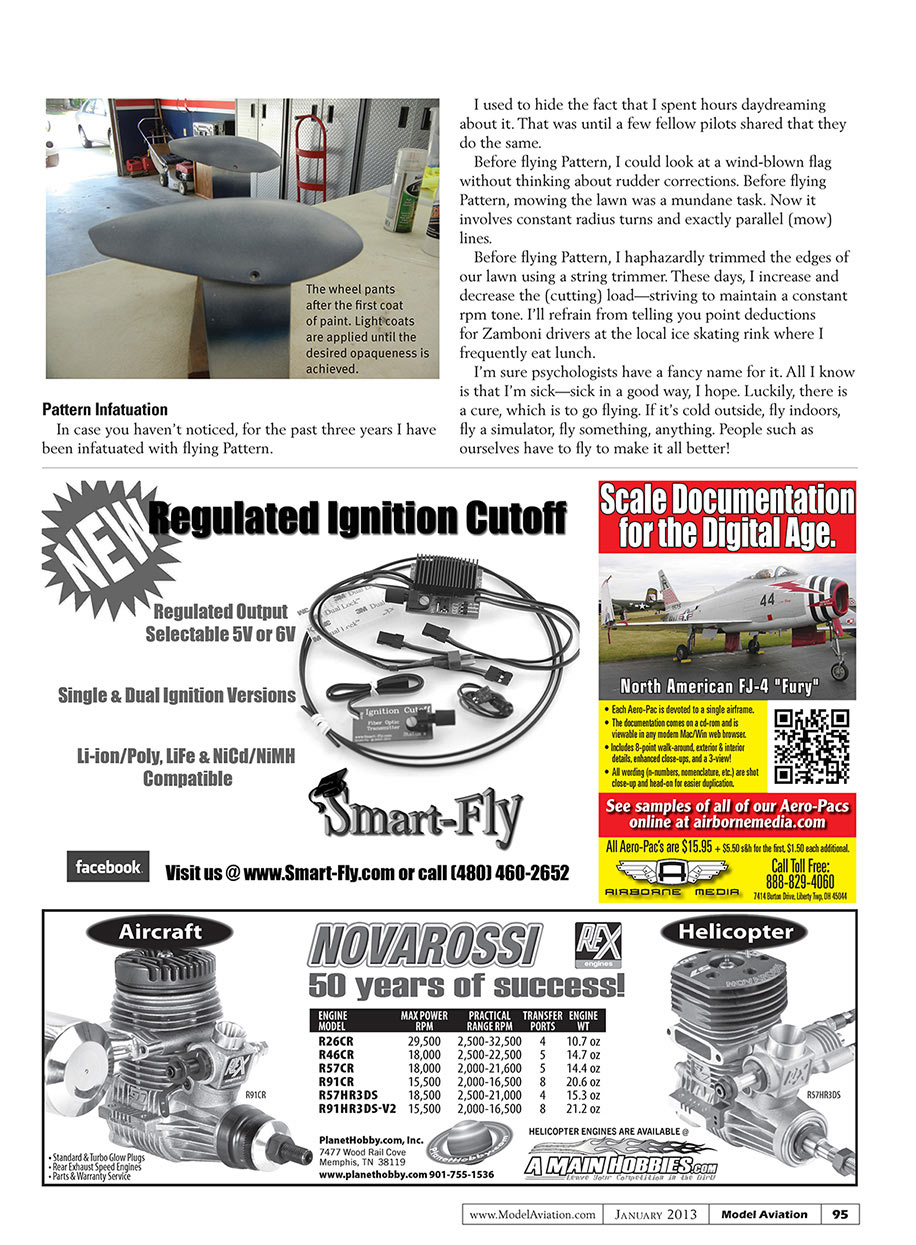
With the air compressor set at 40 psi, the paint was applied—per the instructions—straight from the bottle in many very light coats—emphasis on light. This paint does not flow out. It will sag or run without warning. A heat gun can be used to shorten dry time between coats and stop runs and sags.
Typically, my right hand holds the airbrush while my left holds the heat gun. Coat after coat is applied until the desired level of opaqueness is achieved. The process goes quickly and can be masked almost immediately.
Rattle-can lacquer was chosen as a clearcoat for convenience. Wheel pants often get beat up, leaving two choices: finish the wheel pants with an expensive, bullet-proof finish, or use the easiest, repeatable method available.
Another alternative for finishing wheel pants is film covering. If I had the covering skills necessary to apply a wrinkle-free finish over the many compound curves of wheel pants, this would likely be my choice.
It is now time to reveal Wayne's wizardry and mount the wheel pants. Instead of using a locator pin, a small dab of household silicone glue is applied to the landing gear leg above the axle hole. The (8-32) wheel axle is secured to the landing gear with an 8-32 nylon stop nut. When dry, the silicone prevents the wheel pants from rotating and provides some flexibility for bumps, bruises, and not-so-perfect landings.
I used to hide the fact that I spent hours daydreaming about it. That was until a few fellow pilots shared that they do the same.
Before flying Pattern, I could look at a wind-blown flag without thinking about rudder corrections. Before flying Pattern, mowing the lawn was a mundane task. Now it involves constant radius turns and exactly parallel (mow) lines.
Before flying Pattern, I haphazardly trimmed the edges of our lawn using a string trimmer. These days, I increase and decrease the (cutting) load—striving to maintain a constant rpm tone. I'll refrain from telling you point deductions for Zamboni drivers at the local ice skating rink where I frequently eat lunch.
I'm sure psychologists have a fancy name for it. All I know is that I'm sick—sick in a good way, I hope. Luckily, there is a cure, which is to go flying. If it's cold outside, fly indoors, fly a simulator, fly something, anything. People such as ourselves have to fly to make it all better!
RC Aerobatics
Mike Riggs
2013 World Championship Team
Estimates are that it will take more than $60,000 to send our United States F3A team to South Africa. At the time of this writing, fundraising plans include a large raffle and selling team merchandise.
The rumor is that RTF International Miniature Aerobatic Club (IMAC) airplanes are planned for the raffle. You can also support the team by buying yourself a new airplane from 3D Hobby Shop. How cool is that? Donations are also appreciated.
Flight complete.
SOURCES:
NSRCA http://nsrca.us
US F3A Team www.teamusaf3a.com
MPI (847) 438-2233 www.maxxprod.com
Hobby King www.hobbyking.com
Auto Air Colors (800) 509-6563 www.autoaircolors.com
Paasche Airbrush (773) 867-9191 www.paascheairbrush.com
3D Hobby Shop (717) 814-5316 www.3dhobbyshop.com
IMAC www.mini-iac.com
Transcribed from original scans by AI. Minor OCR errors may remain.

