
New practice regimen for the upcoming contest season
by Mike Riggs [email protected]
Contest season is about to begin. Bursting at the seams with excitement and anticipation of the upcoming season, I await. Yep, it's time to bring out the competition airplanes and show our stuff. Memorial Day weekend and the National Society of Radio Control Aerobatics (NSRCA) District 8 season opener in Wenatchee, Washington, are only a few weeks away.
The past building season was dark and cold. Instead of spending the winter months flying a simulator and indoor airplanes, I decided to brave the elements and continue flying outdoors. That worked out great until January brought daytime highs in the low teens.
Despite the bitter cold, a day job, holidays, and limited daylight hours, I managed to get in a few flights. Every day at the flying field during the winter was extra special.
Shedding winter clothes has already begun. Soon shorts and T-shirts will be the uniform of the day at the flying field.
Talk of flying brings a question to mind. How many flights do you average per flying session? Driving home from a contest last year, I contemplated why flying four rounds on Saturday was always so exhausting—fun, but exhausting. By the end of a typical four-round contest on a Saturday, I am spent. What can we do to minimize feeling so exhausted?
What I came up with is twofold: health and practice.
Health
- Sunscreen: We've heard it a hundred times. Put it on and keep it on.
- Water: No matter what the temperature is, always drink plenty of water.
- Eyes: Looking up into the sky, focusing on the relatively small moving objects we call airplanes, strains our eyes. Through some hand-me-down advice, I started using eyedrops before going flying.
Not being a doctor, all I can report is that the eye drops have at least given me the perception of relieving eye strain. I've been using my wife's Visine. I have been told that a product called Systane works even better and I plan to try it as soon as my wife runs out of Visine.
- Nutrition: Being a Type II diabetic means my blood sugar level is always on my mind. Contest lunches are generally served at the convenience of the contest, between rounds and not planned for a particular time.
In an effort to always fly my rounds with a healthy blood sugar level, I have gotten into the habit of eating something before each flight, roughly every hour to hour and a half. Typically, I eat an apple or a banana. A side benefit is I do not get as nervous as I used to, particularly when I lose the airplane's orientation.
Practice
- Three to four flights used to be a typical trip to the flying field for me. Add the stress of contest flying and it's no wonder I become so exhausted. Flying six flights during a typical, all-day trip to the flying field is my new regime. The idea is that more flights during practice will make flying fewer flights during a contest less exhausting.
Last fall, after the contest season, I began a six-flight regime when I started flying my Baby-O, a 47-inch Osiris, regularly. The first few six-flight sessions felt like a marathon, especially in the cold. It became normal after a while.
Whether changing health and practice habits helps contest performance remains to be seen. The real goal is to find ways to enjoy contest flying even more. It's just part of the reason that I'm so excited that the season is about to begin!
RC Aerobatics
Mike Riggs
Cheap Discharger
Taking six flights worth of charged packs to the field is convenient. Not hauling a smelly generator around is especially nice. My armada of chargers can charge six 4S Baby-O flight packs in roughly 30 minutes.
Charging six flights worth of 10S packs, which are typically used in two-meter Pattern airplanes, is different. Completing this Herculean charging task in a reasonable amount of time requires a substantial investment in power supplies, chargers, and batteries.
Pat Harris charges two strings of six 5S batteries in parallel at 30 amps. That works out to six 10S flight packs after roughly an hour's worth of charging. I envy Pat's no-generator routine!
My reality is that I have eight 5S packs from a variety of manufacturers, with varying degrees of use; some are old and some are fairly new. I generally replace two 5S packs every year.
For my particular mixed-pack situation, I am wary of parallel charging. Erring on the side of caution, I do not see myself charging newer and older packs with vastly different internal resistance (IR) levels together in parallel. I'll even toting my trusty generator around with all of its associated maintenance and smells, charging 5S packs in series as 10S.
When I arrive at the flying field, I first crank up the generator and begin continuously charging. This setup works great, except when it's time to go home and I have a fully charged pack, a three-quarter-charged pack, a couple of discharged packs, or similar. What's a person to do?
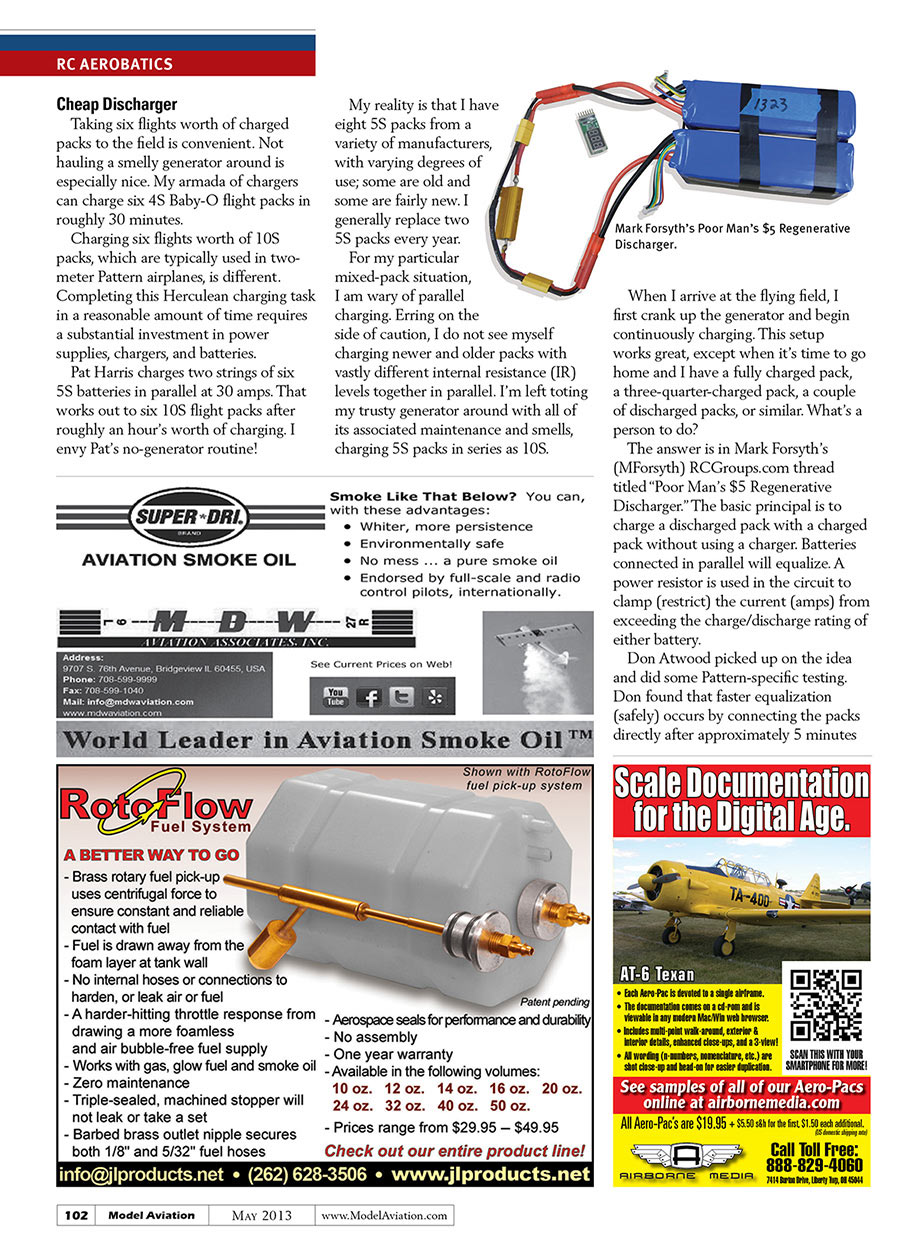
The answer is in Mark Forsyth's (MForsyth) RCGroups.com thread titled "Poor Man's $5 Regenerative Discharger." The basic principle is to charge a discharged pack with a charged pack without using a charger. Batteries connected in parallel will equalize. A power resistor is used in the circuit to clamp (restrict) the current (amps) from exceeding the charge/discharge rating of either battery.
Don Atwood picked up on the idea and did some Pattern-specific testing. Don found that faster equalization (safely) occurs by connecting the packs directly after approximately 5 minutes with the resistor in the circuit. A simple jumper with alligator clips can be used to bypass the resistor in the circuit.
Before trying regenerative discharge, I recommend that you read Mark's RCGroups.com thread and/or Don Atwood's NSRCA K-Factor newsletter column.
Sportsman of the Month
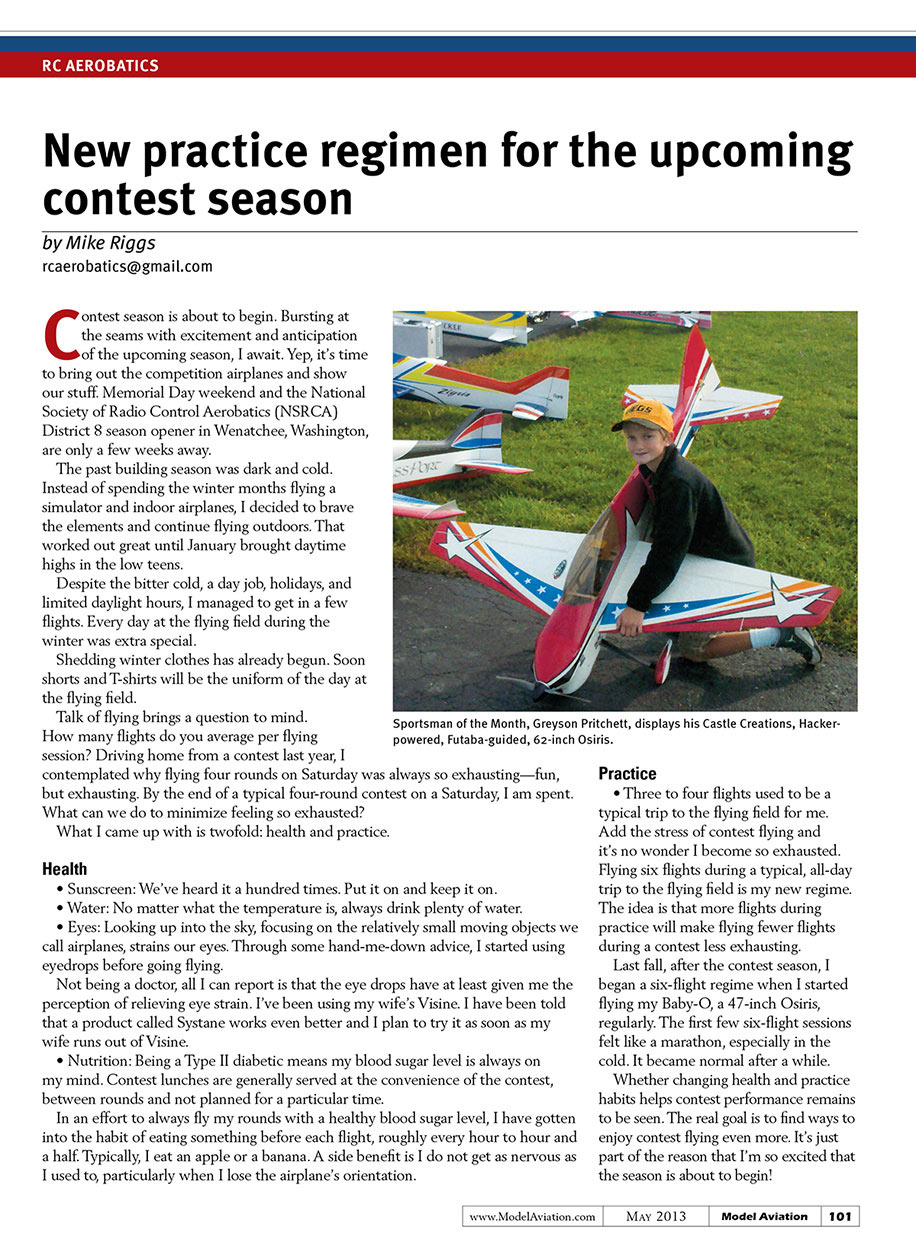
Flying in his first Pattern contest, 8-year-old Sportsman of the Month, Greyson Pritchett from Muncie, Indiana, won third place at the 2012 NSRCA District 4 Championship. Way to go, Greyson.
Help
My column could use more photographs from readers. Anything Pattern goes—kids, haulers, airplanes, etc. Pictures of fliers new to Pattern are preferred.
Shameless Self-Promotion
The Boise Area Radio Kontrol Society will be hosting its fourth annual Treasure Valley Pattern Contest, June 8-9, 2013, near Boise, Idaho. As CD, I offer my "Good Weather Guarantee" and hope to see you there.
January Follow-Up
The caption under January 2013 Sportsman of the Month, Rudy Yarbrough, had the names of Chris Elliott and Jim Robb reversed. My apologies to both.
Thanks to Don Ramsey for identifying Wayne Galligan as the source of Wayne's Wheel Pant Wizardry in the January 2013 column. Wayne wrote that his wheel pant mounting method is actually a culmination of several people's methods and ideas.
After making a few refinements, Bob Pastorello posted an illustration on his old website, which most likely is where I discovered the technique. Don Ramsey has a detailed illustration on his RC Pattern website.
Flight complete.
SOURCES:
- NSRCA
- Systane Eye Drops
(800) 862-5266 www.systane.com
- Don Ramsey's RC Pattern Site
[email protected] http://pages.suddenlink.net/donramsey
- Treasure Valley Pattern Contest
- RC Groups
Poor Man's $5 Regenerative Discharger www.rcgroups.com/forums/showthread.php?t=1255751
Transcribed from original scans by AI. Minor OCR errors may remain.

