
Wag your tail
by Mike Riggs [email protected]
My friend, "Right Rudder Rex," has said many times that contest flying will teach you more than several practice sessions. From those wise words, as pilots we should learn something from every contest: a golden nugget of knowledge.
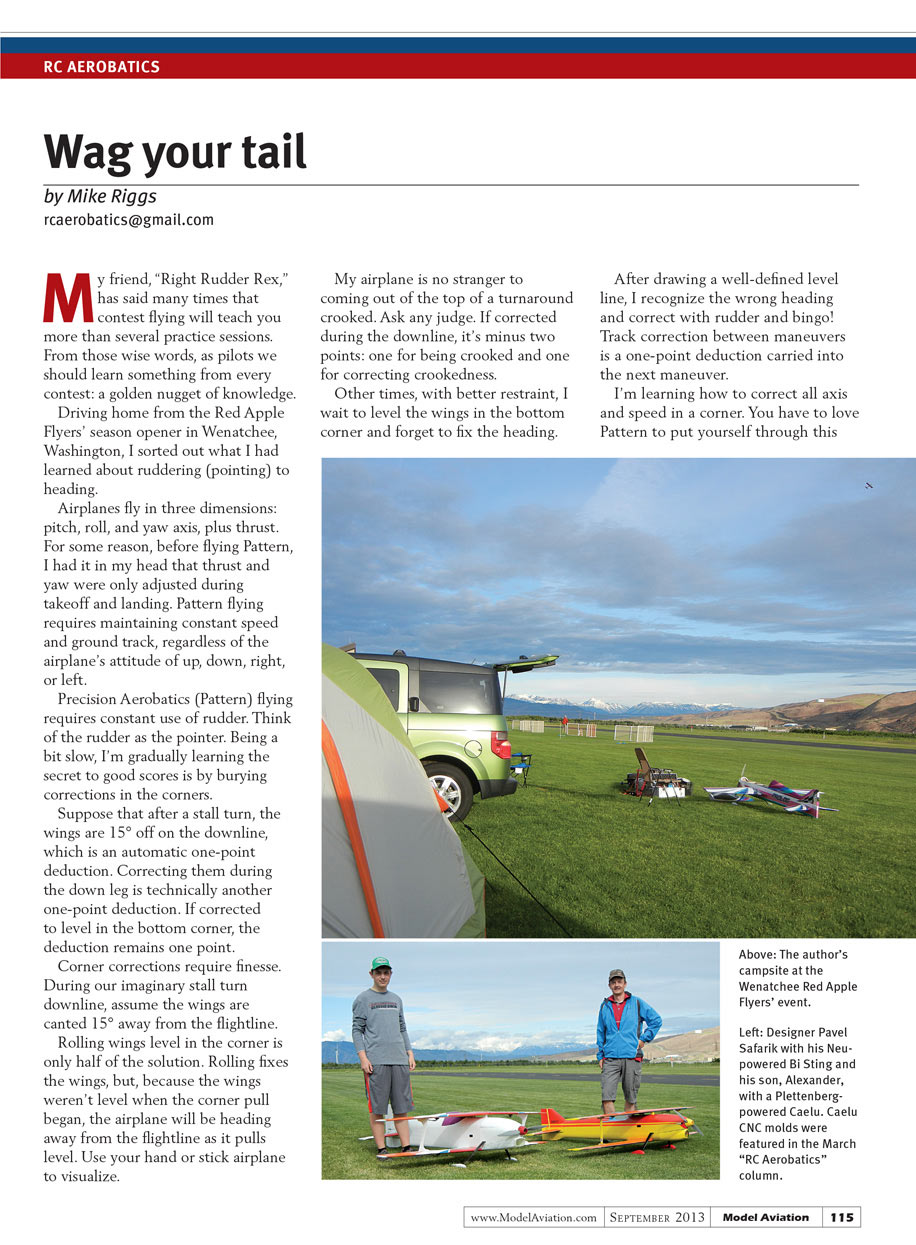
Driving home from the Red Apple Flyers' season opener in Wenatchee, Washington, I sorted out what I had learned about ruddering (pointing) to heading.
Airplanes fly in three dimensions: pitch, roll, and yaw axis, plus thrust. For some reason, before flying Pattern, I had it in my head that thrust and yaw were only adjusted during takeoff and landing. Pattern flying requires maintaining constant speed and ground track, regardless of the airplane's attitude of up, down, right, or left.
Precision Aerobatics (Pattern) flying requires constant use of rudder. Think of the rudder as the pointer. Being a bit slow, I'm gradually learning the secret to good scores is by burying corrections in the corners.
Suppose that after a stall turn, the wings are 15° off on the downline, which is an automatic one-point deduction. Correcting them during the down leg is technically another one-point deduction. If corrected to level in the bottom corner, the deduction remains one point.
Corner corrections require finesse. During our imaginary stall turn downline, assume the wings are canted 15° away from the flightline.
Rolling wings level in the corner is only half of the solution. Rolling fixes the wings, but, because the wings weren't level when the corner pull began, the airplane will be heading away from the flightline as it pulls level. Use your hand or stick airplane to visualize.
My airplane is no stranger to coming out of the top of a turnaround crooked. Ask any judge. If corrected during the downline, it's minus two points: one for being crooked and one for correcting crookedness.
Other times, with better restraint, I wait to level the wings in the bottom corner and forget to fix the heading.
After drawing a well-defined level line, I recognize the wrong heading and correct with rudder and bingo! Track correction between maneuvers is a one-point deduction carried into the next maneuver.
I'm learning how to correct all axis and speed in a corner. You have to love Pattern to put yourself through this.
Help someone flying the Sportsman schedule I covered in my July 2013 column?
The majority of the Sportsman schedule contains maneuvers with a loop segment. Only a few Sportsman maneuvers have 90° corners. The skidding technique I described works as well for looping maneuvers as it does for corner maneuvers. Loops are really a long corner.
Practice
Flying parallel to the runway, set up to perform a centered loop. Shortly before starting the pull, drop a wingtip 10° to 15°. What happens? It ends up being a loop laid on its side, correct?
Apply the rudder technique after pulling up as the wings are leveled, rudder to a heading, and establish a vertical track. Concentrate on keeping the wings level while adjusting heading for a vertical track. Try a few times going both directions and let me know how things work out.
You know you're a Pattern pilot when you think about this kind of stuff all of the time!
RC Aerobatics
Mike Riggs
Cool Your Motor
For a long time I thought of electric motors as having endless lifespans. What can wear out other than easily replaceable bearings? I was wrong. I know two people who replaced electric motors in Pattern airplanes this past spring because of sagging performance.
Eventually, through normal use and/or excessive heat, magnets lose their magnetism. The interaction between the motor can and motor rotor changes with time. As electric motors age, they tend to produce more heat and less power. A cooling fan can help preserve a motor.
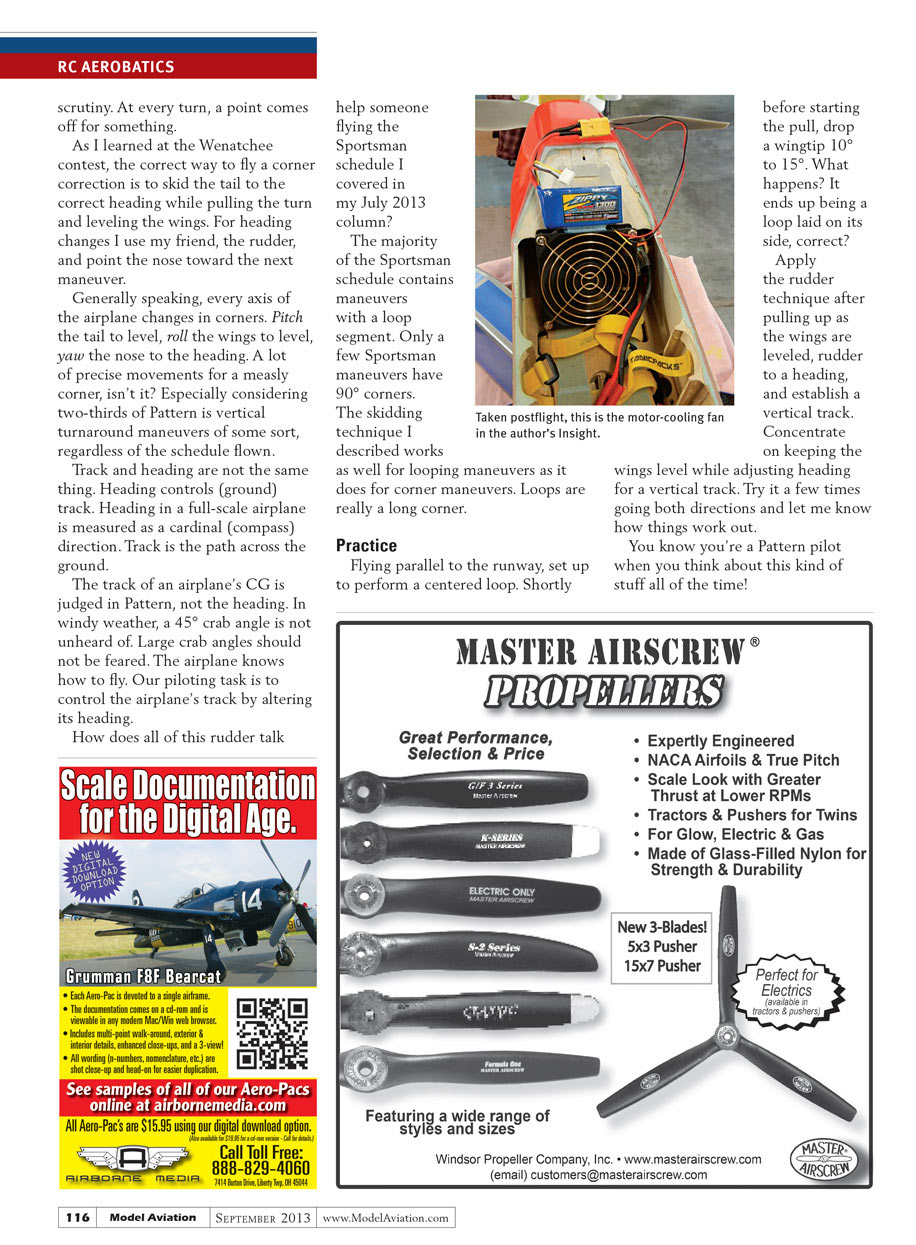
After flying, the temperature of a moderately warm motor will increase while resting. Why? The motor lacks air circulation. At a minimum, leave the hatch or canopy off. Position the airplane so air circulates around and through the motor.
Taking cooling a little further, I wired up a 3S LiPo battery used in a sailplane to an inexpensive 12-volt computer fan. Simple mathematics shows the 1,300 mAh battery has enough capacity to run the .3-amp-rated fan for more hours than a day is long. There is no need for a BEC.
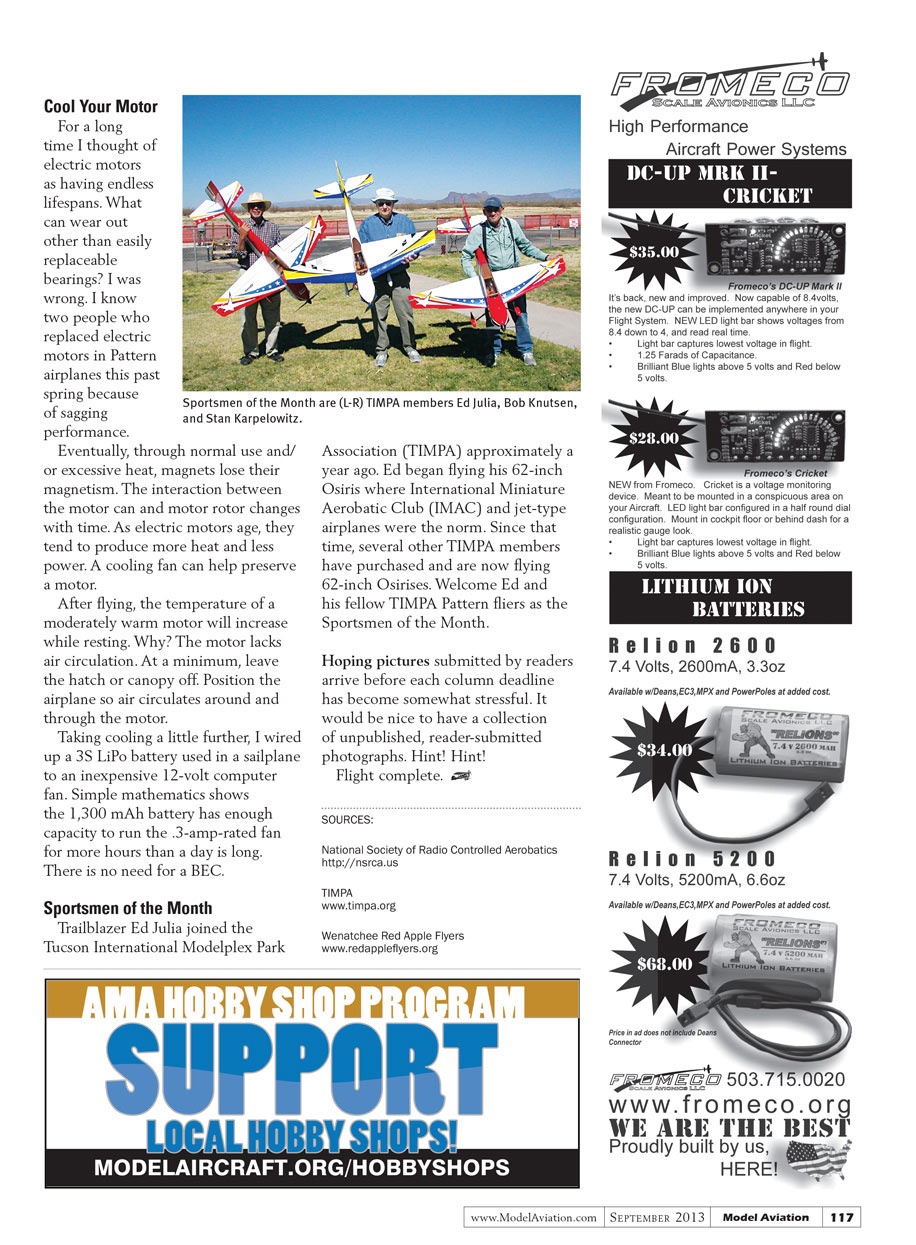
Hoping pictures submitted by readers arrive before each column deadline has become somewhat stressful. It would be nice to have a collection of unpublished, reader-submitted photographs. Hint! Hint!
Flight complete.
Transcribed from original scans by AI. Minor OCR errors may remain.

