
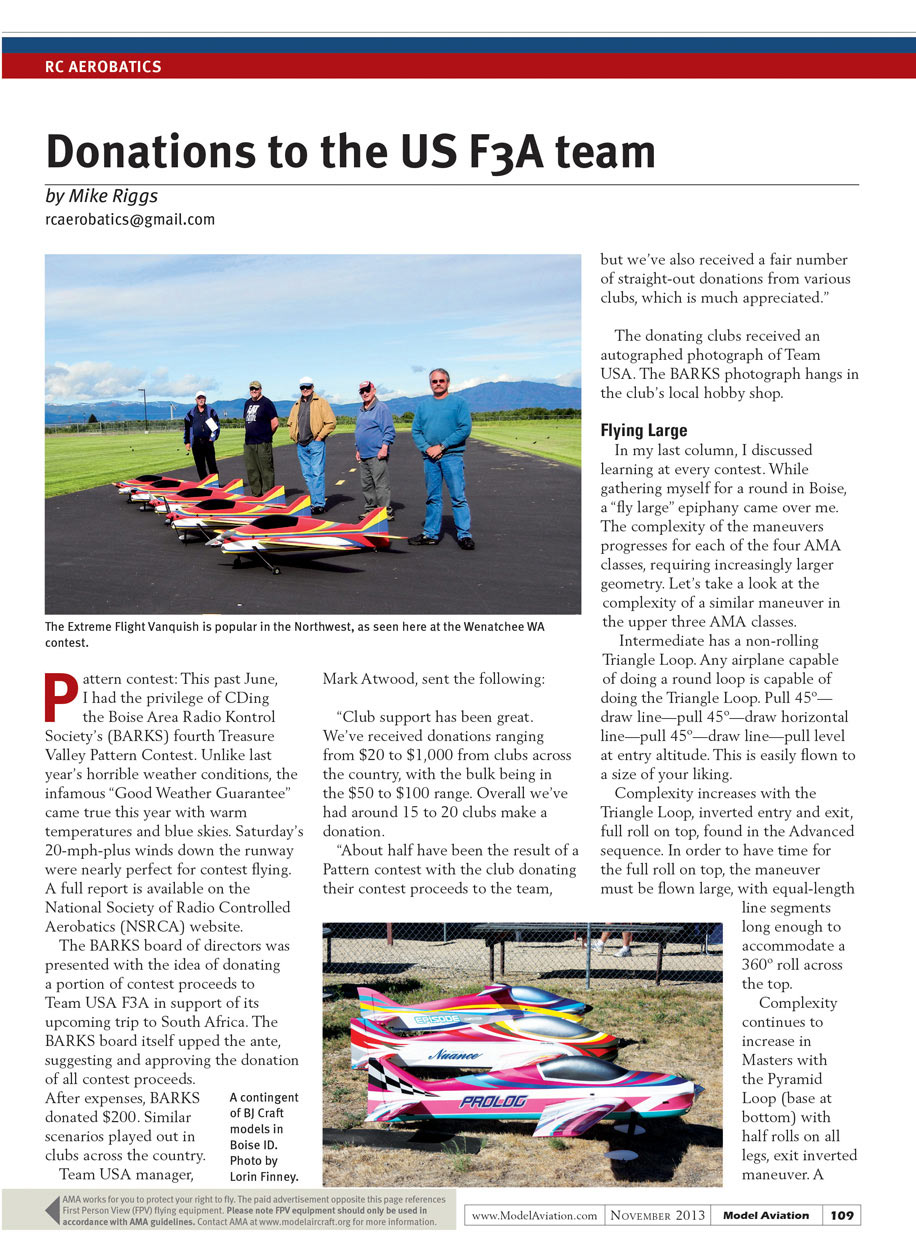
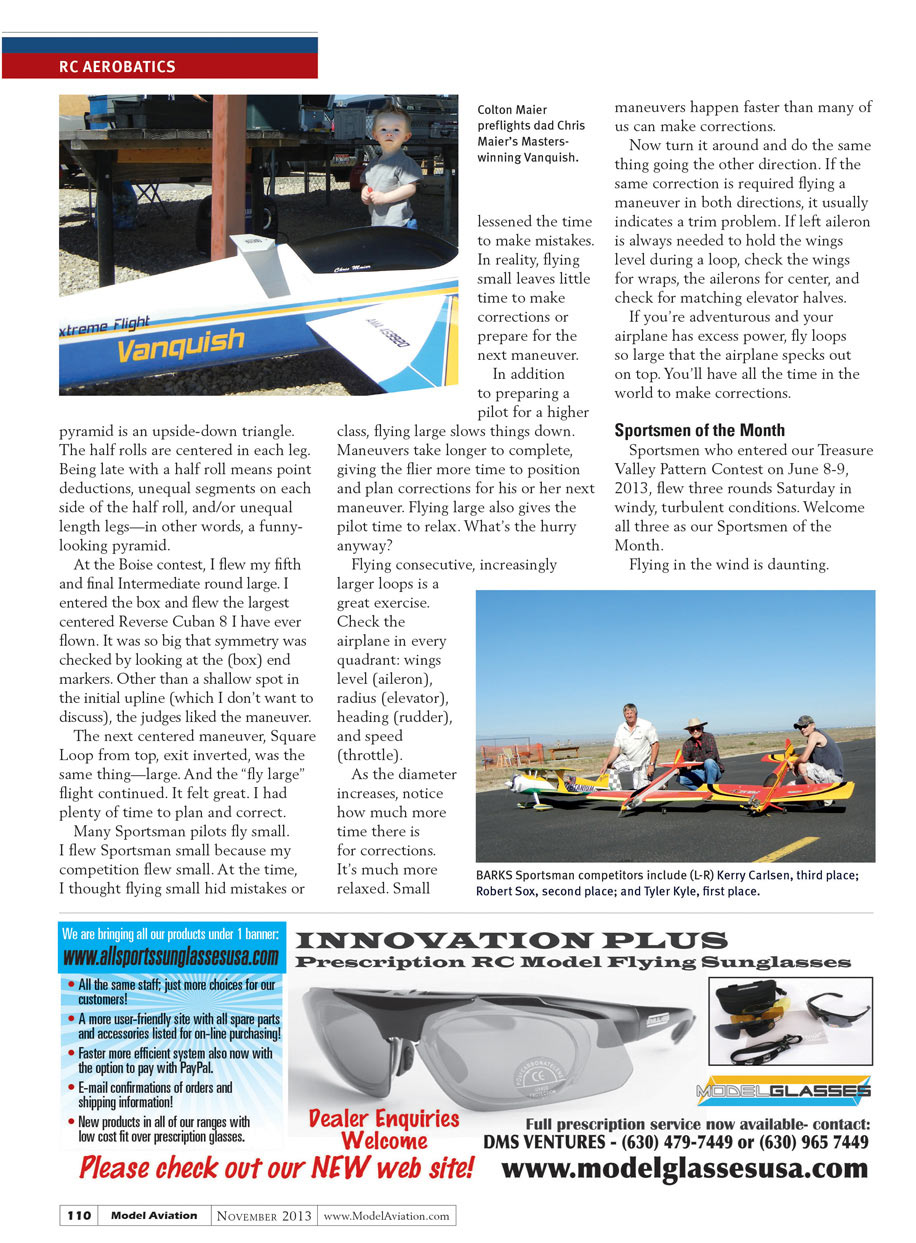
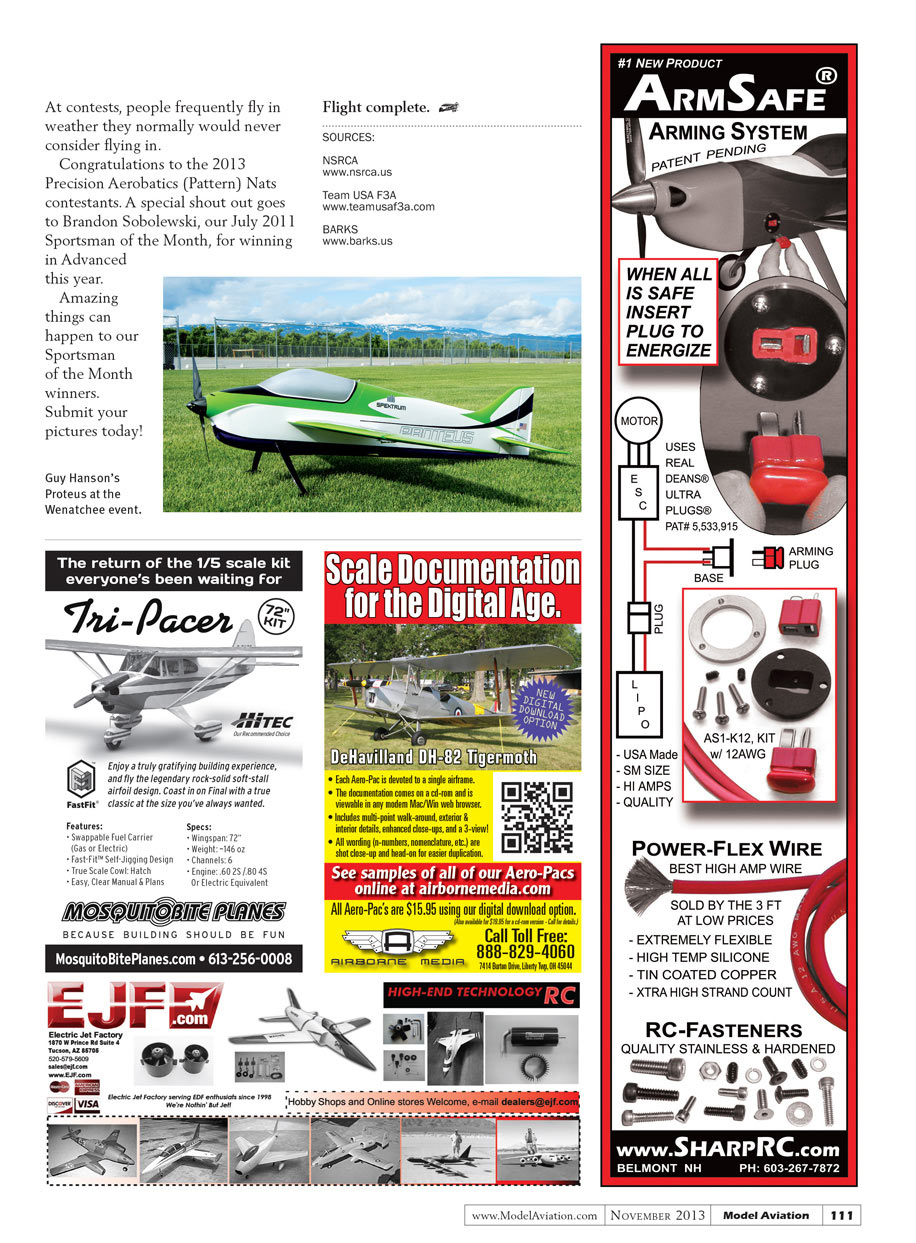
Donations to the US F3A team
by Mike Riggs [email protected]
Pattern contest: This past June, I had the privilege of CDing the Boise Area Radio Kontrol Society's (BARKS) fourth Treasure Valley Pattern Contest. Unlike last year's horrible weather conditions, the infamous "Good Weather Guarantee" came true this year with warm temperatures and blue skies. Saturday's 20-mph-plus winds down the runway were nearly perfect for contest flying. A full report is available on the National Society of Radio Controlled Aerobatics (NSRCA) website.
The BARKS board of directors was presented with the idea of donating a portion of contest proceeds to Team USA F3A in support of its upcoming trip to South Africa. The BARKS board itself upped the ante, suggesting and approving the donation of all contest proceeds. After expenses, BARKS donated $200. Similar scenarios played out in clubs across the country.
Team USA manager, Mark Atwood, sent the following:
"Club support has been great. We've received donations ranging from $20 to $1,000 from clubs across the country, with the bulk being in the $50 to $100 range. Overall we've had around 15 to 20 clubs make a donation.
"About half have been the result of a Pattern contest with the club donating their contest proceeds to the team, but we've also received a fair number of straight-out donations from various clubs, which is much appreciated."
The donating clubs received an autographed photograph of Team USA. The BARKS photograph hangs in the club's local hobby shop.
Flying Large
In my last column, I discussed learning at every contest. While gathering myself for a round in Boise, a "fly large" epiphany came over me. The complexity of the maneuvers progresses for each of the four AMA classes, requiring increasingly larger geometry. Let's take a look at the complexity of a similar maneuver in the upper three AMA classes.
Intermediate has a non-rolling Triangle Loop. Any airplane capable of doing a round loop is capable of doing the Triangle Loop. Pull 45°—draw line—pull 45°—draw horizontal line—pull 45°—draw line—pull level at entry altitude. This is easily flown to a size of your liking.
Complexity increases with the Triangle Loop, inverted entry and exit, full roll on top, found in the Advanced sequence. In order to have time for the full roll on top, the maneuver must be flown large, with equal-length line segments long enough to accommodate a 360° roll across the top.
Complexity continues to increase in Masters with the Pyramid Loop (base at bottom) with half rolls on all legs, exit inverted maneuver. A
RC Aerobatics
Mike Riggs
pyramid is an upside-down triangle. The half rolls are centered in each leg. Being late with a half roll means point deductions, unequal segments on each side of the half roll, and/or unequal length legs—in other words, a funny-looking pyramid.
At the Boise contest, I flew my fifth and final Intermediate round large. I entered the box and flew the largest centered Reverse Cuban 8 I have ever flown. It was so big that symmetry was checked by looking at the (box) end markers. Other than a shallow spot in the initial upline (which I don't want to discuss), the judges liked the maneuver.
The next centered maneuver, Square Loop from top, exit inverted, was the same thing—large. And the "fly large" flight continued. It felt great. I had plenty of time to plan and correct.
Many Sportsman pilots fly small. I flew Sportsman small because my competition flew small. At the time, I thought flying small hid mistakes or lessened the time to make mistakes. In reality, flying small leaves little time to make corrections or prepare for the next maneuver.
In addition to preparing a pilot for a higher class, flying large slows things down. Maneuvers take longer to complete, giving the flier more time to position and plan corrections for his or her next maneuver. Flying large also gives the pilot time to relax. What's the hurry anyway?
Flying consecutive, increasingly larger loops is a great exercise. Check the airplane in every quadrant: wings level (aileron), radius (elevator), heading (rudder), and speed (throttle).
As the diameter increases, notice how much more time there is for corrections. It's much more relaxed. Small maneuvers happen faster than many of us can make corrections.
Now turn it around and do the same thing going the other direction. If the same correction is required flying a maneuver in both directions, it usually indicates a trim problem. If left aileron is always needed to hold the wings level during a loop, check the wings for wraps, the ailerons for center, and check for matching elevator halves.
If you're adventurous and your airplane has excess power, fly loops so large that the airplane specks out on top. You'll have all the time in the world to make corrections.
Sportsmen of the Month
Sportsmen who entered our Treasure Valley Pattern Contest on June 8-9, 2013, flew three rounds Saturday in windy, turbulent conditions. Welcome all three as our Sportsmen of the Month.
Flying in the wind is daunting.
RC Aerobatics
Mike Riggs
At contests, people frequently fly in weather they normally would never consider flying in.
Congratulations to the 2013 Precision Aerobatics (Pattern) Nats contestants. A special shout out goes to Brandon Sobolewski, our July 2011 Sportsman of the Month, for winning in Advanced this year.
Amazing things can happen to our Sportsman of the Month winners. Submit your pictures today!
Flight complete.
SOURCES:
NSRCA www.nsrca.us
Team USA F3A www.teamusaf3a.com
BARKS www.barks.us
Transcribed from original scans by AI. Minor OCR errors may remain.

