
RADIO CONTROL AEROBATICS
Rick Allison, 26405 SE 160th St., Issaquah WA 98027
At some point in our competition careers, most of us will find ourselves functioning in the role of "coach" to another competitor.
Depending on our mental makeup and circumstances, we may happily volunteer for this task, be reluctantly co-opted for it, or just sigh and stumble into the situation because of the difficulty inherent in watching someone we like smack their thumb 37 times in a row with the hammer they are trying to fly.
By far, the most usual arrangement is for two Pattern-flying buddies to coach each other in a reciprocal sort of deal. This is an excellent system, provided the personalities, degree of commitment, and work ethics involved are a good match, and each is able to properly shift gears from "pilot" mode to "coach" mode.
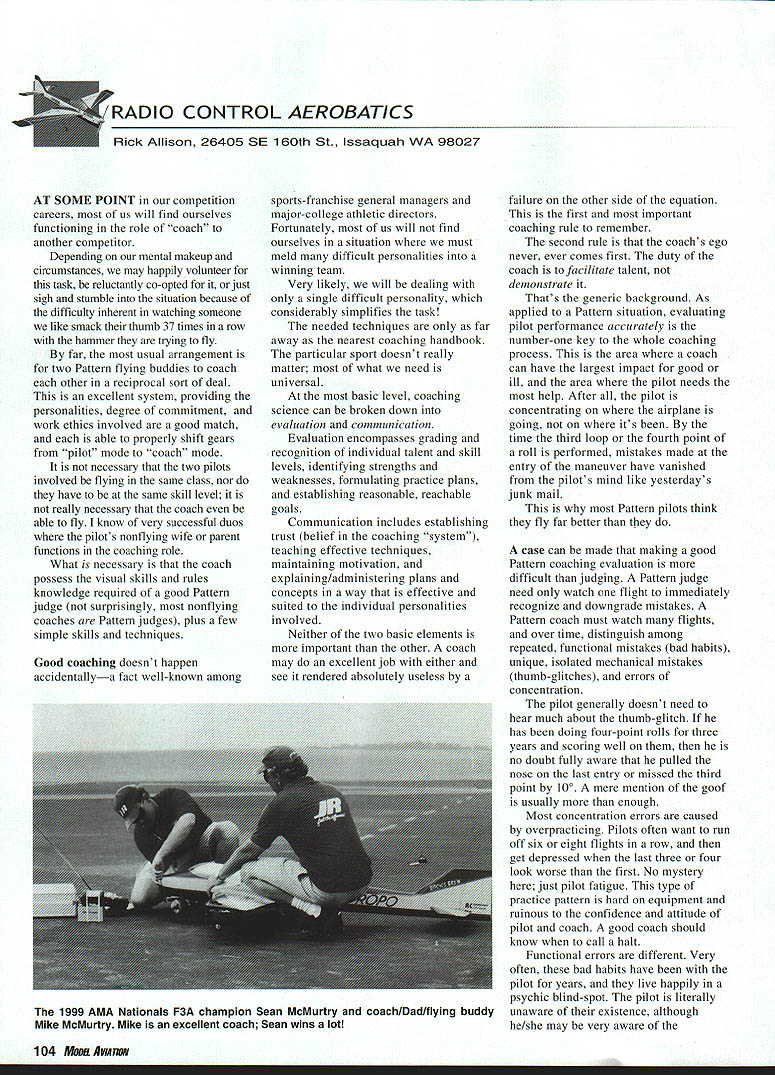
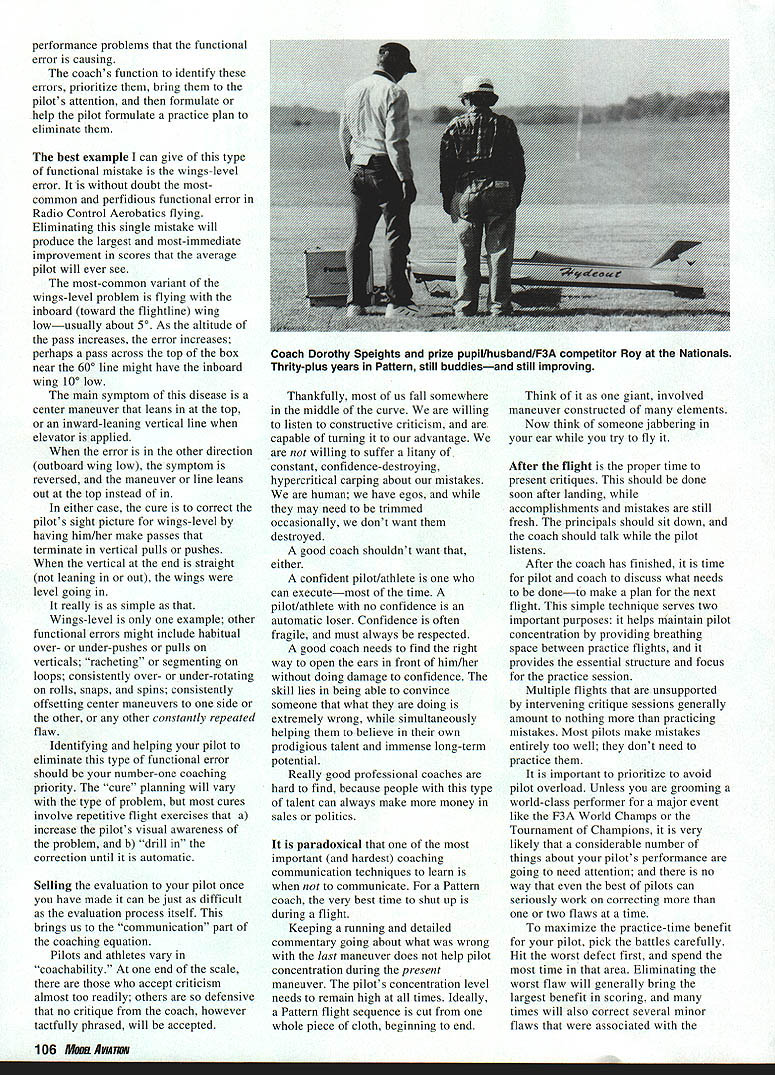
It is not necessary that the two pilots involved be flying in the same class, nor do they have to be at the same skill level; it is not really necessary that the coach even be able to fly. I know of very successful duos where the pilot's nonflying wife or parent functions in the coaching role.
What is necessary is that the coach possess the visual skills and rules knowledge required of a good Pattern judge (not surprisingly, most nonflying coaches are Pattern judges), plus a few simple skills and techniques.
Good coaching doesn't happen accidentally—a fact well-known among sports-franchise general managers and major-college athletic directors. Fortunately, most of us will not find ourselves in a situation where we must meld many difficult personalities into a winning team.
Very likely, we will be dealing with only a single difficult personality, which considerably simplifies the task!
The needed techniques are only as far away as the nearest coaching handbook. The particular sport doesn't really matter; most of what we need is universal.
The two fundamentals: evaluation and communication
At the most basic level, coaching science can be broken down into evaluation and communication.
Evaluation encompasses grading and recognition of individual talent and skill levels, identifying strengths and weaknesses, formulating practice plans, and establishing reasonable, reachable goals.
Communication includes establishing trust (belief in the coaching "system"), teaching effective techniques, maintaining motivation, and explaining/administering plans and concepts in a way that is effective and suited to the individual personalities involved.
Neither of the two basic elements is more important than the other. A coach may do an excellent job with either and see it rendered absolutely useless by a failure on the other side of the equation. This is the first and most important coaching rule to remember.
The second rule is that the coach's ego never, ever comes first. The duty of the coach is to facilitate talent, not demonstrate it.
Evaluation in Pattern coaching
As applied to a Pattern situation, evaluating pilot performance accurately is the number-one key to the whole coaching process. This is the area where a coach can have the largest impact for good or ill, and the area where the pilot needs the most help. After all, the pilot is concentrating on where the airplane is going, not on where it's been. By the time the third loop or the fourth point of a roll is performed, mistakes made at the time of the maneuver have vanished from the pilot's mind like yesterday's junk mail.
This is why most Pattern pilots think they fly far better than they do.
A case can be made that making a good Pattern coaching evaluation is more difficult than judging. A Pattern judge need only watch one flight to immediately recognize and downgrade mistakes. A Pattern coach must watch many flights, and over time, distinguish among repeated, functional mistakes (bad habits), unique, isolated mechanical mistakes (thumb-glitches), and errors of concentration.
The pilot generally doesn't need to hear much about the thumb-glitch. If he has been doing four-point rolls for three years and scoring well on them, then he is no doubt fully aware that he pulled the nose on the last entry or missed the third point by 10°. A mere mention of the goof is usually more than enough.
Most concentration errors are caused by overpracticing. Pilots often want to run off six or eight flights in a row, and then get depressed when the last three or four look worse than the first. No mystery here, just pilot fatigue. This type of practice pattern is hard on equipment and ruinous to the confidence and attitude of pilot and coach. A good coach should know when to call a halt.
Functional errors are different. Very often, these bad habits have been with the pilot for years, and they live happily in a psychic blind spot. The pilot is literally unaware of their existence, although he or she may be very aware of the performance problems that the functional error is causing.
The coach's function is to identify these errors, prioritize them, bring them to the pilot's attention, and then formulate or help the pilot formulate a practice plan to eliminate them.
The wings-level error
The best example I can give of this type of functional mistake is the wings-level error. It is without doubt the most-common and perfidious functional error in Radio Control Aerobatics flying. Eliminating this single mistake will produce the largest and most-immediate improvement in scores that the average pilot will ever see.
The most-common variant of the wings-level problem is flying with the inboard (toward the flightline) wing low—usually about 5°. As the altitude of the pass increases, the error increases; perhaps a pass across the top of the box rather than the 60° line might have the inboard wing 10° low.
The main symptom of this disease is a center maneuver that leans in at the top, or an inward-leaning vertical line when elevator is applied.
When the error is in the other direction (outboard wing low), the symptom is reversed, and the maneuver or line leans out at the top instead of in.
In either case, the cure is to correct the pilot's sight picture for wings-level by having him or her make passes that terminate in vertical pulls or pushes. When the vertical at the end is straight (not leaning in or out), the wings were level going in.
It really is as simple as that.
Wings-level is only one example; other functional errors might include:
- Habitual over- or under-pushes or pulls on verticals
- "Ratcheting" or segmenting on loops
- Consistently over- or under-rotating on rolls, snaps, and spins
- Consistently offsetting center maneuvers to one side or the other
- Any other constantly repeated flaw
Identifying and helping your pilot to eliminate this type of functional error should be your number-one coaching priority. The "cure" planning will vary with the type of problem, but most cures involve repetitive flight exercises that increase the pilot's visual awareness of the problem, and by "drill" in the correction until it is automatic.
Communication and coachability
Selling the evaluation to your pilot once you have made it can be just as difficult as the evaluation process itself. This brings us to the "communication" part of the coaching equation.
Pilots and athletes vary in "coachability." At one end of the scale, there are those who accept criticism almost too readily; others are so defensive that no critique from the coach, however tactfully phrased, will be accepted.
Thankfully, most of us fall somewhere in the middle of the curve. We are willing to listen to constructive criticism, and are capable of turning it to our advantage. We are not willing to suffer a litany of constant, confidence-destroying, hypercritical carping about our mistakes. We are human; we have egos, and while they may need to be trimmed occasionally, we don't want them destroyed.
A good coach shouldn't want that, either.
A confident pilot/athlete is one who can execute—most of the time. A pilot/athlete with no confidence is an automatic loser. Confidence is often fragile, and must always be respected.
A good coach needs to find the right way to open the ears in front of him or her without doing damage to confidence. The skill lies in being able to convince someone that what they are doing is extremely wrong, while simultaneously helping them to believe in their own prodigious talent and immense long-term potential.
Really good professional coaches are hard to find, because people with this type of talent can always make more money in sales or politics.
When not to talk
It is paradoxical that one of the most important (and hardest) coaching communication techniques to learn is when not to communicate. For a Pattern coach, the very best time to shut up is during a flight.
Keeping a running and detailed commentary going about what was wrong with the last maneuver does not help pilot concentration during the present maneuver. The pilot's concentration level needs to remain high at all times. Ideally, a Pattern flight sequence is cut from one whole piece of cloth, beginning to end.
Think of it as one giant, involved maneuver constructed of many elements.
Now think of someone jabbering in your ear while you're trying to fly it.
After the flight is the proper time to present critiques. This should be done soon after landing, while accomplishments and mistakes are still fresh. The principals should sit down, and the coach should talk while the pilot listens.
After the coach has finished, it is time for pilot and coach to discuss what needs to be done—make a plan for the next flight. This simple technique serves two important purposes: it helps maintain pilot concentration by providing breathing space between practice flights, and it provides the essential structure and focus for the practice sessions.
Multiple flights that are unsupported by intervening critique sessions generally amount to nothing more than practicing mistakes. Most pilots make mistakes entirely too well; they don't need to practice them.
Prioritizing practice
It is important to prioritize to avoid pilot overload. Unless you are grooming a world-class performer for a major event like the F3A World Champs or the Tournament of Champions, it is very likely that a considerable number of things about your pilot's performance are going to need correction; and there is no way that even the best of pilots can seriously work on correcting more than one or two flaws at a time.
To maximize the practice-time benefit for your pilot, pick the battles carefully. Hit the worst defect first, and spend the most time in that area. Eliminating the worst flaw will generally bring the largest benefit in scoring, and many times will also correct several minor flaws that were associated with the same defect.
Realize that building a functional Pattern pilot from a kit (human being, thumbs, transmitter, and associated small parts/organs) is a long-term project. Improvement is often a slow process. The coach and the pilot are liable to become frustrated at times with the pace of things. The difference is, the pilot may be able to occasionally vent a little of that frustration; the coach needs to remain calm and patient, for the good of the pilot. If you must bang your head, do it in private.
Expect two steps back for every three forward. There is an old saying in the coaching business: "Last learned; first forgotten." This means that whatever hurdle you think you got over on the last session will still be waiting to trip you on the next. It will, however, be slightly shorter.
The pilot/coach relationship is a little like a marriage. It does require something of a commitment. It absolutely will not work (and should never be entered into) without trust, mutual respect, cooperation, and a heaping measure of friendship on both sides. The last is probably the most necessary component; without it, the whole affair becomes an exercise in drudgery and futility.
When it does work as it should, the resulting shared success is very gratifying for pilot and coach. The rewards are definitely worth the effort. Most of the time, between good friends, even the effort is worth the effort.
Observe, evaluate, prioritize, plan, communicate, encourage, and execute. If it all sounds like it came right out of a football coach's handbook, well, maybe it did.
Now, get out there and help somebody win one for the Gipper!
MA
Transcribed from original scans by AI. Minor OCR errors may remain.

