
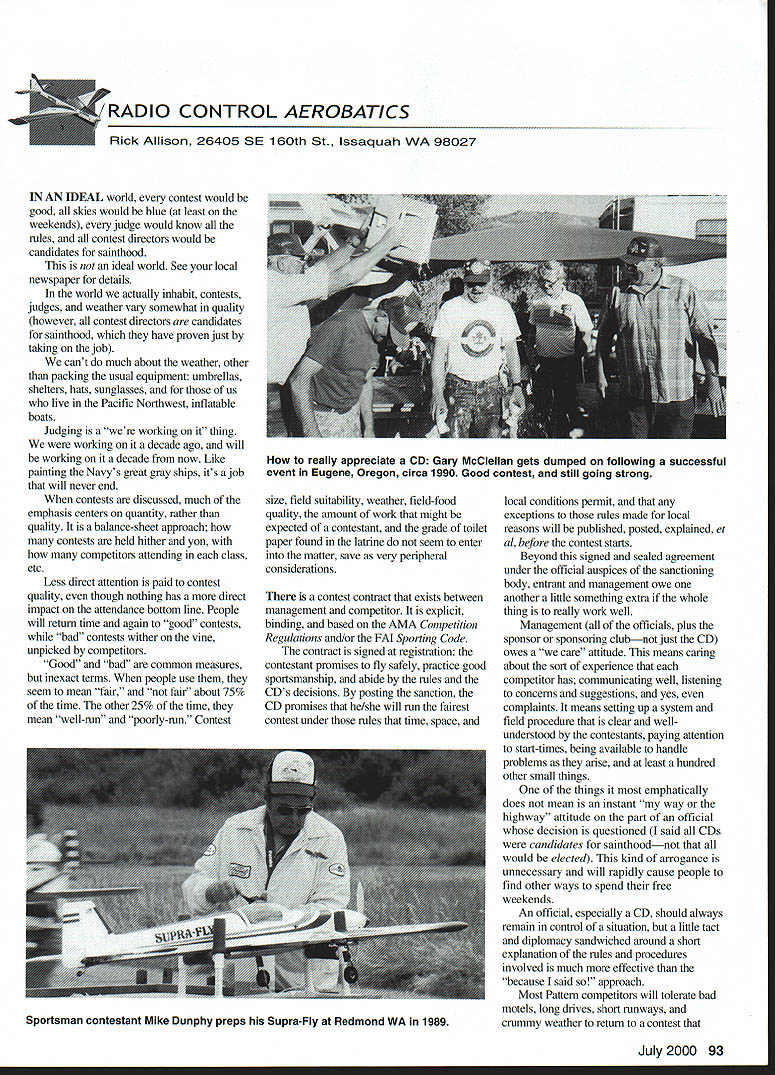
RADIO CONTROL AEROBATICS
Rick Allison, 26405 SE 160th St., Issaquah WA 98027
IN AN IDEAL world, every contest would be good, all skies would be blue (at least on the weekends), every judge would know all the rules, and all contest directors would be candidates for sainthood.
This is not an ideal world. See your local newspaper for details.
In the world we actually inhabit, contests, judges, and weather vary somewhat in quality (however, all contest directors are candidates for sainthood, which they have proven just by taking on the job).
We can't do much about the weather, other than packing the usual equipment: umbrellas, shelters, hats, sunglasses, and for those of us who live in the Pacific Northwest, inflatable boats.
Judging is a "we're working on it" thing. We were working on it a decade ago, and will be working on it a decade from now. Like painting the Navy's great gray ships, it's a job that will never end.
When contests are discussed, much of the emphasis centers on quantity, rather than quality. It is a balance-sheet approach: how many contests are held hither and yon, with how many competitors attending in each class, etc.
Less direct attention is paid to contest quality, even though nothing has a more direct impact on the attendance bottom line. People will return time and again to "good" contests, while "bad" contests wither on the vine, unpicked by competitors.
"Good" and "bad" are common measures, but inexact terms. When people use them, they seem to mean "fair," and "not fair" about 75% of the time. The other 25% of the time, they mean "well-run" and "poorly-run." Contest size, field suitability, weather, field-food quality, the amount of work that might be expected of a contestant, and the grade of toilet paper found in the latrine do not seem to enter into the matter, save as very peripheral considerations.
There is a contest contract that exists between management and competitor. It is explicit, binding, and based on the AMA Competition Regulations and/or the FAI Sporting Code.
The contract is signed at registration; the contestant promises to fly safely, practice good sportsmanship, and abide by the rules and the CD's decisions. By posting the sanction, the CD promises that he/she will run the fairest contest under those rules that time, space, and local conditions permit, and that any exceptions to those rules made for local reasons will be published, posted, explained, et al., before the contest starts.
Beyond this signed and sealed agreement under the official auspices of the sanctioning body, entrant and management owe one another a little something extra if the whole thing is to really work well.
Management (all of the officials, plus the sponsor or sponsoring club—not just the CD) owes a "we care" attitude. This means caring about the sort of experience that each competitor has: communication with, listening to concerns and suggestions, and yes, even complaints. It means setting up a system and a field procedure that is clear and well-understood by the contestants, paying attention to start-times, being available to handle problems as they arise, and at least a hundred other small things.
One of the things it most emphatically does not mean is an instant "my way or the highway" attitude on the part of an official whose decision is questioned (I said all CDs were candidates for sainthood—not that all would be elected). This kind of arrogance is unnecessary and will rapidly cause people to find other ways to spend their free weekends.
An official, especially a CD, should always remain in control of a situation, but a little tact and diplomacy sandwiched around a short explanation of the rules and procedures involved is much more effective than the "because I said so" approach.
Most Pattern competitors will tolerate bad motels, long drives, short runways, and crummy weather to return to a contest that they thought was fair, but a couple of experiences with an arrogant official who ignores the rules in favor of his own opinion, or an apathetic contest crew with a "who cares?" attitude will disperse them faster than a tear-gas canister.
Once gone, they tend to stay gone. Blue skies, great field food, parties, barbecues, and a beautiful flying site won't bring them back. Even worse, they usually tell their friends about all the fun they didn't have.
On the other side of the fence, a contestant, besides basic good sportsmanship, owes contest management the benefit of the doubt. In these days of few officials and many contestants, he or she should also expect to help out when asked.
There are many ways and styles of staffing and running a contest, and most of them can work well. Things may have been done differently where you last flew; but that doesn't mean that they were done better.
The Laws of Contests
- The First Law is that contests must always be as fair as possible.
- The Second Law is that contests must be fun. Otherwise, there is no point in their existence.
- The Third Law is that the First Law is always paramount, even when it seems to conflict with the Second Law.
The reason for the absolute ascendancy of the First Law over the Second Law should be obvious. Fairness makes fun possible, and the lack of fairness makes fun almost impossible to come by.
In this society, the idea of fair and equal justice is an integral part of our consciousness; embedded in the structure of our language, taught in our schools and churches, and constantly reinforced by our popular culture in the form of books, songs, and TV shows. Long before we are adults, any injustice, either perceived or real, provokes instant righteous anger within us. We just can't help it, no matter how many times we stop and remind ourselves that life isn't always fair.
Conflict sometimes occurs because a contest functions as much as a social event as a competition event. You often hear "We're just here to have fun," or "this is supposed to be a good time, right?" at an event. This is the sound of intensely competitive people who are reminding themselves not to take it too seriously; that this is a competition among friends, not a war to the death; and that minor injustices should be overlooked and forgotten in the spirit of good sportsmanship.
This is very, very human, and the soul of that contract I mentioned.
Management's primary function is to keep injustices and even the appearance of injustices from occurring. The competitor's job is to overlook them when they inevitably happen. It's difficult to say who has the harder task.
It does amuse me to watch a person's attitude toward contest officials change after they become a Contest Director and run a few contests themselves. They become a little slower to criticize, and a lot faster to empathize.
The Contest Director job is tough and high-pressure, and as a contestant, you should realize that person probably isn't having as much fun as you are. The CD has to take care of the First Law mostly alone, but your own personal attitude can help a lot with seeing that the Second Law is obeyed by those around you.
You will always hear about the extraordinarily bad or extraordinarily good events, but most contests, like most contestants, fall somewhere in between. Most often, the events you attend will be as bad or as good as you make them.
The party most responsible for the contest experience you have is you, so get out there and have some fun. While you're at it, remember to be fair to that CD. The chances are excellent that the CD is trying very hard to be fair to you.
Since 1987, I've been writing a Pattern aerobatics column somewhere, every single month. First in the K-Factor (the newsletter of the National Society of Radio Controlled Aerobatics), then in the now-defunct Model Builder magazine, and then in this wonderful publication of ours, Model Aviation.
In case you are interested, that adds up to well in excess of 160 columns and roughly 400,000 words on the single, limited subject of Pattern aerobatics. For purposes of comparison, the average novel is roughly 75,000 words.
In that time I've written about the technical side of Pattern models, the psychological aspects of Pattern flying, Pattern practice strategies, and Pattern design, trimming, building, judging, coaching, calling, and rules. I've expounded at great length (some say too great length) on the philosophy of competition. On occasion, I've ventured to delve into the history of Pattern, and—silly me—even predict the future of Pattern.
I've looked at Pattern humorously, quizzically, pedantically, and sometimes almost microscopically (I once wrote an entire column on transmitter stick lengths and spring tensions).
I've related Pattern to subjects as diverse as sport, meditation, politics, and artistic perspective.
I've produced semi-scholarly treatises on pitch stability and propeller theory, I’ve covered setup, teardown, contest preparation, maintenance, color schemes, and slop-free control systems.
Enough already. I've told you everything I know about Pattern. In some cases, where I thought it important, I've told you several times over. I've tried to be educational, useful, honest about the issues of the day, and entertaining.
It's time to exit, stage right, before I'm reduced to churning out columns on the proper use of neck-strap adjustments, stunning new techniques for cleaning the grit out of tail wheel fittings, or the psychological implications of transmitter-tray dependency.
There will be a new columnist in this space next month, and we are all in his debt. I will not be idle. I have no doubt that whoever inherits this privilege will give you their monthly best, and I hope that you will support them as you have supported me.
I won't be totally disappearing from these pages. The current plan is to contribute occasional features of "general modeling interest"—a term that considerably expands the subject matter available—and perhaps do a little event coverage. I'm looking forward to it.
Editor's note
Our thanks to Rick for a job well done during his time as columnist and feature writer. Although he will no longer be writing this column, you will see plenty of his work in future issues.
Eric Hendrickson will begin a three-column trial in the "R/C Aerobatics" chair in the August issue. Reader reaction will play a large part in determining the temporary or permanent nature of this assignment. MA
Transcribed from original scans by AI. Minor OCR errors may remain.

