
RC Combat
Greg Rose, 1312 NW 196th St., Edmond OK 73003
I'll start by correcting an error from the last column. I take pride in the fact that I can tell the difference between a Zero and an Oscar, and I've never mistaken a Mustang for a Messerschmitt.
But I admit that I misidentified a ComBat as a Bat Trick in the December issue. In my defense, there are more than a few similarities between the two.
They both use a child's plastic baseball bat as a fuselage, they both have foam wings that sit on a cradle in somewhat of a parasol wing fashion, and they both have Coroplast™ tail feathers.
The important thing about both designs is how well the child's Wiffle-ball bat works as a Combat-model fuselage.
It is incredibly tough and more likely to bend under load than break. A round fuel tank fits inside like a (tight) glove, and even the cutouts for the servos don't seem to weaken the basic structure very much.
The only failure I saw on either of the designs at the Nationals (Nats) was when a rapid deceleration (similar to what happens when you fly straight into the ground, for instance) allowed the rubber bands holding the wings on to bend the bat fuselage into a U-shaped tube that would never fly again.
A week after the Nats I borrowed Scott Anderson's ComBat model for an impromptu round of Combat. (It turned out to be one round because I promptly smacked the borrowed model into another of Scott's ComBats. He got to watch as two of his models plummeted to the ground. What is that saying about letting no good deed go unpunished?)
Scott pointed out the differences between the two designs. The obvious one is the Bat Trick's longer-span, higher-aspect-ratio, tapered wings compared to the ComBat's stubbier constant-chord wing.
Strictly speaking, this difference should be enough to tell the two apart, but since wing and wing designs are so easy to interchange in Open Combat, you may not be able to depend on this difference alone.
The vertical stabilizer designs can also vary greatly from airplane to airplane, so you can't count on them to help you distinguish which is which. The real difference is in the elevator.
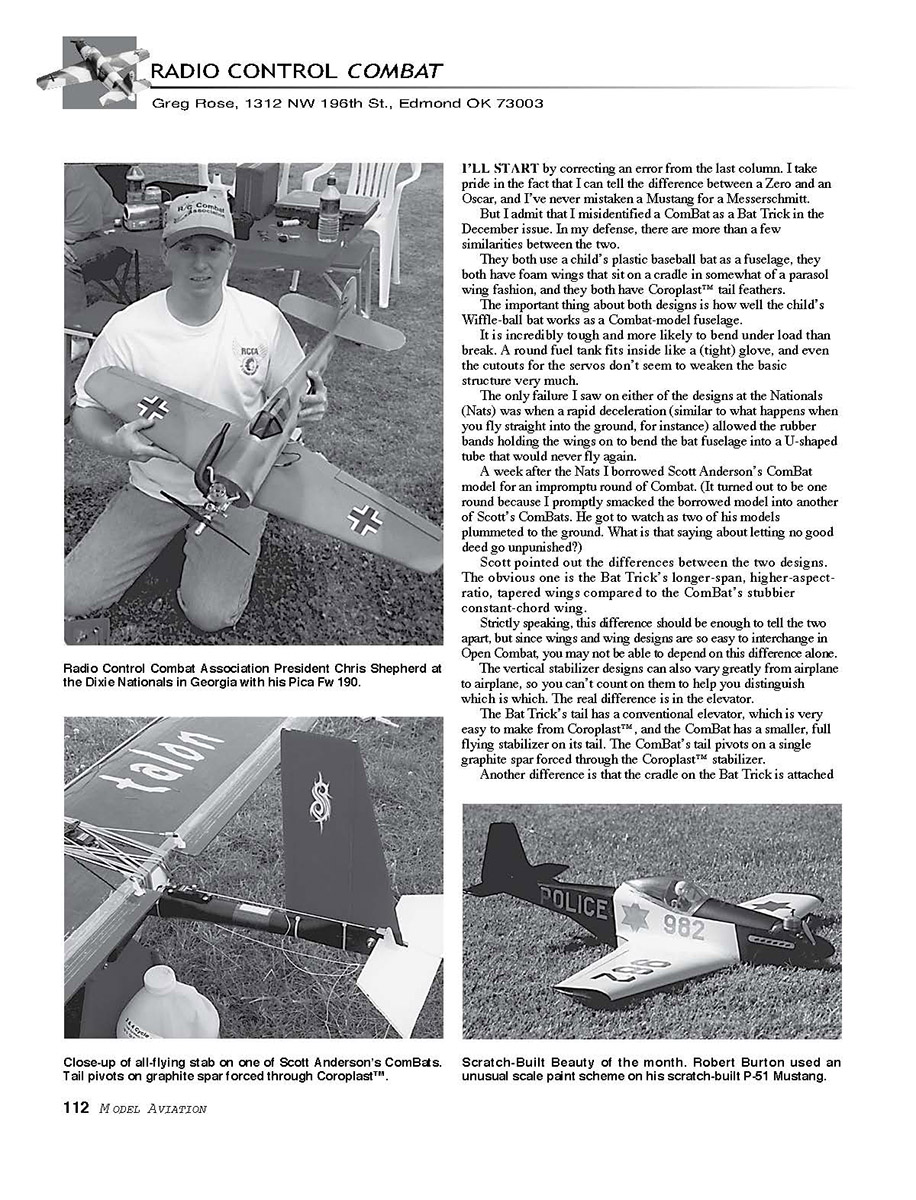
The Bat Trick's tail has a conventional elevator, which is very easy to make from Coroplast™, and the ComBat has a smaller, full flying stabilizer on its tail. The ComBat's tail pivots on a single graphite spar forced through the Coroplast™ stabilizer.
Another difference is that the cradle on the Bat Trick is attached
Transcribed from original scans by AI. Minor OCR errors may remain.

