
Sticky alternative and Gnat Combat
by Don Grissom [email protected]
Once again, it is nearly time to get started with another year of Combat, although for some, the Combat season will start early with contests in Florida and other warmer states. I checked my airplanes from last year and although I lost a few, I did well keeping my airplanes ready to go.
One issue I had was not checking the batteries and I had some go bad during the winter months. It is always a good idea to take care of your batteries. It could be many months before you fly again.
I left the airplane on, which ran the battery completely down and damaged it. This was a case of quickly putting everything away and not looking at it again for quite a while.
Another issue that I have had is not storing the airplanes correctly. I’ve left fuel in them and neglected putting after-run oil in the engines. A few years ago at the Nats, I noticed that Scott Gilkey did this before he put each of his airplanes away. It is important to make sure that the airplanes are ready to go, because it can be months between flying.
Tread Tape
A few months ago I discussed using tread tape on the wing’s LE and how it eliminated messy Tanglefoot and other sticky options. One issue that did not show up until the Nats was the amount of damage the tape did to other airplanes—as well as people—if they happen to get hit by the tape. We were then in its trial period, but the RC Combat Association (RCCA) has since ruled that tread tape will not be allowed because of safety concerns.
Another option is carpet tape, which you can get at home improvement stores. Some of the carpet tapes do not work well, but one of the best is sold by Home Depot as RhinoGrip Indoor Acrylic Carpet Tape.
One problem with the tape during a contest is you have to reapply it many times because grass and other debris will get stuck to it. It is a good idea to use blue painter’s tape on the LE before you apply the carpet tape so that you can clean the wing at the end of the day.
Gnat Combat
Earlier this year, Bob Loescher and William Drumm III started talking about another type of Combat they were working on, employing airplanes that are easy to build using simple tools that most pilots have. Everyone would have the same airplane and there would be no distinct advantage.
The event is called Gnat, and here is some information that William sent me, as well as a report from his October 2012 contest, which included some rounds of Gnat Combat.
“RC Combat has been on the decline. To help get the ARF generation into flying Combat, we need a class that is simple and inexpensive to build and maintain.
“Gnat Combat has been flown by clubs across the nation for years because it is cheap, easy to build, and a whole lot of fun. Nothing like having a plane that can cut its own streamer!
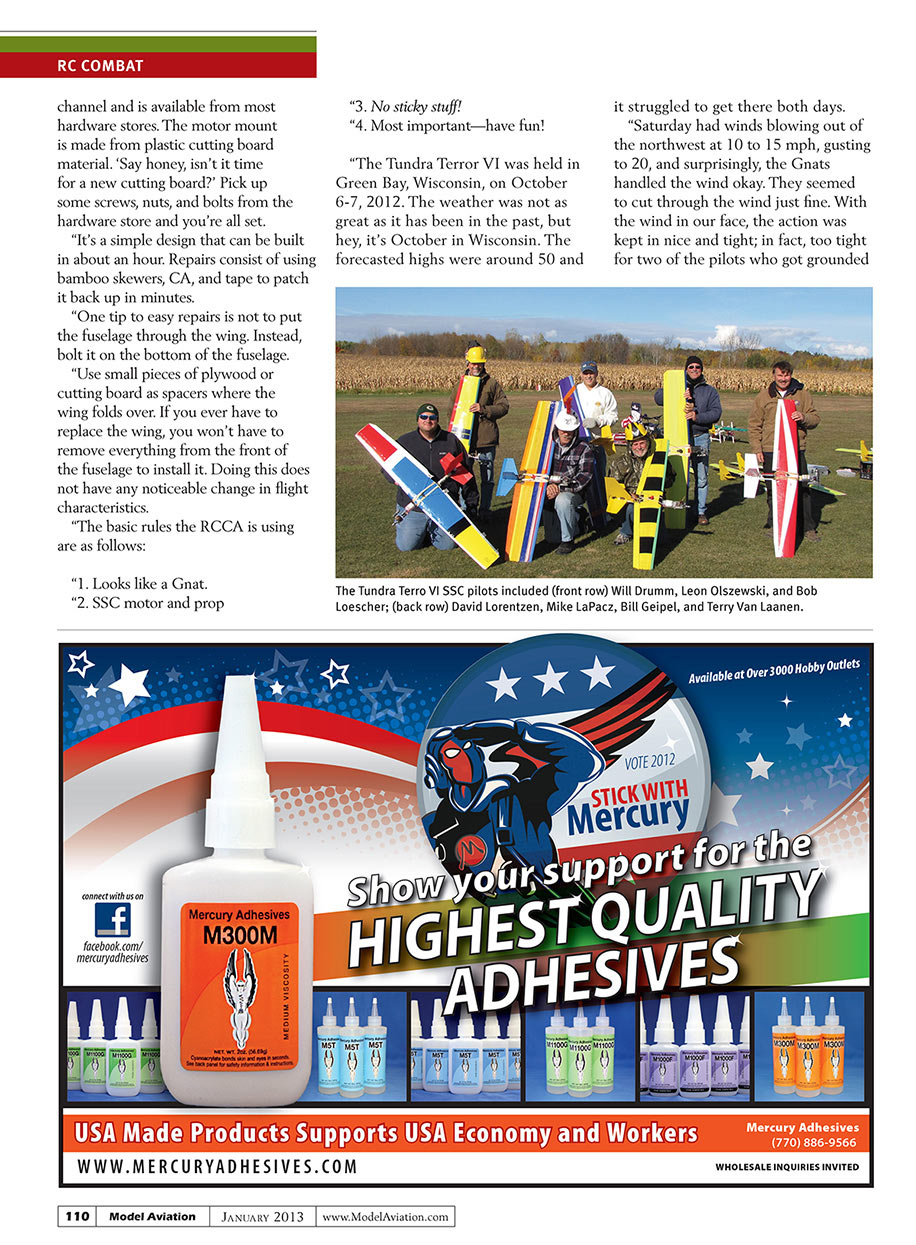
“The cost of a Gnat ‘kit’ is around $10. The wing and tail feathers are made from 4 mil Coroplast. Coroplast is mainly used for sign material. If you are able to find some Coroplast sign material, then there is no cost in the wing and tail. Otherwise, you can buy the material from sign suppliers. Harbor Sales (see ‘Sources’ listing) has 2 x 3-foot sheets available, which saves on shipping.
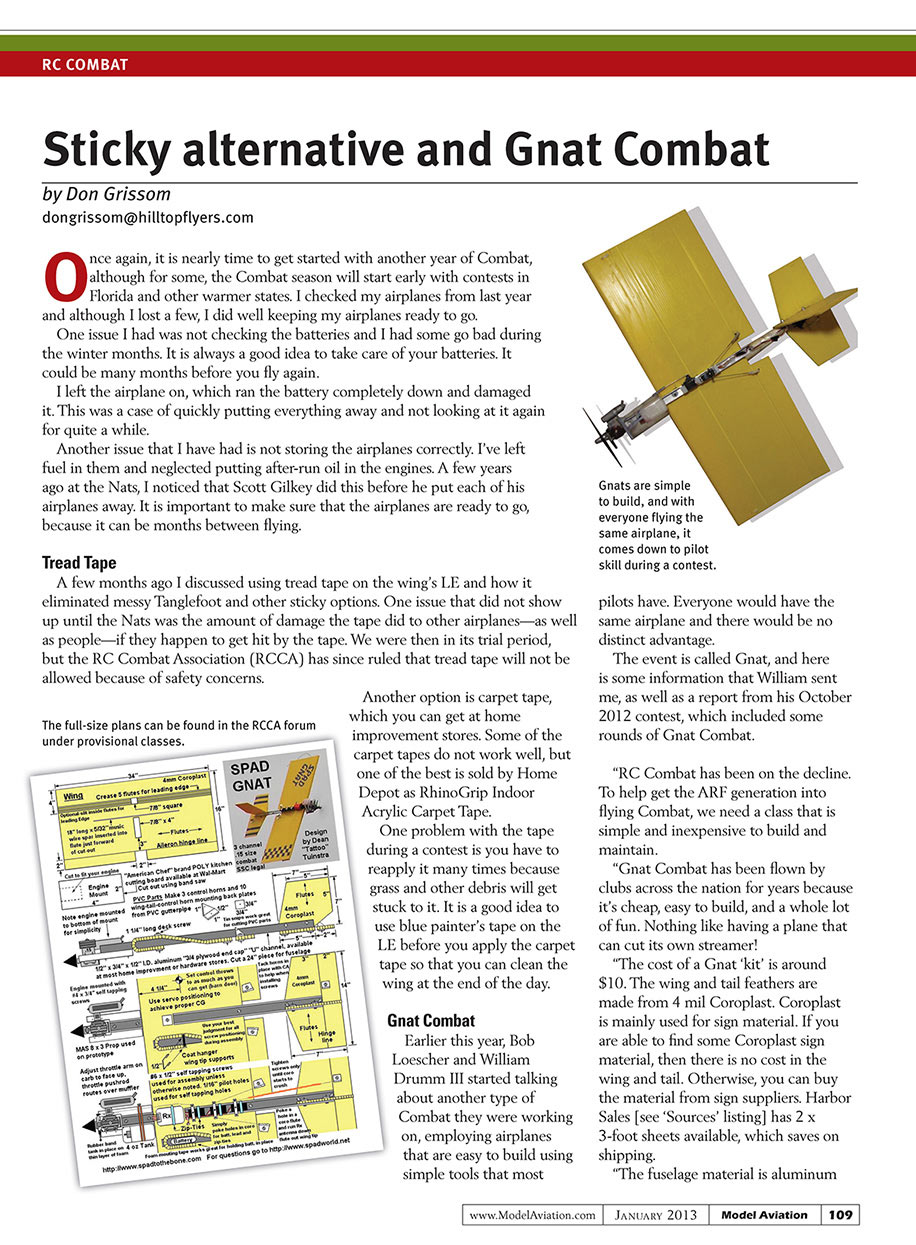
“The fuselage material is aluminum channel and is available from most hardware stores. The motor mount is made from plastic cutting board material. 'Say honey, isn't it time for a new cutting board?' Pick up some screws, nuts, and bolts from the hardware store and you're all set.
'It's a simple design that can be built in about an hour. Repairs consist of using bamboo skewers, CA, and tape to patch it back up in minutes.
'One tip to easy repairs is not to put the fuselage through the wing. Instead, bolt it on the bottom of the fuselage.
'Use small pieces of plywood or cutting board as spacers where the wing folds over. If you ever have to replace the wing, you won't have to remove everything from the front of the fuselage to install it. Doing this does not have any noticeable change in flight characteristics.
'The basic rules the RCCA is using are as follows:
'1. Looks like a Gnat. '2. SSC motor and prop '3. No sticky stuff! '4. Most important—have fun!'
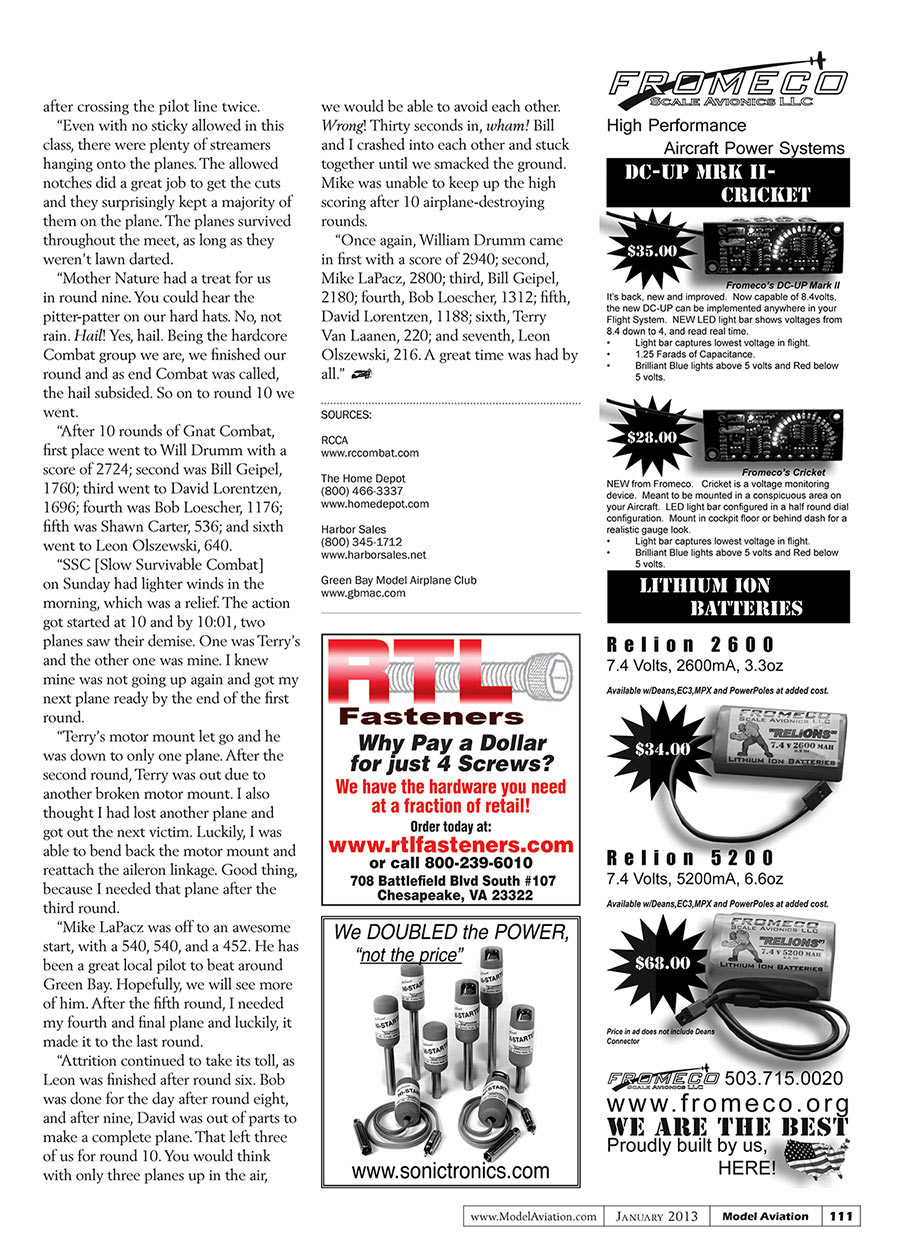
The Tundra Terror VI was held in Green Bay, Wisconsin, on October 6-7, 2012. The weather was not as great as it has been in the past, but hey, it's October in Wisconsin. The forecasted highs were around 50 and it struggled to get there both days.
'Saturday had winds blowing out of the northwest at 10 to 15 mph, gusting to 20, and, surprisingly, the Gnats handled the wind okay. They seemed to cut through the wind just fine. With the wind in our face, the action was kept in nice and tight; in fact, too tight for two of the pilots who got grounded.'
"After 10 rounds of Gnat Combat, first place went to Will Drumm with a score of 2724; second was Bill Geipel, 1760; third went to David Lorentzen, 1696; fourth was Bob Loescher, 1176; fifth was Shawn Carter, 536; and sixth went to Leon Olszewski, 640.
"SSC (Slow Survivable Combat) on Sunday had lighter winds in the morning, which was a relief. The action got started at 10 and by 10:01, two planes saw their demise. One was Terry's and the other one was mine. I knew mine was not going up again and got my next plane ready by the end of the first round.
"Terry's motor mount let go and he was down to only one plane. After the second round, Terry was out due to another broken motor mount. I also thought I had lost another plane and got out the next victim. Luckily, I was able to bend back the motor mount and reattach the aileron linkage. Good thing, because I needed that plane after the third round.
"Mike LaPacz was off to an awesome start, with a 540, 540, and a 452. He has been a great local pilot to beat around Green Bay. Hopefully, we will see more of him. After the fifth round, I needed my fourth and final plane and luckily, it made it to the last round.
"Attrition continued to take its toll, as Leon was finished after round six. Bob was done for the day after round eight, and after nine, David was out of parts to make a complete plane. That left three of us for round 10. You would think with only three planes up in the air, we would be able to avoid each other. Wrong! Thirty seconds in, wham! Bill and I crashed into each other and stuck together until we smacked the ground. Mike was unable to keep up the high scoring after 10 airplane-destroying rounds.
"Once again, William Drumm came in first with a score of 2940; second, Mike LaPacz, 2800; third, Bill Geipel, 2180; fourth, Bob Loescher, 1312; fifth, David Lorentzen, 1188; sixth, Terry Van Laanen, 220; and seventh, Leon Olszewski, 216. A great time was had by all."
SOURCES:
- RCCA
- The Home Depot
(800) 466-3337 www.homedepot.com
- Harbor Sales
(800) 345-1712 www.harborsales.net
- Green Bay Model Airplane Club
Transcribed from original scans by AI. Minor OCR errors may remain.

