
Summer contest season was eventful
by Don Grissom [email protected]
It has been a great year so far with many contests being held across the country. Once again, Texas is showing that it is the top in scoring when scores are looked at by state. The Maryland and Virginia areas are also putting on some great contests and I hope to make it there later this year.
One area we do not hear much about is Idaho. This is one part of the country that continues to fly 2610 Scale Combat. This category uses 1/12-scale airplanes and some of the same rules as Open B, such as no rpm limit.
One issue with Scale was always the build time, so the slower 2948 has been adopted in most of the country because there is less damage if you have a midair collision. As of July, the Idaho fliers have flown 18 rounds of 2610, with Jerry Haines as the point leader.
Scoring at the Nats
Keith Jones and Jill Aldridge were unable to make it to the Nats in July, which meant that we did not have our normal scorekeeper. Because I had a computer for reporting for NatsNews, I volunteered to run the scoring for this year's contest.
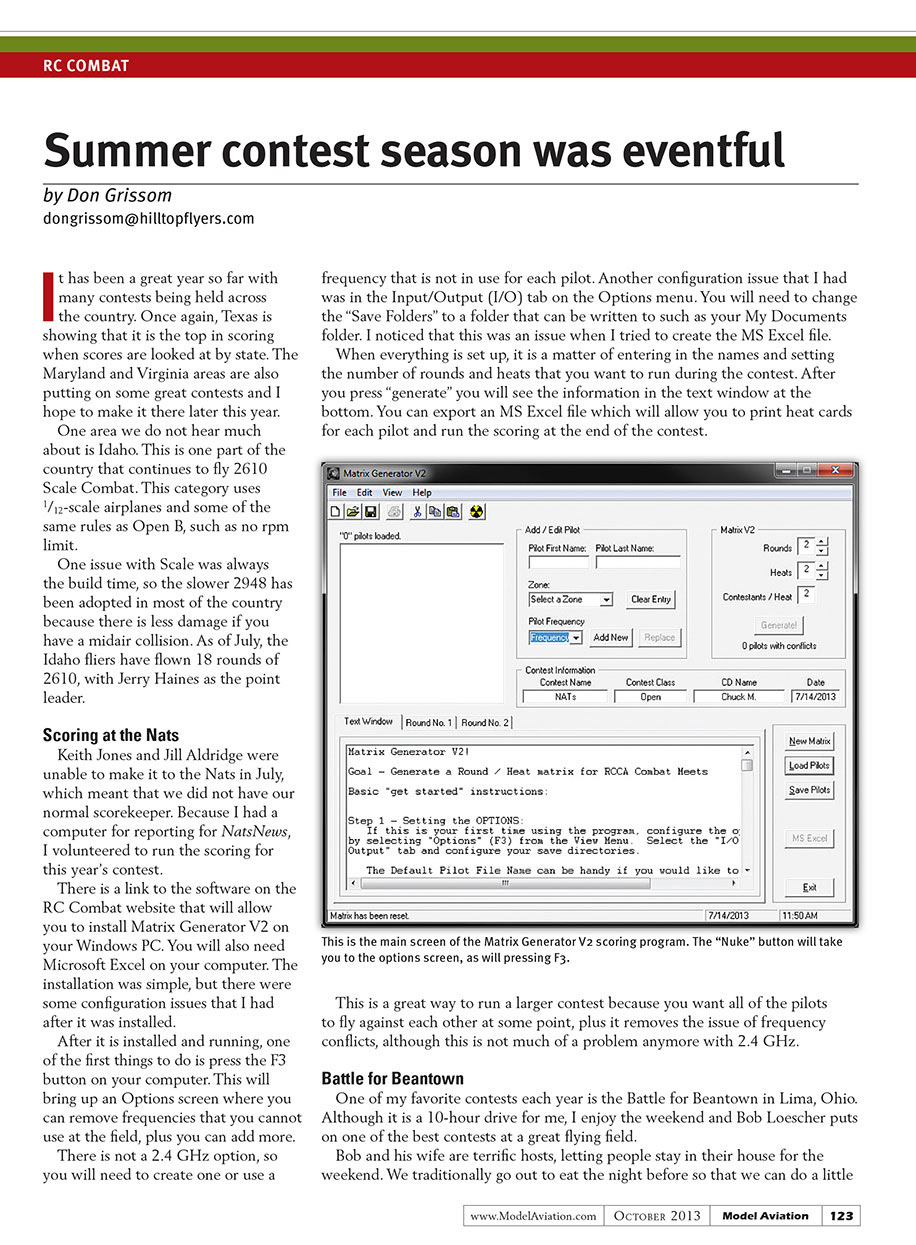
There is a link to the software on the RC Combat website that will allow you to install Matrix Generator V2 on your Windows PC. You will also need Microsoft Excel on your computer. The installation was simple, but there were some configuration issues that I had after it was installed.
After it is installed and running, one of the first things to do is press the F3 button on your computer. This will bring up an Options screen where you can remove frequencies that you cannot use at the field, plus you can add more.
There is not a 2.4 GHz option, so you will need to create one or use a frequency that is not in use for each pilot. Another configuration issue that I had was in the Input/Output (I/O) tab on the Options menu. You will need to change the "Save Folders" to a folder that can be written to such as your My Documents folder. I noticed that this was an issue when I tried to create the MS Excel file.
When everything is set up, it is a matter of entering in the names and setting the number of rounds and heats that you want to run during the contest. After you press "generate" you will see the information in the text window at the bottom. You can export an MS Excel file which will allow you to print heat cards for each pilot and run the scoring at the end of the contest.
This is a great way to run a larger contest because you want all of the pilots to fly against each other at some point, plus it removes the issue of frequency conflicts, although this is not much of a problem anymore with 2.4 GHz.
Battle for Beantown
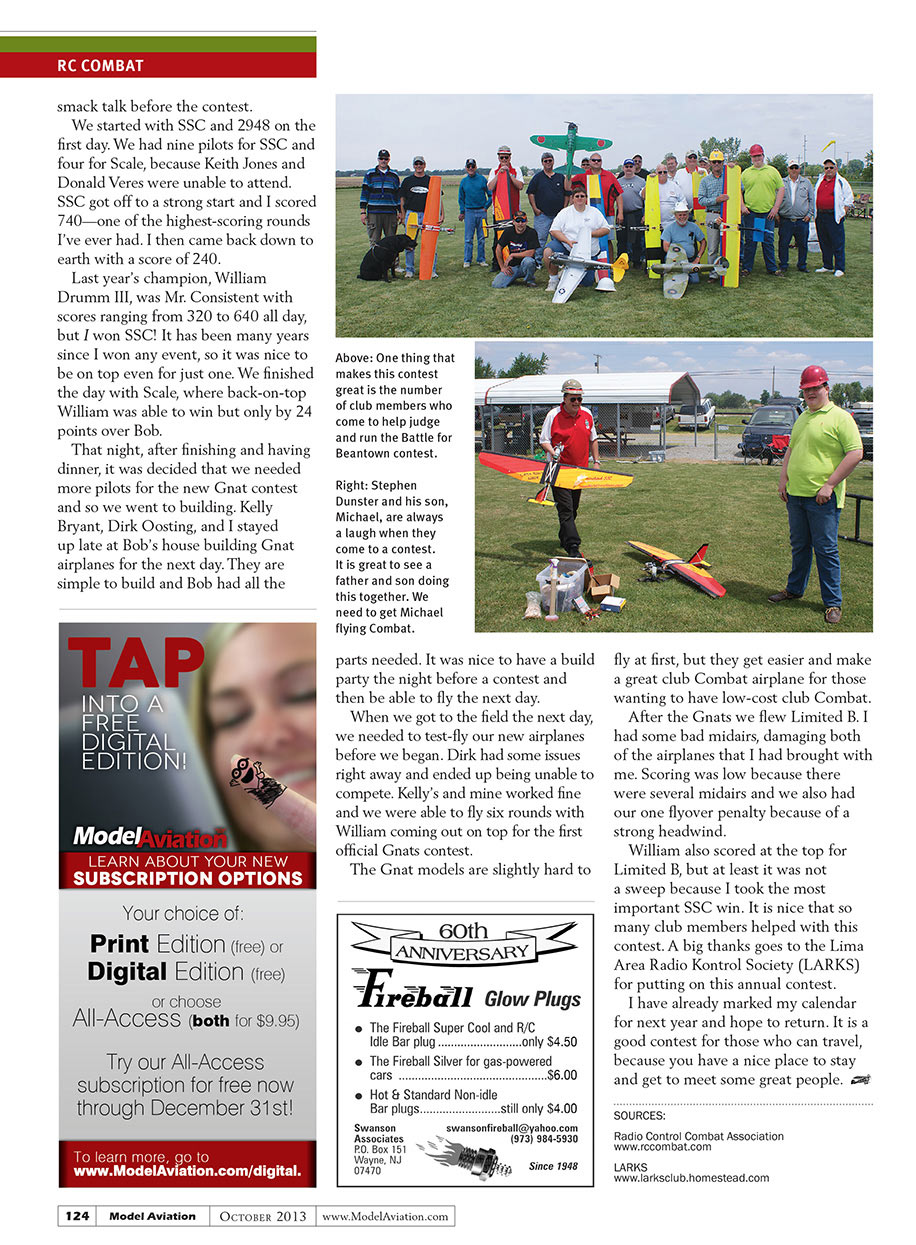
One of my favorite contests each year is the Battle for Beantown in Lima, Ohio. Although it is a 10-hour drive for me, I enjoy the weekend and Bob Loescher puts on one of the best contests at a great flying field.
Bob and his wife are terrific hosts, letting people stay in their house for the weekend. We traditionally go out to eat the night before so that we can do a little smack talk before the contest.
We started with SSC and 2948 on the first day. We had nine pilots for SSC and four for Scale, because Keith Jones and Donald Veres were unable to attend. SSC got off to a strong start and I scored 740—one of the highest-scoring rounds I've ever had. Then came back down to earth with a score of 240.
Last year's champion, William Drumm III, was Mr. Consistent with scores ranging from 320 to 640 all day, but I won SSC! It has been many years since I won any event, so it was nice to be on top even for just one. We finished the day with Scale, where back-on-top William was able to win but only by 24 points over Bob.
That night, after finishing and having dinner, it was decided that we needed more pilots for the new Gnat contest and so we went to building. Kelly Bryant, Dirk Oosting, and I stayed up late at Bob's house building Gnat airplanes for the next day. They are simple to build and Bob had all the parts needed. It was nice to have a build party the night before a contest and then be able to fly the next day.
When we got to the field the next day, we needed to test-fly our new airplanes before we began. Dirk had some issues right away and ended up being unable to compete. Kelly's and mine worked fine and we were able to fly six rounds with William coming out on top for the first official Gnats contest.
The Gnat models are slightly hard to fly at first, but they get easier and make a great club Combat airplane for those wanting to have low-cost club Combat.
After the Gnats we flew Limited B. I had some bad midairs, damaging both of the airplanes that I had brought with me. Scoring was low because there were several midairs and we also had our one flyover penalty because of a strong headwind.
William also scored at the top for Limited B, but at least it was not a sweep because I took the most important SSC win. It is nice that so many club members helped with this contest. A big thanks goes to the Lima Area Radio Control Society (LARKS) for putting on this annual contest.
I have already marked my calendar for next year and hope to return. It is a good contest for those who can travel, because you have a nice place to stay and get to meet some great people.
RC Combat
Don Grissom
SOURCES: Radio Control Combat Association www.rcccombat.com
LARKS www.larksclub.homestead.com
Transcribed from original scans by AI. Minor OCR errors may remain.

