
RC Combat
Greg Rose, 1312 NW 196th St., Edmond OK 73003
The Nationals (Nats)—there is no substitute.
There is a very special feeling in every AMA event flown at the Nats; some of the best of the best mix it up in friendly competition with any AMA modeler and even inexperienced beginners.
What happens when we are not flying is just as important as the flying portion of the event; the communication and technical tips pour in from every angle.
The Nats is also a great time to renew old friendships, as well as make new ones, and the 2001 Radio Control (RC) Combat Nats was no exception.
Bringing the RC Combat community together for the three days (July 3-5 this year) of Nats competition is one of the most important times we have to build the camaraderie within our sport.
Despite the fierce competition in the skies this year, RC Combat fliers pulled together on the ground and helped the contest officials, other modelers, and even their direct competitors, making the Nats a great success.
In the air, the 2001 RC Combat Nats certainly was competitive, with nine rounds of some of the hottest Combat around flown in Scale Combat and Open Class B Combat.
This year three different forces took command of the skies throughout the event. The action in the two Combat events would come to a sudden halt whenever the weather would decide to flex its muscles.
Intermittent thunderstorms and a huge, gusty front not only grounded the models but made some tents fly!
The plan was to run the first day with a half day of Open followed by a half day of Scale, reverse the order the second day, and revert to Open followed by Scale the last day.
However, rain ended the first day of the event early then delayed the start of the second day, cutting heavily into the Scale competition.
A good portion of lost flight time was made up the second day, when the weather finally cleared to beautiful, but windy—until a sudden front kicked up high winds, poured rain, and spawned a tornado to bring that day to an abrupt end.
The weather finally cooperated on the third day and allowed us to bring the total rounds up to nine in each event—only one short of the originally planned 10 rounds.
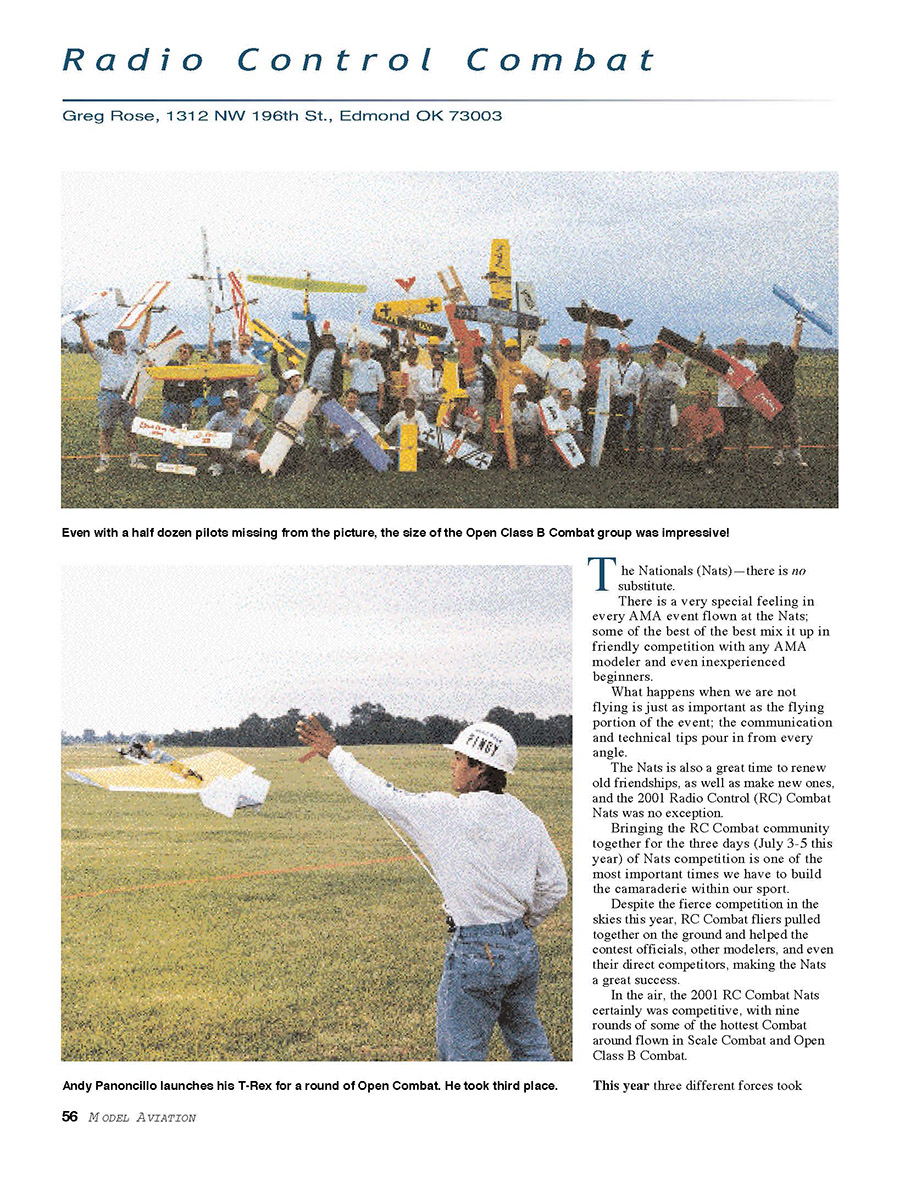
A total of 49 pilots showed up for the RC Combat Nats; 36 competed in Class B Open and 30 competed in Scale.
More than half of the Scale pilots and almost half of the Open-class pilots—16 total—flew in both events, which illustrates the large amount of crossover fliers in Combat.
The greatest challenge facing these crossover pilots was the constant pressure to fly. If it was not raining, they were flying in that round.
Because of the sheer size of the group, each round was broken into four heats; each heat averaged nine fliers.
One of the great features of Open Class B Combat is that the designer has few restrictions—with the exception of weight and power—to hold back his or her imagination.
Tried-and-true designs—some that were truly deserving of the term "classic"—flew against new designs, with some surprising results for everyone.
Of the 36 pilots in Class B Open, few flew the exact same airframes as their competitors. Even the "same" design looked different when different modelers built them, such as Mike Fredricks' Bat Trick design.
Mike's Bat Trick flew with an entirely different wing and tail design from the fleet of Bat Tricks the Anderson clan brought to the meet.
Walking the flightline you could see several variations on any model, and I counted at least 17 different designs flying at the Nats. The Bat Trick and the TuFlight Predator were popular, and there was a number of different SPAD Copilot—type designs.
Several new designs made their mark on the event, and I expect to see more fliers with them next year.
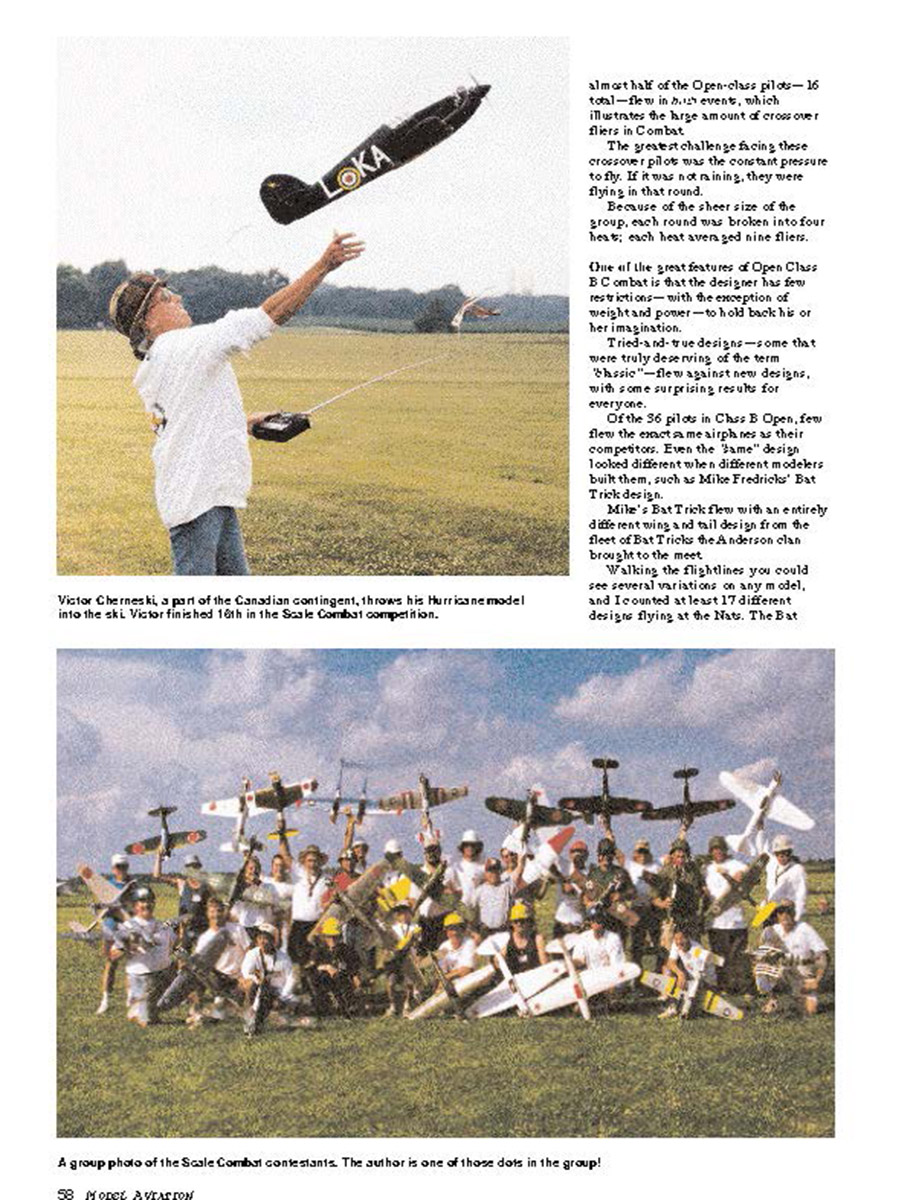
Down Home RC brought the new Lil Bull 25 Combat design to the Nats and gave it a good test run. The model ran very well—so well that it helped the Down Home "Tennessee Gang" take second and fourth places in the Open event!
One unique thing was that Lil Bull 25 was the only Open-class design that used rudder, rather than aileron, control. The large dihedral wing—a feature left over from its trainer roots—helped make each launch effortless, while the large rudder literally jerked it around in a turn in the blink of an eye.
Watching the different designs fly did make one thing obvious: Open Class is not about to evolve into a one-design event anytime soon! There are several excellent Combat designs, and any one in the hands of a good Combat flier can make a very potent combination.
With eight to nine airplanes flying per heat, cuts were plentiful; the top three scorers in Open averaged three cuts per round!
Each of the top three fliers competed with different designs. Mike Fredricks and his long-spanned Bat Trick took first place with 3,248 points at the end of nine rounds.
Mike had a memorable double midair in one round, where another airplane struck his before he could regain control. The Bat Trick's plastic baseball-bat fuselage demonstrated its incredible toughness by absorbing both impacts and allowing Mike to reclaim control.
Nipping at Mike's heels in second place was 14-year-old newcomer Addison Rackley, with 3,036 total points.
Addison had flown Combat in his local club, but this was the first time he had ever flown AMA RC Combat. You couldn't have guessed that by watching him fly as he chucked up putts after cut with his new Lil Bull 25.
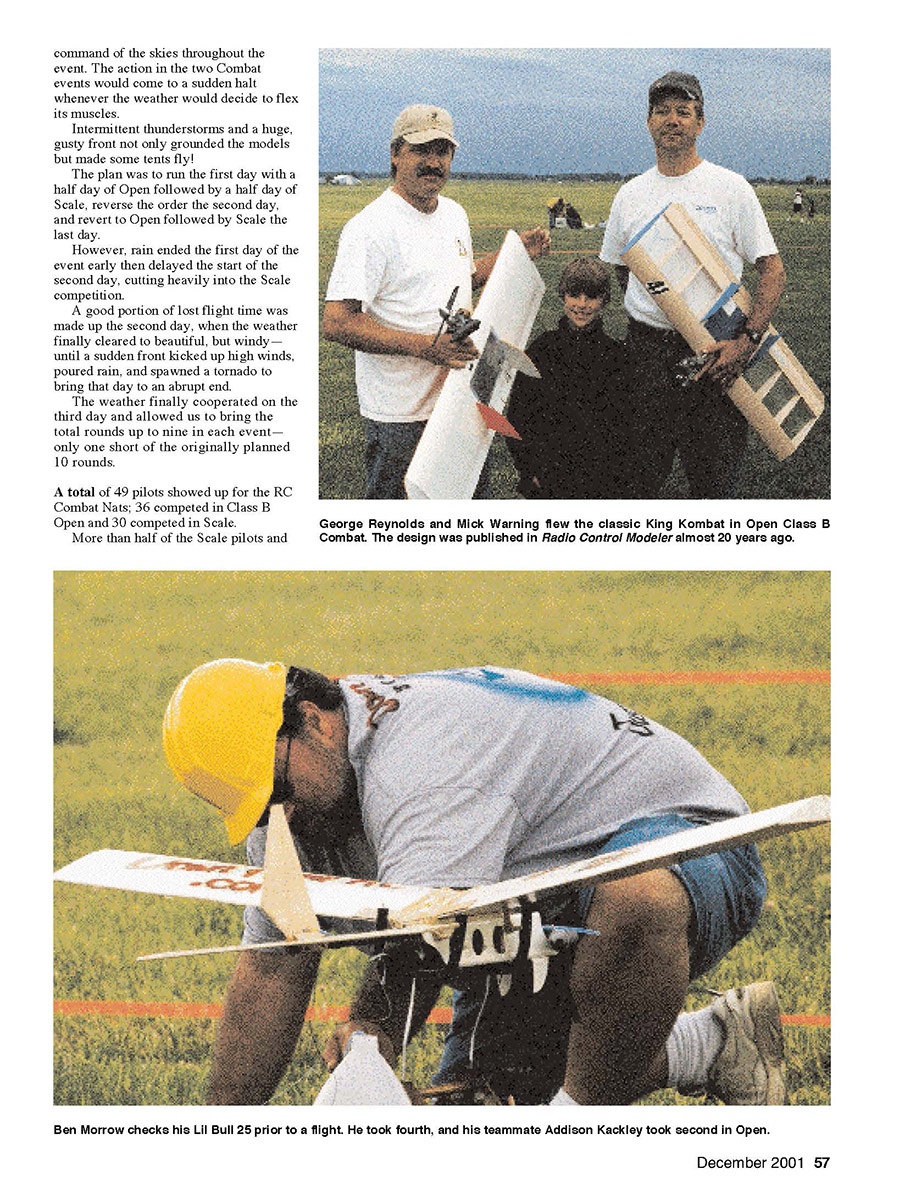
In third place was the smooth-flying and very experienced Andy Panoncillo, who rolled up 2,948 points in the meet.
Andy's new T-Rex design, with its distinctive forward-swept wings, seemed to be everywhere in the sky, but Andy's score was kept down by a number of early-round midairs.
In Scale Combat the action was no less furious, although the scores were kept low as a rain squall swept closer. Scale fliers try to squeeze in one more flight.
RC Combat
Lower scores were caused by problems with the streamers detaching because of the weather.
Dozens of damp streamers fell off — some during the climbout after launch, forcing the fliers to land and reattach new streamers. A few heats were shorted when all the streamers fell off the models and the competition was called for lack of targets!
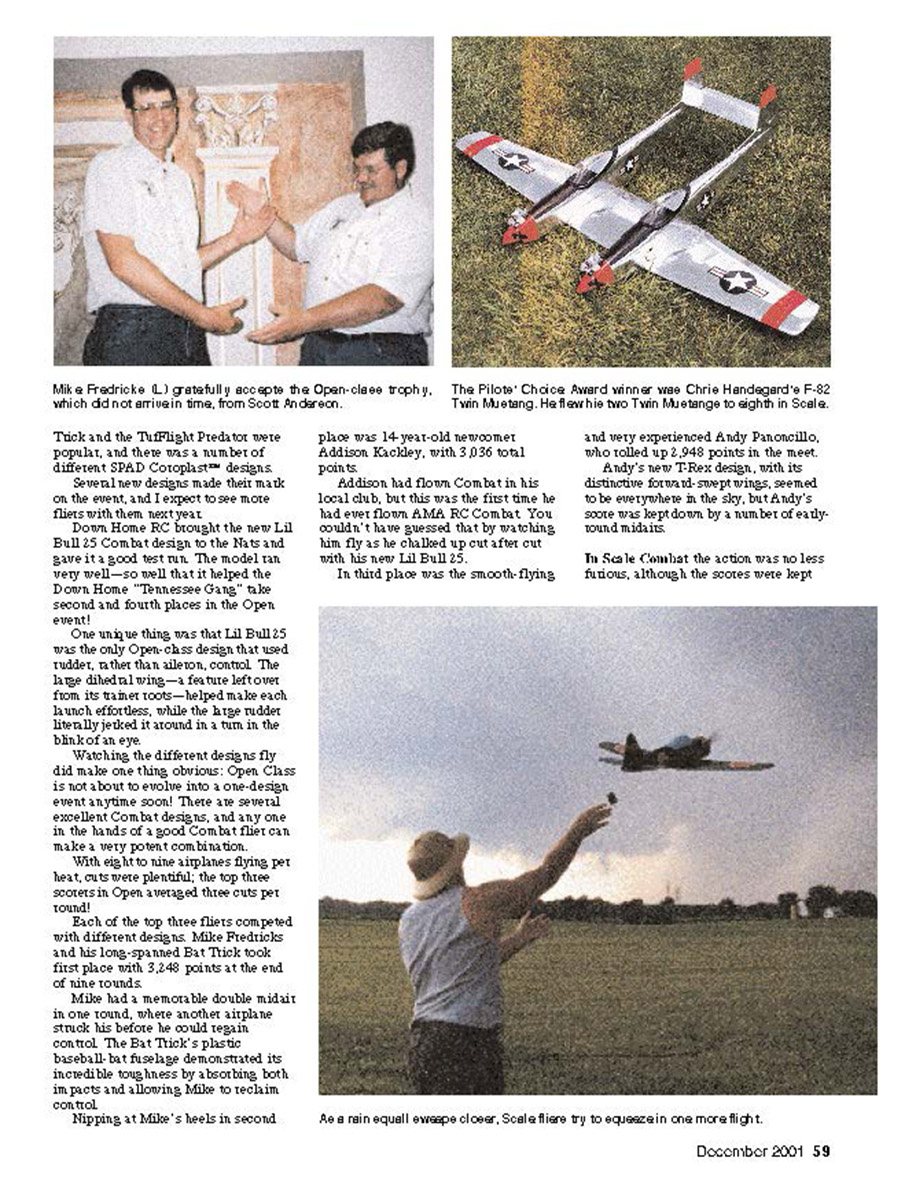
The trend in Scale was toward larger-span models, but, just as in Open, a large variety of models was flown. Of the 30 pilots flying in the category, I counted an incredible 27 designs represented! Some, such as the Il-2 and the long-span Ta 152, were several fliers' favored mounts.
Damp streamers or not, Mike Fredricks was on top of the heap averaging two cuts per round. Flying scratch-built Fairey Fulmars, Mike earned 2,452 points by the end of nine rounds.
With a first place in both events, it might seem as though Mike is a shoe-in for winning Combat events — but nothing could be further from the truth. The caliber of the other pilots made Mike work hard for every point.
In second place — a mere 126 points behind, with 2,326 total — was another veteran competitor: Jeff Weiss, flying his Air-Kit Ta 152s.
Mike and Jeff had flown in heats in which each was the only flier left with a streamer. Out of targets, and in a sky full of fighters seeking revenge, they put on dazzling displays of low-altitude, defensive flying that would have made a seasoned crop duster break out into a cold sweat.
In third place, steady as a rock, was Bob Wallace. Using his own Wallace RC Ki-64 Rob kits, Bob racked up 2,122 points.
Thanks to the 2001 RC Combat Nats sponsors and to the companies that helped make the Nats a success: The Academy of Model Aeronautics, Air-Kill Products, Check Six Plans, Combat Goblin Models, Down Home RC, and Dremel®.
Also Hat Trick Models, JK Aerotech, Middle Wallop Engineering, Pica models, PowerMaster fuels, Radical RC, R/C Excellence magazine, R/C Report magazine, Servo City, SPAD, TurbFlight, Wallace RC, Warzone Models, and Zurich Sunglasses.
It was an incredible event, and everyone came away with something special: the memory of an RC Combat Nats with 49 pilots from 23 states and Canada, with more than 250 Combat models, flying in 72 individual heats, totaling more than seven hours of Combat flight time.
There is no substitute for the Nats. MA
Transcribed from original scans by AI. Minor OCR errors may remain.

