
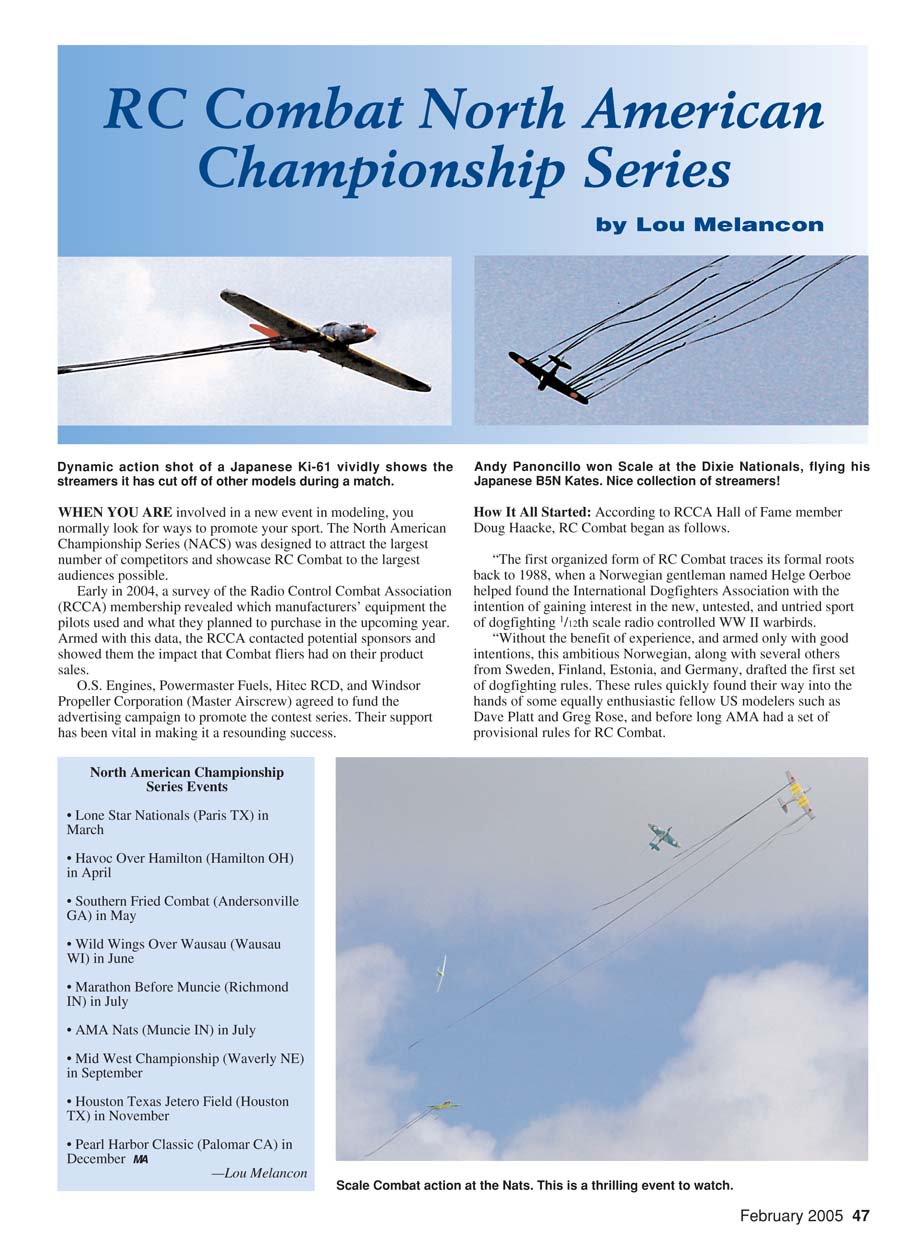
RC Combat North American Championship Series
by Lou Melancon
When you are involved in a new event in modeling, you normally look for ways to promote your sport. The North American Championship Series (NACS) was designed to attract the largest number of competitors and showcase RC Combat to the largest audiences possible.
Early in 2004, a survey of the Radio Control Combat Association (RCCA) membership revealed which manufacturers' equipment the pilots used and what they planned to purchase in the upcoming year. Armed with this data, the RCCA contacted potential sponsors and demonstrated the impact that Combat fliers had on product sales. O.S. Engines, Powermaster Fuels, Hitec RCD, and Windsor Propeller Corporation (Master Airscrew) agreed to fund an advertising campaign to promote the contest series. Their support has been vital in making it a resounding success.
How It All Started
According to RCCA Hall of Fame member Doug Haacke, RC Combat began as follows:
"The first organized form of RC Combat traces its formal roots back to 1988, when a Norwegian gentleman named Helge Oerboe helped found the International Dogfighters Association with the intention of gaining interest in the new, untested, and untried sport of dogfighting 1/12th-scale radio-controlled WWII warbirds.
"Without the benefit of experience, and armed only with good intentions, this ambitious Norwegian, along with several others from Sweden, Finland, Estonia, and Germany, drafted the first set of dogfighting rules. These rules quickly found their way into the hands of some equally enthusiastic fellow U.S. modelers such as Dave Platt and Greg Rose, and before long the AMA had a set of provisional rules for RC Combat."
What Is RC Combat?
- An airplane trails a 30-foot crepe-paper streamer and attempts to "cut" other models' streamers while protecting its own during a match that lasts five minutes.
- Four to 12 airplanes fly against each other at one time.
- The pilot with the most "cuts" wins the match. At North American Championship Series events, pilots fly six to eight times each day, and the one with the highest cumulative score wins. Contestants' scores are entered into the RCCA's National Points Standings; point totals are kept annually for national rankings.
- There are two types of Combat models: World War II scale fighters and "Open" designs. Two popular engine classes are .15 and .25–.30.
- Because of stringent regulations, a safe environment is maintained for pilots and spectators.
RC Combat Myths
- Combat airplanes have to be fast. To fly effectively you must fly at speeds similar to the competition, but Combat aircraft are also large for their engine sizes. The wings—not the propeller—are used to cut the streamers.
- Combat airplanes are skittish. These are among the most stable models in the sport. They have to be easy to fly and completely trustworthy to use effectively in Combat.
- You need great aerobatic skills to fly Combat. Successful Combat fliers value patience and planned pursuit. Good piloting ability helps, but most fliers have average aerobatic skills and an above-average ability to process visual data quickly.
North American Championship Series Events
- Lone Star Nationals (Paris, TX) — March
- Havoc Over Hamilton (Hamilton, OH) — April
- Southern Fried Combat (Andersonville, GA) — May
- Wild Wings Over Wausau (Wausau, WI) — June
- Marathon Before Muncie (Richmond, IN) — July
- AMA Nats (Muncie, IN) — July
- Mid West Championship (Waverly, NE) — September
- Houston Texas Jetero Field (Houston, TX) — November
- Pearl Harbor Classic (Palomar, CA) — December
Evolution of Classes
In the late 1990s a second Combat classification called "Open" was created. It is a nonscale division in which a designer's imagination is limited only by a maximum engine displacement of .30 cid and a maximum model weight of 3.5 pounds. Open Combat has grown rapidly since its beginnings and is now the dominant category.
Late in 2002, Combat fliers realized that Open Combat models' speeds and kinetic energy had reached a point of diminishing return. Airframes were being damaged in midair collisions at an unacceptable rate. To address this, a new Open class called Slow Survivable Combat (SSC) was developed to slow the airplanes down, reduce battle damage, and lessen the technological arms race—making competition more about pilots than machines. SSC succeeded beyond expectations and was the most-contested class in 2004.
The Internet has played a pivotal role in bringing Scale Combat pilots together globally in a short time. The Scale Combat website (www.rccombat.com), started in 1995, provided a forum for novice and experienced RC pilots to share experiences and display the trials and tribulations of this new sport. A short time later, the American Scale Dogfighters Association was formed.
2004 NACS: Event Summaries and Results
The NACS features nine large regional Combat events to provide pilots venues for competition and to introduce the RC community to this exciting event. The 2004 nine-event series began in March in Paris, Texas. Competitors came from across the country—Virginia, Ohio, Kentucky, Tennessee, Georgia, Wisconsin, Oklahoma, Kansas, Nebraska, California, and Arizona—more than 70 pilots in all.
At Paris, 52 pilots signed up for the .25-size Open B event (the fastest Open category). The computer-generated matrix determined which heat of five each pilot would fly in for six rounds. There were 30 matches of 10 airplanes or more that day. After an epic battle, Texan Lee Liddle emerged on top, averaging more than three cuts per round.
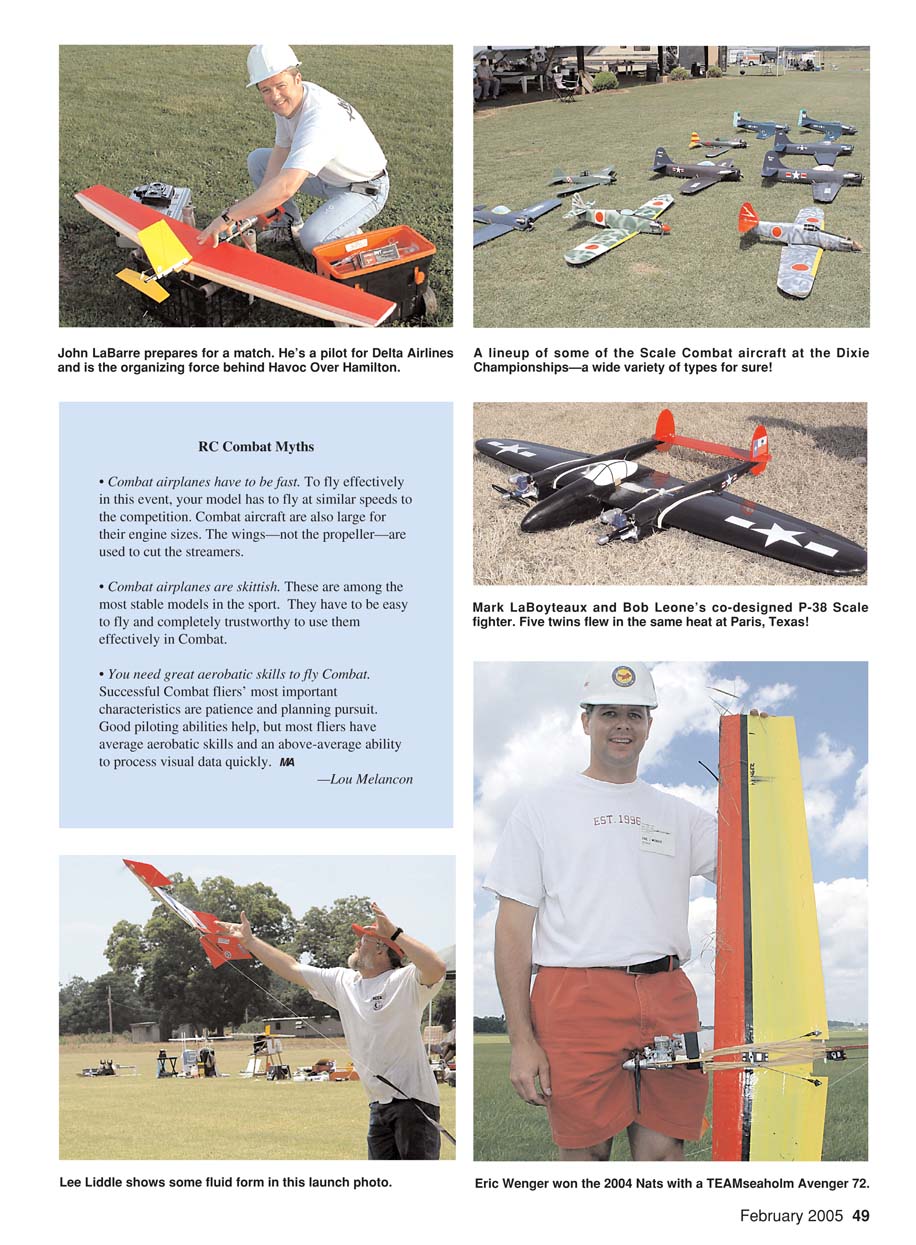
Scale Combat (Class 2610) was contested throughout the series and had 20 participants. For the first time there were five Scale twin-engine aircraft entered: an F7F Tigercat, a P-38, a MiG-5, an Me 110, and an Fw 189. At the end of four rounds, Maryland's Kirk Adams won in a close race with Oklahoma's Don Howard. Kirk flew Blackburn Firebrands, and Don campaigned TBD Devastators.
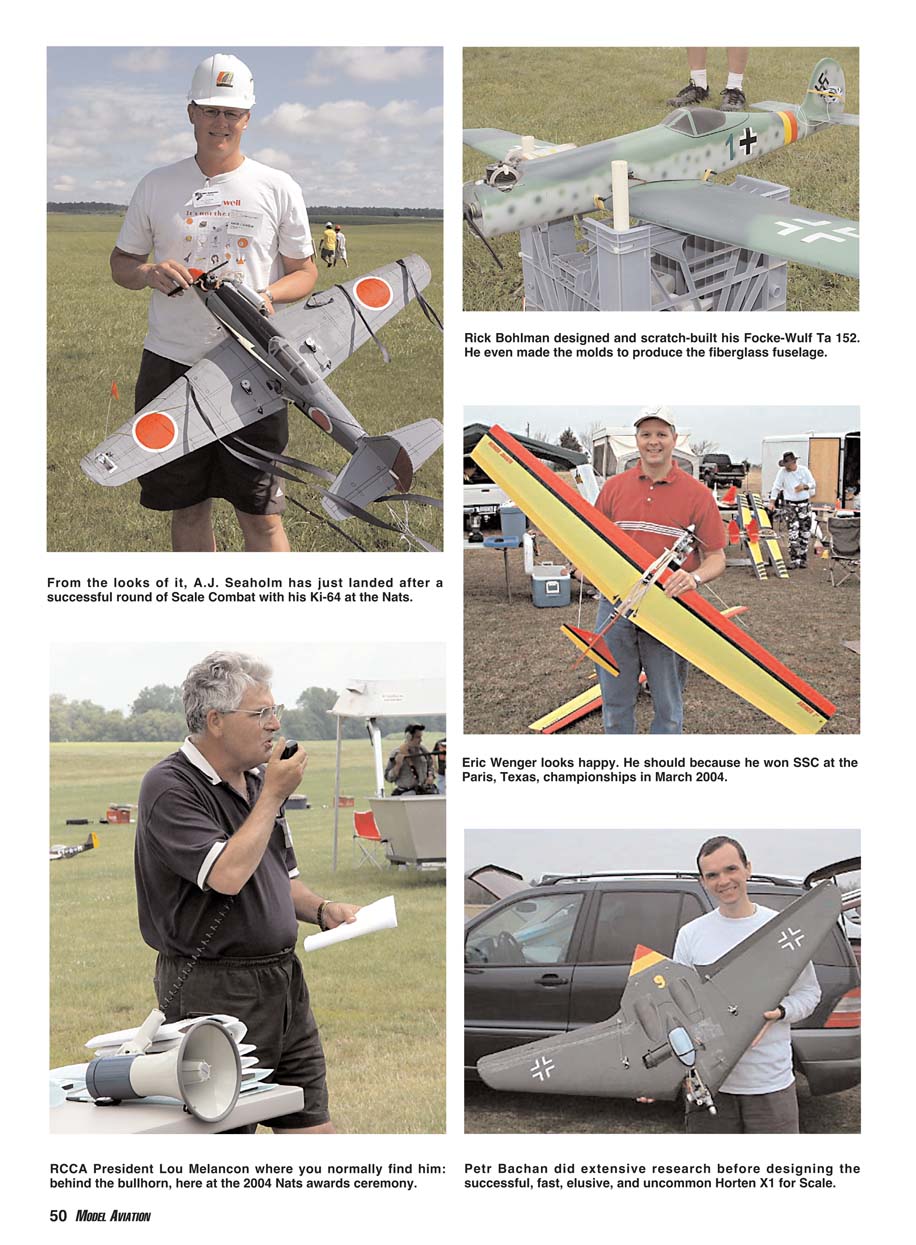
SSC (the RCCA's provisional class) had 61 entrants at Paris. Six-airplane heats were flown with 10 heats for six rounds. Winds gusted to 25 mph for these big .15-powered models. Oklahoman Eric Wenger won SSC, with Lee Liddle finishing second.
Next on the NACS trail was Havoc Over Hamilton (near Cincinnati, OH). Many fliers who competed at Paris made the trek to the Midwest. Kirk Adams successfully defended his Scale Combat title by winning after six rounds. Tennessean Chris Quinn prevailed after 10 rounds of SSC and jumped to the top of the standings. In Open B, Wisconsin’s Mike “Dr. Evil” Fredericks won the event.
Southern Fried Combat at the Dixie Championships was held in late May at Mac Hodges Field. Lee Liddle dominated SSC, taking a win and the series lead. Texan Mike Willcox, the reigning control-line Combat World Champion at the time, won Open B. Andy Panoncillo, traveling from Muncie, Indiana, won Scale (he had won Open B at the first Dixie Championships in 2001). Kirk Adams remained close behind in the series Scale standings.
The series then moved to Wausau, Wisconsin, hosted by the Wausau R/C Sportsmen. Many competitors were flying their first NACS contest of the year. Mike Fredericks earned his first SSC win and added to his earlier scores. Mike Bohlman won Open B with exceptionally well-performing airplanes.
In July the series moved to the AMA Nats at the National Flying Site. SSC was flown first; Chris Quinn took his second event of the series and the lead in SSC. Ten rounds of Open B and Scale were flown during the three-day schedule. Open B saw Eric Wenger rise to the top and become the new series leader. Lee Liddle won Scale and remained locked in a close race with Kirk Adams.
In early September the series reached Waverly, Nebraska, home of the Mid West Championship. Several leaders (including SSC leader Chris Quinn and Scale leader Kirk Adams) were unable to attend, giving Texans and Oklahomans a chance to advance. Don Howard won both Open B and Scale at Waverly, boosting his standing in the National Points Standings. Lee Liddle won SSC and took a clear series lead.
The RCCA used its National Points Standings (NPS) system to determine the 2004 NACS winners. Congratulations to Overall National Champion Lee Liddle for his victories in SSC, Open B, and Scale. It was an exciting year that featured many technological improvements and advances in piloting skills.
RC Combat is one of the fastest-growing disciplines in modeling, and 2005 promises to be another banner year. For more information about this event, visit www.rccombat.com to learn the rules, see the models, and read about building and flying Combat airplanes.
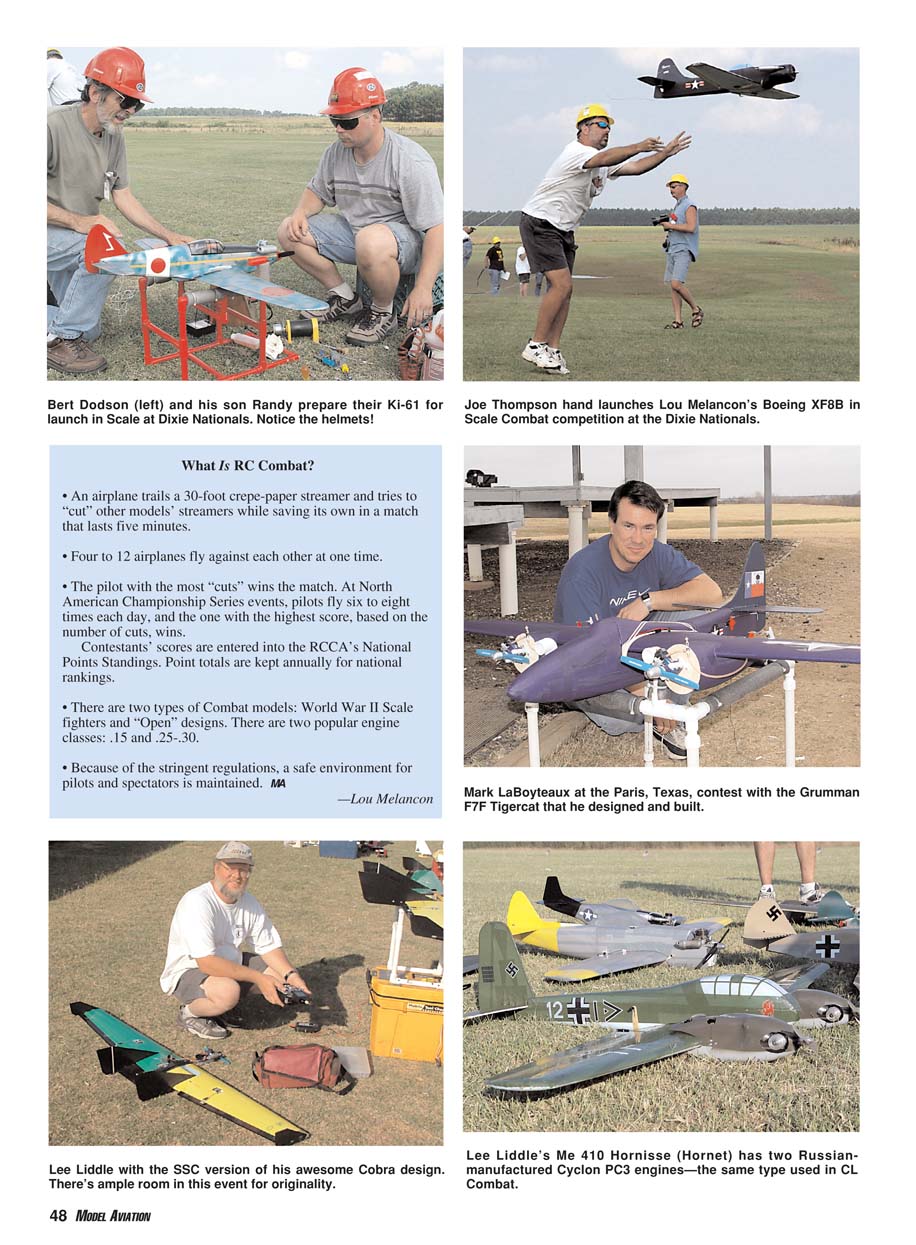
Andy Panoncillo won Scale at the Dixie Nationals, flying his Japanese B5N Kates.
—Lou Melancon 105 Morton Walk Dr. Alpharetta, GA 30022
Transcribed from original scans by AI. Minor OCR errors may remain.

