
RADIO CONTROL ELECTRICS
Tom Hunt, 8914 W. Evergreen Ave., Apt. C, Indianapolis IN 46240
Three letters in a string, www, is not a prefix to a World Wide Web address, but a descriptor for the 2000 E-Nats (Radio Control [RC] Electric events at the AMA National Championships). Wild, windy, and wet best describes these four days.
The wind was relentless; it blew steadily each day from sunrise, and gusts to 15 mph were the norm later in the day. Rain threatened most days, but fortunately there was only one two-hour delay, on the third day of the competition.
Four "official" AMA events and five NEAC (National Electric Aircraft Council) events were staged between July 31 and August 3.
One AMA category was held each day:
- Event 610 (Class A Sailplane) on Sunday
- Event 612 (Class B Sailplane) on Monday
- Event 618 (Class A Old-Timer) on Tuesday
- Event 620 (Class B Old-Timer) on Wednesday
Those are LMR (Limited Motor Run) events; each competitor is allowed a finite motor-run time to gain altitude, then must glide to a landing precisely eight minutes after launch. Coming to a stop in a 20- or 40-foot-diameter circle gains the pilot 20 or 10 bonus points.
NEAC events were also held each day:
- Sunday: 1/2A Sailplane (similar to event 610, but the motor must be a Mabuchi RS-380 or equivalent)
- Monday: Sport Electric Sailplane (also similar to event 610, but only rudder, elevator and spoilers may be used to control the model)
- Tuesday: 1/4A Texaco Old-Timer (an endurance event using the RS-380 motor)
- Wednesday: 1/2A Pylon and Electric Scale
What made the E-Nats wild?
Scrambling to get eight rounds in on two different aircraft per day with a constant threat of rain was one thing. The fierce competition—always present at this event—was another.
The wind did nothing to help matters—especially on the lighter-loaded RS-380-powered models.
Though we could not complain about only two hours of rain delay in four days, that two hours was the wildest time!
Just after noon Tuesday, AMA notified the event director that a very violent thunderstorm was bearing down on the AMA facility. We could see the darkness off to the north long before that radio call.
Pilots scrambled to get their models into the vans, cars, and trailers. Those who stayed out on the flightline got soaked. Heavy hail began, roofs were dented and several models were damaged. The storm passed quickly, but the rest of the day was unsettled.
Many had time to drop their canopies. By the time the torrential rains came, a few canopies were still standing. Many huddled inside the large AMA-erected tent, and others found comfort in their vehicles.
As the winds began to increase, a canopy was seen leaving the field in a great hurry. Others were knocked to the ground and, one by one, the Porta-Johns fell over like dominos. Winds were clocked at 55 mph!
Almost as soon as it began, the worst was over. The rain stopped, and reassembly of the pits and the contest began.
AMA immediately sent a ground crew out to help get the field back in order. Not long after the group left, AMA radioed again: "Put the things away boys! Another one is a half-hour away!"
This second "cell" was not anywhere near as violent, and we sat it out too. After it passed, the skies cleared quickly and the contest resumed.
Model Aviation lists the official-event winners elsewhere in this issue, so I won't bore you with the standings.
I will say that Aveox brushless motors dominated the winning places in Class A and B Sailplane. However, AstroFlight geared brush motors gained a few places in Class A and B Old-Timer.
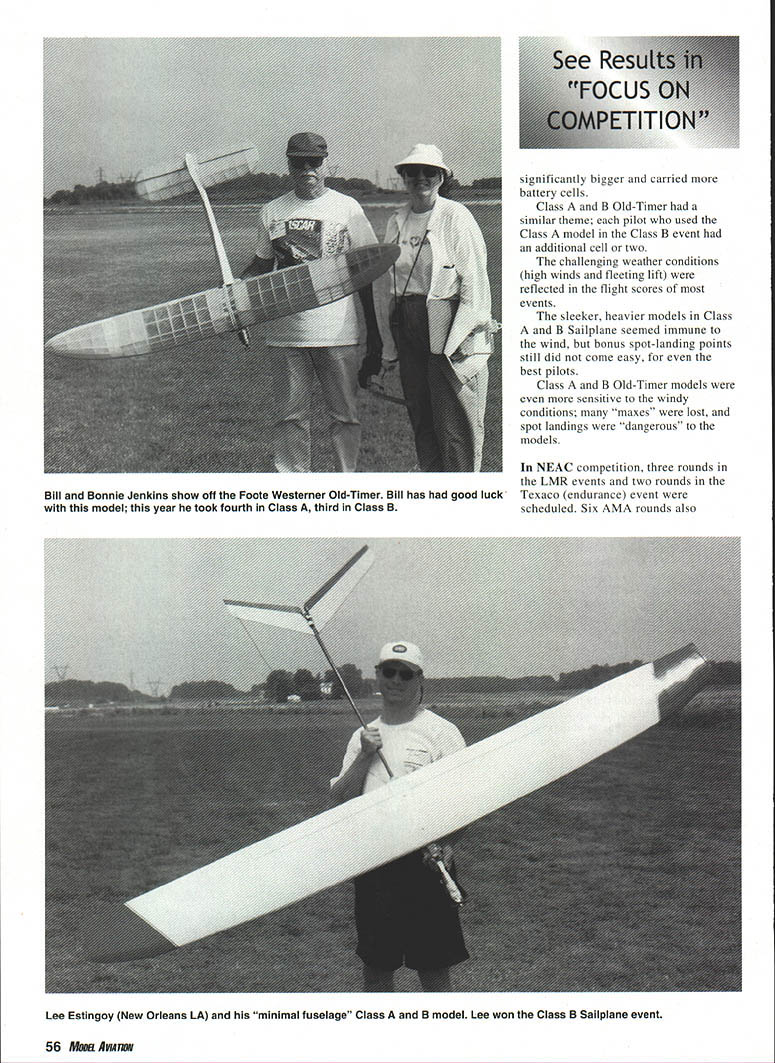
As has happened in past years, many pilots used the same models in Class A and Class B Sailplane. Generally, the only change was the cell count and the propeller. When different Class B models were used, they were significantly bigger and carried more battery cells.
Class A and B Old-Timer had a similar theme; each pilot who used the Class A model in the Class B event had an additional cell or two.
The challenging weather conditions (high winds and fleeting lift) were reflected in the flight scores of most events.
The sleeker, heavier models in Class A and B Sailplane seemed immune to the wind, but bonus spot-landing points still did not come easy, even for the best pilots.
Class A and B Old-Timer models were even more sensitive to the windy conditions; many "maxes" were lost, and spot landings were hazardous to the models.
In NEAC competition, three rounds in the LMR events and two rounds in the Texaco (endurance) event were scheduled. Six AMA rounds also scheduled most days made for a busy competition!
Many competitors flew their NEAC event rounds in the morning while the winds were still low, although it was never "still."
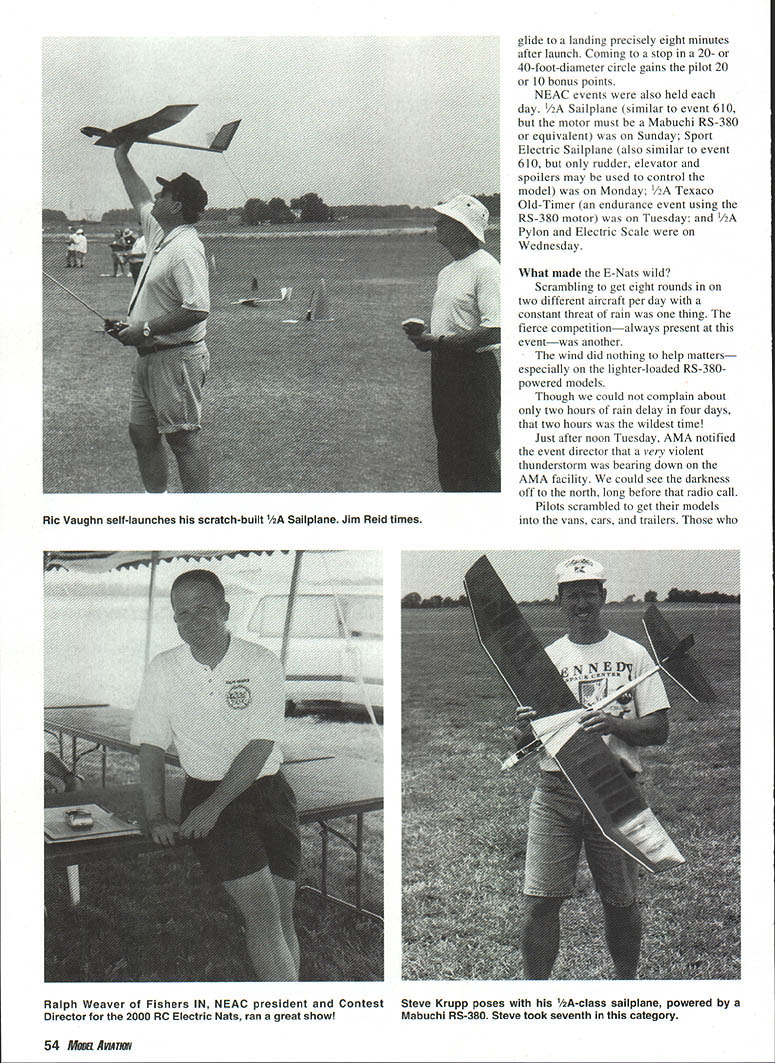
The 1/2A Sailplane event attracted most of the pilots who attended the AMA events. These models are generally less expensive and less sophisticated than the Class A models.
Typically driven by a version of the Speed 400 motor and a high-ratio gearbox, these smallish 1.5-meter 1/2A models climb rather briskly. A 90-second motor run gets the models to thermal-hunting altitude very nicely.
1/2A Sailplane had its first Junior contestant in the top three! Twelve-year-old Marc Elias of Jupiter, Florida gained a respectable third place—a mere four points behind second-place finisher Don Richmond (San Diego CA).
Bill Jenkins (Memphis TN) earned first place, four points ahead of Don, out of a possible 1,500! A very close finish!
On the second day, a fairly new event, Sport Electric Sailplane, was run in a format similar to that of 1/2A Sailplane.
This event allows a rather long motor run (two minutes), but requires a 10-minute total flight (eight-minute glide). The models are limited to RES (Rudder, Elevator, Spoiler) control.
Sport Electric Sailplane was envisioned as a low-tech, "fly-whatever-you've-got" contest.
Typically, any good Two-Meter glider and an inexpensive .05 motor and gearbox can carry this type of model to the limit of the normal modeler's vision in two minutes—more than high enough to go thermal-hunting. Some modelers even flew their Old-Timers.
I won this event, with the same model with which I won the first Class A Sailplane event at Muncie five years ago. Although powered by a direct-drive Aveox brushless motor, the model sported no spoilers. It had built-up wing and tail construction with a fiberglass fuselage.
Ric Vaughn (Marietta GA) took second with his own-design model, mostly of composite structure. Earl Robinson (Tyrone GA) was third. He also used a low-tech, built-up model.
Only 19 points out of 1,800 separated the top three places!
Tuesday proved to be the windiest day. This made it rather difficult for the 1/2A Texaco Old-Timers.
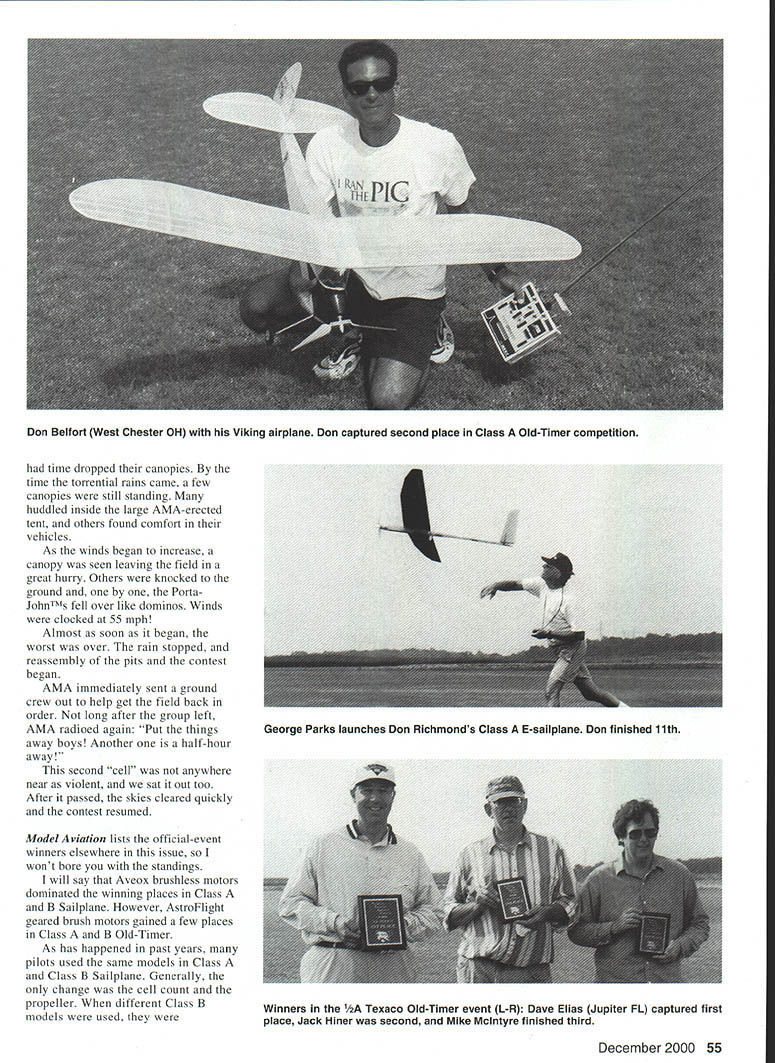
The object of this event is to fly the model for 15 minutes, using a maximum of seven cells of 600 mAh capacity. The motors are restricted to Mabuchi RS-380 types.
Despite the harsh environment, three pilots managed to make two 15-minute flights, moving them into a flyoff round late in the day (after that malicious thunderstorm rumbled through).
When all was said and done, David Elias (Marc's dad) finished in first place, and Jack Hiner and Mike McIntyre (both from Illinois) took second and third respectively.
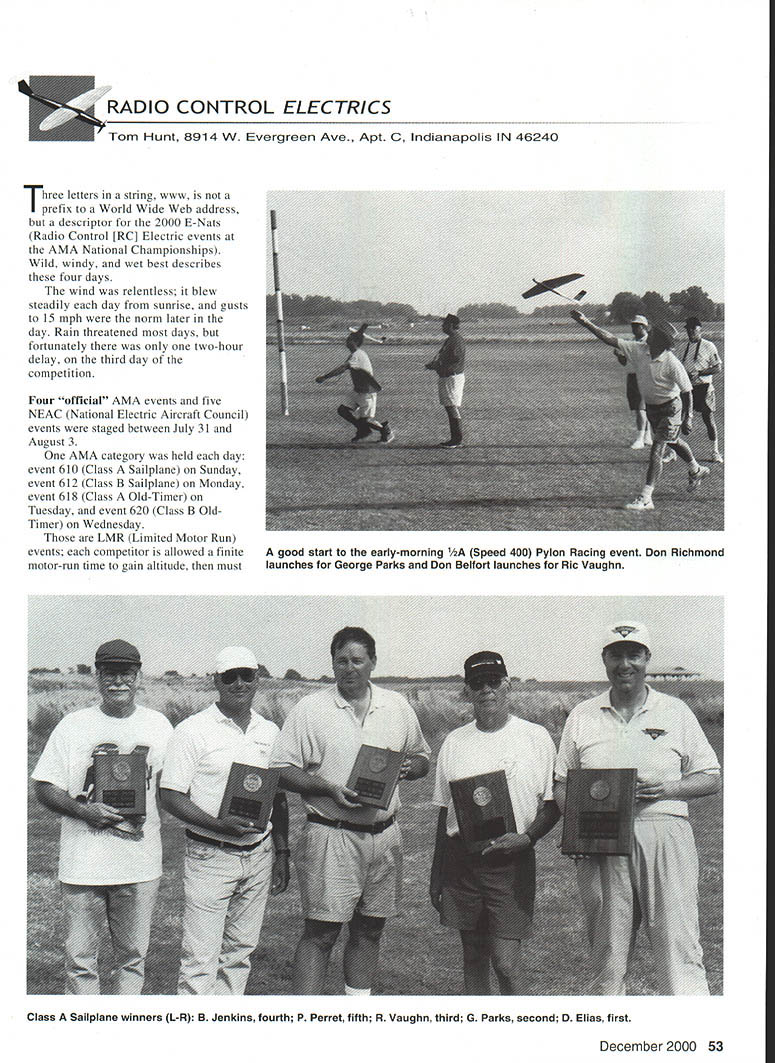
The last day of competition was busy. Besides having to fly three rounds of Class B Old-Timer, Speed 400 Pylon Racing was staged for four racers between 7 and 10 a.m., and Electric Fun Scale was held later in the day.
Helpers got to the field early to set up the pylon course, which is similar to that of the 1/2A "glow" Pylon event.
The format was 10 laps around the course in man-on-man competition. Each pilot was allowed to lose once; after the second loss, he became an armchair pilot.
After the double-elimination rounds, George Parkas (Austintx TX) won with his Sliver. Both flying SeaTs, Dave Elias and Don Belfort (West Chester OH) placed second and third respectively.
Don Belfort flew his SeaT considerably faster than Dave in the semifinal round, but Don smacked the ground in a late-race turn.
The faster model did not win in the final round, either. Dave's SeaT looked considerably faster than George's Sliver, but Dave met Mother Earth in a late-race turn, giving George the win.
Sometimes just having an airplane left when the races are finished gets you first place!
Later that day (after Class B Old-Timer was finished), Electric Fun Scale was held.
Five modelers entered Speed 400-powered airplanes (one was a twin), and one .05-powered model was entered.
All models were judged for a total of 20 static points—10 points maximum for accuracy and 10 points for craftsmanship. After the models were scored for appearance, only one flying round was held because of the high winds. The maximum score for the flying round was 20 points.
After the static judging, Jim Reid's (West Islip NY) Cessna Airmaster had a perfect 20. Don Belfort's Fokker Dr.I triplane was in second at 18 points, and Glen Poole's (Naperville IL) Fokker D.VIII (the only non-Speed 400-powered model) was in third at 16 points.
My Percival Mew Gull was fourth with 15 points, and Bud Bragg's OV-10 Bronco and Steve Krupp's Bf 109 had 13 points.
The winds were gusty for these small, light models; however, all but one made a flight. It was surprising to see how well these airplanes handled the wind.
The OV-10 seemed to care the least, but it was certainly the heaviest, and probably had one of the highest wing loadings. My sleek Mew Gull (which had a rather high wing loading of 22 ounces per square foot) penetrated the winds quite well, and it showed in my flight score.
With the flight points combined with the static scores, first place in Sport Scale went to Jim Reid and his Airmaster. First, second, and third places, regardless of motors used, went to Don Belfort, myself, and Glen Poole respectively.
NEAC awarded a trophy to the modeler who placed the highest in all AMA- and NEAC-hosted events. Dave Elias took the honors with the most “placings” points; he earned four firsts and finished in the top 10 in each event he entered!
The 2000 E-Nats was managed and run smoothly—mostly because of Ralph Weaver's (NEAC president and Contest Director) hard work, and his significant helper/scorer, Don Blackburn. Many thanks to them.
Although it was threatening, the weather never became much worse. We will return next year, hopefully with some new blood to increase the activity in this part of RC modeling.
'Til next year, fly quietly! MA
Note: The rest of the line and following text on this page is unclear in the provided scan. Please supply a higher-resolution image or the next portion of the page for complete transcription.
Note: The remainder of this page is partially illegible in the provided scan. Please supply a higher-resolution image of this page (or the next page) to complete the transcription.
Transcribed from original scans by AI. Minor OCR errors may remain.

