
RADIO CONTROL ELECTRICS
Bob Kopski, 25 West End Dr., Lansdale PA 19446
Meet announcement
Bob Tabler (1041 Casanova Dr., Virginia Beach VA 23454; Work tel.: [757] 430-3344; Home tel.: [757] 427-0508; Fax: [757] 430-1750; E-mail: [email protected]) wrote to announce the All Electric Fun Fly.
The event will be held at the Fentress Naval Auxiliary Landing Field, Chesapeake VA, Saturday, June 16 and Sunday, June 17, 2001.
Bob describes the meet as "an open Electric fun-fly with fun events if you wish to enter." This theme sounds much like that of NEAT (the Northeast Electric Aircraft Technology fair), the old KRC affair, and many other E-gatherings that have been successful.
There will be event plaques, a 120-volt generator on site, food, comfort facilities, what's described as "a perfect takeoff area," and many flying opportunities all day each day.
You can get a more detailed description by contacting Bob as above, and do tell 'em Bob sent ya!
Electric Connection Service (ECS)
The Electric Connection Service (ECS) is a column feature that encourages those seeking E-others in their area to announce so here. This month I have an unusual—and great-sounding—ECS request!
Gene Chalile, 1401 NE 102 St., Miami Shores FL 33138; E-mail: [email protected], wrote to describe "a nice flying site for Electrics" that he wants to share. According to Gene, the site is plenty large and you can fly big aerobatic models and sailplanes there.
It sounds as though the only thing missing is enough fliers! So would all you E-aeromodelers in Northeast Miami get in touch with Gene, then head to the field?
Goodness knows, the last thing any aeromodeler should allow is an unused flying site!
Please include an SASE with any correspondence for which you'd like a reply.
Universal Slow Charger (USC) feedback
Readers continue to show a strong interest in the Universal Slow Charger (9/00 MA). This includes comment, query, and problem-sharing.
Several readers have asked if there is a (physically smaller) alternative inductor to part L1 on the USC Control Circuit. I'm sure there is, but I'm not able to properly specify one.
In general, such inductors would be among the most difficult and pricey parts for most people—including me—to obtain, so I did not pursue this course.
As were other electronic projects I've shared with you via MA, the USC was carefully planned to use readily available and reasonably priced parts and supplies, so everyone interested could build the project.
Speaking of the part, although the specified L1 is shown "soft-mounted" on rubber grommets for the sake of quietness, it is neither necessary nor recommended that you similarly mount the power transformer T1. Just mount it solidly, as shown.
One reader overextended the soft-mount idea to include T1, and has an interference fit with the meter switch because of it. That's not good—it shorted the terminals!
As encouraged in the USC article, if you do experience difficulty with a checkout step, stop and find and fix the problem before continuing. Unless you have in-depth circuit design insight and skill, you will likely get deeper into trouble by advancing beyond a trouble point. This has been reader-proven!
Another thing that has been reader-proven (repeatedly) is that a properly built USC works as described. Count on it!
Charger design and safety
If you are building a charger, include adequate ventilation and fuse protection. Chargers can fail and sometimes in dramatic fashion. A fuse in the primary and a fuse or other current-limiting device in the secondary are inexpensive insurance.
Long-term battery experiment
There is a booming growth of interest in small E-airplanes—the so-called "park flyers." One thing that characterizes these models is the use of many small packs of varied makeup and capacity. Modelers often try a pack and then, as the model is flown, substitute another pack that has different characteristics. This practice makes consistent charging and flight-time prediction more difficult.
I have been running a long-term battery experiment for some months using 12-cell, 2-Ah packs on my own models and test gear. The idea was to see how the packs behaved after many charge/discharge cycles using time-limited charges, as many of you do in the field.
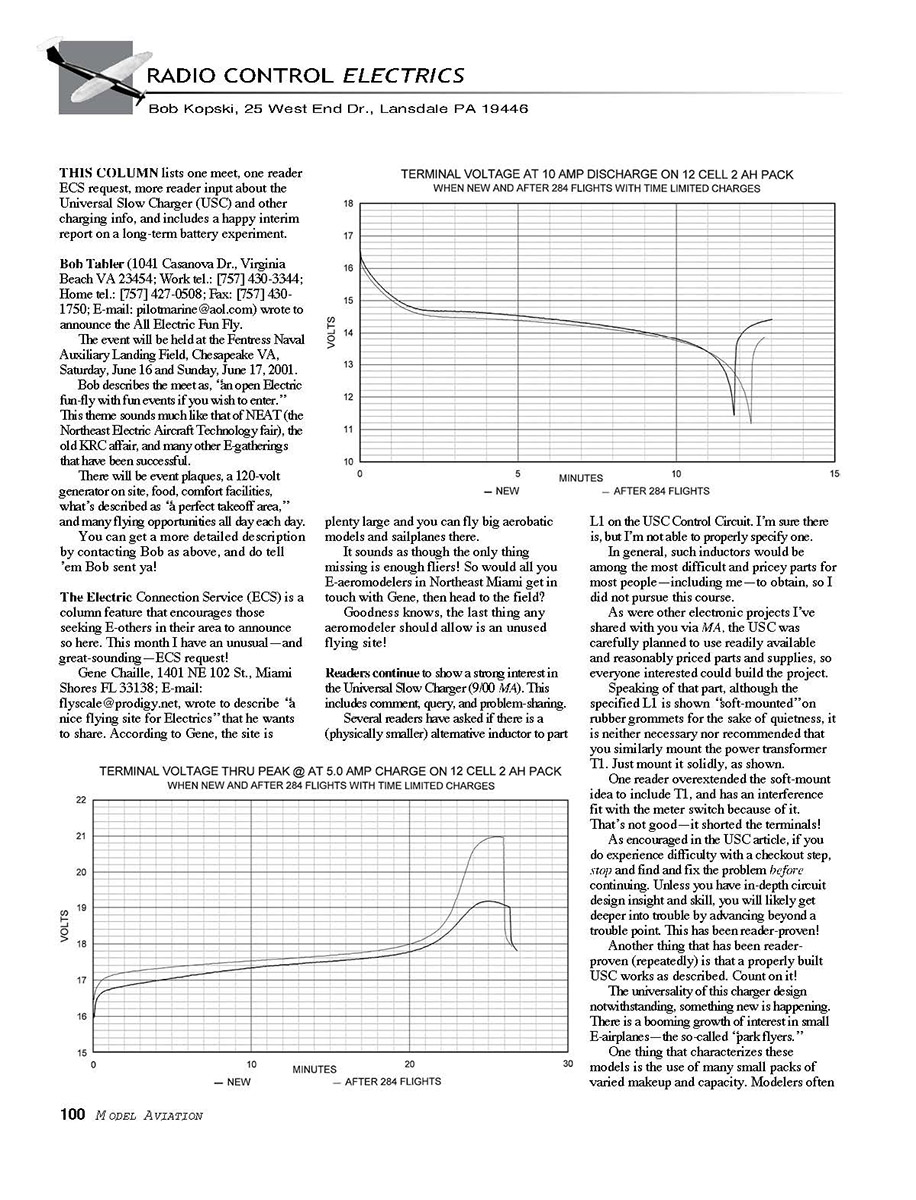
Several packs, new and after 284 flights (yes I actually counted), were discharged at a 10-amp rate on the USC Control Circuit. The terminal voltages are shown in the graphs.
What I found was encouraging: the packs, after many flights, still held up well and the terminal-voltage curves were not dramatically different from new packs. In one case the after-284-flights curve dropped farther toward the end of the discharge and then recovered somewhat; in another there was a gentle sag. But overall the results were better than I'd feared.
I should emphasize that these results are not universal. Pack construction, cell type, charge regimen, storage conditions, and the vagaries of manufacturing can all affect longevity. Consider this an interim report, not a definitive study.
Timed-charging experiment and SSC
In 04/00 "RC Electrics" columns I included discussion and data from treating cells and packs "in a kinder, more gentle way," and the possible merits thereof.
I found what seemed to be a strong correlation between not deep discharging packs and a corresponding delay in the appearance of the false-peak syndrome.
This finding was tied in with one performance feature of the Sport Speed Control (9/99 and 10/99 MA), or SSC, that allowed automatic shutdown of the motor as pack voltage approached 0.9 volts per cell.
This SSC feature—which precludes deep discharging and the associated temperature rise—extends pack life, as manifested in the delayed onset of false-peaking behavior, but it doesn't prevent it.
In August 1999 I undertook a new experiment wherein, beginning with a new pack installed in a REVOLT! under SSC control, I charged this pack only with timed charges.
Timed charges? What a radical step backwards! I even overheard some expressed skepticism (or worse) on a meet flightline! My rationale for this is simply an extension of the "kinder, gentler" approach: I theorized that since the greatest rate of pack heating was during deep discharge (and associated cell reversal) and in the last minute or so of peak charging, then perhaps the onset of the false-peaking syndrome could be delayed even further if both of those extremes could be avoided.
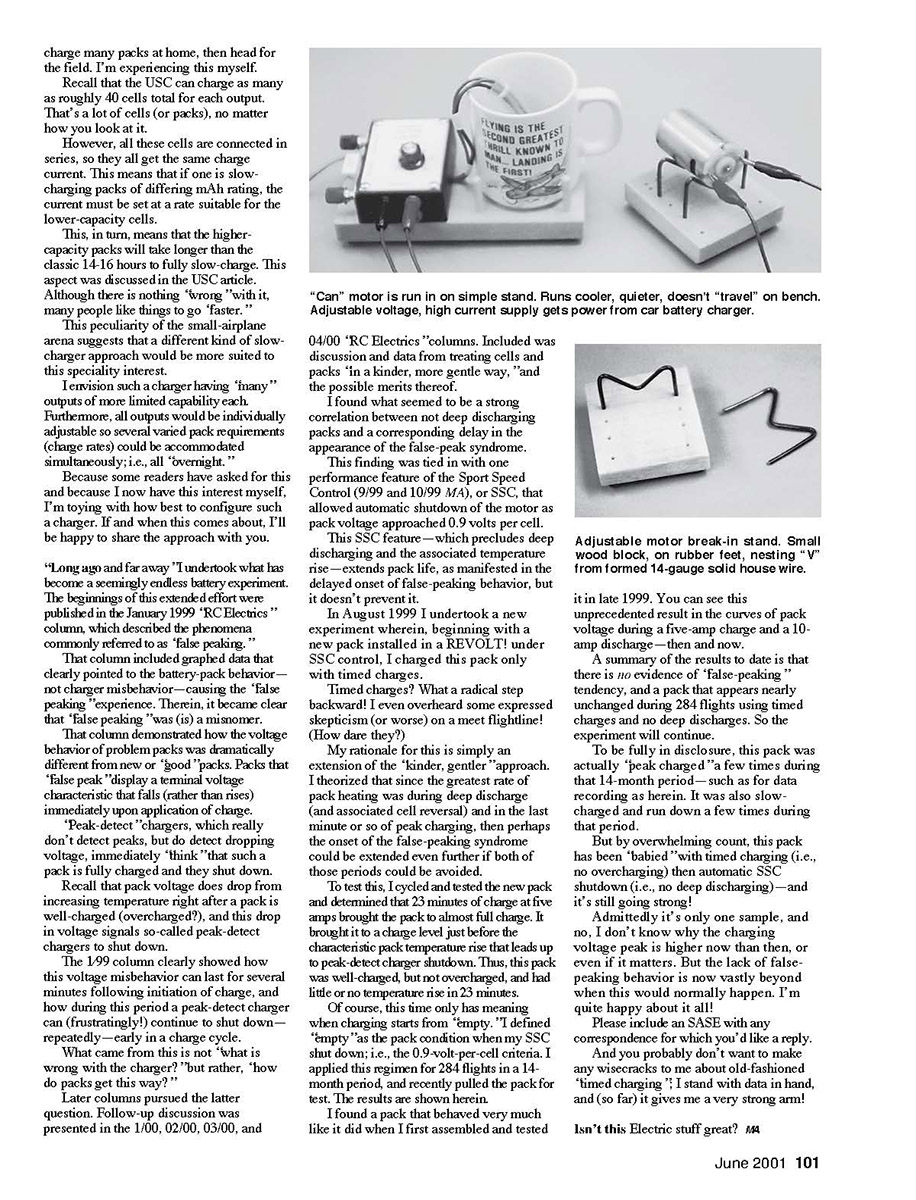
To test this, I cycled and tested the new pack and determined that 23 minutes of charge at five amps brought the pack up to almost full charge. It brought it to a charge level just before the characteristic peak temperature rise that leads up to peak-detect charger shutdown. Thus, this pack was well-charged, but not overcharged, and had little or no temperature rise in 23 minutes.
Of course, this only has meaning when charging starts from "empty." I defined "empty" as the pack condition when my SSC shut down; i.e., the 0.9-volt-per-cell cutoff applied. This regimen continued for 284 flights in a 14-month period, and I recently pulled the pack for test. The results are shown herein.
I found a pack that behaved very much like it did when I first assembled and tested it in late 1999. You can see this unprecedented result in the curves of pack voltage during a five-amp charge and a 10-amp discharge—then and now.
A summary of the results to date is that there is no evidence of "false-peaking" tendency, and a pack that appears nearly unchanged during 284 flights using timed charges and no deep discharges. So the experiment will continue.
To be fully in disclosure, this pack was actually "peaked" charged a few times during that 14-month period—such as for data recording as herein. It was also slow-charged and run down a few times during that period.
But by overwhelming count, this pack has been "babied" with timed charging (i.e., no overcharging) then automatic SSC shutdown (i.e., no deep discharging)—and it's still going strong!
Admittedly it's only one sample, and no, I don't know why the charging voltage peak is higher now than then, or even if it matters. But the lack of false-peaking behavior is not vastly beyond what would normally happen. I'm quite happy about it all!
Isn't this Electric stuff great? MA
Transcribed from original scans by AI. Minor OCR errors may remain.

