
RC Electrics
Bob Kopski, 25 West End Dr., Lansdale PA 19446
THIS COLUMN will discuss getting into Electric and will list three meets.
I admit that getting into Electric can be a bit confusing and challenging. Getting into rubber power could be comparably confusing and challenging. And rubber is the earliest popular means of onboard aeromodel motivation; it's been around "forever."
But how would you go about getting into rubber right now—"cold turkey"?
What kind of airplane would you want? How big? Kit or scratch? Where do you get the rubber? What kind? What size? How much is needed? How do you wind it, and with how many turns?
What kind of propeller, and how large? Fixed-blade or folder, and why?
Rubber lube—what's that? How do you store rubber? How much will the whole thing weigh? Will it fly? What will it cost? Where do you fly it? Would it be welcome at the local Radio Control (RC) field?
There can be plenty of early confusion and challenge to do what modelers have been doing for nearly a century. Electric has been around for roughly a quarter-century, and many early questions were of the same nature as those above.
But is "gas" any different?
If you were isolated and wanted to start in aeromodeling the noisy way, the same kinds of questions and challenges would arise. But with gas there is much more immediately available info in most hobby shops and on most flightlines.
Wet power is much more popular, established, familiar, and widespread, so "getting in" seems relatively easy.
Reader after reader tells me that his hobby-shop guy knows nothing about Electric, doesn't want to, and discourages it—despite the fact that most Electric is RC.
Then there's the argument that Electric is no good to learn to fly. Utter nonsense! And it's the same story you'll find on most fields. Just imagine inquiring about rubber power!
Historically it's been somewhat of a "popularity contest" out there, but there is some change taking place. As a cruise through any popular aeromodeling magazine will illustrate, Electric is growing out of its earlier obscure or specialty image and is spreading its wings.
Electric is gradually finding more and more welcome on fields—and on dealer shelves. In fact, Electric is opening up previously unavailable flying sites. But it's not everywhere yet.
Probably the largest boost to Electric growth is the recent emergence of the "park flyer" and similar craft. Lots of contemporary E-advertising is for this niche within E-aeromodelling. And this thrust is "self-fueling"; the more there is, the much more seems to come about.
I'm very happy to see this, because the "small E-flyer" can be just the E-beginning for many.
This recent appearance of the "small RC Electric," which encompasses many distinct variations, has permitted more and more people to discover flying "down the street" or in the back yard—quietly, safely, and in a low-cost way.
This kind of Electric has also sort of "snuck in" to many established wet-power modelers' lives. I've been told that for some it's become somewhat of an "in" thing!
So for the first time in my 30 years of E-aeromodelling, I can loudly pronounce that Electric is finally on its way to "popularity"!
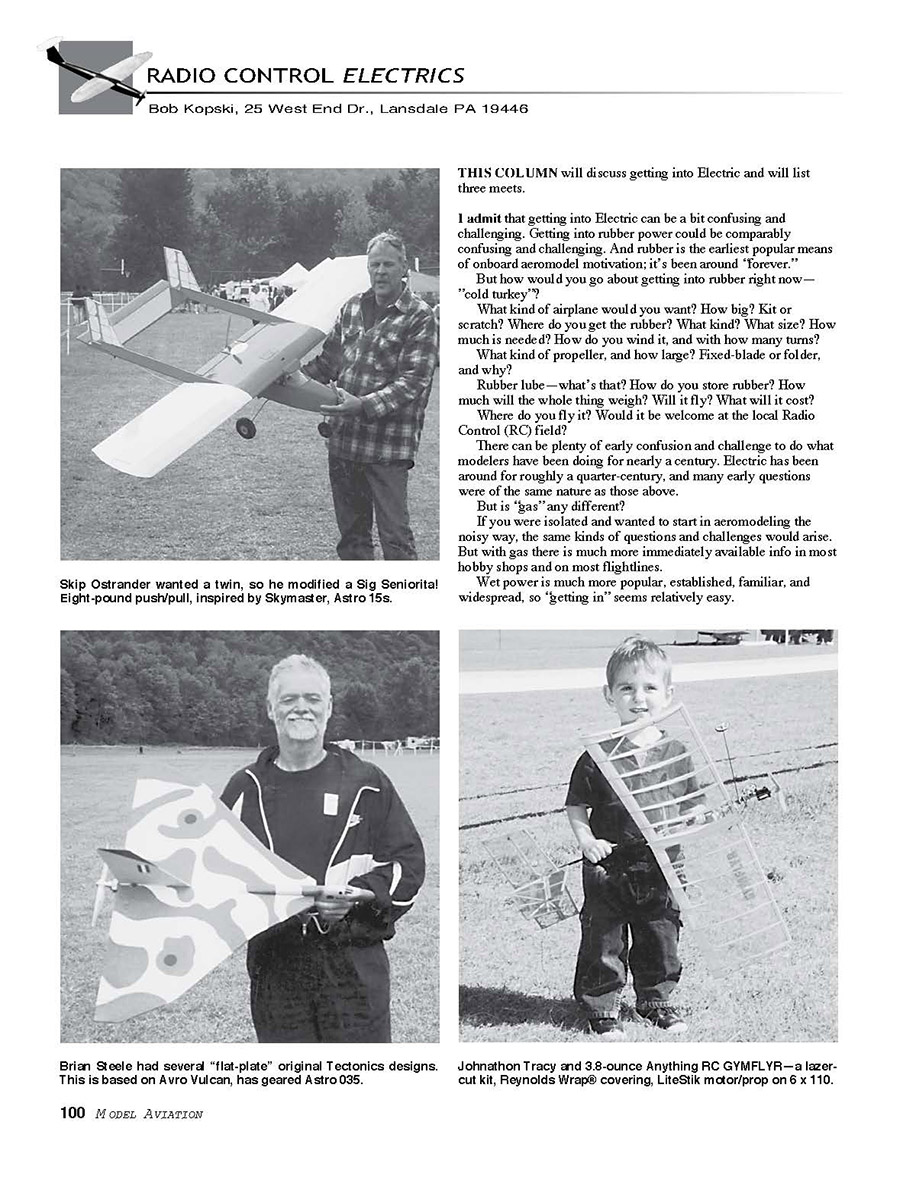
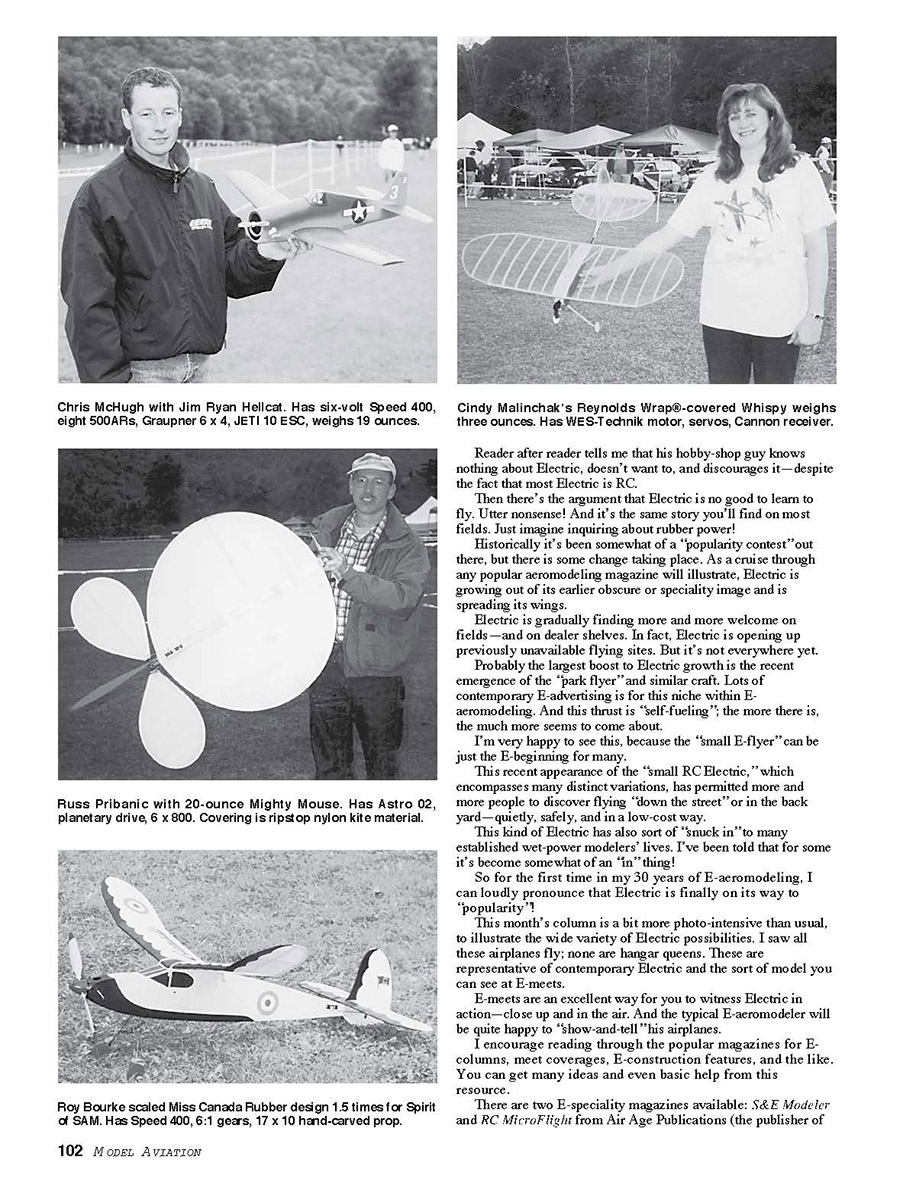
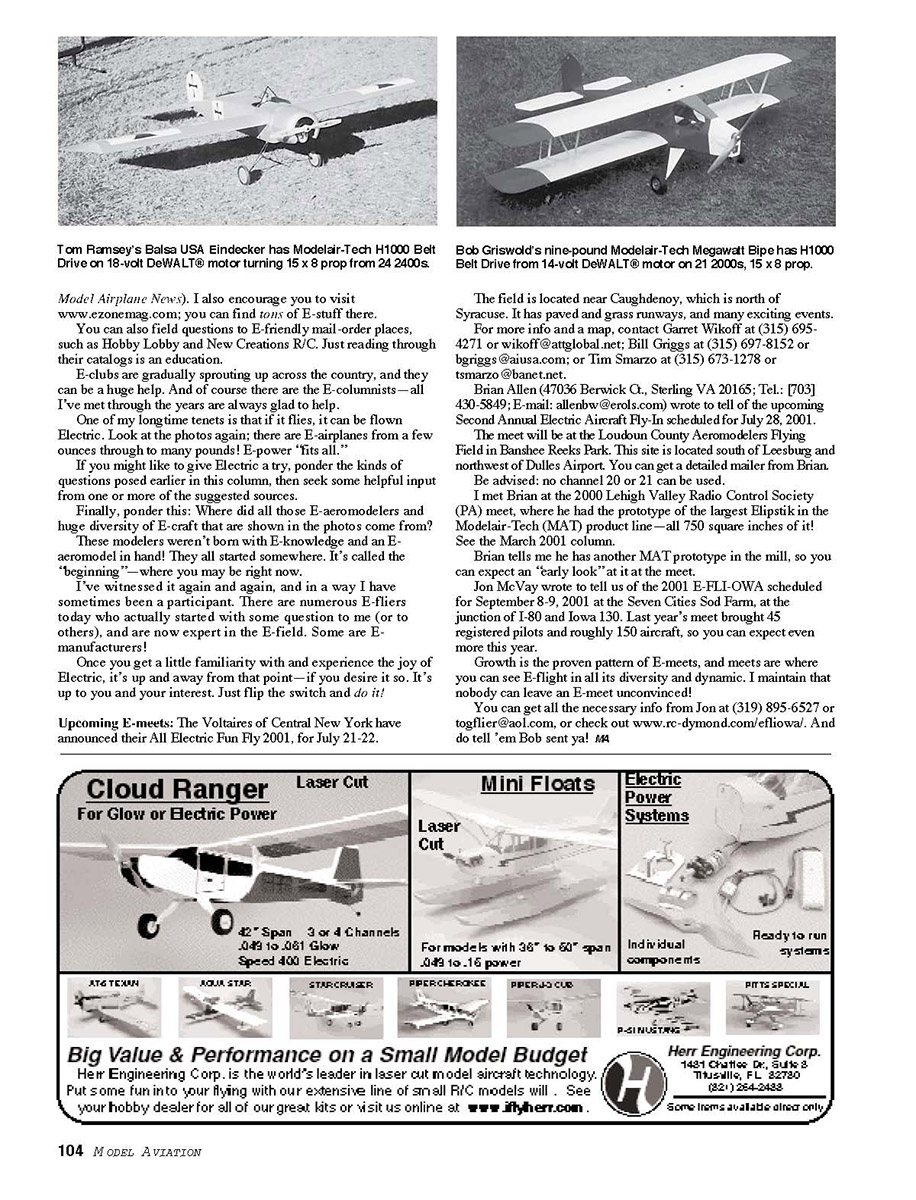
This month's column is a bit more photo-intensive than usual, to illustrate the wide variety of Electric possibilities. I saw all these airplanes fly; none are hangar queens. These are representative of contemporary Electric and the sort of model you can see at E-meets.
E-meets are an excellent way for you to witness Electric in action—close up and in the air. And the typical E-aeromodeler will be quite happy to "show-and-tell" his airplanes.
I encourage reading through the popular magazines for E-columns, meet coverages, E-construction features, and the like. You can get many ideas and even basic help from this resource.
There are two E-specialty magazines available: S&E Modeler and RC MicroFlight from Air Age Publications (the publisher of Model Airplane News). I also encourage you to visit www.ezonemag.com; you can find tons of E-stuff there.
You can also field questions to E-friendly mail-order places, such as Hobby Lobby and New Creations R/C. Just reading through their catalogs is an education.
E-clubs are gradually sprouting up across the country, and they can be a huge help. And of course there are the E-columnists—all I've met through the years are always glad to help.
One of my longtime tenets is that if it flies, it can be flown Electric. Look at the photos again; there are E-airplanes from a few ounces through to many pounds! E-power "fits all."
If you might like to give Electric a try, ponder the kinds of questions posed earlier in this column, then seek some helpful input from one or more of the suggested sources.
Finally, ponder this: Where did all those E-aeromodelers and huge diversity of E-craft that are shown in the photos come from? These modelers weren't born with E-knowledge and an E-aeromodel in hand! They all started somewhere. It's called the "beginning"—where you may be right now.
I've witnessed it again and again, and in a way I have sometimes been a participant. There are numerous E-fliers today who actually started with some question to me (or to others), and are now expert in the E-field. Some are E-manufacturers!
Once you get a little familiarity with and experience the joy of Electric, it's up and away from that point—if you desire it so. It's up to you and your interest. Just flip the switch and do it!
Upcoming E-meets
- The Voltaires of Central New York — All Electric Fun Fly 2001
- Date: July 21-22
- Location: Field near Caughdenoy, north of Syracuse; paved and grass runways
- Events: Many exciting events planned
- Contacts:
- Garret Wikoff: (315) 695-4271 or [email protected]
- Bill Griggs: (315) 697-8152 or [email protected]
- Tim Smarzo: (315) 673-1278 or [email protected]
- Second Annual Electric Aircraft Fly-In
- Date: July 28, 2001
- Location: Loudoun County Aeromodelers Flying Field in Banshee Reeks Park (south of Leesburg, northwest of Dulles Airport)
- Note: You can get a detailed mailer from Brian Allen
- Contact: Brian Allen, 47036 Berwick Ct., Sterling VA 20165; Tel.: (703) 430-5849; E-mail: [email protected]
- Be advised: no channel 20 or 21 can be used.
- Note: Brian had the prototype of the largest Elipstick in the Modelair-Tech (MAT) product line at the 2000 Lehigh Valley Radio Control Society meet; he has another MAT prototype in the mill.
- 2001 E-FLI-OWA
- Date: September 8-9, 2001
- Location: Seven Cities Sod Farm, at the junction of I-80 and Iowa 130
- Note: Last year's meet brought 45 registered pilots and roughly 150 aircraft
- Contact: Jon McVay at (319) 895-6527 or [email protected]
- Website: www.rc-dymond.com/efliowA
Growth is the proven pattern of E-meets, and meets are where you can see E-flight in all its diversity and dynamics. I maintain that nobody can leave an E-meet unconvinced!
You can get all the necessary info from Jon, Garret, Brian, or the other contacts listed above. And do tell 'em Bob sent ya!
Transcribed from original scans by AI. Minor OCR errors may remain.

