
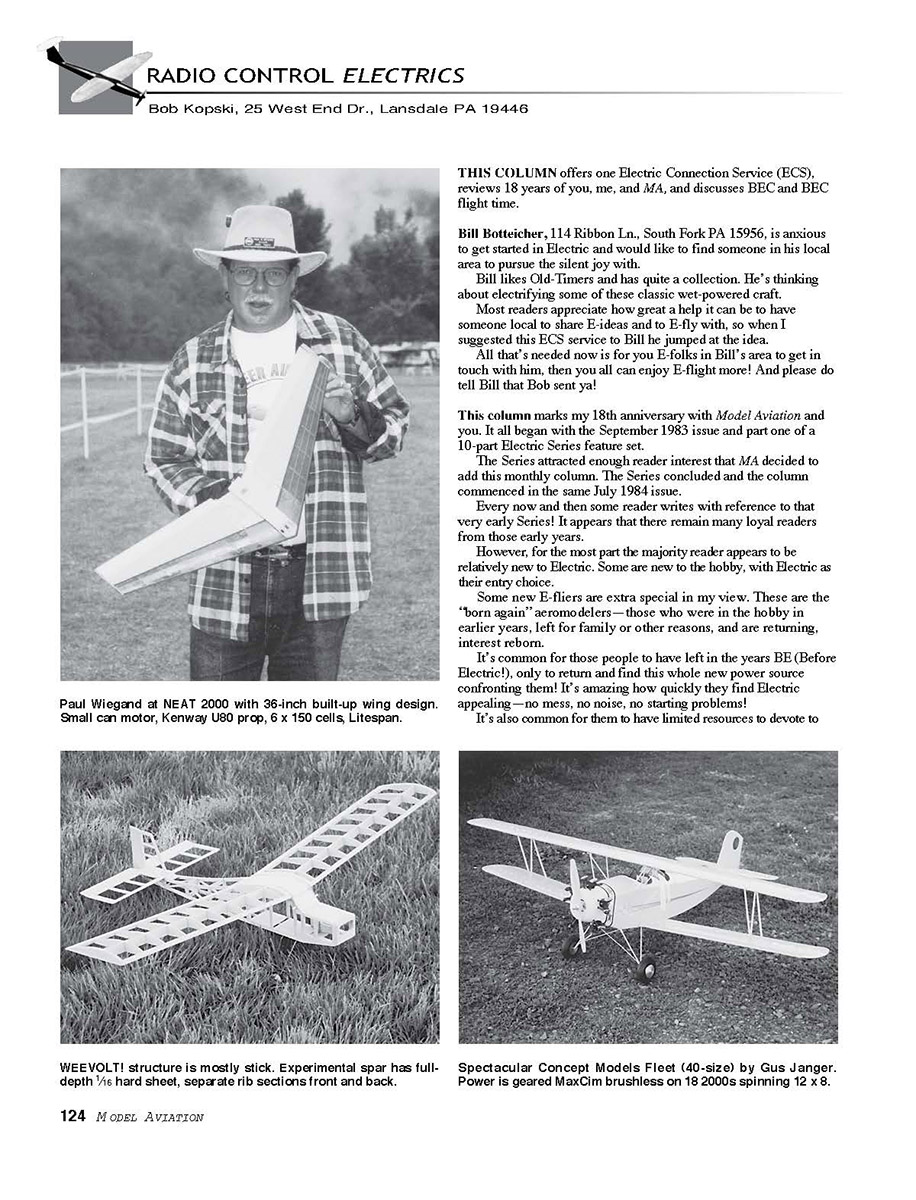
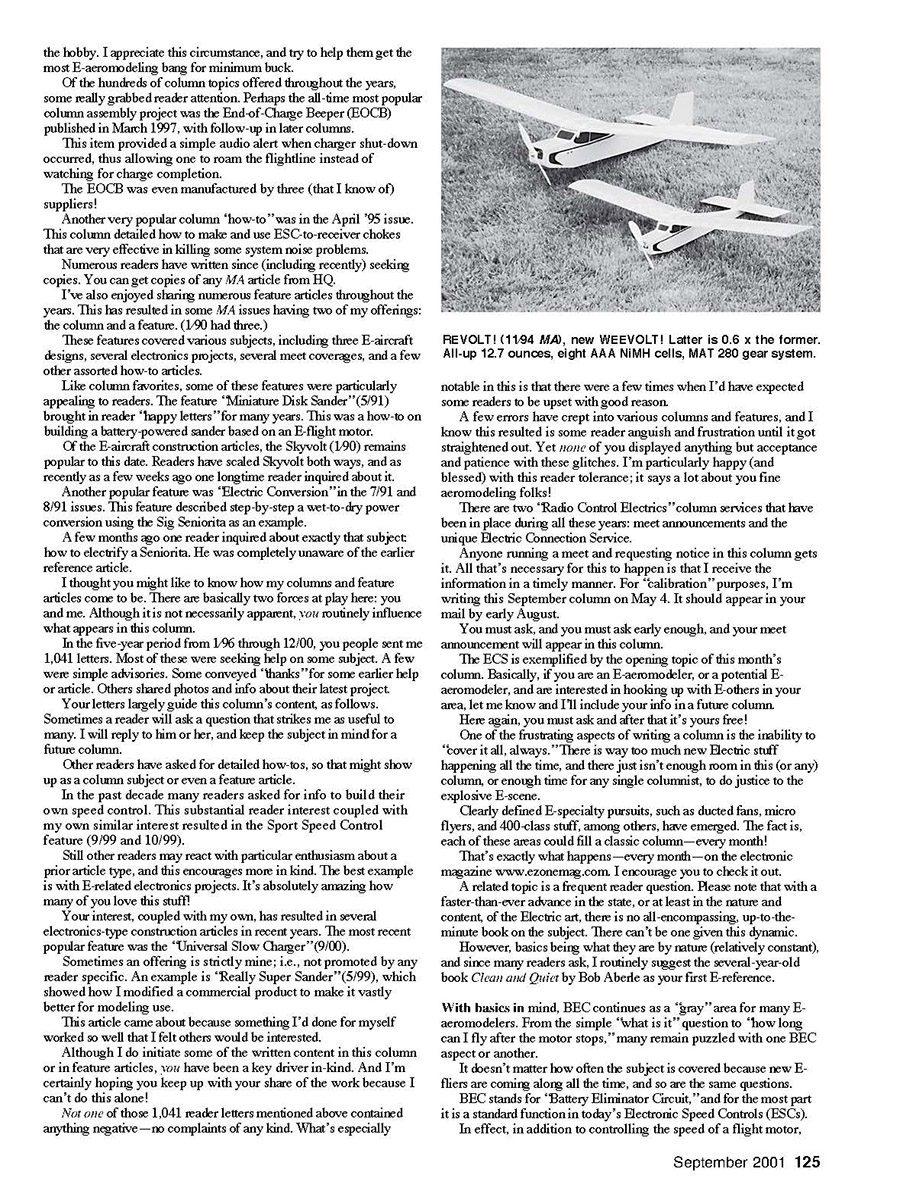
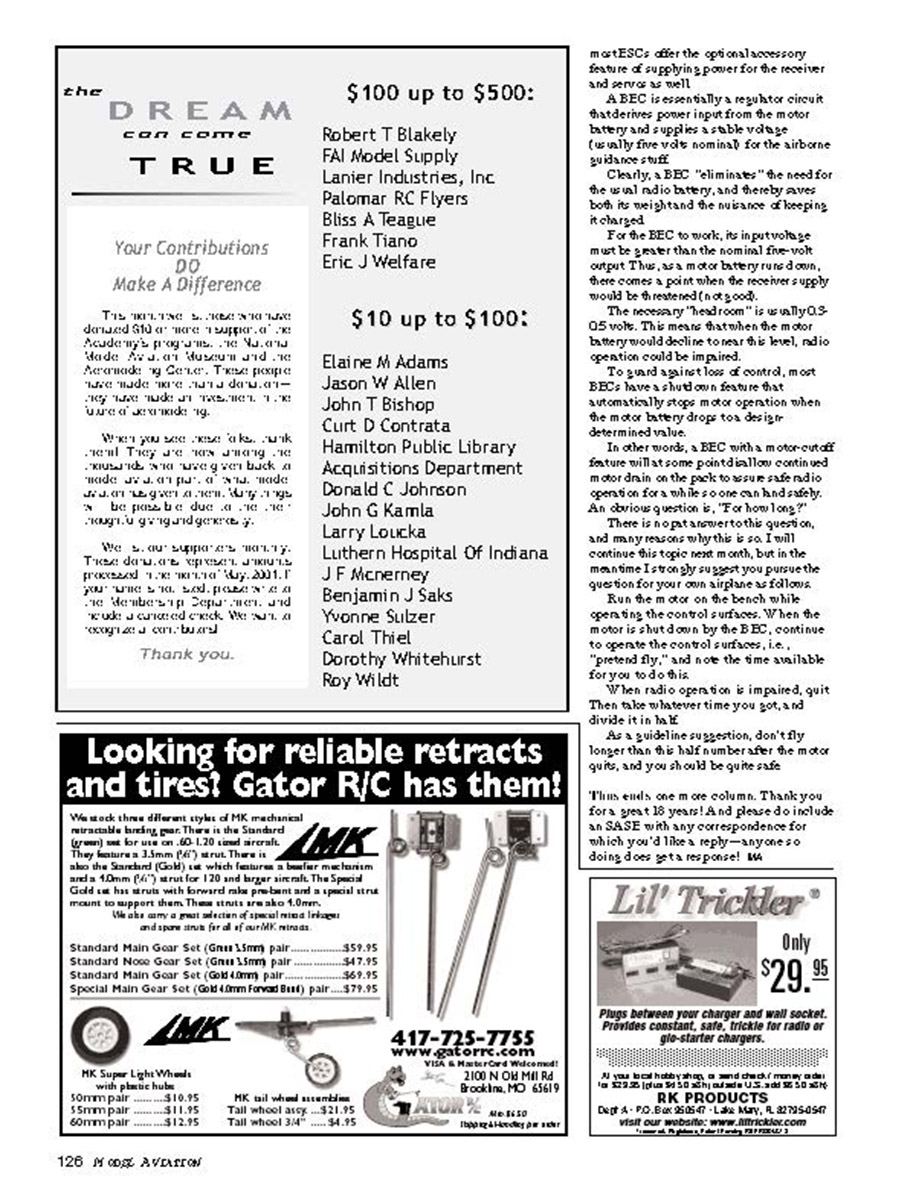
RC Electrics
Bob Kopski, 25 West End Dr., Lansdale PA 19446
Electric Connection Service (ECS) / Meet-up request
THIS COLUMN offers one Electric Connection Service (ECS), reviews 18 years of you, me, and MA, and discusses BEC and BEC flight time.
Bill Botteicher, 114 Ribbon Ln., South Fork PA 15956, is anxious to get started in electric and would like to find someone in his local area to pursue the silent joy with.
Bill likes Old-Timers and has quite a collection. He's thinking about electrifying some of these classic wet-powered craft.
Most readers appreciate how great a help it can be to have someone local to share E-ideas and to E-fly with, so when I suggested this ECS service to Bill he jumped at the idea.
All that's needed now is for you E-folks in Bill's area to get in touch with him, then you all can enjoy E-flight more! And please do tell Bill that Bob sent ya!
Eighteen-year retrospective
This column marks my 18th anniversary with Model Aviation and you. It all began with the September 1983 issue and part one of a 10-part Electric Series feature set.
The Series attracted enough reader interest that MA decided to add this monthly column. The Series concluded and the column commenced in the same July 1984 issue.
Every now and then some reader writes with reference to that very early Series! It appears that there remain many loyal readers from those early years.
However, for the most part the majority of readers appear to be relatively new to electric. Some are new to the hobby, with electric as their entry choice.
Some new E-fliers are extra special in my view. These are the "born again" aeromodelers—those who were in the hobby in earlier years, left for family or other reasons, and are returning, interest reborn.
It's common for those people to have left in the years BE (Before Electric!), only to return and find this whole new power source confronting them! It's amazing how quickly they find electric appealing—no mess, no noise, no starting problems!
It's also common for them to have limited resources to devote to the hobby. I appreciate this circumstance, and try to help them get the most E-aeromodelling bang for minimum buck.
Popular columns and features
Of the hundreds of column topics offered throughout the years, some really grabbed reader attention.
- Perhaps the all-time most popular column assembly project was the End-of-Charge Beeper (EOCB) published in March 1997, with follow-up in later columns. This item provided a simple audio alert when charger shut-down occurred, thus allowing one to roam the flightline instead of watching for charge completion. The EOCB was even manufactured by three (that I know of) suppliers.
- Another very popular column "how-to" was in the April 1995 issue. This column detailed how to make and use ESC-to-receiver chokes that are very effective in killing some system noise problems. Numerous readers have written since (including recently) seeking copies. You can get copies of any MA article from HQ.
I've also enjoyed sharing numerous feature articles throughout the years. This has resulted in some MA issues having two of my offerings: the column and a feature. (I had three.)
These features covered various subjects, including three E-aircraft designs, several electronics projects, several meet coverages, and a few other assorted how-to articles.
Like column favorites, some of these features were particularly appealing to readers.
- The feature "Miniature Disk Sander" (May 1991) brought in reader "happy letters" for many years. This was a how-to on building a battery-powered sander based on an E-flight motor.
- Of the E-aircraft construction articles, the Skybolt (January 1990) remains popular to this date. Readers have scaled both ways, and as recently as a few weeks ago one longtime reader inquired about it.
- Another popular feature was "Electric Conversion" in the July 1991 and August 1991 issues. This feature described step-by-step a wet-to-dry power conversion using the Sig Seniorita as an example. A few months ago one reader inquired about exactly that subject: how to electrify a Seniorita. He was completely unaware of the earlier reference article.
How column topics are chosen
I thought you might like to know how my columns and feature articles come to be. There are basically two forces at play here: you and me. Although it is not necessarily apparent, you routinely influence what appears in this column.
In the five-year period from January 1996 through December 2000, you people sent me 1,041 letters. Most of these were seeking help on some subject. A few were simple advisories. Some conveyed "thanks" for some earlier help or article. Others shared photos and info about their latest project.
Your letters largely guide this column's content, as follows.
- Sometimes a reader will ask a question that strikes me as useful to many. I will reply to him or her, and keep the subject in mind for a future column.
- Other readers have asked for detailed how-tos, so that might show up as a column subject or even a feature article.
- In the past decade many readers asked for info to build their own speed control. This substantial reader interest coupled with my own similar interest resulted in the Sport Speed Control feature (September 1999 and October 1999).
- Still other readers may react with particular enthusiasm about a prior article type, and this encourages more in kind. The best example is with E-related electronics projects. It's absolutely amazing how many of you love this stuff!! Your interest, coupled with my own, has resulted in several electronics-type construction articles in recent years. The most recent popular feature was the "Universal Slow Charger" (September 2000).
Sometimes an offering is strictly mine; i.e., not prompted by any reader specific. An example is "Really Super Sander" (May 1999), which showed how I modified a commercial product to make it vastly better for modeling use. This article came about because something I'd done for myself worked so well that I felt others would be interested.
Although I do initiate some of the written content in this column or in feature articles, you have been a key driver in-kind. And I'm certainly hoping you keep up with your share of the work because I can't do this alone!
Not one of those 1,041 reader letters mentioned above contained anything negative—no complaints of any kind. What's especially notable in this is that there were a few times when I'd have expected some readers to be upset with good reason.
A few errors have crept into various columns and features, and I know this resulted in some reader anguish and frustration until it got straightened out. Yet none of you displayed anything but acceptance and patience with these glitches. I'm particularly happy (and blessed) with this reader tolerance; it says a lot about you fine aeromodeling folks!
Column services and announcements
There are two "Radio Control Electrics" column services that have been in place during all these years: meet announcements and the unique Electric Connection Service.
- Anyone running a meet and requesting notice in this column gets it. All that's necessary for this to happen is that I receive the information in a timely manner. For "calibration" purposes, I'm writing this September column on May 4. It should appear in your mail by early August. You must ask, and you must ask early enough, and your meet announcement will appear in this column.
- The ECS is exemplified by the opening topic of this month's column. Basically, if you are an E-aeromodeler, or a potential E-aeromodeler, and are interested in hooking up with E-others in your area, let me know and I'll include your info in a future column. Here again, you must ask and after that it's your free!
One of the frustrating aspects of writing a column is the inability to "cover it all". Always there is way too much new electric stuff happening all the time, and there just isn't enough room in this (or any) column, or enough time for any single columnist, to do justice to the explosive E-scene.
Clearly defined E-specialty pursuits, such as ducted fans, micro flyers, and 400-class stuff, among others, have emerged. The fact is, each of these areas could fill a classic column—every month!
That's exactly what happens—every month—on the electronic magazine www.ezonemag.com. I encourage you to check it out.
A related topic is a frequent reader question. Please note that with a faster-than-ever advance in the state, or at least in the nature and content, of the electric art, there is no all-encompassing, up-to-the-minute book on the subject. There can't be one given this dynamic.
However, basics being what they are by nature (relatively constant), and since many readers ask, I routinely suggest the several-year-old book Clean and Quiet by Bob Aberle as your first E-reference.
BEC (Battery Eliminator Circuit) overview
With basics in mind, BEC continues as a "gray" area for many E-aeromodellers. From the simple "what is it" question to "how long can I fly after the motor stops," many remain puzzled with one BEC aspect or another.
It doesn't matter how often the subject is covered because new E-fliers are coming along all the time, and so are the same questions.
BEC stands for "Battery Eliminator Circuit," and for the most part it is a standard function in today's Electronic Speed Controls (ESCs). In effect, in addition to controlling the speed of a flight motor, most ESCs offer the optional accessory feature of supplying power for the receiver and servos as well.
A BEC is essentially a regulator circuit that derives power input from the motor battery and supplies a stable voltage (usually five volts nominal) for the airborne guidance stuff.
Clearly, a BEC "eliminates" the need for the usual radio battery, and thereby saves both its weight and the nuisance of keeping it charged.
For the BEC to work, its input voltage must be greater than the nominal five-volt output. Thus, as a motor battery runs down, there comes a point when the receiver supply would be threatened (not good).
The necessary "headroom" is usually 0.5–0.8 volt. This means that when the motor battery would decline to near this level, radio operation could be impaired.
To guard against loss of control, most BECs have a shutdown feature that automatically stops motor operation when the motor battery drops to a pre-determined value.
In other words, a BEC with a motor-cutoff feature will at some point allow continued motor drain on the pack to ensure safe radio operation for a while on one hand and safety on the other. An obvious question is, "For how long?"
There is no pat answer to this question, and many reasons why this is so. I will continue this topic next month, but in the meantime I strongly suggest you pursue the question for your own airplane as follows.
- Run the motor on the bench while operating the control surfaces.
- When the motor is shut down by the BEC, continue to operate the control surfaces, i.e., "pretend fly," and note the time available for you to do this.
- When radio operation is impaired, quit.
- Then take whatever time you got, and divide it in half.
As a guideline suggestion, don't fly longer than this half-number after the motor quits, and you should be quite safe.
Closing
That's still one more column. Thank you for a nice 18 years! And please do include an SASE with any correspondence for which you'd like a reply—anyone so doing does get a response!
MA
Transcribed from original scans by AI. Minor OCR errors may remain.

