
RC Electrics
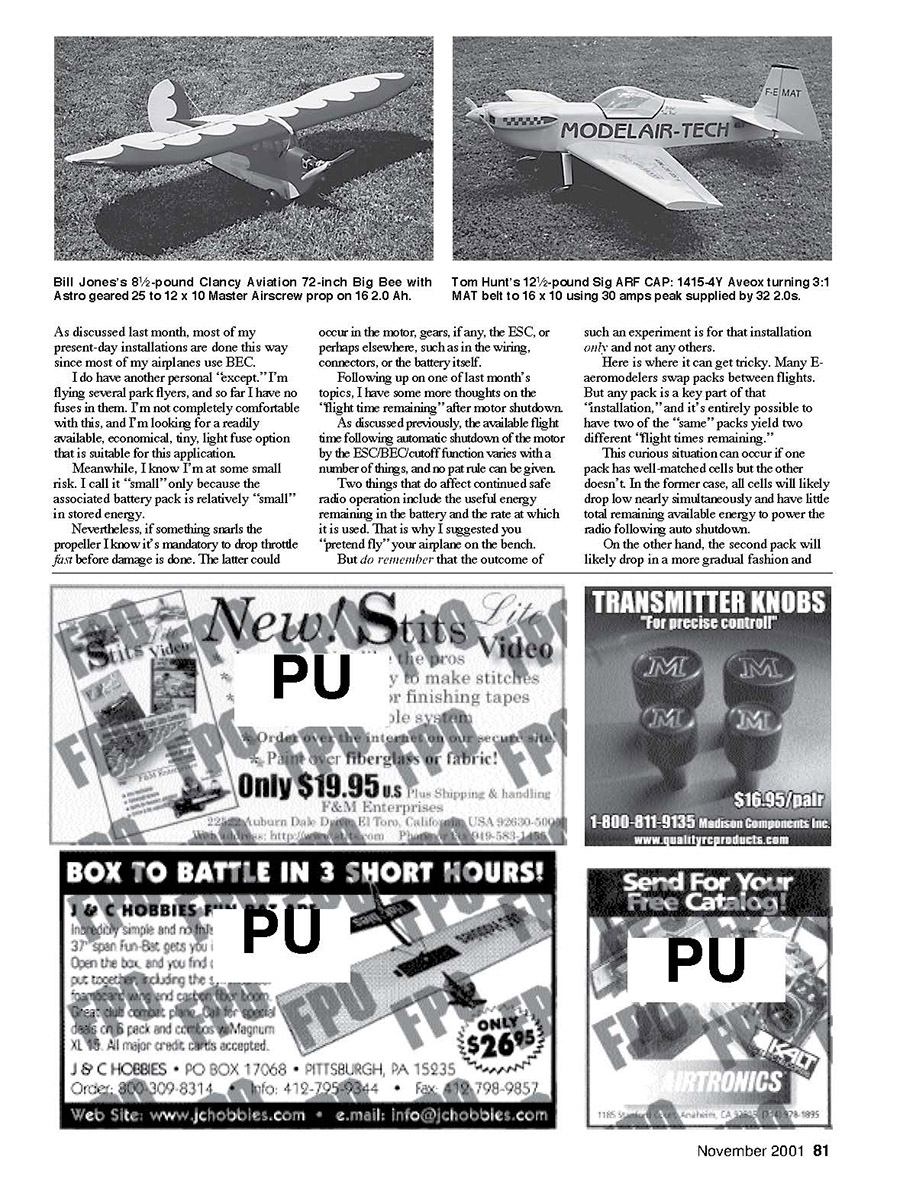
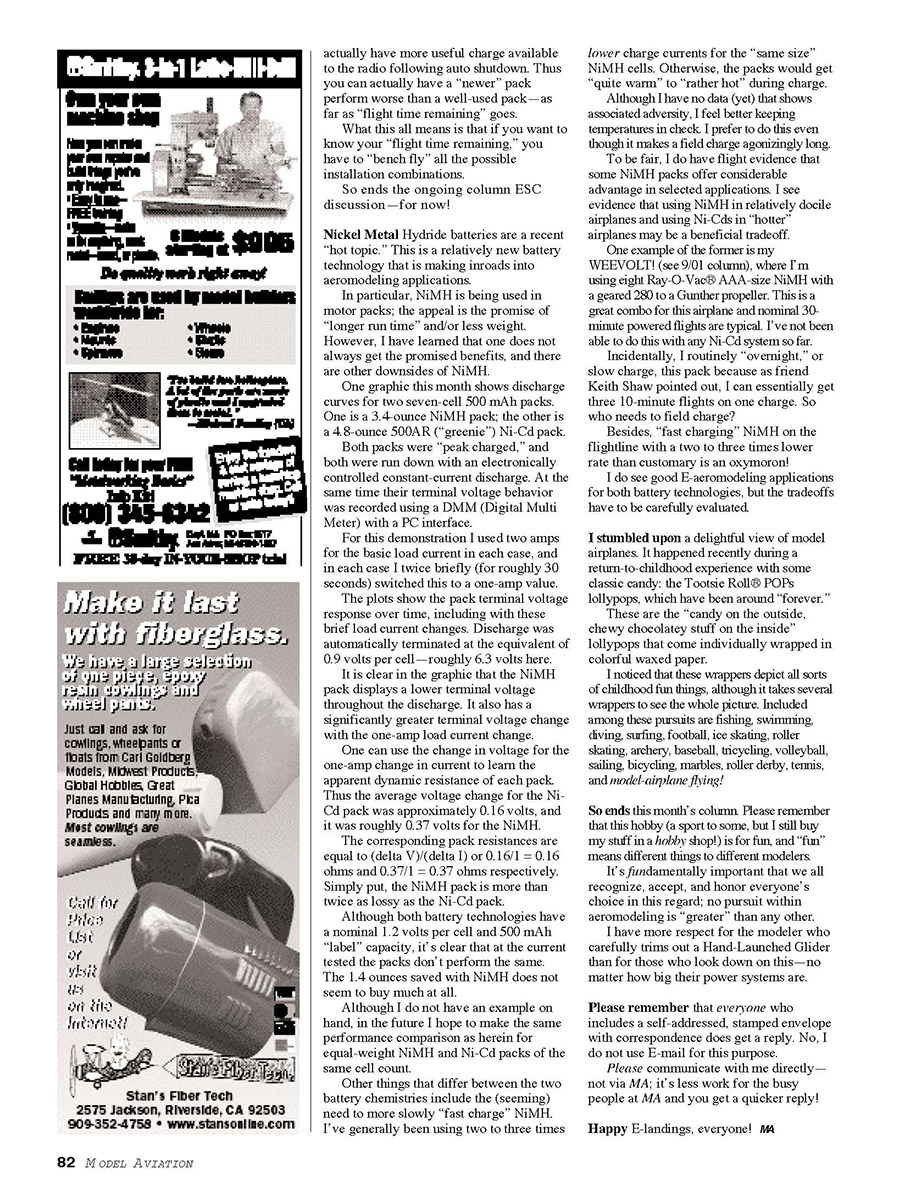
THIS COLUMN concludes the ongoing discussion of Electronic Speed Controls (ESCs), and shares some NiMH/Ni-Cd observations and a delightful aeromodeling legacy. The photos are from the 2001 Lehigh Valley Radio Control Society (PA) meet.
The last two columns included discussion of ESCs, primarily for the benefit of E-aeromodeling newcomers. This presentation was prompted by reader letters—as are many column topics.
It seems that there is a never-ending arrival of beginning E-modelers, which is great! That in itself mandates occasional information "recycling" in this column. I'm not sure there is a better use for this column space!
This ongoing ESC discussion began in the September column. This is an overview of some basic ESC topics—not an all-inclusive ESC documentary. The closest you can get to the latter (as far as I know) is with Bernard Cawley's "A Controlling Interest" column at ezonemag.com.
Visit this site, and do access the topical archives for a huge store of detailed ESC product and operational information.
Now for some ESC-related installation and application notes.
Many readers who are beginners ask about fuses. As do many subjects, fuses often invoke strong personal preferences among experienced E-fliers, but surely most will agree that fuses are a good idea. Like fuses (or the contemporary "breakers" in your home), the fundamental idea is safety and protection.
My preference is to fuse right after the battery and before any other power-system stuff except with ESC installations that are using Battery Eliminator Circuit (BEC). In that case I fuse between the ESC and the motor. The rationale is simple.
As in your home, fuses (or breakers) are best located before any "loads." A load could be a toaster or television in your home or an ESC/motor installation in your Electric.
Thus installing protection right where the wiring enters your plane and, similarly, right at the battery in your model protects everything after the power source in either case.
But what about that "except" in the preceding?
If you are using the BEC feature now common in ESCs and as discussed in the last two columns, the best location for a fuse is between the ESC and the motor. If some overload befell the motor, the fuse would blow, protecting the latter while still allowing the ESC/BEC to power the radio.
This installation approach is a good compromise, and I routinely do it myself.
actually have more useful charge available to the radio following auto shutdown. Thus you can actually have a "newer" pack perform worse than a well-used pack—as far as "flight time remaining" goes.
What this all means is that if you want to know your "flight time remaining," you have to "bench fly" all the possible installation combinations.
So ends the ongoing column ESC discussion—for now!
Nickel Metal Hydride batteries are a recent "hot topic." This is a relatively new battery technology that is making inroads into aeromodelling applications.
In particular, NiMH is being used in motor packs; the appeal is the promise of "longer run time" and/or less weight. However, I have learned that one does not always get the promised benefits, and there are other downsides of NiMH.
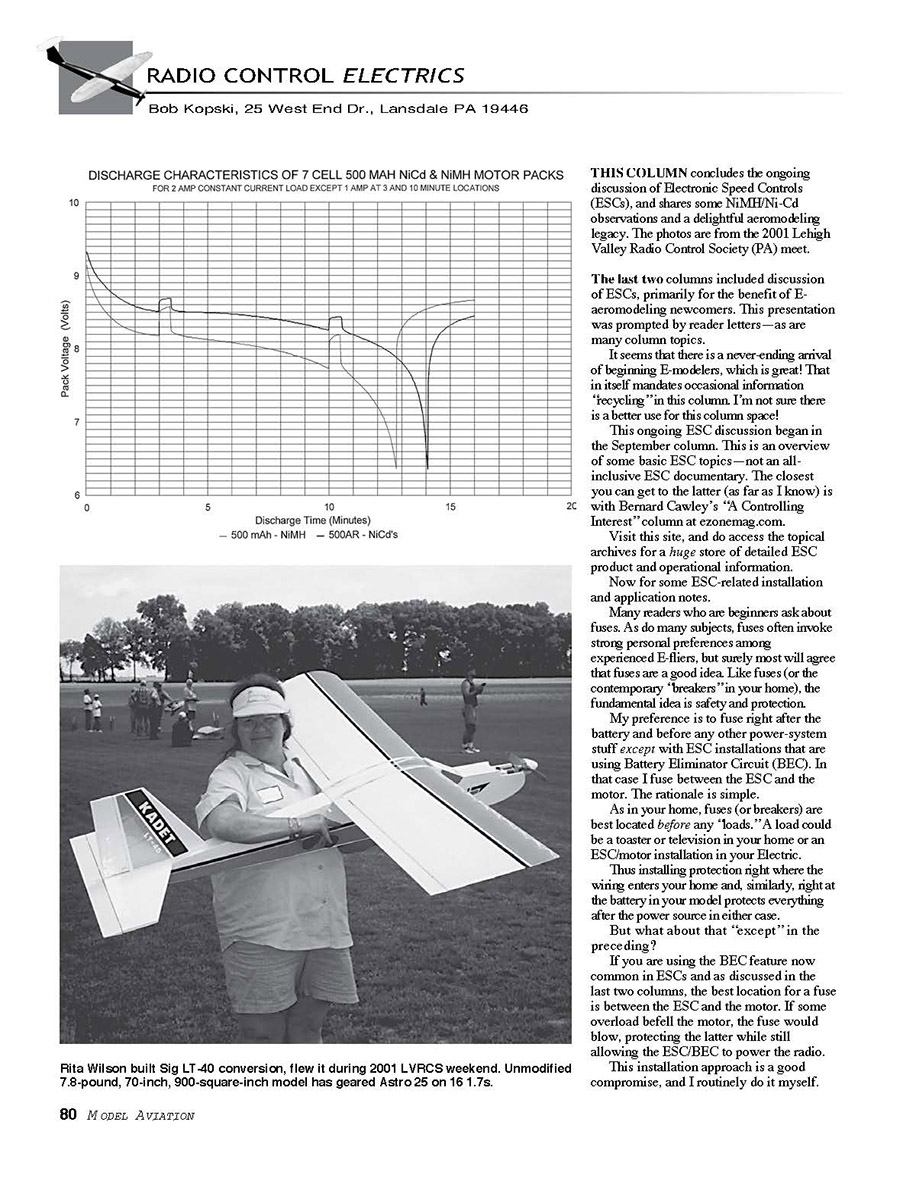
One graphic this month shows discharge curves for two seven-cell 500 mAh packs. One is a 3.4-ounce NiMH pack, the other is a 4.8-ounce 500AR ("greencie") Ni-Cd pack.
Both packs were "peak charged," and both were run down with an electronically controlled constant-current discharge. At the same time their terminal voltage behavior was recorded using a DMM (Digital Multi Meter) with a PC interface.
For this demonstration I used two amps for the basic load current in each case, and in each case I twice briefly (for roughly 30 seconds) switched this to a one-amp value.
The plots show the pack terminal voltage response over time, including with these brief load current changes. Discharge was automatically terminated at the equivalent of 0.9 volts per cell—roughly 6.3 volts here.
It is clear in the graphic that the NiMH pack displays a lower terminal voltage throughout the discharge. It also has a significantly greater terminal voltage change with the one-amp load current change.
One can use the change in voltage for the one-amp change in current to learn the apparent dynamic resistance of each pack. Thus the average voltage change for the Ni-Cd pack was approximately 0.16 volts, and it was roughly 0.37 volts for the NiMH.
The corresponding pack resistances are equal to (delta V)/(delta I) or 0.16/1 = 0.16 ohms and 0.37/1 = 0.37 ohms respectively. Simply put, the NiMH pack is more than twice as lossy as the Ni-Cd pack.
Although both battery technologies have a nominal 1.2 volts per cell and 500 mAh "label" capacity, it's clear that at the current tested the packs don't perform the same. The 1.4 ounces saved with NiMH does not seem to buy much at all.
Although I do not have an example on hand, in the future I hope to make the same performance comparison as herein for equal-weight NiMH and Ni-Cd packs of the same cell count.
Other things that differ between the two battery chemistries include the (seeming) need to more slowly "fast charge" NiMH. I've generally been using two to three times lower charge currents for the "same size" NiMH cells. Otherwise, the packs would get "quite warm" to "rather hot" during charge.
Although I have no data (yet) that shows associated adversity, I feel better keeping temperatures in check. I prefer to do this even though it makes a field charge agonizingly long.
To be fair, I do have flight evidence that some NiMH packs offer considerable advantage in selected applications. I see evidence that using NiMH in relatively docile airplanes and using Ni-Cds in "hotter" airplanes may be a beneficial tradeoff.
One example of the former is my WEEVOLT! (see 9/01 column), where I'm using eight Ray-O-Vac® AAA-size NiMH with a geared 280 to a Gunter propeller. This is a great combo for this airplane and nominal 30-minute powered flights are typical. I've not been able to do this with any Ni-Cd system so far.
Incidentally, I routinely "overnight," or slow charge, this pack because as friend Keith Shaw pointed out, I can essentially get three 10-minute flights on one charge. So who needs to field charge?
Besides, "fast charging" NiMH on the flightline with a two to three times lower rate than customary is an oxymoron!
I do see good E-aeromodelling applications for both battery technologies, but the tradeoffs have to be carefully evaluated.
I stumbled upon a delightful view of model airplanes. It happened recently during a return-to-childhood experience with some classic candy: the Tootsie Roll® POPs lollipops, which have been around "forever."
These are the "candy on the outside, chewy chocolaty stuff on the inside" lollipops that come individually wrapped in colorful waxed paper.
I noticed that these wrappers depict all sorts of childhood fun things, although it takes several wrappers to see the whole picture. Included among these pursuits are fishing, swimming, diving, surfing, football, ice skating, roller skating, archery, baseball, bicycling, volleyball, sailing, bicycling marbles, roller derby, tennis, and model-airplane flying!
So ends this month's column. Please remember that this hobby (a sport to some, but I still buy my stuff in a hobby shop!) is for fun, and "fun" means different things to different modelers.
It's fundamentally important that we all recognize, accept, and honor everyone's choice in this regard; no bravado and aeromodeling is "greater" than any other.
I have more respect for the modeler who carefully trims out a Hand-Launched Glider than for those who look down on this—no matter how big their power systems are.
Please remember that everyone who includes a self-addressed, stamped envelope with correspondence does get a reply. No, I do not use E-mail for this purpose.
Please communicate with me directly—not via MA; it's less work for the busy people at MA and you get a quicker reply!
Happy E-landings, everyone! MA
Transcribed from original scans by AI. Minor OCR errors may remain.

