
RC Electrics
Tom Hunt, 1 Dianne Ave., Centereach NY 11720
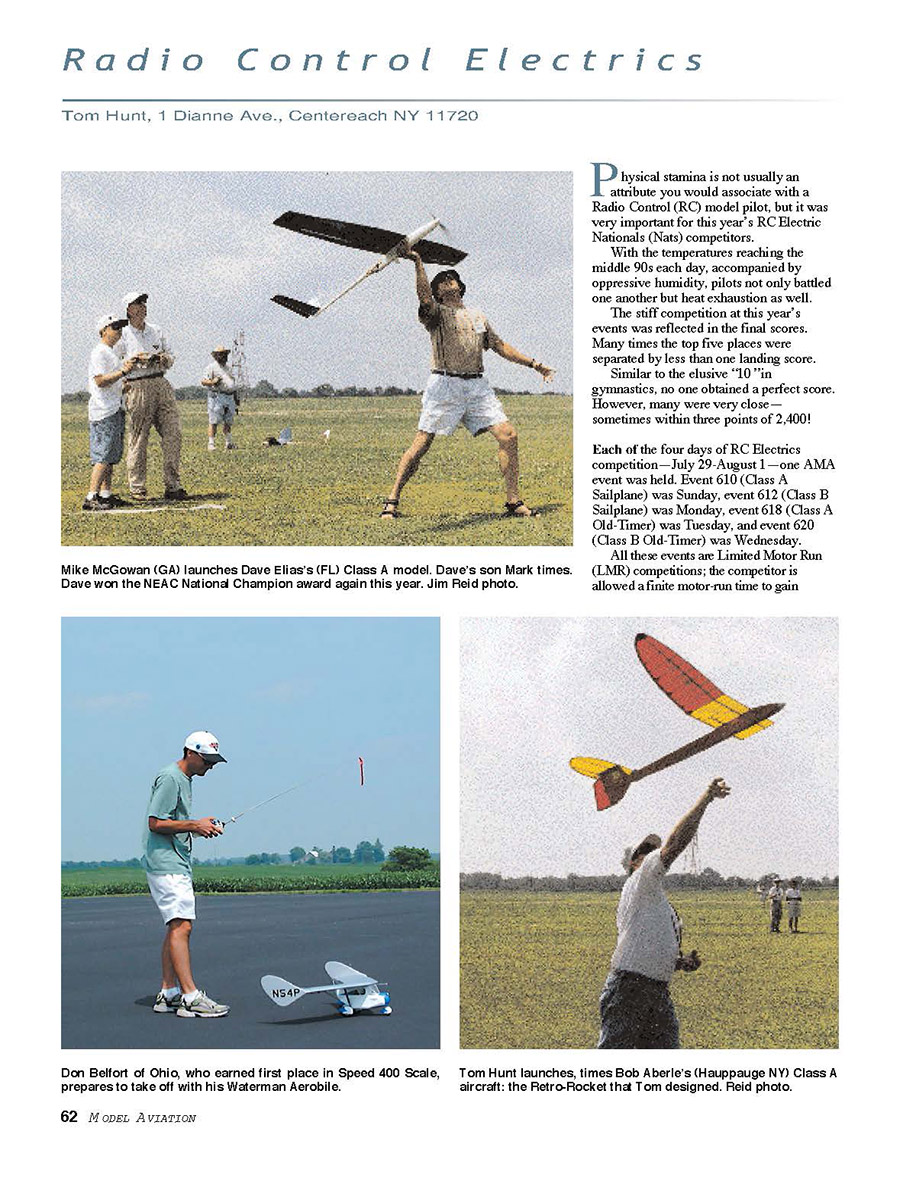
Physical stamina is not usually an attribute you would associate with a Radio Control (RC) model pilot, but it was very important for this year's RC Electric Nationals (Nats) competitors.
With the temperatures reaching the middle 90s each day, accompanied by oppressive humidity, pilots not only battled one another but heat exhaustion as well.
The stiff competition at this year's events was reflected in the final scores. Many times the top five places were separated by less than one landing score.
Similar to the elusive "10" in gymnastics, no one obtained a perfect score. However, many were very close—sometimes within three points of 2,400!
Each of the four days of RC Electrics competition—July 29–August 1—one AMA event was held. Event 610 (Class A Sailplane) was Sunday, event 612 (Class B Sailplane) was Monday, event 618 (Class A Old-Timer) was Tuesday, and event 620 (Class B Old-Timer) was Wednesday.
All these events are Limited Motor Run (LMR) competitions; the competitor is allowed a finite motor-run time to gain altitude then must glide his or her model to a landing precisely eight minutes after launch.
Coming to a stop in a 20- or 40-foot-diameter circle gains the pilot 20 or 10 bonus points.
National Electric Aircraft Council (NEAC) events were also held each day. 1/2A Sailplane (similar to Class A Sailplane, but the motor must be a Mabuchi RS-380 or equivalent) was held Sunday.
Sport Electric Sailplane (also similar to Class A Sailplane, but only rudder, elevator, and spoilers may be used to control the model) was held Monday.
1/2A Texaco Old-Timer (an endurance event using the RS-380 motor) was held Tuesday, and 1/2A Pylon and Electric Scale took place Wednesday.
The winners in each of the official events are listed elsewhere in this issue, so I won't include the standings here, but I will point out that brushless motors dominated the winning places in Class A and B Sailplane.
This year Hacker brushless motors (from Germany) were keeping pace with the domestic Aveox brand. However, a few AstroFlight geared brush motors gained a few places in Class A and B Old-Timer.
As has happened in past years, many pilots used the same models in Class A and B Sailplane; generally, the only change was the cell count and the propeller used. When different Class B models were used, they were significantly bigger aircraft and carried more battery cells.
Class A and B Old-Timer had a similar theme, with each pilot using the Class A model in the Class B event with an additional cell or two.
Although it was very hot, thermal activity was not always present throughout the four days. You had to pick the proper part of the sky and the right time to fly. Conditions in any part of the sky seemed to change minute by minute.
When thermals were found, they were generally very strong, and it seemed as if you could thermal a brick. Many times during the climbout I was rising through lift. The model continued to climb aggressively when the motor was shut down.
Thermal activity seemed to be more elusive much later in the day, making the "thermal-sniffing" pilots rise to the top of the pack. No throwaway rounds were offered; each flight had to be your best!
Each day, three rounds in the NEAC LMR events and two rounds in the NEAC Texaco (endurance) event were scheduled. With five AMA rounds also scheduled most days, it made for a busy competition!
The second day of competition, the fairly new Sport Electric Sailplane event was run in a similar format. This category allows rather long motor run (two minutes) but requires only a 10-minute total flight (electric in-ute glide).
The models are limited to 100 inch span and rudder-elevator-spoiler control (RES). This event was envisioned as a "low-tech," fly-whatever-you-have contest.
Typically, any good Two-Meter Glider and an inexpensive OS motor and gearbox can carry this type of model to the limit of the normal modeller's vision in two minutes—more than high enough to hunt thermals. Some modelers even flew their Old-Timers in this event.
Only seven points of 1,000 separated the top three places; Eric Vaughn (Manito, CA) took first, Tom Jacobson second, and Ron Schanck took third.
Tuesday proved to be a great day for the SA Texaco/Old-Timer event. A mild morning and a light breeze the rest of the day was just what these light and sometimes frail models needed.
The object of this event is to fly the model for 15 minutes using a maximum of seven cells of 600 mAh capacity. The motor is restricted to the Mabuchi RS-380 type.
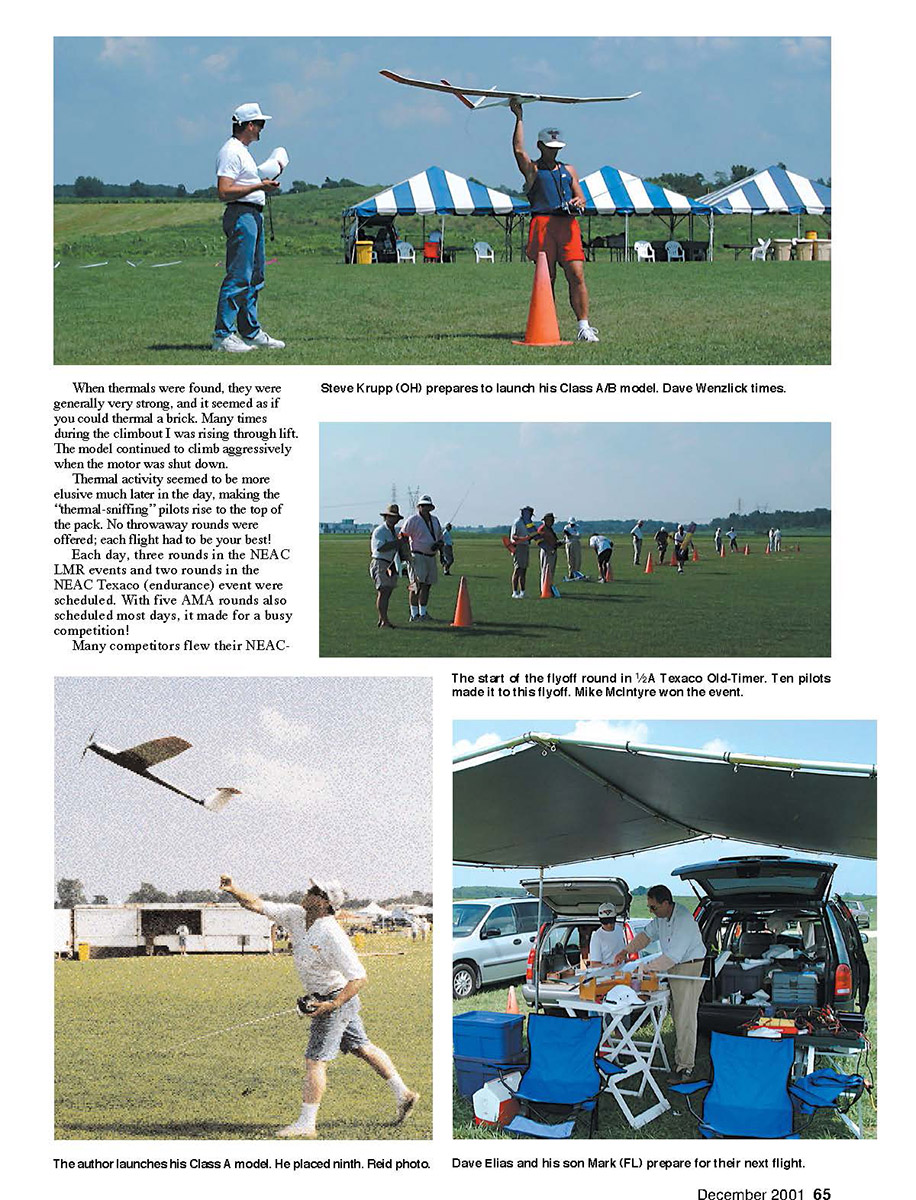
Because of the great conditions and some advances in motor/gear/prop technology, 10 of the 15 entrants made two 15-minute flights, which advanced them to the flyoff round later in the afternoon.
After the A-M-A Class Old-Timer event was finished at 4 p.m., 10 pilots and their models assembled at the flightline for a slightly staggered mass-launch flyoff.
It was wonderful to see 10 majestic Free-Flight-type models from the late 1930s and early 1940s flying slowly around the blue-and-white sky.
Mike McIntyre's (Plainfield IL) Buzzard Bomber was the last model down 25 minutes and 28 seconds later. Jack Hiner's (Downers Grove IL) model landed less than 10 seconds before Mike's for second place, and Ric Vaughn's airplane landed less than a minute before that for third place.
Wednesday, the last day of the competition, was busy. Besides having to fly three rounds of Class B Old-Timer, Speed 400 Pylon races were staged between 7 a.m. and 10 a.m. for seven racers, and Electric Fun Scale was held later in the day.
Helpers got to the field early to set up the Pylon course, which is similar to that of the Nats Glow Pylon event. Ten laps around the course in a man-on-man format were run.
Each pilot was allowed to lose only once; he became an armchair pilot after the second loss.
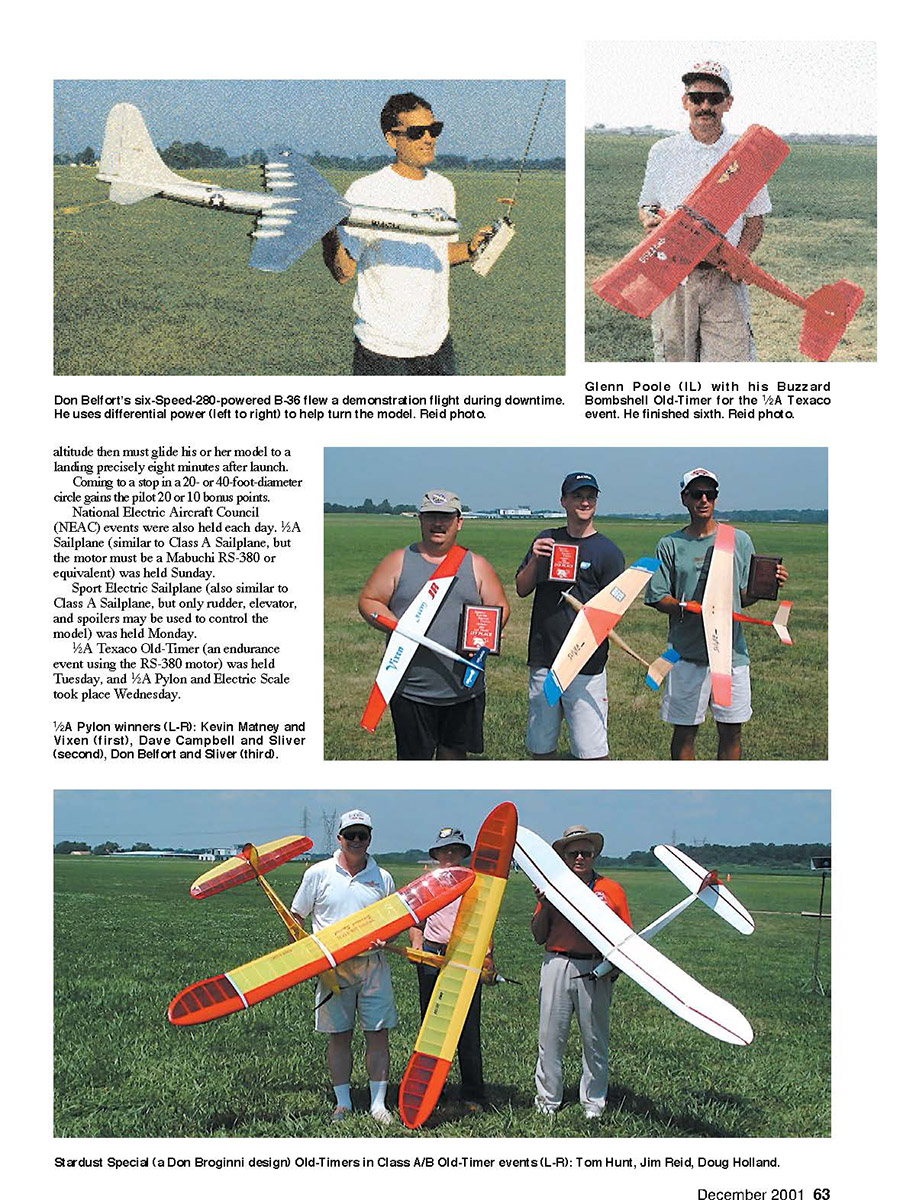
After the double-elimination rounds were finished, Kevin Matranga was the fastest man on the field, flying a Vortex. David Campbell finished second, and Don Belfort placed third.
David and Don each flew a Sliver—an Arnett-designed ship. Kevin's fastest flight was his latest 1:26. That's not the fastest time I have seen, but it was very fast considering the high temperature and humidity (propeller-efficiency killers) even early that morning!
Later that day, Electric Fun Scale was held after Class B Old-Timer was finished. Three models competed with Speed 400-powered models, and one geared .05-powered airplane and one geared .15 model were entered.
Models were judged for static points and for each of two flying rounds. The event score was a total of the three.
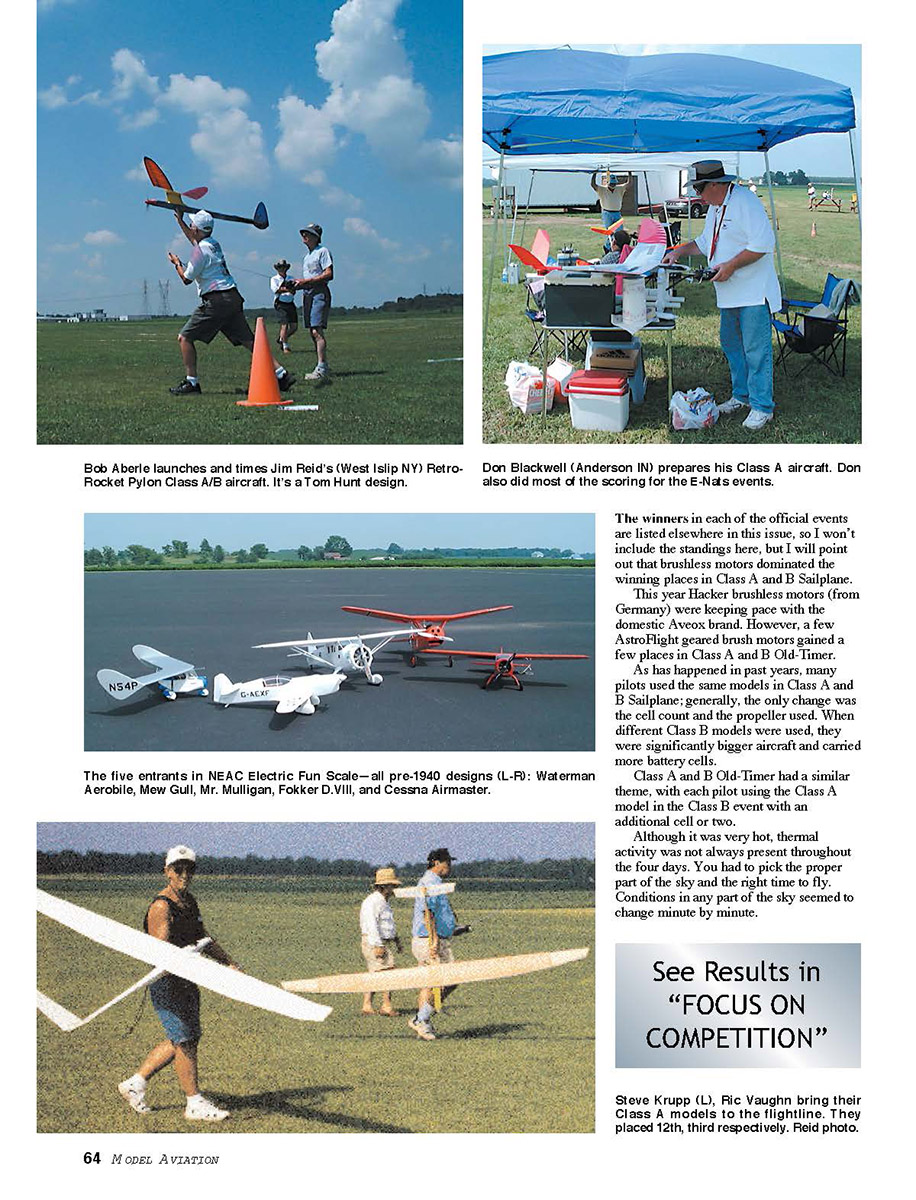
All four models in Electric Fun Scale were pre-1940 designs! They were Jim Reid's (West Liberty NC) Gee Bee C.1-45, my Percival E.2b, Melow, Steve Krupp's (Galena OH) DGA-6, M. Mulligan, Glenn Poole's (Naperville IL) Fokker D.VII, and Don Belfort's Waterman Aerobile.
After the second round of flights were scored, I finished in first place, Jim Reid earned second, and Glenn Poole was third. Don Belfort won first place for the highest-scoring Speed 400 model.
NEAC awards a trophy to the modeler who places the highest in all the AMA- and NEAC-hosted events. Dave Elias (Jupiter FL) took those honors, as he did last year, with the most placing points.
Dave handily won with 50 cumulative points, beating the next highest placing competitor by 17 points!
The 2001 E-Nats was managed and run smoothly, mostly because of the hard work of Ralph Weaver (NEAC president and E-Nats Contest Director) and his significant helper/scorekeeper Don Blackwell. Many thanks to them.
Brushless motors and controllers are coming down quickly in price. Having to spend a great deal of money to be competitive in the E-Nats is a given anymore.
A capable model with a practiced pilot is what is needed to place well in any of the official AMA events.
Build something, fly it often, and come out next year and join the fun! (Pray it's not too hot!)
If you have any questions about getting started, feel free to E-mail me at [email protected].
Transcribed from original scans by AI. Minor OCR errors may remain.

