
RADIO CONTROL ELECTRICS
Bob Kopski, 25 West End Dr., Lansdale PA 19446
THIS MONTH I will review some sources of E-information, including a new video, and offer an updated look at the Lite Stik, including a controversy!
Through the years I have steadfastly encouraged readers to gather and hold all E-information that can be found. In effect, I've encouraged the idea of having your own E-library, made from collected E-columns, construction and related features, meet coverages, and the like.
In all, there has been a huge amount of good info published in the past decade (and more), and even though a particular topic may not be of contemporary interest, chances are it will eventually become so for the avid E-aeromodeler.
In addition to the more familiar longtime monthlies, such as Model Aviation, there are two newer E-dedicated magazines: Sailplane and Electric Modeler and MicroFlight. The former is published nine times a year, and the latter is a monthly.
S&EM routinely includes something for everyone, including construction, technical stuff, meet coverage, product stuff, etc.
MicroFlight, as the title implies, caters to the "small stuff" exclusively; e.g., indoor and park-flyer models. It includes routine technical and/or "technique" topics, product reviews and announcements, etc.
I know that many readers do routinely clip and file magazine articles as I mentioned. This makes archival storage much easier and much less space-consuming than stashing years of magazines.
Some even tell me they index the stuff! Whatever your level of organization, there is much benefit to be had from your own E-library.
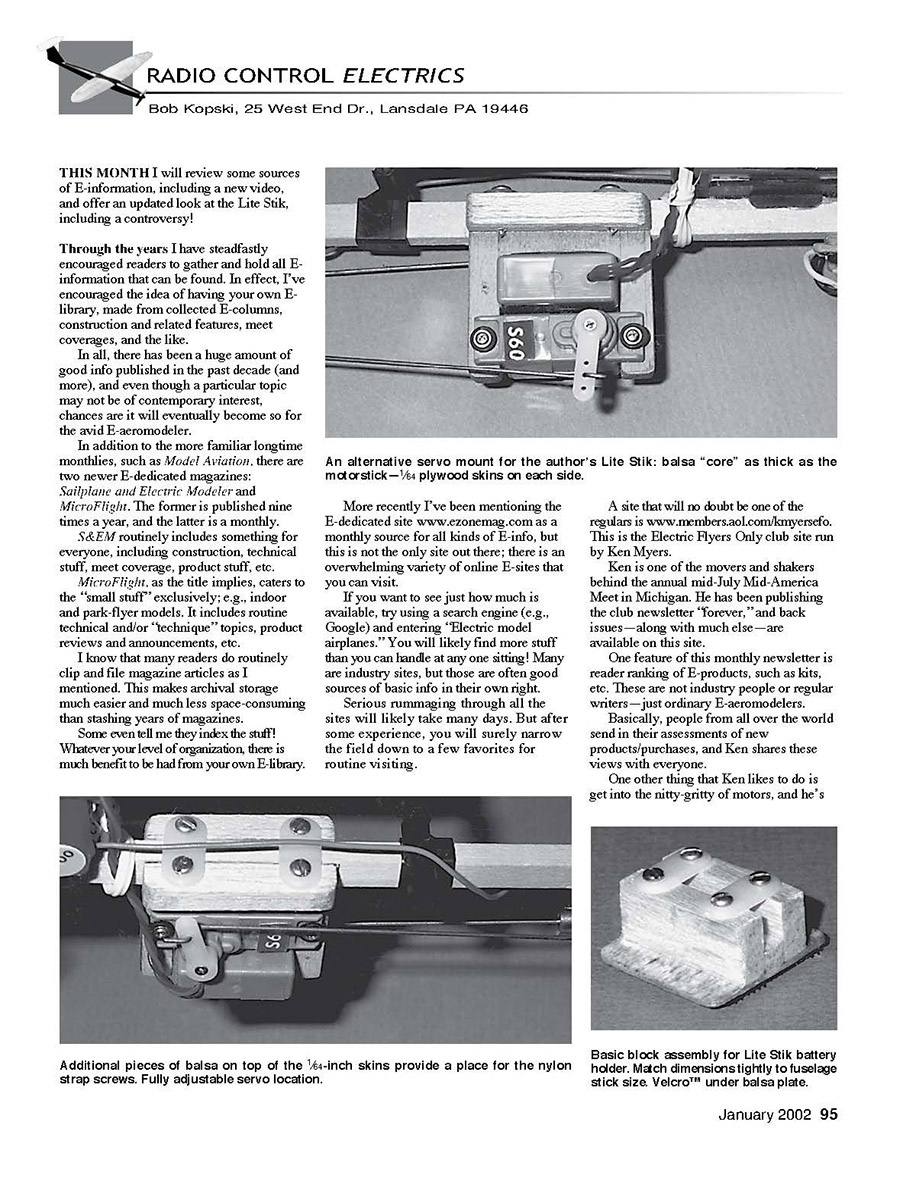
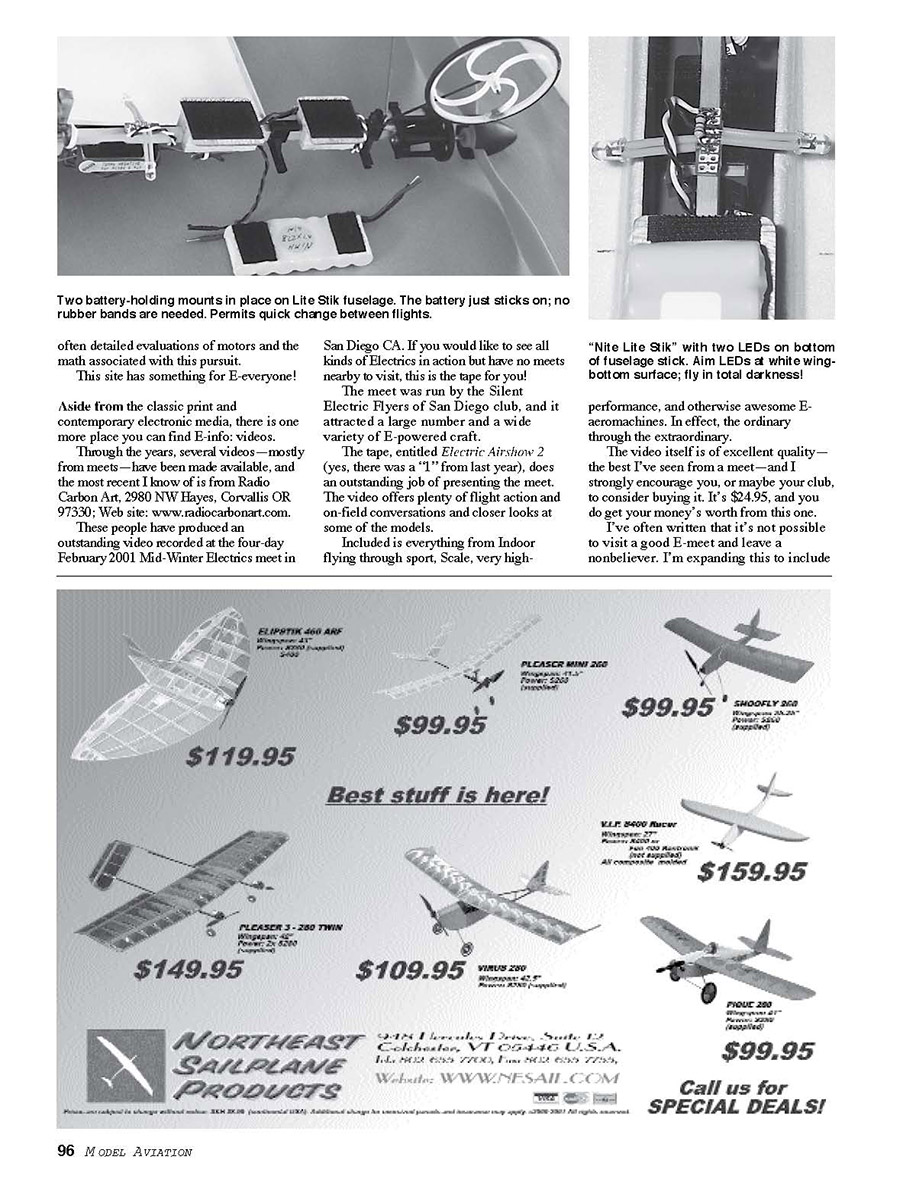
An alternative servo mount for the author's Lite Stik: balsa "core" as thick as the motorstick—¼ plywood skins on each side.
More recently I've been mentioning the E-dedicated site www.ezonomag.com as a monthly source for all kinds of E-info, but this is not the only site out there; there is an overwhelming variety of online E-sites that you can visit.
If you want to see just how much is available, try using a search engine (e.g., Google) and entering "Electric model airplanes." You will likely find more stuff than you can handle at any one sitting! Many are industry sites, but those are often good sources of basic info in their own right.
Serious rummaging through all the sites will likely take many days. But after some experience, you will surely narrow the field down to a few favorites for routine visiting.
A site that will no doubt be one of the regulars is www.members.aol.com/kmyelectro. This is the Electric Flyers Only club site run by Ken Myers.
Ken is one of the movers and shakers behind the annual mid-July Mid-America Meet in Michigan. He has been publishing the club newsletter "forever," and back issues—along with much else—are available on this site.
One feature of this monthly newsletter is a reader ranking of E-products, such as kits, etc. These are not industry people or regular writers—just ordinary E-aeromodelers.
Basically, people from all over the world send in their assessments of new products/purchases, and Ken shares these views with everyone.
One other thing that Ken likes to do is get into the nitty-gritty of motors, and he's often into detailed evaluations of motors and the math associated with this pursuit.
This site has something for E-everyone!
Aside from the classic print and contemporary electronic media, there is one more place you can find E-info: videos.
Through the years, several videos—mostly from meets—have been made available, and the most recent I know of is from Radio Carbon Art, 2980 NW Hayes, Corvallis OR 97330; Web site: www.radiocarbonart.com.
These people have produced an outstanding video recorded at the four-day February 2001 Mid-Winter Electrics meet in San Diego CA. If you would like to see all kinds of Electrics in action but have no meets nearby to visit, this is the tape for you!
The meet was run by the Silent Electric Flyers of San Diego club, and it attracted a large number and a wide variety of E-powered craft.
The tape, entitled Electric Airshow 2 (yes, there was a "1" from last year), does an outstanding job of presenting the meet. The video offers plenty of flight action and on-field conversations and closer looks at some of the models.
Included is everything from Indoor flying through sport, Scale, very high-performance, and otherwise awesome E-aeromachines. In effect, the ordinary through the extraordinary.
The video itself is of excellent quality—the best I've seen from a meet—and I strongly encourage you, or maybe your club, to consider buying it. It's $24.95, and you do get your money's worth from this one.
I've often written that it's not possible to visit a good E-meet and leave a nonbeliever. I'm expanding this to include that it's not possible to view this video and remain a nonbeliever!
The simple and thoroughly delightful Lite Stik slow-flyer, Almost Ready to Fly (ARF) may be the best all-around E-flyer modeler. The Lite Stik, a product of Wraith, was shown and discussed in the November 2000 column.
This mostly electric ARF comes complete with geared motor and propeller and all the necessary fittings for a complete B-pack flyer—including glue! (There are five hinge joints to make.)
Perhaps the best part is that all this routinely sells for less than $60. (Hmmm. Maybe the best part is the way it flies.) You just add a micro radio system, battery, Electronic Speed Control (ESC), and you're in for lots of fun.
I originally outfitted mine with the HPI 6800 receiver along with two S60 servos and a Pro 7 ESC. Power was six 110 mAh cells and all-up weight was 6.3 ounces.
Since then I've used a Feather receiver and other packs, including a secure cell 1200 mAh NiMH one. Other local fliers have used some small dual-conversion receivers (e.g., JR) and larger packs, including 270 mAh Ni-Cd and 600 mAh NiMH packs.
However, the above is but a small sample of what can be done with a Lite Stik. If you want to be dazzled, enter "Lite Stik" in your search engine and stand back! There're tons of Lite Stik stuff out there.
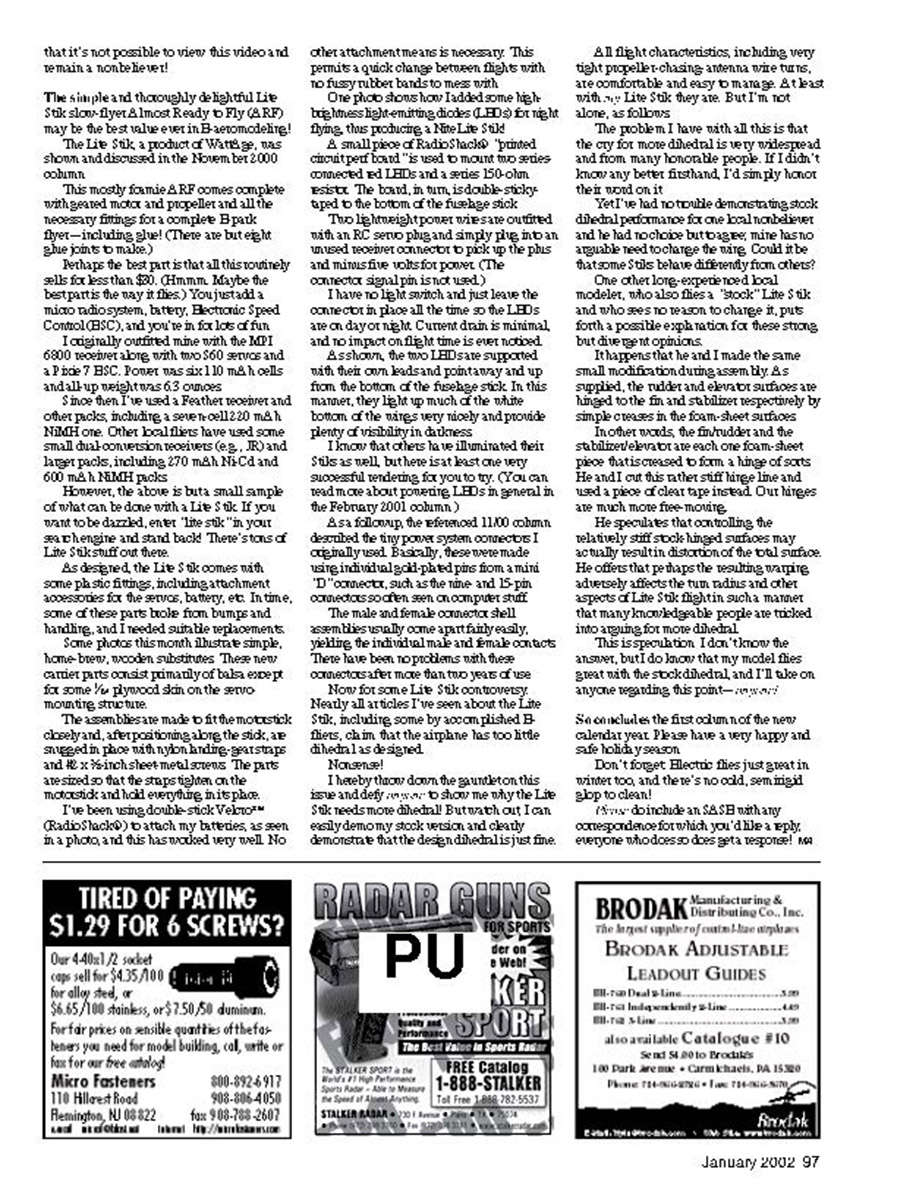
As designed, the Lite Stik comes with some plastic fittings, including attachment accessories for the servos, battery, etc. In time, some of these parts broke from bumps and handling, and I needed suitable replacements.
Some photos that month illustrate simple, home-brew, wooden substitutes. These new parts consist primarily of balsa except for some 1/8" plywood skin on the servo mounting structure.
The assemblies made to fit the motor stick cleverly and, after positioning along the stick, are glued in place with cyanoacrylate and glassed with fine strips of glass cloth and epoxy. The parts are sized so that the strips sit on the motor stick and hold everything in its place.
I've been using double-stick Velcro (RadioShack) to attach my batteries, as seen in a photo, and this has worked very well. No other attachment means is necessary. This permits a quick change between flights with no fussy rubber bands to mess with.
One photo shows how I added some high-brightness light-emitting diodes (LEDs) for night flying, thus producing a Lite Stik "Stik!"
A small piece of RadioShack "printed circuit prot board" is used to mount two series-connected red LEDs and a series 150-ohm resistor. The board, in turn, is double-stick taped to the bottom of the fuselage stick.
Two lightweight power wires are outfitted with an RC servo plug and simply plug into an unused receiver connector to pick up the plus and minus five volts for power. (The connector signal pin is not used.)
I have no light switch and just leave the connector in place all the time so the LEDs are on day or night. Current drain is minimal and no impact on flight time is ever noticed.
As shown, the two LEDs are spaced with about a 3/8-inch lead and point away and up from the bottom of the fuselage stick. In this manner, they light up much of the white bottom of the wings very nicely and provide plenty of visibility in darkness.
I know that others have illuminated their Stiks as well, but there is at least one very successful rendering for you to try. (You can read more about powering LEDs in general in the February 2001 column.)
As a followup, the referenced tiny power system connectors I originally used were made using individual gold-plated pins from a mini "D" connector, such as the nine- and 15-pin connectors shown on computer boards.
The male and female connector shell assemblies usually come apart fairly easily, yielding the individual male and female contacts. There have been no problems with these connectors after more than two years of use.
Now for some Lite Stik controversy. Nearly all articles I've seen about the Lite Stik, including some by accomplished builders, claim that the airplane has too little dihedral as designed.
I hereby throw down the gauntlet on this issue and offer proof—to those who think the Lite Stik needs more dihedral. What I can easily demonstrate with my stock version clearly shows that the design dihedral is just fine.
All flight characteristics, including very tight propeller-chasing antenna wire turns, are comfortable and easy to manage. At least with the Lite Stik they are. But I'm not alone, as follows:
The problem I have with all this is that the cry for more dihedral is very widespread and from many honorable people. If I didn't know any better friends, I'd simply honor the word on it.
Yet I've had trouble demonstrating stock dihedral performance for the local nonbeliever and he had no choice but to agree mine has no greater need to change the wing. Could it be that some Stiks behave differently from others?
One other long-experienced local modeler, who also flies a "stock" Lite Stik and who sees no reason to change it, puts forth a possible explanation for these strong but divergent opinions.
It happens that he and I made the same small modification during assembly: As supplied, the rudder and elevator surfaces are hinged to the fin and stabilizer respectively by simple creases in the foam-sheet surfaces.
In other words, the rudder and the stabilizer/elevator are each one foam-sheet piece that is creased to form a hinge of sorts.
He and I cut away a strip of the hinge line and used a piece of clear tape instead. Our hinges are much more free-moving.
He speculates that controlling the relatively stiff stock hinge surfaces may actually result in distortion of the tail surface. He offers that perhaps the resulting warping adversely affects the turn radius and other aspects of Lite Stik flight in such a manner that many knowledgeable people are tricked into arguing for more dihedral.
This is speculation. I don't know the answer, but I do know that my model flies great with the stock dihedral, and I'll take on anyone regarding this point.
So concludes the first column of the new calendar year. Please have a very happy and safe holiday season.
Don't forget: Electric flies just great in winter too, and there's no odd, semi-rigid slop to clean!
If you'd like an SASE with any correspondence for which you'd like a reply, everyone who does so does get a response. MA
RC Electrics
Transcribed from original scans by AI. Minor OCR errors may remain.

