
RC Electrics
Bob Kopski, 25 West End Dr., Lansdale PA 19446
THIS COLUMN updates discussion about an ongoing, long-term battery experiment and describes how to make a high-versatility battery cooler.
In August 1999 I began a long-term experiment with a then-new 12-cell 2,000 mAh pack installed in an Astro 15G-equipped REVOLT. The installation included a Sport Speed Control (M.A. 9/99, 10/99), or SSC, which has a precisely adjustable motor-cutoff feature.
The experiment used the SSC cutoff feature to shut down the motor at the equivalent of 0.9 volts per cell—10.8 volts in this case. Except for some limited data purposes, this pack was always charged at five amps for 23 minutes beginning with "empty" as below.
The purpose and progress of this experiment were described in full detail during the span of MA issues 01/99, 01/00, 02/00, 03/00, 04/00, and 06/01. The references include detailed descriptions of how this pursuit came about and include data during the course of the experiment.
I suspected that not overdischarging a pack (thereby avoiding substantial heating and/or cell reversal) and not peak charging (thereby avoiding pack heating again) would yield a longer-lasting, better-performing, more trouble-free pack.
Based on results to date, it looks as though this is indeed the case.
Discharging to 0.9 volts per cell equivalent is a popular voltage level used to describe "empty." Thus this pack was repeatedly charged beginning with this "empty" condition for more than two years.
Since the motor was automatically retarded at the 0.9-volt-per-cell equivalent, this pack was never "deep discharged."
The 23-minute period mentioned was the charge time at five amps that preempted pack "peaking" but still installed almost all the useful charge that would be the case if the pack were peaked.
This number, as in the references, was custom-determined for this specific pack, and, except for some data runs on the bench, all charges were done this way.
Thus this pack was always essentially fully charged but never reached the charging temperatures typically associated with "peaking."
That brings this story to now, and, finally, after more than two years and 400 flights (charge/discharge cycles), this pack has just shown noticeable degradation. Basically, the most recent flights have been less spirited and shorter.
Digging into the pack, I learned that one cell was clearly impaired and another was coming along behind it. These clearly displayed reduced capacity. This condition apparently came about in the span of a few flights; it was relatively sudden.
Six cells in this 12-cell pack were essentially identical in discharge characteristics; i.e., they were still "matched."
The remaining four cells presented a more loose but still fairly tight spread in discharge behavior compared with the preceding six. I would consider these 10 total for use as a "10-cell pack"—still!
But the most gratifying outcome of all this effort is that the pack never displayed signs of "false peaking": that annoying condition that so often tricks peak-detect chargers into premature shut-down.
Admittedly, this is only one pack of no-longer-available 2.0 Ah cells, but the outcome beats all prior experience with packs treated "normally"; i.e., peak charged then run down deep.
It's the best data I have to offer so far, and I'm hoping to continue this pursuit with a new pack—maybe with some modification—on into the future.
One reader inquired about this ongoing experiment at the recent NEAT (Northeast Electric Aircraft Technology) 2001 affair, so I know some people are interested. For now I can offer, with a clear conscience, that a "kinder, gentler" approach to Ni-Cd-pack handling appears to have its rewards!
If this all strikes your fancy, do check out the references for a more complete and detailed story.
And yes, I know that strictly competitive types will likely have no interest; this stuff is most potentially beneficial to sport-flying people who like or need economy while enjoying more trouble-free and better flying.
Just a thought: How many years does it take you to accumulate 400 flights on one pack?
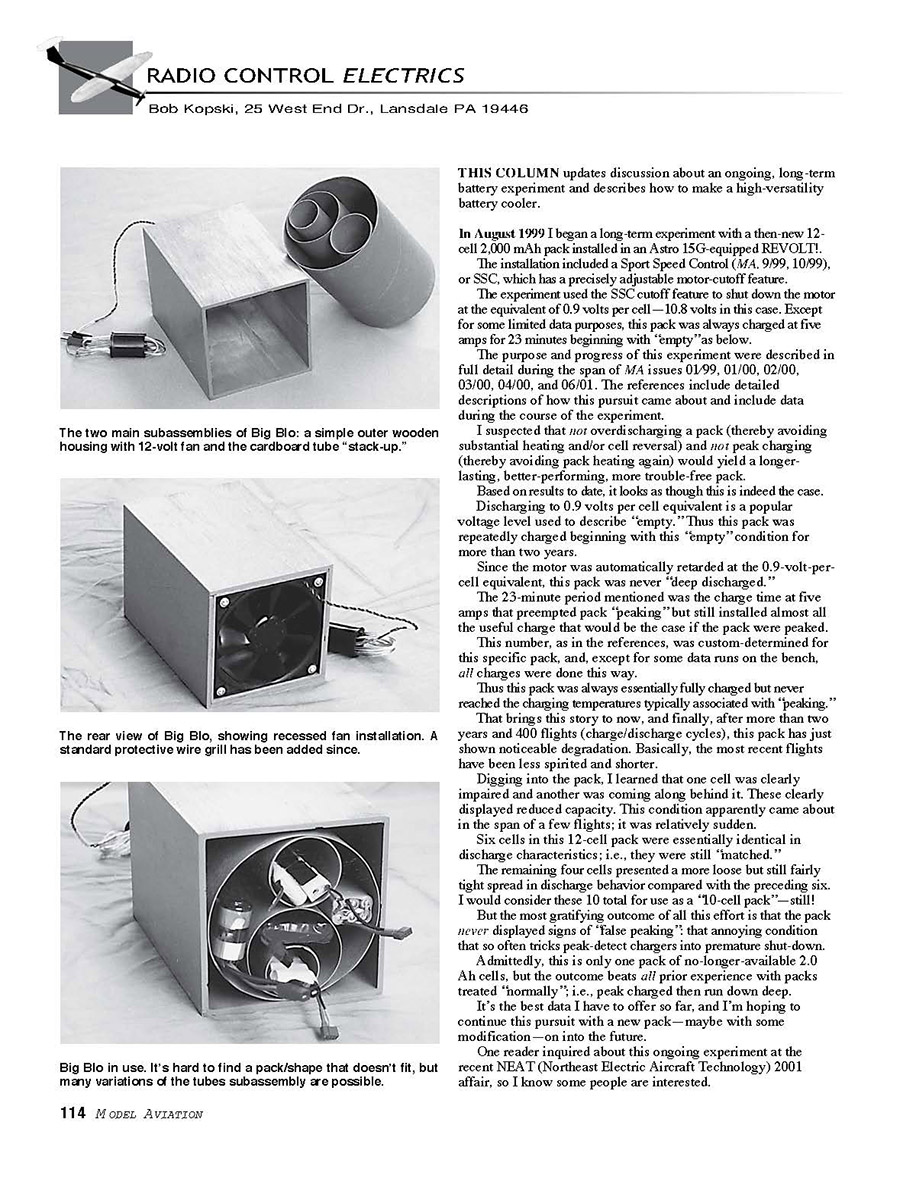
"Big Blo" is what I call it, and photos this month reveal all.
Although some of my Electrics have not-easily-removable motor packs, some do. Most of the latter are "smaller" packs, with fewer and/or smaller cells. These comprise a wide variety of overall sizes and shapes, so I needed a versatile cooler for them.
From this need emerged the concept of Big Blo, and it's clear from the photos that "versatile" is an appropriate description!
And based on the reaction I got to Big Blo at NEAT Fair 2001, it seems that this basic design idea would fit many E-aeromodelers' interests and needs. Therefore, I'm sharing the details of Big Blo's design for your consideration.
Big Blo is based on a standard 12-volt, 4 3/4-inch brushless fan that is readily available for a few dollars from most electronics suppliers. Mine is a 12-volt, 0.33-amp (four-watt), 80-CFM version, but there is nothing critical about the specifics.
These types of fans come in a variety of standard sizes and power levels. Typical units are generally $5-$10. Check out www.jameco.com, www.hosfelt.com, or almost any electronics catalog for such fans.
Having the fan described, my next task was to fashion a housing. Mine is made from 1/8 plywood from the hardware store. It measures approximately 5 1/4 inches square x 8 inches overall, and the fan fits inside at one end.
These dimensions are not rigid, but were chosen to be adequate for my purposes and for the completed unit to fit where I wanted to keep it.
The fan is secured with four #6 screws that thread into blind nuts. The battery are held by four plywood corner triangles of the same back stock. They were glued in place in each inner corner of the box at a depth of one inch—the thickness of this fan.
You can easily customize this for the fan of your choosing.
The hardest part of this undertaking was trying to structure the inner cylinders or tubes for Big Blo. I had decided on the basic tube or open-cylinder idea only on because it would allow inner packs to rest on only two edges rather than on a flat pack surface—there are no flat surfaces!
Two-edge support in round housings allowed the most air to flow in contact with the greatest total pack surface possible.
I studied all the packs I had in use and even speculated on some future pack shapes. What I came up with on paper for tube design is basically what you see in the final unit.
So much for design. Now to get the cardboard tubes I needed.
I spent hours touring the aisles of dollar and grocery stores—ruler in hand—and rummaging about the house.
I finally settled on a Quaker Oats container for the large outer cylinder and some mailing tubes and a wrapping-paper tube for the inner structures. All were chosen to "stack up" nicely as shown.
All the tubes were cut to length, and the ends were soaked with thin cyanoacrylate glue (CyA) to harden the cardboard for durability.
Then the various tubes were spot-glued in and on each other with thick CyA to yield the "stack-up" shown.
Last, I sprayed the whole works with gray Krylon® paint.
I had originally planned on gluing the "tubes" structure within the outer wooden box. However, I changed my mind when I realized that being able to rotate this cylindrical subassembly might offer some advantages now and then.
In use, my Big Blo is powered from my minimum battery and runs quietly and smoothly. I turn it on at the beginning of a flying session and let it run for the duration, inserting packs as necessary for cooling.
Current drain for most of these fans is normally a few hundred milliamps, so there is no significant consequence to the car battery.
There are readily available grills for these standard fans, and I intend to add one at the fan intake to minimize chances of something (fingers and field mice) getting in there.
In use so far, Big Blo has performed very well with every pack I've put in it. I've even faced it head-on on some hot, humid days to get some personal cooling benefit!
There is nothing hard-and-fast in this design; surely you can customize such a device to your own needs and liking. However, I do encourage you to stay within the "tube" idea; it does allow very effective airflow around and about the typical battery pack.
As for the effort involved, I began assembling my Big Blo roughly mid-morning, and it was completed and in use on the same afternoon.
The work is rather inexpensive, and Big Blo gives a lot of cooling bang for the expanded buck!
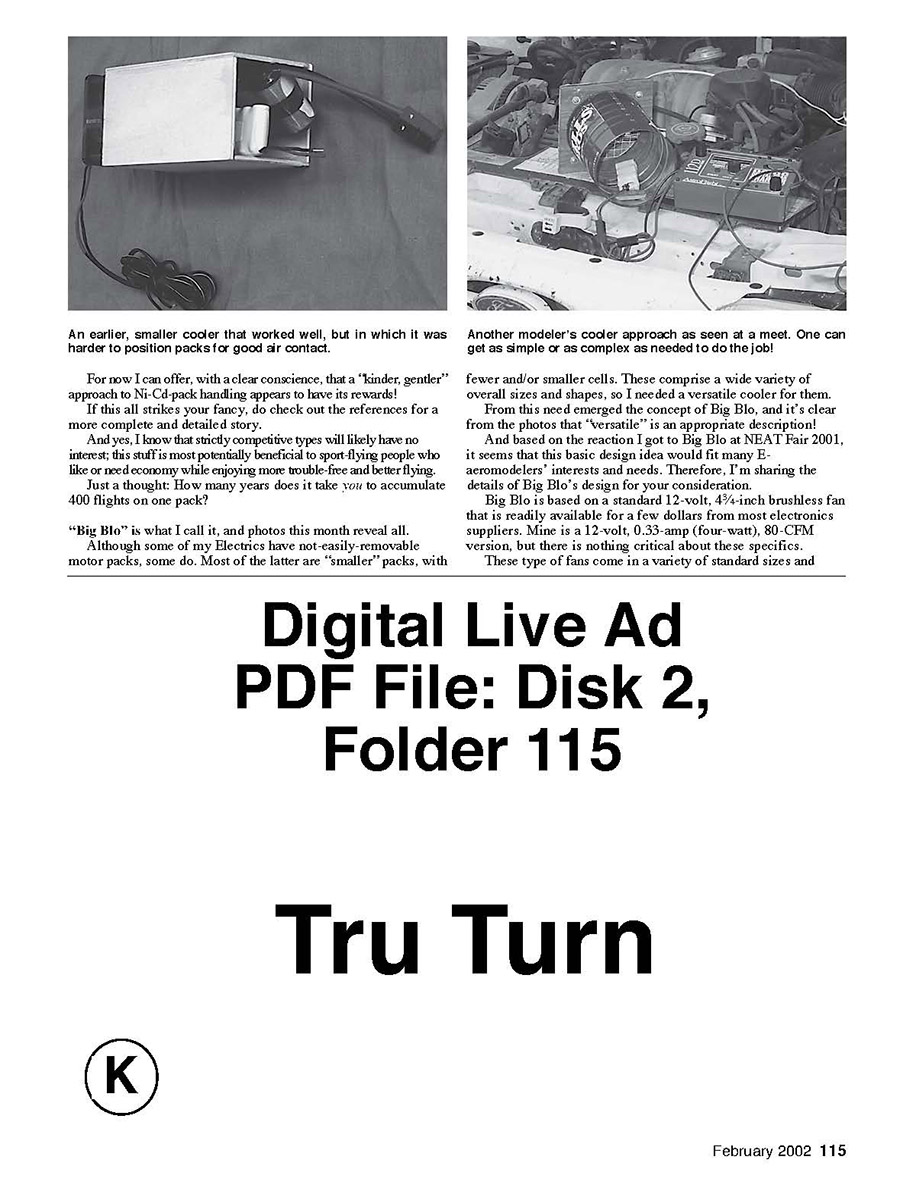
The other two photos this month show similar, simpler approaches to pack cooling. The smaller boxed one is an early version I used. It has a 2 1/2-inch, 12-volt, 0.22-amp fan. The five-inch-long box is made from Vis Lite Ply.
It's more difficult to position packs so that the most pack surface is exposed to the passing airstream. However, this earlier unit did show me the ease of use and benefits of such cooling.
I snapped the last photo at a meet.
Transcribed from original scans by AI. Minor OCR errors may remain.

