
Radio Control Electrics
Greg Gimlick, 100 Maple Glen Ln., Holly Springs NC 27540; E-mail: [email protected]
THE WEATHER WASN'T the biggest story this year, but it certainly played its part. We started out with extremely high temperatures and humidity reminiscent of last year, but we ended with cooler and much more comfortable weather. Winds went from next to nothing to "stout," and each pilot was tested in some way or another by the conditions. I took one photo during a sudden downpour, and from 200 feet away you can barely pick out the people trying to get their airplanes back on the ground.
The Radio Control Electrics Nationals (Nats) encompasses a variety of events as pilots compete in AMA and National Electric Aircraft Council (NEAC) events. This is a great format, and it sets the stage for someone to gain competitive experience without breaking the bank. With careful choice of airplanes and setups, some pilots compete in several classes with the same airframe.
As usual, the competition's atmosphere was relaxed and competitors continued to impress me with their willingness to help those competing against them. Though relaxed, the competitors were dead serious about doing their best and beating the best. Each time someone raised the bar, someone else raised it farther. The winners worked for every point, and the close scores showed how difficult it was to rise above the others.
Each day comprised an AMA event and an NEAC event. For those competing in both groups, the day proved to be very busy. The winners in each class are listed elsewhere, so I'll go through the highlights.
Sunday, August 4: Sunday greeted the competitors with hot temps and thin, high overcast. It cleared as the day progressed, and some cumulus clouds started to build. This made for some boomer thermals, but it wilted the fliers with 96° temperatures and a heat index of almost 110°. By the time the day ended, the fliers had prevailed.
The 1/2A Sailplane field was crowded, and the scores were tight. These are relatively small sailplanes powered by seven cells and a Speed 400 motor. After a 90-second motor run, the goal is to finish with an eight-minute flight and a spot landing. Ric Vaughn led the field to the finish with three near-perfect scores.
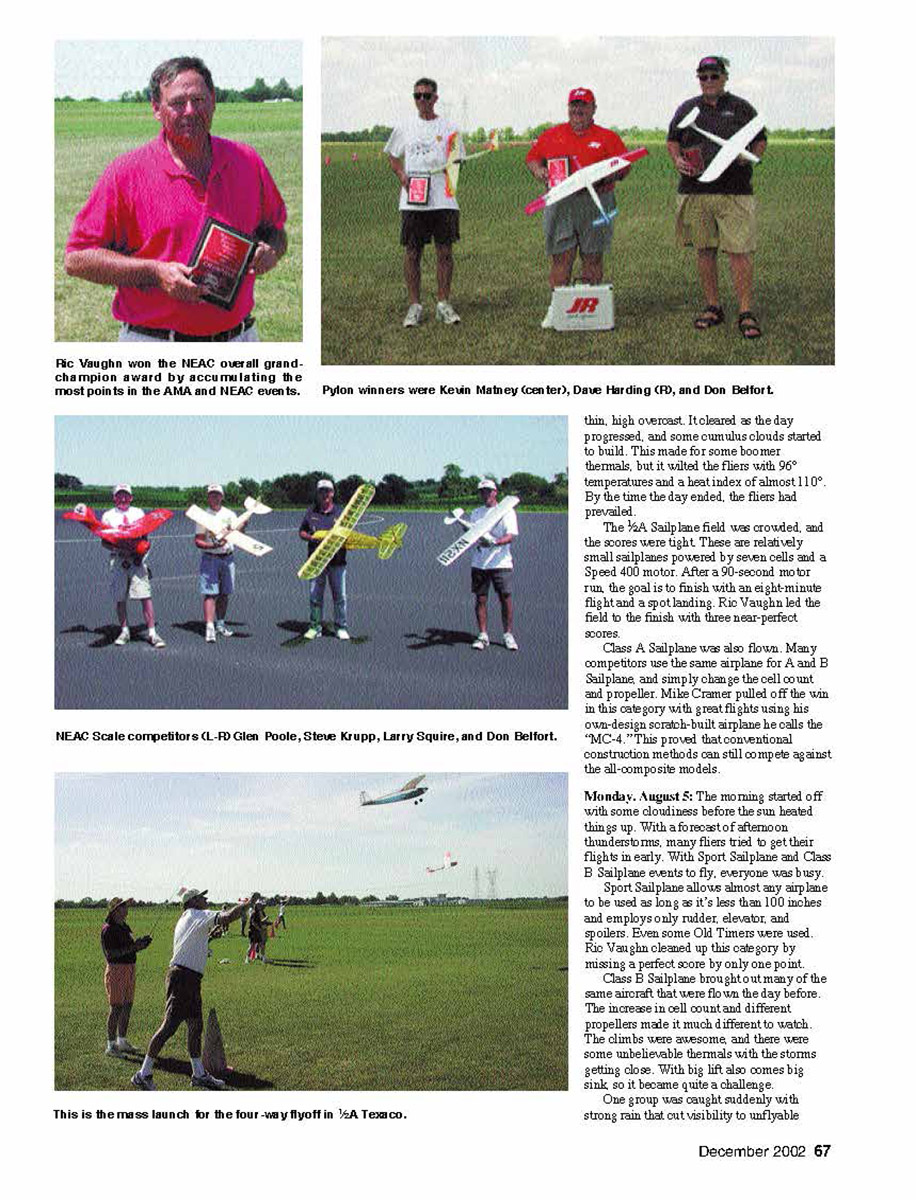
Class A Sailplane was also flown. Many competitors use the same airplane for A and B Sailplane, and simply change the cell count and propeller. Mike Cramer pulled off the win in this category with great flights using his own-design scratch-built airplane he calls the "MC-4." This proved that conventional construction methods can still compete against the all-composite models.
Monday, August 5: The morning started off with some cloudiness before the sun heated things up. With a forecast of afternoon thunderstorms, many fliers tried to get their flights in early. With Sport Sailplane and Class B Sailplane events to fly, everyone was busy.
Sport Sailplane allows almost any airplane to be used as long as it's less than 100 inches and employs only rudder, elevator, and spoilers. Even some Old Timers were used. Ric Vaughn cleaned up this category by missing a perfect score by only one point.
Class B Sailplane brought out many of the same aircraft that were flown the day before. The increase in cell count and different propellers made it much different to watch. The climbs were awesome, and there were some unbelievable thermals with the storms getting close. With big lift also comes big sink, so it became quite a challenge.
One group was caught suddenly with strong rain that cut visibility to unflyable conditions. One model was lost, and the others landed with drenched electronics and pilots. After the rain subsided, the day was extended to allow those who were washed out to retry the round. In the end, Ric Vaughn swam away with another victory.
Tuesday, August 6: The previous day's storms presented everyone with a real challenge by completely changing the conditions. Tuesday was cooler by almost 20° and the wind went from being calm to brisk with gusts. Lifters were there if you could find it and it was a day of extremes.
Most competitors tried to get their two 15-minute qualifying flights in early for 1/2A Texaco. Powered by seven 600 mAh cells and a 330 type ferrite motor, these models are very light and challenging to fly in strong winds. By the end of the day, there was a four-way flyoff to determine the winner. Don Belton won the category with his immaculate Star Duster.
Class A Old Timer consists of seven-cell gas-powered models designed in the 1930s and 1940s. The variety of designs and their graceful appearances made for a beautiful sight as they were hunched into the clear, blue sky. Translucent covering, cell and doped wood frames or balsa, displaying the competitors' handiwork.
The gusty wind made it more than challenging to set the models safely back on the ground. Several were damaged in the process and repaired in time to complete the required three rounds. This was clearly Don Belton's day; he took home first place with his Astro Viking.
Wednesday, August 7: The last day of competition started early with the 7 a.m. NEAC Pylon event. It was a busy day with NEAC Scale and AMA Class B Old Timer following. The weather was cool, but the winds seemed to give the competitors a bit of a break.
Pylon suffered an odd ratio of some sort that took out two competitors' primary airplanes. Competition was held while radios and spare components were completed and resolved on an improvised flight on another part of the property was suspected.
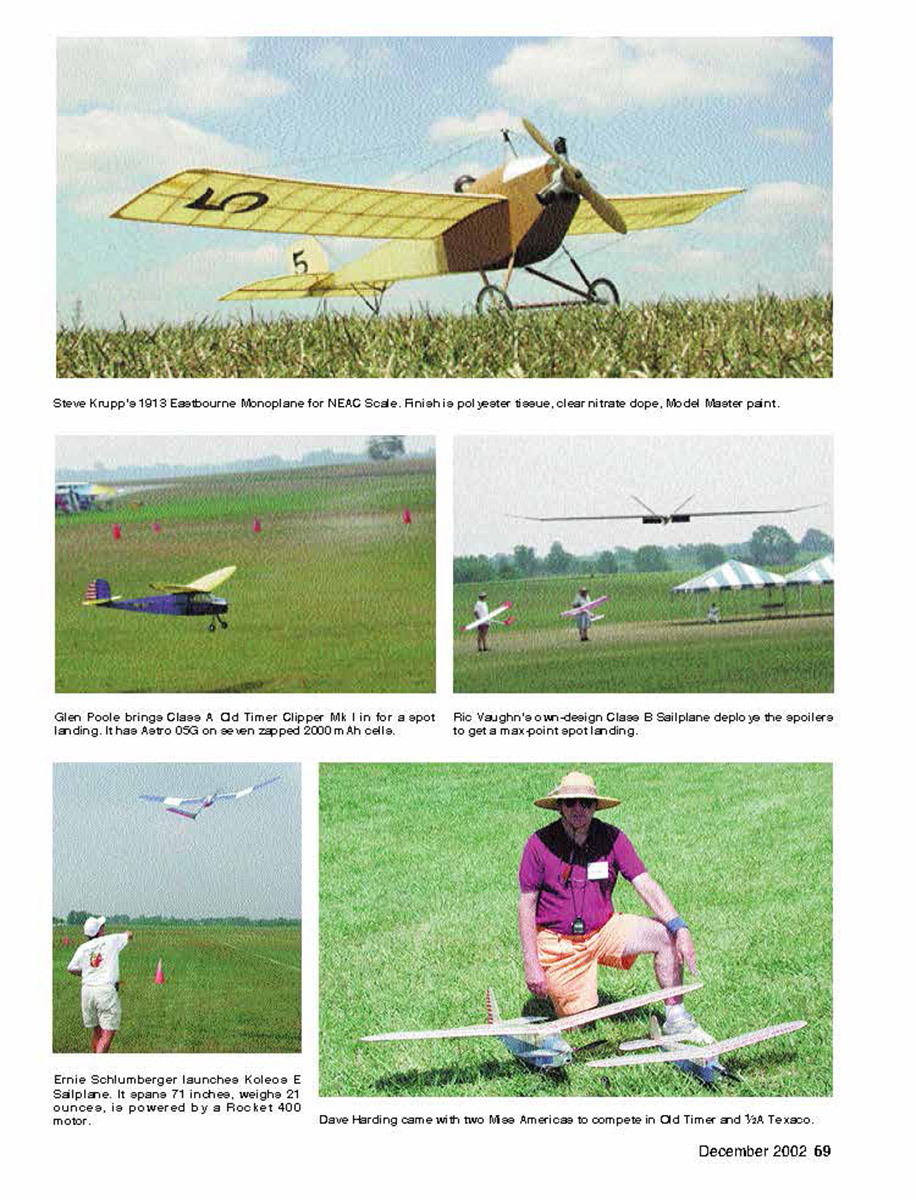
When the rounds were completed, Kevin Mabrey was the winner with his own-designed Vixen. He also won the event last year. Again this year, we saw how important piloting skill is in addition to speed.
The wind returned after the Pylon event, just in time to present some challenges to the B Old Timer group. It wasn't as bad as the previous day, but it certainly was challenging. Perennial winner Bill Jenkins showed that he hasn't lost a thing in this category; he flew a beautiful Westner to take home the trophy.
The story behind the story is that Bill had a fly-away during a meet a few weeks prior to the Nats and lost the Westner before locating it in Monroe. They have overcome many adversities makes a champion, and it sure was true in Class B Old Timer.
Scale at the Electric Nats is an NEAC event. The field was a bit smaller this year, and the wind picked up just in time to make the flying portion extremely difficult. The judges shortened the competition to one round to avoid risking the models more than necessary. Each airplane was judged in a static competition prior to flying, and the quality of subjects was excellent.
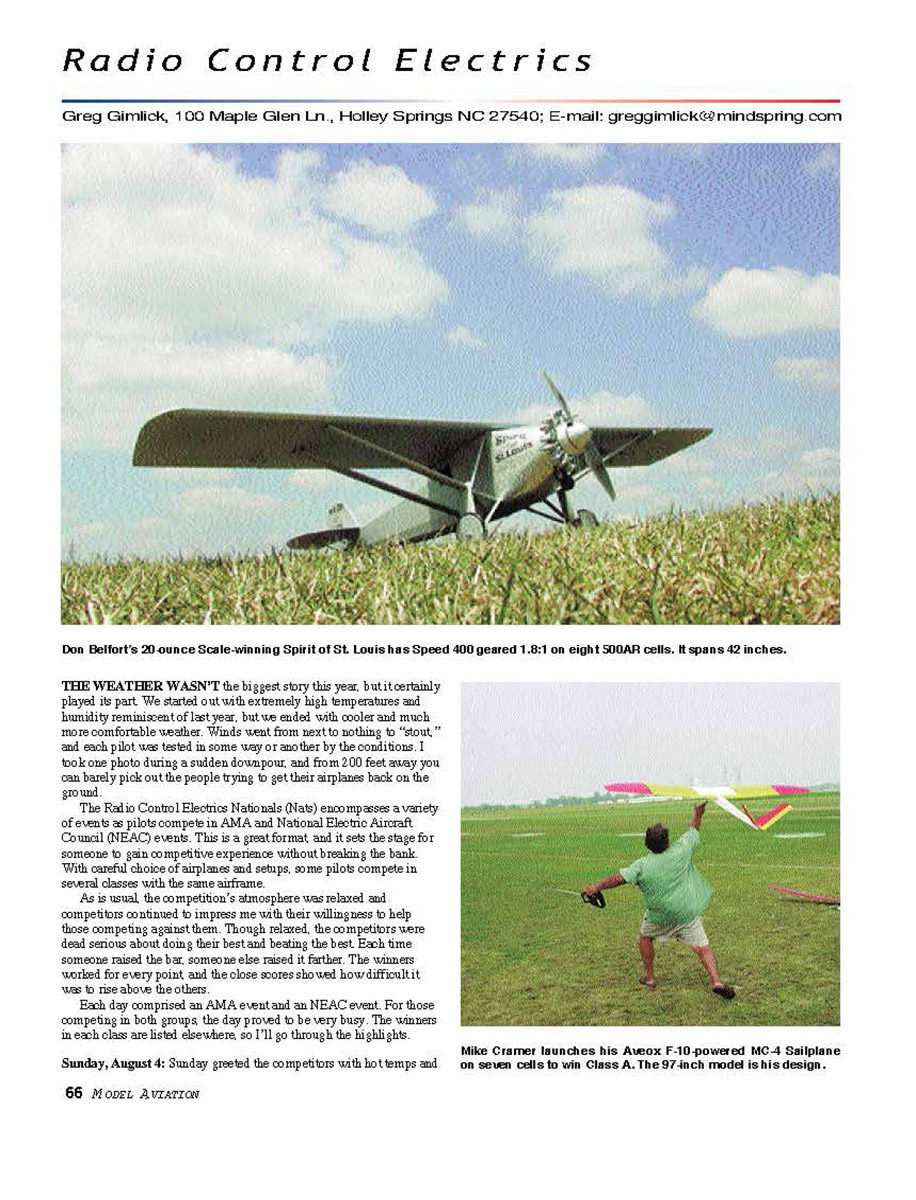
Riding to the top of the Scale heap was Don Belton's Speed 400-powered Spirit of St. Louis.
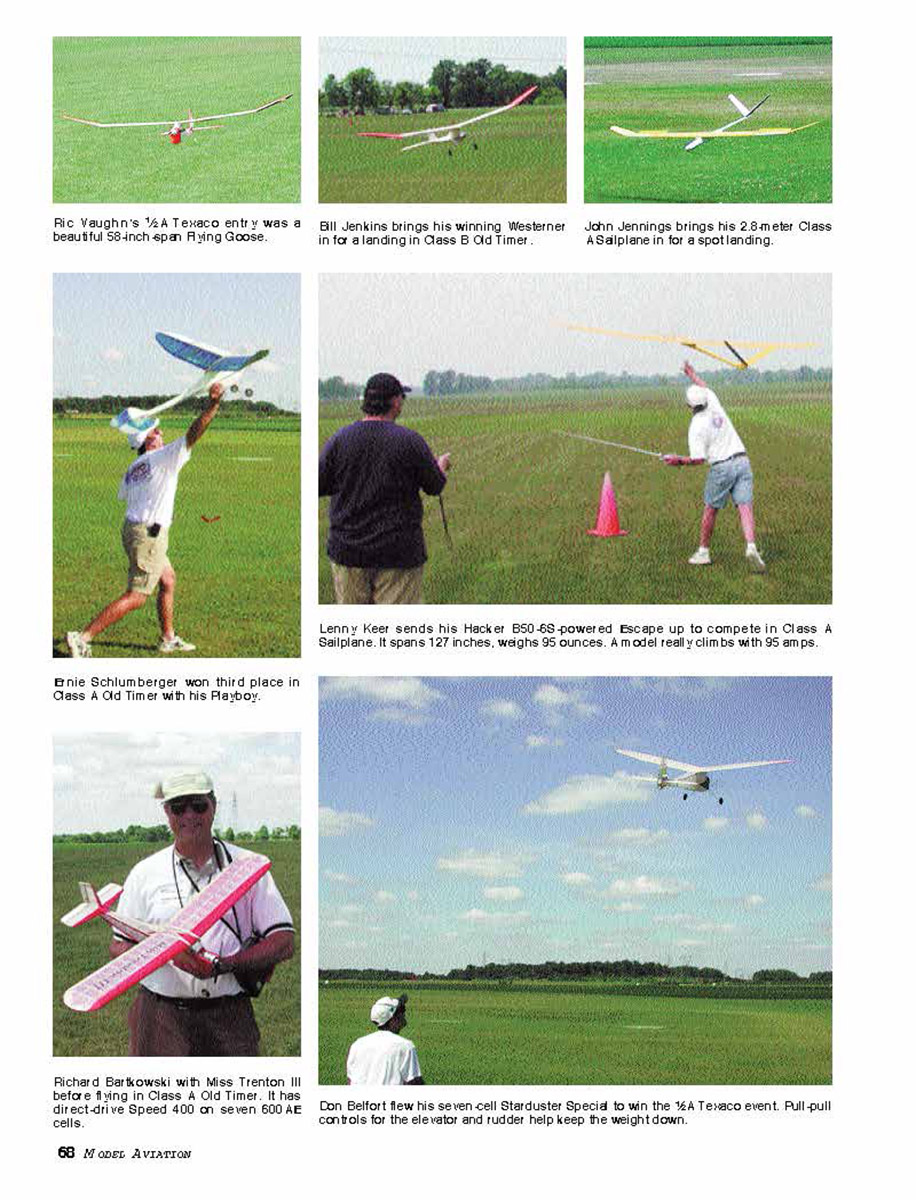
Ric Vaughn took home the honor of overall champion this year. NEAC gives this award to recognize the competitor who accumulates the most points in AMA and NEAC events. Ric was also elected NEAC president for the upcoming term.
Administration: Ralph Weaver, assisted by Don Bischowell, ran a smooth Nats. Ralph's easygoing personality provides a pleasant atmosphere, but there is no doubt who is in charge. I think this is key to how successful the event has been.
The range of equipment used successfully in the events is remarkable. There are high-tech designs and motor systems, but some well-proven conventional systems are doing well. This tells me that you don't need to be rich to be competitive; practice is the key.
If you want to try some competition or just see what's about, a trip to the Nats is a must. I hope to see you there next year. t&w
See results in "Focus on Competition"
Transcribed from original scans by AI. Minor OCR errors may remain.

