
RADIO CONTROL ELECTRICS
Greg Gimlick, [email protected]
WELCOME BACK. In the last column I did the introductions and looked at a bit of history. This month I'll discuss the Toledo Weak Signals show and a new speed controller. That's a lot to do in a short amount of space, so let's go.
Toledo 2005: This is my favorite stop on the trade-show circuit. The SeaGate facility is huge, the lighting and heat are good, and I see more goodies in three days than I can take in.
Every year before I head home, several manufacturers and vendors ask me what made the biggest impression on me or what I thought the coolest thing was. Answering this was a real problem because what jumped out wasn't one particular thing—it was the vast multitude of items related to Electrics!
Everywhere I looked there was a booth with something electric-flight oriented. There was Giant Scale, small Scale, sport, foamies, built-up, ARFs, helicopters, simulators, batteries, chargers, conditioners, testers, telemetry systems, you name it.
Honestly, until this year there was plenty of neat new stuff to look at, but there wasn't an entire show of neat new stuff. I'm going to trickle in bits and pieces in the next few columns to give you a taste and try to do justice to the many wonderful vendors and manufacturers who are investing in our segment of the hobby.
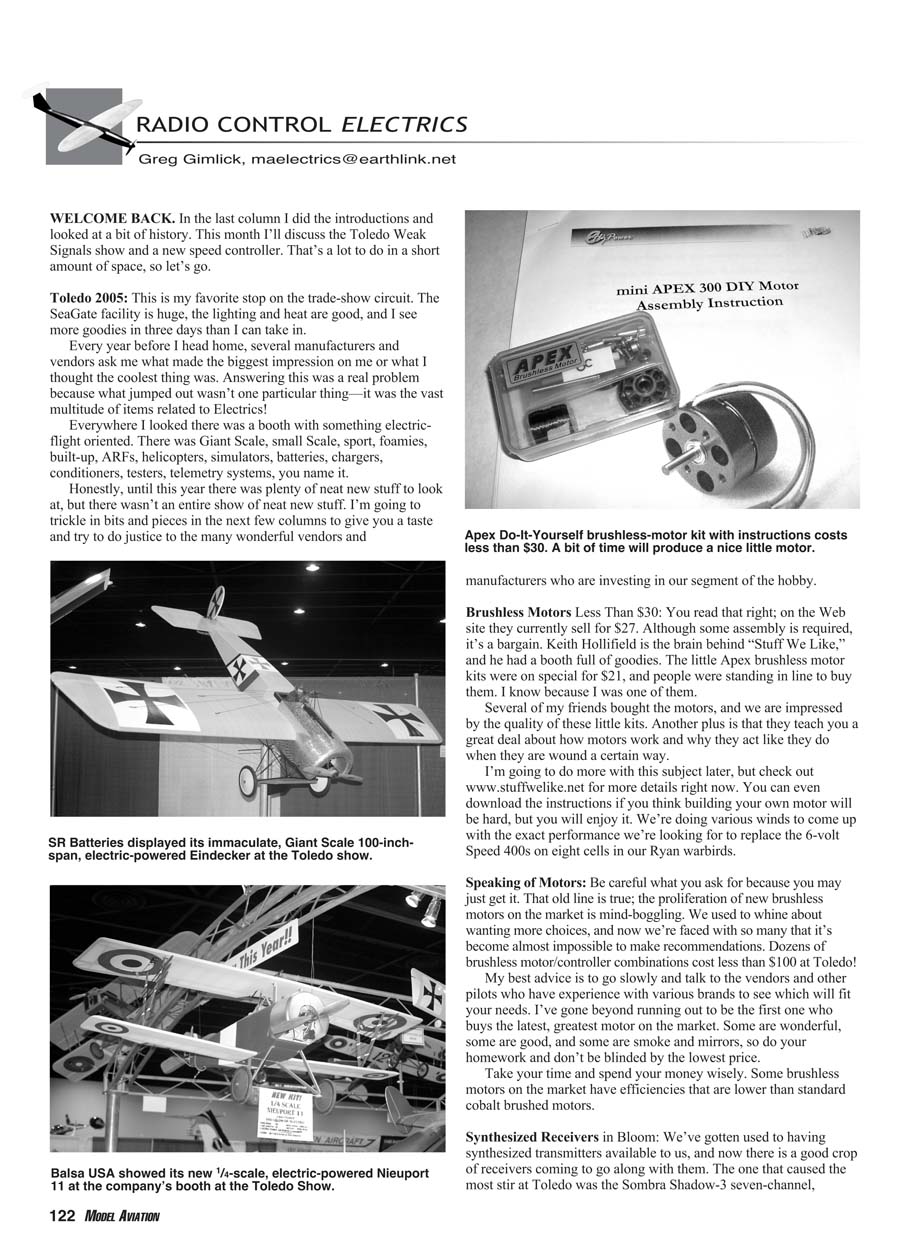
Brushless Motors Less Than $30: You read that right; on the Web site they currently sell for $27. Although some assembly is required, it's a bargain. Keith Hollifield is the brain behind "Stuff We Like," and he had a booth full of goodies. The little Apex brushless motor kits were on special for $21, and people were standing in line to buy them. I know because I was one of them.
Several of my friends bought the motors, and we are impressed by the quality of these little kits. Another plus is that they teach you a great deal about how motors work and why they act like they do when they are wound a certain way.
I'm going to do more with this subject later, but check out www.stuffwelike.net for more details right now. You can even download the instructions if you think building your own motor will be hard, but you will enjoy it. We're doing various winds to come up with the exact performance we're looking for to replace the 6-volt Speed 400s on eight cells in our Ryan warbirds.
Speaking of Motors: Be careful what you ask for because you may just get it. That old line is true; the proliferation of new brushless motors on the market is mind-boggling. We used to whine about wanting more choices, and now we're faced with so many that it's become almost impossible to make recommendations. Dozens of brushless motor/controller combinations cost less than $100 at Toledo!
My best advice is to go slowly and talk to the vendors and other pilots who have experience with various brands to see which will fit your needs. I've gone beyond running out to be the first one who buys the latest, greatest motor on the market. Some are wonderful, some are good, and some are smoke and mirrors, so do your homework and don't be blinded by the lowest price.
Take your time and spend your money wisely. Some brushless motors on the market have efficiencies that are lower than standard cobalt brushed motors.
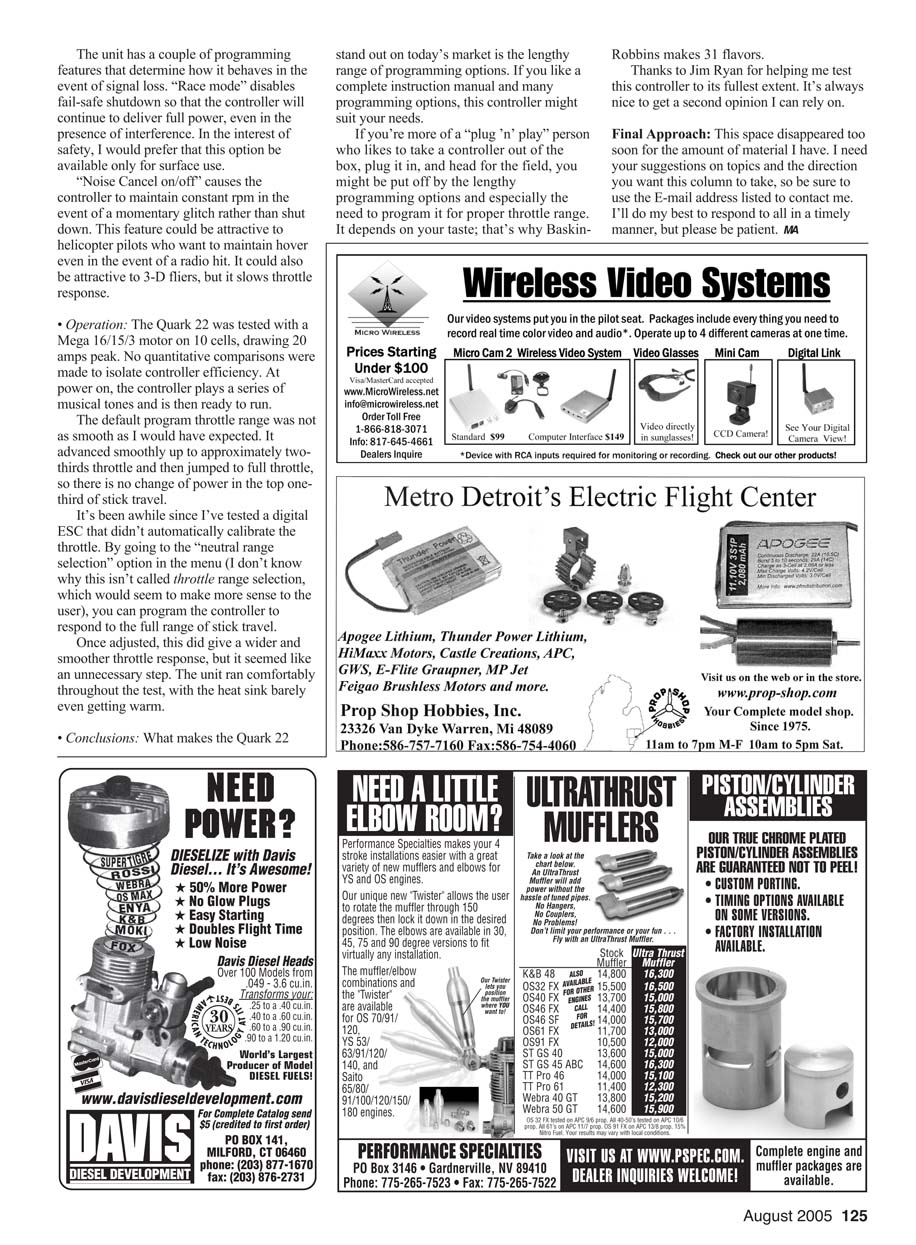
Synthesized Receivers in Bloom: We've gotten used to having synthesized transmitters available to us, and now there is a good crop of receivers coming to go along with them. The one that caused the most stir at Toledo was the Sombra Shadow-3 seven-channel, crystal-less receiver sold by Kennedy Composites (www.kennedycomposites.com).
This little gem is easily programmable, dual conversion, full range, and ultra narrow band (5 kHz or better). At roughly $90 with the universal programmer, it's a real winner. Once you buy a programmer, you can use it on any Shadow-3 receiver you add to your arsenal.
You can see the programmer plugged into a receiver in the photo. This thing is foolproof to program, just the way I like it. For a closer look at this fine receiver, look up Bob Kopski's May RC Electrics column in which he discussed it at length.
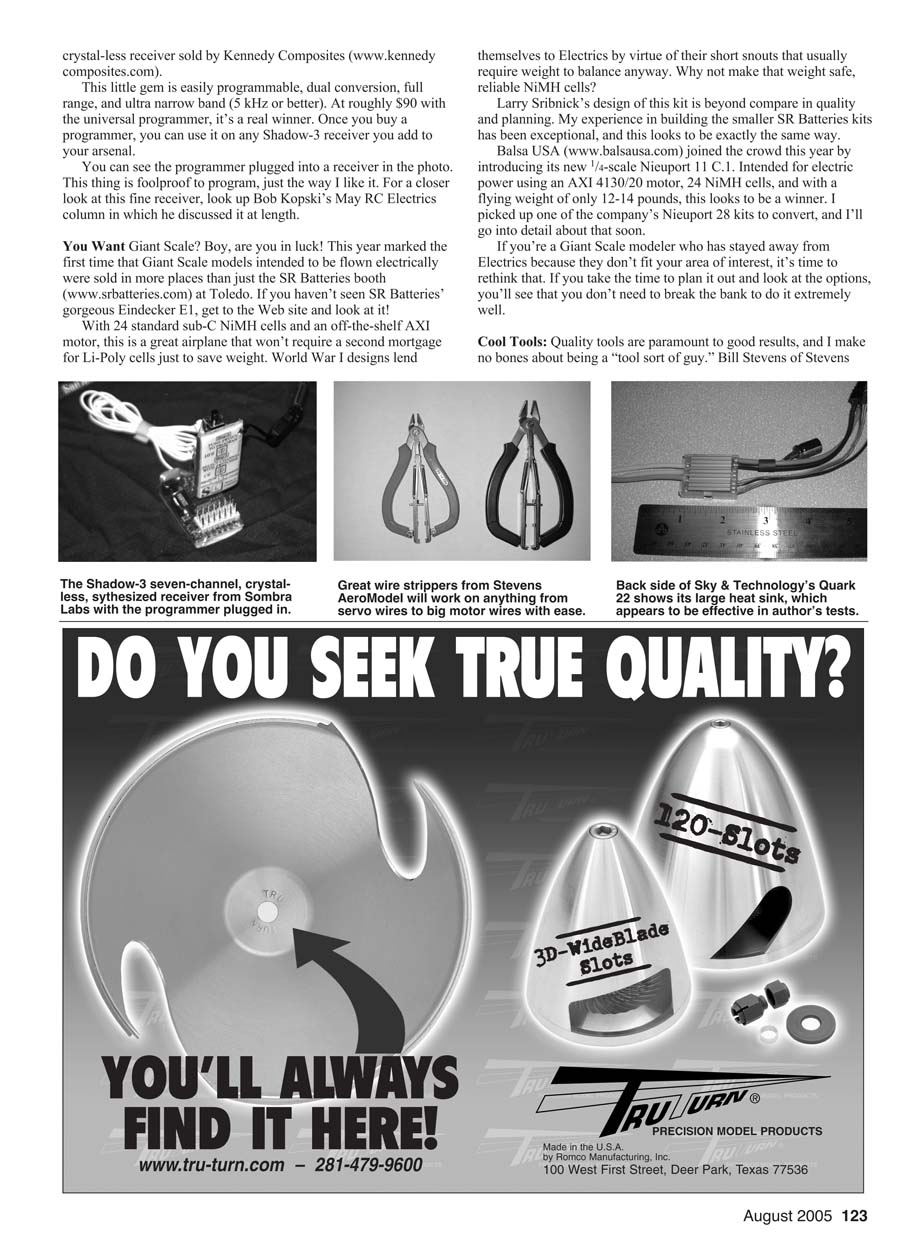
You Want Giant Scale? Boy, are you in luck! This year marked the first time that Giant Scale models intended to be flown electrically were sold in more places than just the SR Batteries booth (www.srbatteries.com) at Toledo. If you haven't seen SR Batteries' gorgeous Eindecker E1, get to the Web site and look at it!
With 24 standard sub-C NiMH cells and an off-the-shelf AXI motor, this is a great airplane that won't require a second mortgage for Li-Poly cells just to save weight. World War I designs lend themselves to Electrics by virtue of their short snouts that usually require weight to balance anyway. Why not make that weight safe, reliable NiMH cells?
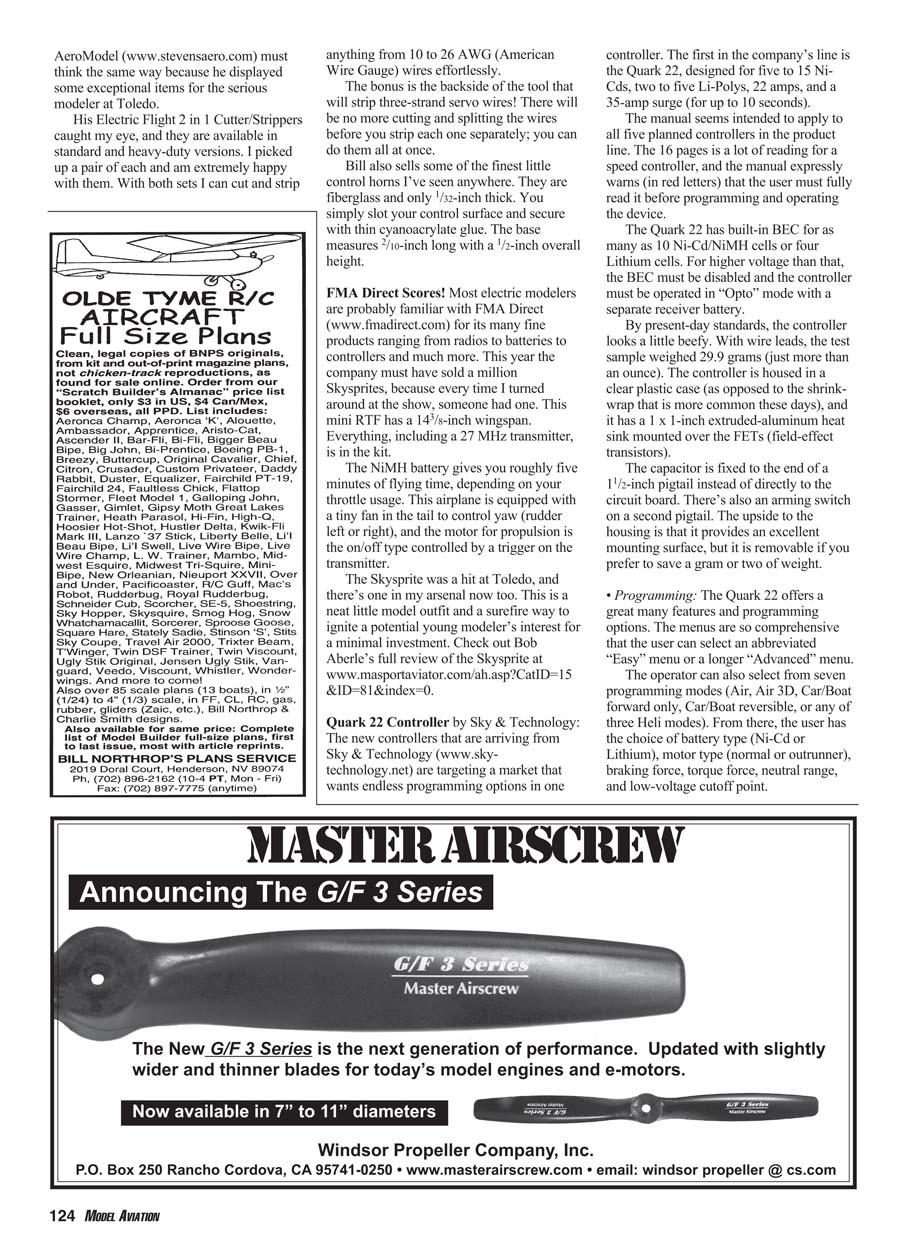
Larry Sribnick's design of this kit is beyond compare in quality and planning. My experience in building the smaller SR Batteries kits has been exceptional, and this looks to be exactly the same way. Balsa USA (www.balsausa.com) joined the crowd this year by introducing its new 1/4-scale Nieuport 11 C.1. Intended for electric power using an AXI 430/20 motor, 24 NiMH cells, and with a flying weight of only 12-14 pounds, this looks to be a winner. I picked up one of the company's Nieuport 28 kits to convert, and I'll go into detail about that soon.
If you're a Giant Scale modeler who has stayed away from Electrics because they don't fit your area of interest, it's time to rethink that. If you take the time to plan it out and look at the options, you'll see that you don't need to break the bank to do it extremely well.
Cool Tools: Quality tools are paramount to good results, and I make no bones about being a "tool sort of guy." Bill Stevens of Stevens AeroModel (www.stevensaero.com) must think the same way because he displayed some exceptional items for the serious modeler at Toledo.
His Electric Flight 2 in 1 Cutter/Strippers caught my eye, and they are available in standard and heavy-duty versions. I picked up a pair of each and am extremely happy with them. With both sets I can cut and strip anything from 10 to 26 AWG (American Wire Gauge) wires effortlessly.
The bonus is the backside of the tool that will strip three-strand servo wires! There will be no more cutting and splitting the wires before you strip each one separately; you can do them all at once.
Bill also sells some of the finest little control horns I’ve seen anywhere. They are fiberglass and only 1/32-inch thick. You simply slot your control surface and secure with thin cyanoacrylate glue. The base measures 7/20-inch long with a 1/2-inch overall height.
FMA Direct Scores! Most electric modelers are probably familiar with FMA Direct (www.fmadirect.com) for its many fine products ranging from radios to batteries to controllers and much more. This year the company must have sold a million Skysprites, because every time I turned around at the show, someone had one. This mini RTF has a 14 7/8-inch wingspan. Everything, including a 27 MHz transmitter, is in the kit.
The NiMH battery gives you roughly five minutes of flying time, depending on your throttle usage. This airplane is equipped with a tiny fan in the tail to control yaw (rudder left or right), and the motor for propulsion is on the top of the fuselage and is controlled by a trigger on the transmitter.
The Skysprite was a hit at Toledo, and there’s one in my arsenal now too. This is a neat little model outfit and a surefire way to ignite a potential young modeler’s interest for a minimal investment. Check out Bob Aberle’s full review of the Skysprite at www.masportaviator.com/ah.asp?CatID=15&ID=81&index=0.
Quark 22 Controller by Sky & Technology
The new controllers that are arriving from Sky & Technology (www.sky-technology.net) are targeting a market that wants endless programming options in one controller. The first in the company’s line is the Quark 22, designed for five to 15 Ni-Cds, two to five Li-Polys, 22 amps, and a 35-amp surge (for up to 10 seconds).
The manual seems intended to apply to all five planned controllers in the product line. The 16 pages is a lot of reading for a speed controller, and the manual expressly warns (in red letters) that the user must fully read it before programming and operating the device.
The Quark 22 has built-in BEC for as many as 10 Ni-Cd/NiMH cells or four Lithium cells. For higher voltage than that, the BEC must be disabled and the controller must be operated in “Opto” mode with a separate receiver battery.
By present-day standards, the controller looks a little beefy. With the leads, the test sample weighed 29.9 grams (just more than an ounce). The controller is housed in a clear plastic case (as opposed to the shrink-wrap that is more common these days), and it has a 1 x 1-inch extruded-aluminum heat sink mounted over the FETs (field-effect transistors).
The capacitor is fixed to the end of a 1/2-inch pigtail instead of directly to the circuit board. There’s also an arming switch on a second pigtail. The upside to the housing is that it provides an excellent mounting surface, but it is removable if you prefer to save a gram or two of weight.
Programming
The Quark 22 offers a great many features and programming options. The menus are so comprehensive that the user can select an abbreviated “Easy” menu or a longer “Advanced” menu.
The operator can also select from seven programming modes (Air, Air 3D, Car/Boat forward only, Car/Boat reversible, or any of three Heli modes). From there, the user has the choice of battery type (Ni-Cd or Lithium), motor type (normal or outrunner), braking force, torque force, neutral range, and low-voltage cutoff point.
The unit has a couple of programming features that determine how it behaves in the event of signal loss. "Race mode" disables fail-safe shutdown so that the controller will continue to deliver full power, even in the presence of interference. In the interest of safety, I would prefer that this option be available only for surface use.
"Noise Cancel on/off" causes the controller to maintain constant rpm in the event of a momentary glitch rather than shut down. This feature could be attractive to helicopter pilots who want to maintain hover even in the event of a radio hit. It could also be attractive to 3-D fliers, but it slows throttle response.
Operation
The Quark 22 was tested with a Mega 16/15/3 motor on 10 cells, drawing 20 amps peak. No quantitative comparisons were made to isolate controller efficiency. At power on, the controller plays a series of musical tones and is then ready to run.
The default programmable throttle range was not as smooth as I would have expected. It advanced smoothly up to approximately two-thirds throttle and then jumped to full throttle, so there is no change of power in the top one-third of stick travel.
It's been awhile since I've tested a digital ESC that didn't automatically calibrate the throttle. By going to the "neutral range selection" option in the menu (I don't know why this isn't called throttle range selection, which would seem to make more sense to the user), you can program the controller to respond to the full range of stick travel.
Once adjusted, this did give a wider and smoother throttle response, but it seemed like an unnecessary step. The unit ran comfortably throughout the test, with the heat sink barely even getting warm.
Conclusions
What makes the Quark 22 stand out on today's market is the lengthy range of programming options. If you like a complete instruction manual and many programming options, this controller might suit your needs.
If you're more of a "plug 'n' play" person who likes to take a controller out of the box, plug it in, and head for the field, you might be put off by the lengthy programming options and especially the need to program it for proper throttle range. It depends on your taste; that's why Baskin-Robbins makes 31 flavors.
Thanks to Jim Ryan for helping me test this controller to its fullest extent. It's always nice to get a second opinion I can rely on.
Final Approach: This space disappeared too soon for the amount of material I have. I need your suggestions on topics and the direction you want this column to take, so be sure to use the E-mail address listed to contact me. I'll do my best to respond to all in a timely manner, but please be patient. MA
RC Electrics
Greg Gimlick
Transcribed from original scans by AI. Minor OCR errors may remain.

