
RC Electrics
Bob Kopski, 25 West End Dr., Lansdale PA 19446
THIS COLUMN describes two upcoming meets, offers some thoughts on meets in general, has one Electric Connection Service listing, shares some recent reader reaction (and mine too), and offers a parts/supplies suggestion.
The legacy of the KRC Electric Fly
Most aeromodelers who have flown Electrics for at least a few years are aware of the world-famous KRC Electric Fly. This discontinued meet began in 1980 as the first club-sponsored E-meet in the country. Held annually on the third weekend of September, "The KRC," as it became known, also became the prototype for other meets around the country. It set the pace.
The KRC Electric Fly grew steadily through the years to the point where in 1998, the last or 19th annual meet drew hundreds of participants, with several times that number of Electrics, and many more spectators. A grand success and accomplishment, by any measure. And perhaps the most amazing thing about it: KRC is predominantly a gas club!
It's a long and sad story, but the meet was discontinued two years ago—much to the dismay and sadness of many "regulars." There was nothing like this classic gathering anywhere in the country in 1999, so far as I know.
Then began a stir of sorts—a restless longing among many for a rebirth of this annual frolic. Some modelers in the Northeast, notably members of the Silent Electric Flyers of Long Island (SEFLI) and some associates, undertook the challenge of reestablishing an East Coast meet-in-kind.
NEAT: A revival planned
Plans are firmly in place for The Northeast Electric Aircraft Technology Fair (NEAT) September 22–24 at the Peaceful Valley Campsite in Downsville NY. NEAT is described as "A Revival of the Nation's Largest Electric Model Fly-In." The location is roughly an hour east-southeast of Binghamton NY.
Much of the meet description is "KRC-like," with open flying for most of the three days, as well as some planned demonstration flights, prizes, food concessions, vendors and manufacturers, and so on—familiar names of the past. I understand that the area is a fabulous flying site, and that the area is rich with varied attractions, motels, and more. Preregistration is encouraged.
You can get more information by logging on to www.nyblimp.com/neat.htm, or by sending a SASE to SEFLI, 79 Cookcone Ave., Babylon, NY 11702-1903. Additional site info is at www.peacefulvalley.com.
Some of the "power sources" behind this undertaking are Bob Aberle and Tom Hunt, with site assistance from Joe Beshar. These should be familiar names to most of us modelers, and with this kind of leadership I feel that everyone can be assured of one grand meet.
I think most folks appreciate that it may take a few years for this new venture to establish itself, and any such undertaking needs one key ingredient: you. Any meet without attendance—isn't. Okay?
E-Fly-Owa
Jon McVay (5 Hillcrest Heights, Mt. Vernon IA 52314; Tel.: [319] 895-6527; E-mail: [email protected]) sent information about the Second Annual E-Fly-Owa scheduled for September 9–10 at the Seven Cities Sod Farm, junction of I-80 and Iowa 130. This is described as a fun-fly only, with no competitive events.
There will be a daily raffle for a Hitec Focus III radio. You can get more info and a detailed map from Jon.
Thoughts on meets
A generalized thought about meets: I suspect that most folks attending meets may simply not be aware of the enormous thrust often needed to move such a venture forward. For a meet of KRC's magnitude, it took an entire club nearly a year to develop the following year's meet. Throughout the years I've witnessed again and again the enthusiasm, energy, and effort that went into that annual affair.
The intent going into each meet was to make it bigger and better; there was always an opportunity to "adjust" something for this purpose. KRC always took every input very seriously, and always strove within the bounds of "do-ability" to make things better. In large part, that is how the meet grew. I believe most meet managers act much the same.
I also know that it's very painful to those most seriously invested in the pursuit of meet perfection to discover that critical commentary appears (as on the Net).
Whatever meet you attend, try to appreciate what those folks are trying to do, and always help with mature and sincere offerings when you have some. Maybe the food could have been better, or the runway smoother, or the parking less packed, or the sound system more (or less) loud, or the wind less forceful. Whatever, please always comment to the meet management in good faith and without malice.
Keep in mind that what you want may be in conflict with the wishes of others. It can be a real balancing act to try to please everyone. Most importantly, please don't openly meet-bash; it doesn't help, and it can be downright terminal. Of course, then you don't have to worry anymore about what's not perfect—in your view.
Electric Connection Service
Al Timko (1891 Pennington Rd., Trenton NJ 08618; E-mail: [email protected]) wrote to describe his interest in E-power with preferences in free flight (FF), FF Scale, RC Scale, and Old-Timers, and to seek out others with similar interests. This is what you are reading right now: the Electric Connection Service in action.
If you are near Al's location and have similar interests, please get in touch and share the joy that comes from flying in an E-crowd!
Anyone else who is seeking connection with others, just send me a note and ask to be listed in this Electric Connection Service. It's unique, it's yours, and it's free. But ya gotta ask!
Reader reaction and the Universal Slow Charger
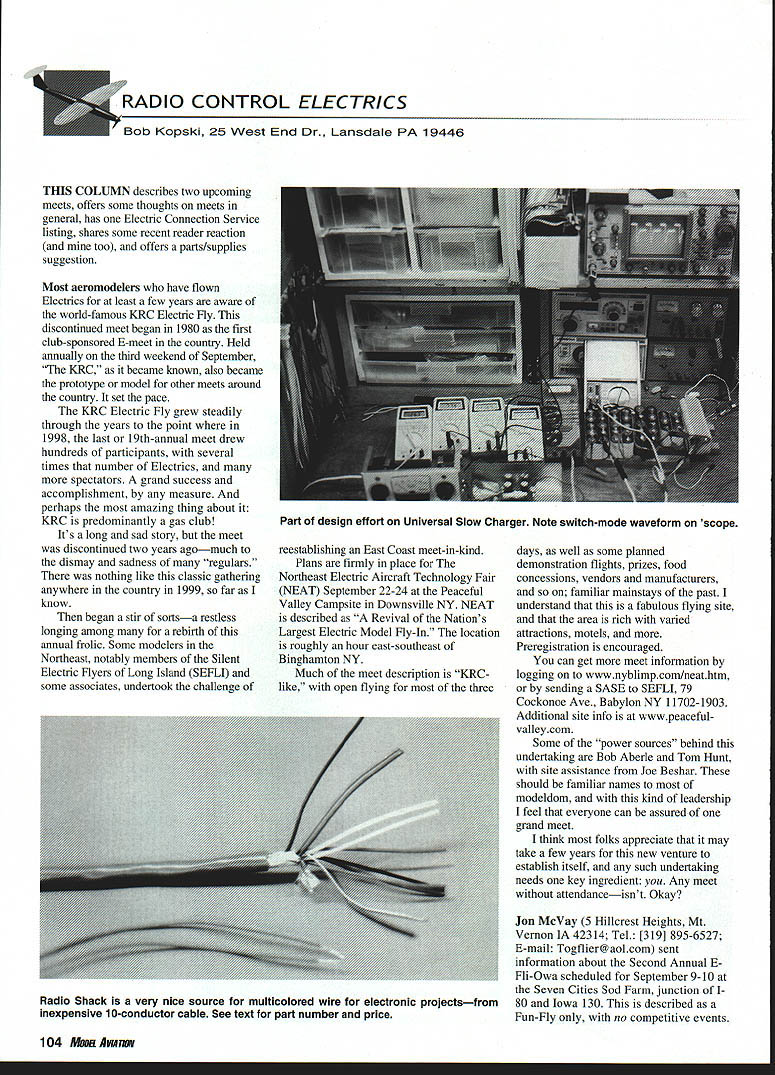
The July column, written just days after the April MA began to circulate, described the immediate early burst of reader interest in the new Universal Slow Charger (described in the March column, with more info and a photo in April). I think it was the photo that did the trick. I am pleased to report that reader interest continues.
As I write this column I'm working on a construction article for the Universal Slow Charger, because "you asked for it!" (Editor's note: The USC is scheduled for publication in the September 2000 issue.)
This has become a fairly major undertaking because I'm now trying to accommodate as many reader requests and suggestions as possible. My approach to this is to provide a very flexible design (one with options) so that you can readily customize it to your needs and interests. The high level of reader interest suggests that industry has totally missed a hobby need and potential marketing opportunity!
Inherent in this design finalization and associated testing is the need to do a lot of test charging—charging many cells in varied pack configurations, over and over. Ordinarily this would present an associated problem: what does one do with lots of charged packs? Clearly, I have to discharge them in order to continue testing, but fortunately this is not a problem for me.
The Active Load
In the August '99 column I described an accessory I had made: an Active Load. This is a device that will discharge most any pack in a very controlled and safe manner. It's a battery discharger that can dump stored energy at up to a 600-watt rate; it can easily accommodate all packs I have (and well beyond).
As it turns out, only two readers ever inquired about the Active Load, and one of them wrote three times!
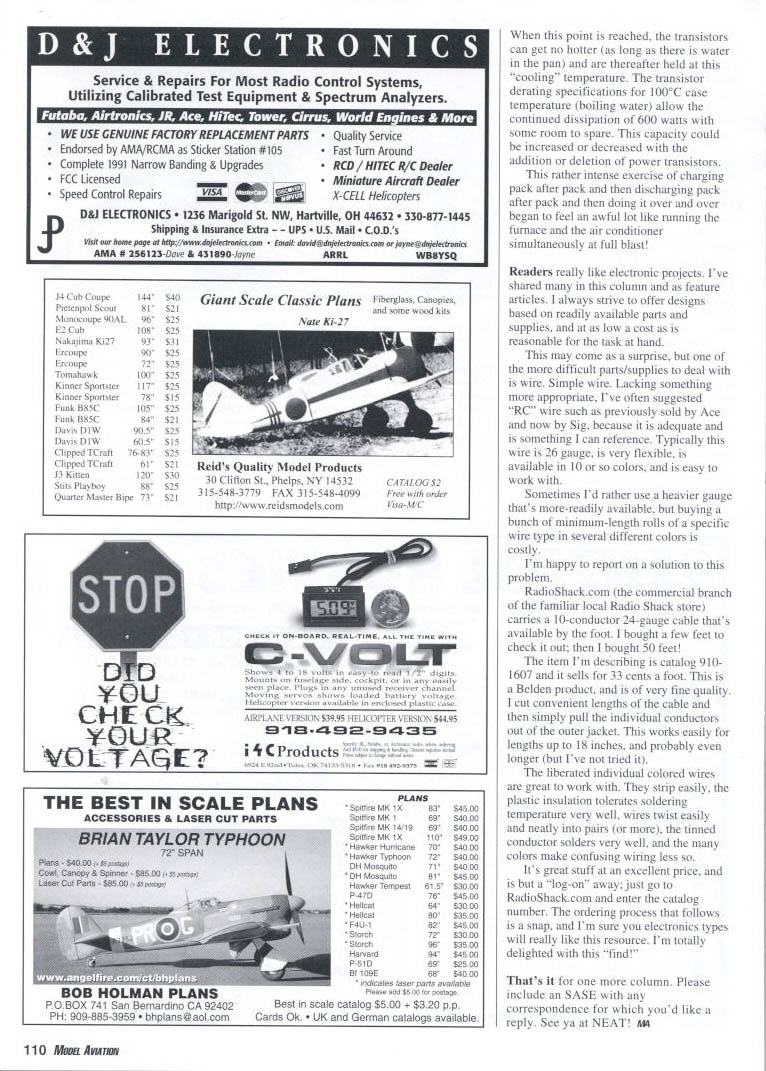
Since some time has gone by, and since I've been using it a lot lately, I thought I'd include a photo of the Active Load this month to see if there's any new interest out there.
The Active Load shown is basically an electronically controlled water-cooled constant-current sink. The water-cooling is my easy, low-cost way of dealing with the heat produced in the discharge process.
Four high-power Darlington bipolar transistors are mounted on a metal plate on standoffs so that they can be immersed "upside down" into cooling water held in a cooking pan. A separate controller establishes an accurate and stable discharge current, which can be selected in steps up to 30 amps. A cutoff circuit feature terminates discharge when the pack voltage decreases to the equivalent of 0.9 volts per cell.
As an operational example, 600 watts brings the water to a boil in approximately 11 minutes, beginning with ice water. When this point is reached, the transistors can get no hotter (as long as there is water in the pan) and are thereafter held at this "cooling" temperature. The transistor derating specifications for 100°C case temperature (boiling water) allow the continued dissipation of 600 watts with some room to spare. This capacity could be increased or decreased with the addition or deletion of power transistors.
This rather intense exercise of charging pack after pack and then discharging pack after pack and then doing it over and over began to feel an awful lot like running the furnace and the air conditioner simultaneously at full blast!
Readers really like electronic projects. I've shared many in this column and ask for feature articles. I always strive to offer designs based on readily available parts and supplies, and at as low a cost as is reasonable for the task at hand.
Parts and supplies: wire solution
This may come as a surprise, but one of the more difficult parts/supplies to deal with is wire. Simple wire. Lacking something more appropriate, I've often suggested "RC" wire such as previously sold by Ace and now by Sig, because it is adequate and is something I can reference. Typically this wire is 26 gauge, is very flexible, is available in 10 or so colors, and is easy to work with.
Sometimes I'd rather use a heavier gauge that's more readily available, but buying a bunch of minimum-length rolls of a specific wire type in several different colors is costly.
I'm happy to report on a solution to this problem.
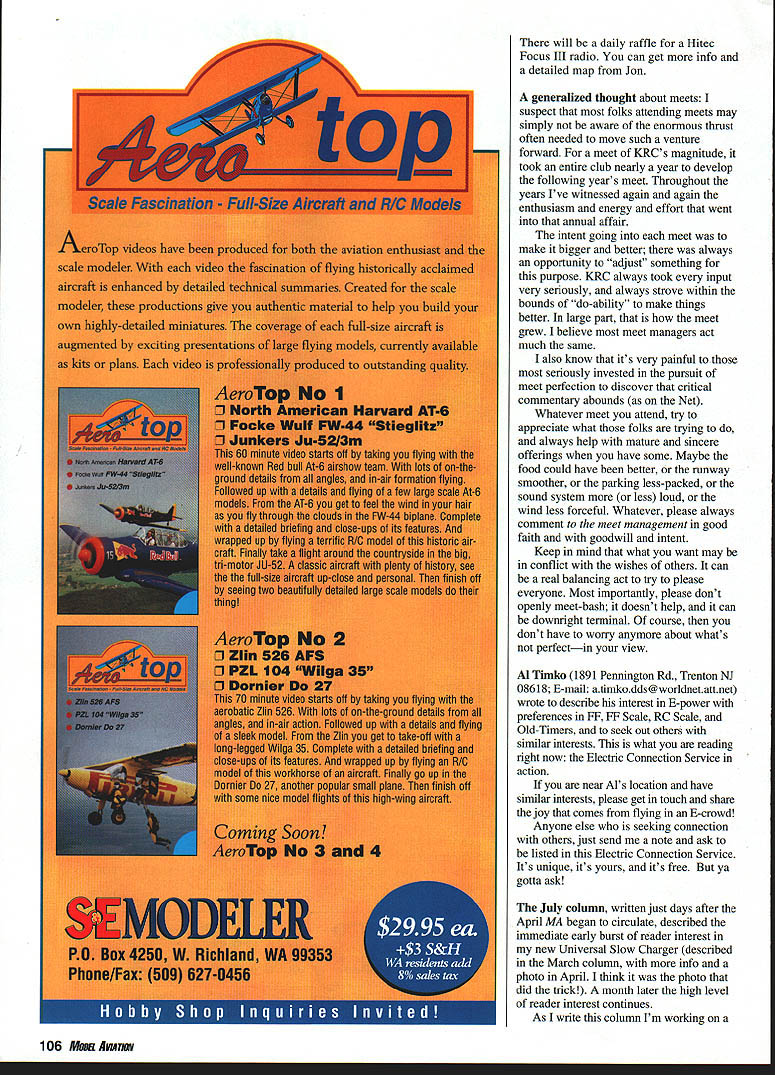
RadioShack.com (the commercial branch of the familiar local Radio Shack store) carries a 10-conductor 24-gauge cable that's available by the foot. I bought a few feet to check it out; then I bought 50 feet!
The item I'm describing is catalog 910-1607 and it sells for 33 cents a foot. This is a Belden product, and is of very fine quality. I cut convenient lengths of the cable and then simply pull the individual conductors out of the outer jacket. This works easily for lengths up to 18 inches, and probably even longer (but I've not tried it).
The liberated individual colored wires are great to work with. They strip easily, the plastic insulation tolerates soldering temperature very well, wires twist easily and neatly into pairs (or more), the tinned conductor solders very well, and the many colors make confusing wiring less so.
It's great stuff at an excellent price, and is but a "log-on" away; just go to RadioShack.com and enter the catalog number. The ordering process that follows is a snap, and I'm sure you electronics types will really like this resource. I'm totally delighted with this "find"!
That's it for one more column. Please include an SASE with any correspondence for which you'd like a reply. See ya at NEAT! MA
Transcribed from original scans by AI. Minor OCR errors may remain.

