
RADIO CONTROL GIANTS
John A. de Vries, 4610 Moffat Ln., Colorado Springs CO 80915
YOU MAY NOT have noticed, but magazine ads have been touting a host of new Almost Ready to Fly (ARF) Giant Radio Control (RC) Scale models.
Surprisingly, most of the ARF Giants are relatively inexpensive. When all you have to do is join a couple wing panels, glue the tail feathers in place, and bolt the landing gear to the fuselage, it gets easier and easier to be a Giant Scale flier.
You still have to add a suitable radio and install an appropriate engine (the expensive "bits"), but those tasks shouldn't be too onerous.
And most of the better "kits" include a scale three-view of the prototype aircraft, so you have everything you need if you're competitively inclined.
There is a hidden bonus in most ARF Giants: they not only take the doozy work out of model construction, they also provide a great opportunity for the dedicated "Scale nut."
Landing gear and retracts
As a money-saving exercise, many of the ARF Giants come equipped with a fixed landing gear — even on models that are supposed to have retracts. It's much cheaper to provide a prebent pair of struts than to include the $200 set of "folders."
So one of the first modifications a conscientious customer should go for is a couple or three Robart or Century retracts.
Many of the ARFs have built-in provisions for retractable landing gear, so a bit of trimming and installing roughly eight bolts can add a great deal of realism to the beautiful new ARF.
Cockpits and scale detailing
It will take a bit of research on your part, but the average ARF can include a scale cockpit.
Many of the warbird kits include an optional "cockpit kit." Instrument panels, switch panels, and cockpit seats are duplicated in thin, vacuum-formed plastic that can be easily inserted into the proper location after a bit of paint finishing.
The cockpit kit is a quick-and-dirty way of improving the usual "meat-and-potatoes" appearance of the big ARF.
You may think you're stuck with the color scheme your ARF came with. Not so; even though the kit parts are already covered, they duplicate one version of the prototype.
With a bit of historical research, a whole new-looking model can be produced.
Even if the model included a film covering, it can be painted over to completely change the appearance. Rough up the cover film with a gentle bit of sandpaper, to provide a "tooth" to get the paint job to stick. With a bit of spray paint, you will have a copy of the prototype you desire.
If you want to spend a bit of time doing a weathering job on your new Giant ARF, break out the fine sandpaper. Use it only on parts of the model you want to paint over.
The big idea here is to change the exterior appearance of the model, so it won't look like every other example of the same kit on the club's flightline.
I know that the extra fiddling with an ARF kind of defeats the purpose of the rebuilt model. Most fliers will take the quick-and-dirty assembly route, in order to get the model into the air in the shortest period of time, with a minimum of extra effort.
There's nothing wrong with that exercise, but most Giant Scalers are Scale nuts at heart; they acquire ARFs only as starting points for true RC Scale models.
Free Flight memories
There is a school of thought that RC was created by frustrated Free Flighters. They got tired of chasing their airplanes downwind, and they wanted devices that would return the models to their immediate vicinity. And radios do that!
However, there is much to be said for pure Free Flight, with no electronic interference! Two models from the "good old days" remind me of the beauty of airplanes without radios.
The first was a .25 Scientific hand-launched glider. It was very carefully assembled, and the wings were treated with what was then called "glider polish."
This concoction consisted of talcum powder mixed into a bottle of clear nitrate dope. Two coats of it, sanded after each application, turned balsa wings into slick, almost glasslike airfoils.
At the time I built this model, I lived across the road from a freshly mown hay field. The flights were beautiful, particularly at sunset, even though I didn't have much of an arm.
The second model of fond remembrance was built from a kit produced by Reginald Denny — the Denny Condor.
The Condor was Japanese tissue-covered and rubber-powered, and with a home-carved balsa propeller (also smoothed with glider polish), it flew like the proverbial "homesick angel."
A wind-up put roughly 200 turns in the rubber, and the propeller folded neatly along the sides of the model's nose when the power gave out.
The Condor was a doozer; it won a gold medal for me.
Another Free Flight model should be noted while I'm reminiscing: a scale rubber-powered WACO Cabin biplane. The model was covered with yellow Japanese tissue, and it was built from one of the more-expensive kits—all of 35¢. The covering was tightened with water, blown through one of the then-popular spritzers.
Watching the WACO fly overhead with the sun shining through was tissue-covering heaven!
Back to reality!
Correspondence and projects
I received a letter from Canadian buddy Ray Gareau. I met Ray in Paris in 1984; he was a member of the Canadian Scale Team, and his entry was a de Havilland Beaver.
It's sad to relate, but Ray spent most of the international contest rebuilding his model after a spate of "incidents" (that tore up his cowling rather severely).
Ray took his difficulties with good grace, and he was the life of the party each night at the Novotel where we were staying. We've been corresponding on and on ever since.
Ray's latest project is a self-designed Giant Scale Curtiss-Reid biplane. The prototype was built in approximately 13 copies by a company in Montreal. Talk about your obscure scale models.
Knowing Ray, the model will be a true beauty and it will be dead-on scale—even the controls in the rear cockpit will be proportioned correctly to the appropriate servo, and all will move in concert with the radio inputs.
Ray has promised to send photographs of the model via the Internet. He has a new computer, and is hooked up. His son can massage his photos for electronic sending. I can hardly wait!
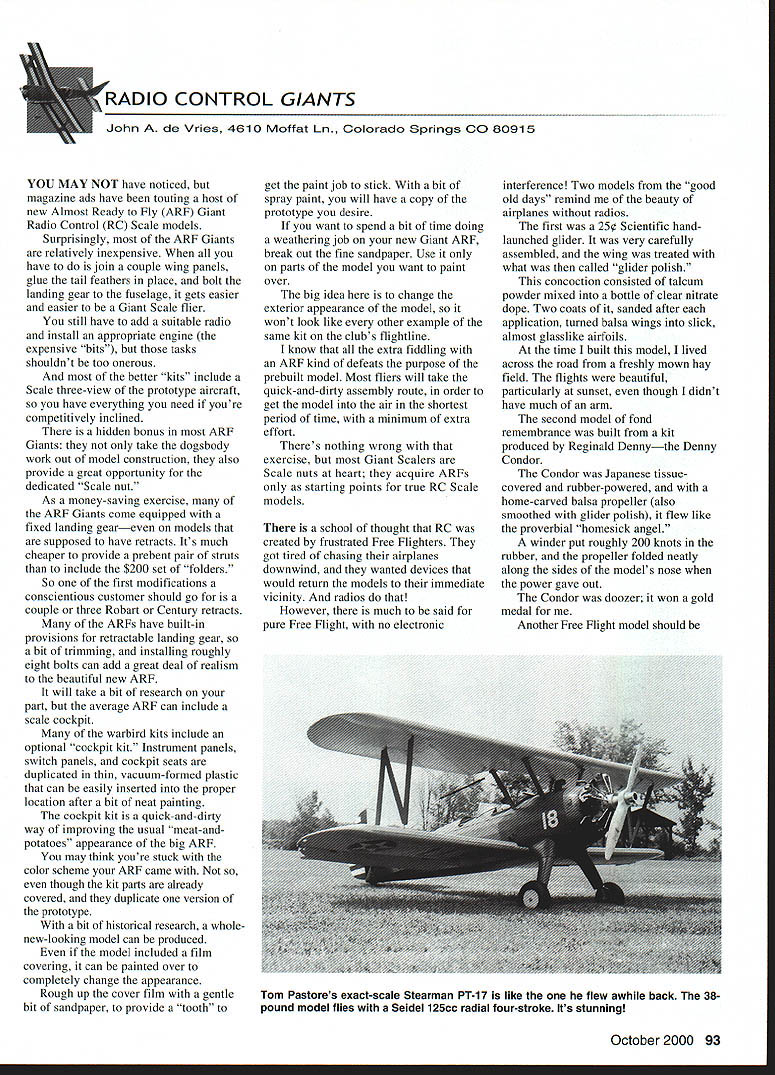
Tom Pastore of East Aurora NY is some kind of Giant Scale model builder.
The evidence is the photograph of his super-scale Stearman PT-17 that accompanies this column. The model spans a spectacular 96 inches, and weighs 38 pounds. In keeping with the exact-scale nature of the model, Tom powers it with a Seidel 125cc four-stroke radial engine.
Tom notes that he's having trouble getting all the cylinders to fire. I can't help him with that; I haven't had any experience with multicylinder model engines.
Of late, there's been a complete dearth of good Giant Scale model photographs in the mailbox. I sure would like to see the results of your current project, flier, or kit-built effort.
There's nothing like a thoroughly illustrated column, but I can't have one if nobody sends me pictures! Be a "somebody" and share your models with all of us.
I hope you're having a great Giant Scale flying season! MA
Transcribed from original scans by AI. Minor OCR errors may remain.

