

RADIO CONTROL GIANTS
John A. de Vries, 4610 Moffat Ln., Colorado Springs CO 80915
I have many books around here, and the number has just increased by three.
The new volumes are about World War I aviation. They include the history of the French Air Force and the Czarist Russian Air Force, and include a detailed monograph on British Sopwith airplanes.
The Great War in the air is well-covered, with big, thick books on the British (Jack Bruce's tour de force), French, Russian, Austrian, and German air forces. The only participant in the air war that hasn't been detailed is Italy, and the history of its airplanes and their pilots.
Why the fascination with what is almost ancient history? Primarily because the airplanes in the earliest air conflicts are little more than full-scale models.
There was a great deal of wood and fabric in their construction. All of them had fixed landing gears, and most were biplanes. With a good set of plans, it's almost a cinch to produce a good Giant Scale model of a WW I fighter or reconnaissance aircraft.
Some of the aircraft do present a balance problem because of their short nose moments, but a healthy gas burner up front in a model tends to minimize the problem. And now there are fabric-like iron-on coverings that duplicate the linen of the prototypes.
Most of the good reference books include color views of the most important WW I aircraft types. Add the fact that many of the WW I aircraft had great paint jobs, and they're naturals for great Giant Scale models.
Most of the research you'll need is readily available in book form, and the drawings are out there.
A good place to start is with generic books on a combatant nation you prefer. The books will give you good overviews of the many types of aircraft used by that country. Most of the good books include comprehensive bibliographies, which are a big help.
A review of photographs and three-views will lead you along the research road, to a suitable subject for your modeling efforts.
Once you've chosen the airplane you want to duplicate, you'll probably find a specific book on it or on the company that produced it. Chances are that the Windsock Datafile series of British monographs will provide a complete exposition on your aircraft of choice.
That should almost complete your research on the World War I modeling subject. The only thing left to do is pore over advertisements in magazines, to find construction drawings or a kit for your favorite aeroplane.
Probably the best source of scratch-building plans is High Flight, the International Miniature Aircraft Association (IMAA) quarterly publication.
Another plus for modeling a WW I aircraft in Giant Scale: the airplanes are small enough that a 1/4-scale duplicate will be a most-reasonable size.
Meeting Larry Klingberg
Still on the WW I kick, I had the honor of being visited by one of the supreme exponents of 1914–1918 models.
Larry Klingberg, model designer, builder, and flier of great repute, dropped in for an afternoon of conversation while he was driving his recreational vehicle down the eastern side of the Rockies.
I've included photographs of several of Larry's beautiful Giants in the column, and it was great to finally meet him in person.
You might remember Larry's stunning Sopwith aircraft on floats. He's done the same thing with his fun-fly Fieseler Storch! I don't know if the Germans ever flew the WW I STOL (Short Takeoff & Landing) aircraft off water, but Larry's doing it.
Larry revealed that he's built a great Curtiss Robin and a WW I Fairey seaplane, as well as the Sopwiths.
His fascination with flying off water has led him to help reconstitute the model Schneider Racers, which were heretofore flown from Lake Havasu in Arizona. We wished him well on the project, and filled him up with a supper of waffles and bacon before he continued on his Colorado beeline. He's a great guy!
Wings Over the Desert and other enthusiasts
Jim Lynch, Tucson (AZ) IMAA manager, noted the 2000 Wings Over the Desert meet. A most successful Giant Scale get-together, the annual gala featured some beautiful models.
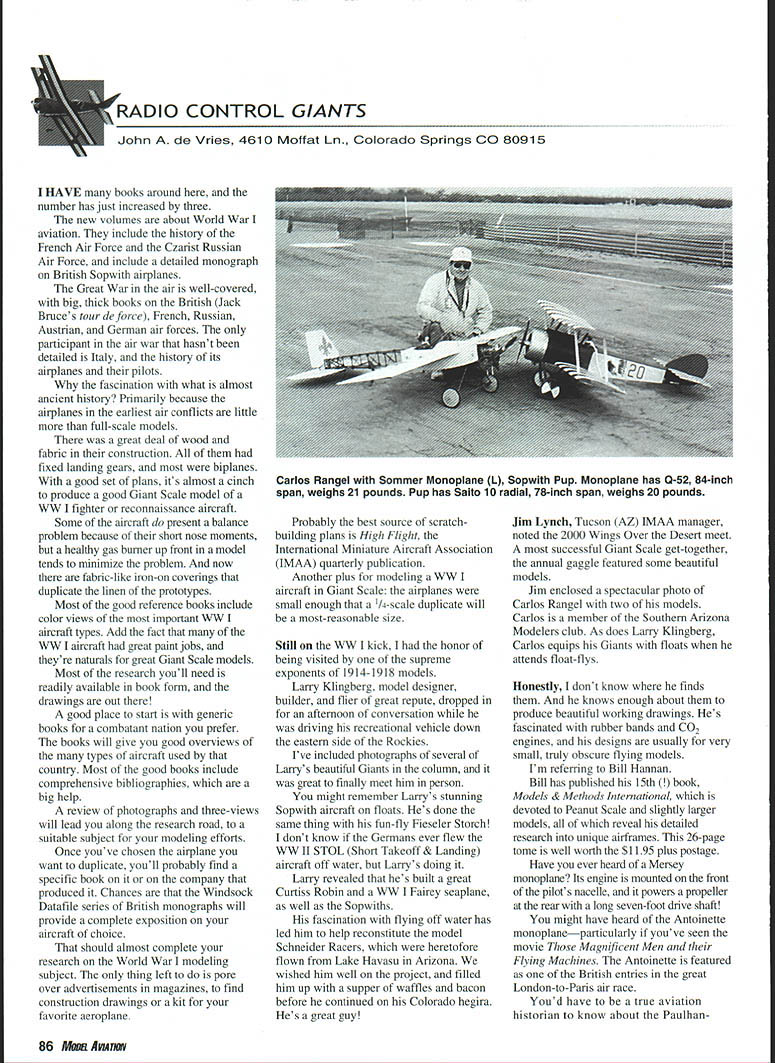
Jim enclosed a spectacular photo of Carlos Rangel with two of his models. Carlos is a member of the Southern Arizona Modelers club. As does Larry Klingberg, Carlos equips his Giants with floats when he attends float-flys.
Honestly, I don't know where he finds them. And he knows enough about them to produce beautiful working drawings. He's fascinated with rubber bands and CO2 engines, and his designs are usually for very small, truly obscure flying models.
Bill Hannah and Models & Methods International
I'm referring to Bill Hannah. Bill has published his 15th (!) book, Models & Methods International, which is devoted to Peacetime Scale and slightly larger models, all of which reveal his detailed research into unique airframes. This 26-page booklet sells for $11.95 plus postage.
Have you heard of a Mersey monoplane? Its engine is mounted on the front of the pilot's nacelle, and it powers a propeller at the rear with a long seven-foot drive shaft! You might have heard of the Antoinette monoplane—particularly if you've seen the movie Those Magnificent Men and Their Flying Machines. The Antoinette is featured as one of the British entries in the great London-to-Paris air race.
You'd have to be a true aviation historian to know about the Paulhan-Tatin Aero-Torpille (torpedo) or the Avro G biplane.
Bill's new book includes drawings of those aircraft and more. His Antoinette drawings are a prime candidate for enlargement to Giant Scale. Beautiful!
If you'd like a copy of Models & Methods International, get in touch with Bill at Hannan's Runway, Box 210, Magalia CA 95954. His telephone number is (530) 873-6421. If you have access to the Internet, check out his Web site at www.hrunway.com.
On radial-engined aircraft and carburetor placement
Thank goodness for radial-engined aircraft.
Why? Because there's enough room in a model's engine compartment to hold a healthy muffler.
Another reason is that there should be adequate room for the ubiquitous Walbro (or Walbro-type) carburetor. Most gas-burners used in Giant Scale models get their fuel and air through a Walbro.
However, the engines that power our models were intended for other kinds of machinery. Where the carburetor was hung was a function of the chain-saw's (or weed-whacker's) design; no thought was given to the fact that the engine would have to be installed in the nose of a Spitfire or Mustang model.
Therefore, that big silver cube sticks outside the cowling in many models, cluttering the beautiful, smooth lines of the Scale airplane.
Some skillful modelers, who have a talent for machining and modification, have designed adapters to reposition the carburetor that came with their engines.
Some manufacturers have designed their engines with the carburetor nestled behind, below, or above the cylinder(s), and have obviated the need to cut large rectangular holes in the Scale model's cowling. Hooray for them!
In extreme cases, modelers have opted for the larger-size glow engines to power their Giants, in spite of the extra cost of using glow fuel and the need for a fuelproof finish on their models.
Glow engines' smaller-size carburetors lend themselves to more-streamlined installations.
Why the palaver about the "silver cube"? If you have an engine that positions its Walbro in a way that does not protrude and yet is in a location that keeps the carburetor from sticking outside the cowling, I'd like to hear about it.
And if you've found a way to install one of the lumpier engines without extra holes in the front of your model, I'd like to hear about that too.
I'll pass your information on to other Giant Scale modelers who emphasize the word "Scale."
Back with you all in the January issue. MA
Transcribed from original scans by AI. Minor OCR errors may remain.

