
RC Giants
Sal Calvagna 1335 Broadway Ave., Holbrook NY 11741 E-mail: [email protected]
WELCOME TO the October segment of "Radio Control Giants." My first column debuted in the July MA, and I have already received a number of E-mail messages and letters from AMA members wishing me well in my new endeavor.
I have responded to all the E-mail I received. Thank you very much for all your kind words of support!
I am especially grateful to Mr. Jacob Garrecht of Stamford, Connecticut, who took the time and trouble to send me a nice typewritten letter with some suggestions for using cold rolled steel versus 1/4‑inch case‑hardened music wire. In one part of his letter he wrote, "after all, I am only 92 so I have been around a long time."
Since we learn from those with more experience, at 92 you certainly have impeccable qualifications, Jake. Thanks!
High-price Giants
In John de Vries' last column (June 2001) he discussed the cost of building and flying Giant Scale Radio Control (RC) airplanes. He wrote that the cost of these models has gone well beyond what could be considered reasonable!
He wrote, "If the trend continues, RC Giants will be limited to lottery winners, the heirs of people who helped Bill Gates establish Microsoft®, and members of the medical profession."
After reading his column and absorbing the contents, I felt that it was important to write further on this subject—mainly because I don't want newcomers or those who are interested in Giant Scale to shy away.
What John wrote has a lot of merit. You certainly can purchase a Giant Scale kit, engine, retracts, radio, and accessories, and spend thousands of dollars even before two pieces of wood are glued together!
However, where there is a will, there is a way, and building and flying an RC Giant can be done without mortgaging your children's future!
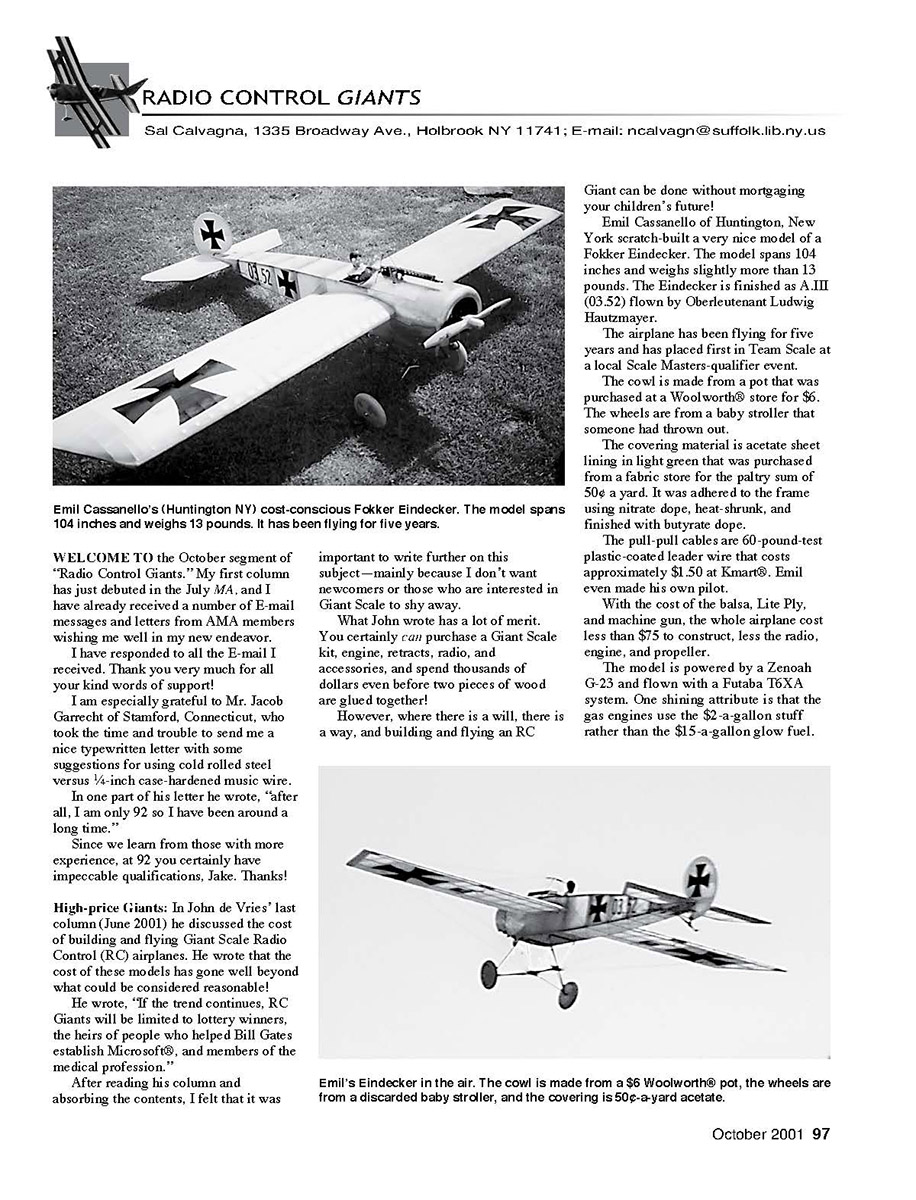
Emil Cassanello of Huntington, New York scratch-built a very nice model of a Fokker Eindecker. The model spans 104 inches and weighs slightly more than 13 pounds. The Eindecker is finished as A.III (03.52) flown by Oberleutnant Ludwig Hautzmayer.
The airplane has been flying for five years and has placed first in Team Scale at a local Scale Masters–qualifier event.
The cowl is made from a pot that was purchased at a Woolworth® store for $6. The wheels are from a baby stroller that someone had thrown out.
The covering material is acetate sheet lining in light green that was purchased from a fabric store for the paltry sum of 50¢ a yard. It was adhered to the frame using nitrate dope, heat‑shrunk, and finished with butyrate dope.
The pull‑pull cables are 60‑pound‑test plastic‑coated leader wire that costs approximately $1.50 at Kmart®. Emil even made his own pilot.
With the cost of the balsa, Lite Ply, and machine gun, the whole airplane cost less than $75 to construct, less the radio, engine, and propeller.
The model is powered by a Zenoah G‑23 and flown with a Futaba T6XA system. One shining attribute is that the gas engines use the $2‑a‑gallon stuff rather than the $15‑a‑gallon glow fuel.
Transcribed from original scans by AI. Minor OCR errors may remain.

