
RC giants - 2012/06
PT-19 kit — designer's notes
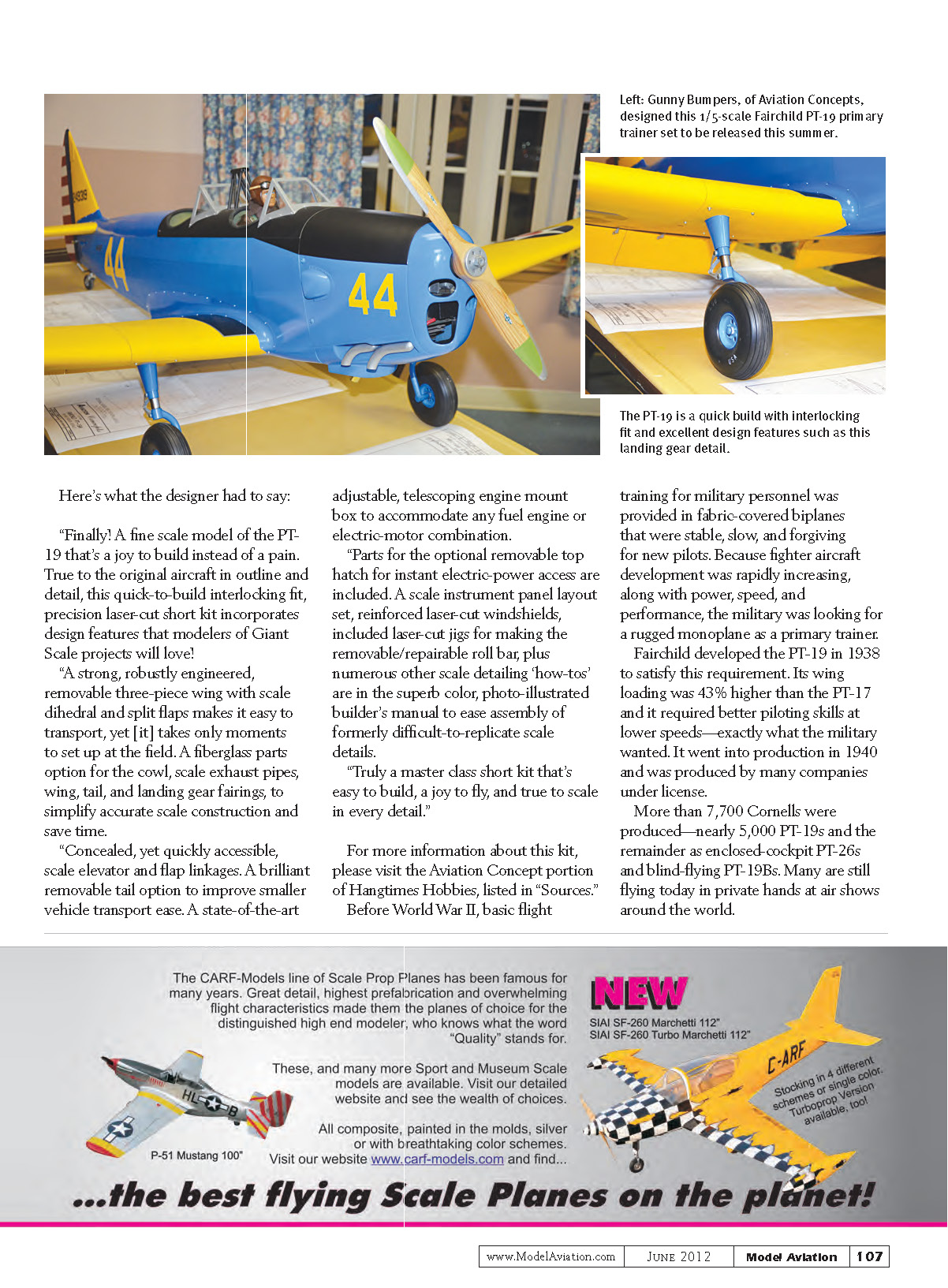
Here's what the designer had to say:
"Finally! A fine-scale model of the PT-19 that's a joy to build instead of a pain. True to the original aircraft in outline and detail, this quick-to-build interlocking-fit, precision laser-cut short kit incorporates design features that modelers of Giant Scale projects will love!
"A strong, robustly engineered, removable three-piece wing with scale dihedral and split flaps makes it easy to transport, yet it takes only moments to set up at the field. A fiberglass parts option for the cowl, scale exhaust pipes, wing, tail, and landing gear fairings simplifies accurate scale construction and saves time.
"Concealed, yet quickly accessible, scale elevator and flap linkages. A brilliant removable tail option to improve smaller-vehicle transport ease. A state-of-the-art adjustable, telescoping engine mount box to accommodate any fuel engine or electric-motor combination.
"Parts for the optional removable top hatch for instant electric-power access are included. A scale instrument panel layout set, reinforced laser-cut windshields, included laser-cut jigs for making the removable/repairable roll bar, plus numerous other scale detailing 'how-tos' are in the superb color, photo-illustrated builder's manual to ease assembly of formerly difficult-to-replicate scale details.
"Truly a master-class short kit that's easy to build, a joy to fly, and true to scale in every detail."
For more information about this kit, please visit the Aviation Concepts portion of Hangtimes Hobbies (listed in Sources).
PT-19 history
Before World War II, basic flight training for military personnel was provided in fabric-covered biplanes that were stable, slow, and forgiving for new pilots. Because fighter aircraft development was rapidly increasing—along with power, speed, and performance—the military was looking for a rugged monoplane as a primary trainer.
Fairchild developed the PT-19 in 1938 to satisfy this requirement. Its wing loading was 43% higher than the PT-17 and it required better piloting skills at lower speeds—exactly what the military wanted. It went into production in 1940 and was produced by many companies under license.
More than 7,700 Cornells were produced—nearly 5,000 PT-19s and the remainder as enclosed-cockpit PT-26s and blind-flying PT-19Bs. Many are still flying today in private hands at air shows around the world.
Mr. Top Gun
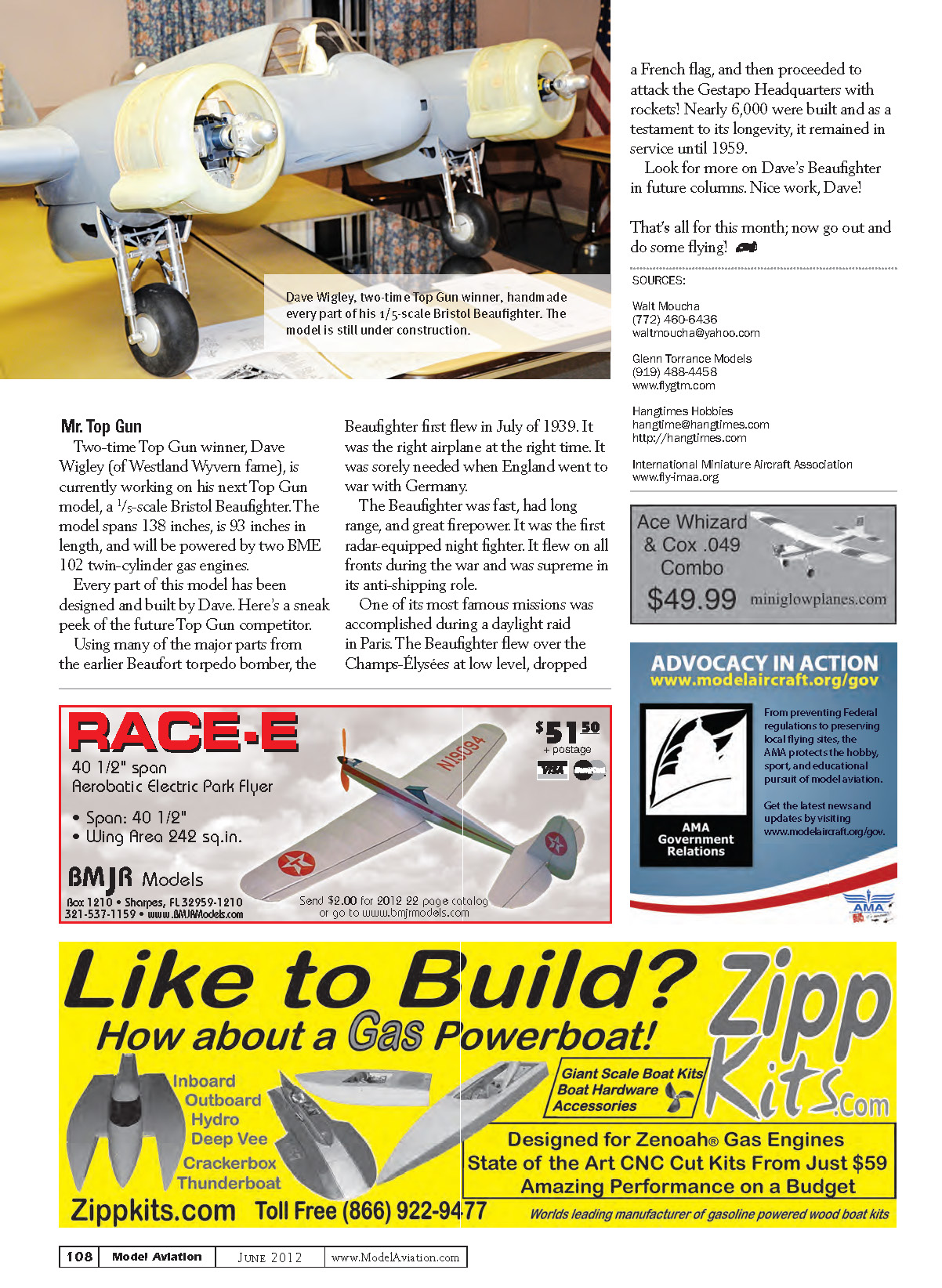
Two-time Top Gun winner Dave Wigley (of Westland Wyvern fame) is currently working on his next Top Gun model, a 1/5-scale Bristol Beaufighter. The model spans 138 inches, is 93 inches in length, and will be powered by two BME 102 twin-cylinder gas engines.
Every part of this model has been designed and built by Dave. Here's a sneak peek of the future Top Gun competitor.
Using many of the major parts from the earlier Beaufort torpedo bomber, the Beaufighter first flew in July 1939. It was the right airplane at the right time and was sorely needed when England went to war with Germany.
The Beaufighter was fast, had long range, and great firepower. It was the first radar-equipped night fighter. It flew on all fronts during the war and was supreme in its anti-shipping role.
One of its most famous missions was accomplished during a daylight raid in Paris. The Beaufighter flew over the Champs-Élysées at low level, dropped a French flag, and then proceeded to attack the Gestapo headquarters with rockets! Nearly 6,000 were built and, as a testament to its longevity, it remained in service until 1959.
Look for more on Dave's Beaufighter in future columns. Nice work, Dave!
That's all for this month; now go out and do some flying!
Sources
- Walt Moucha — (772) 460-6436, [email protected]
- Glenn Torrance Models — (919) 488-4458, www.flygtm.com
- Hangtimes Hobbies — [email protected], http://hangtimes.com
- International Miniature Aircraft Association — www.fly-imaa.org
Transcribed from original scans by AI. Minor OCR errors may remain.

