
RC Giants
Sal Calvagna, <REDACTED>; E-mail: <REDACTED>
IF YOU ARE interested in early aviation and happen to be in the Northeast, you should visit a magical place called the Old Rhinebeck Aerodrome. You won't find any computer animation here! This is the real deal, where the sights, sounds, and smells of early aviation come alive.
The Old Rhinebeck Aerodrome is a collection of hangars and workshops adjacent to a grass airstrip located just a couple hours north of New York City.
The Aerodrome boasts a wonderful collection of early aircraft from approximately 1910 through 1940. Many are authentic and some are accurate replicas, though the replicas have authentic engines.
Visitors can see outstanding pioneer, World War I, and barnstorming aircraft in action and watch this colorful era brought back to life amidst the roar of rotary engines and the smell of burnt castor oil.
There are four buildings that house the Aerodrome's nonflying collection, which is chock-full of early aircraft, engines, and related material.
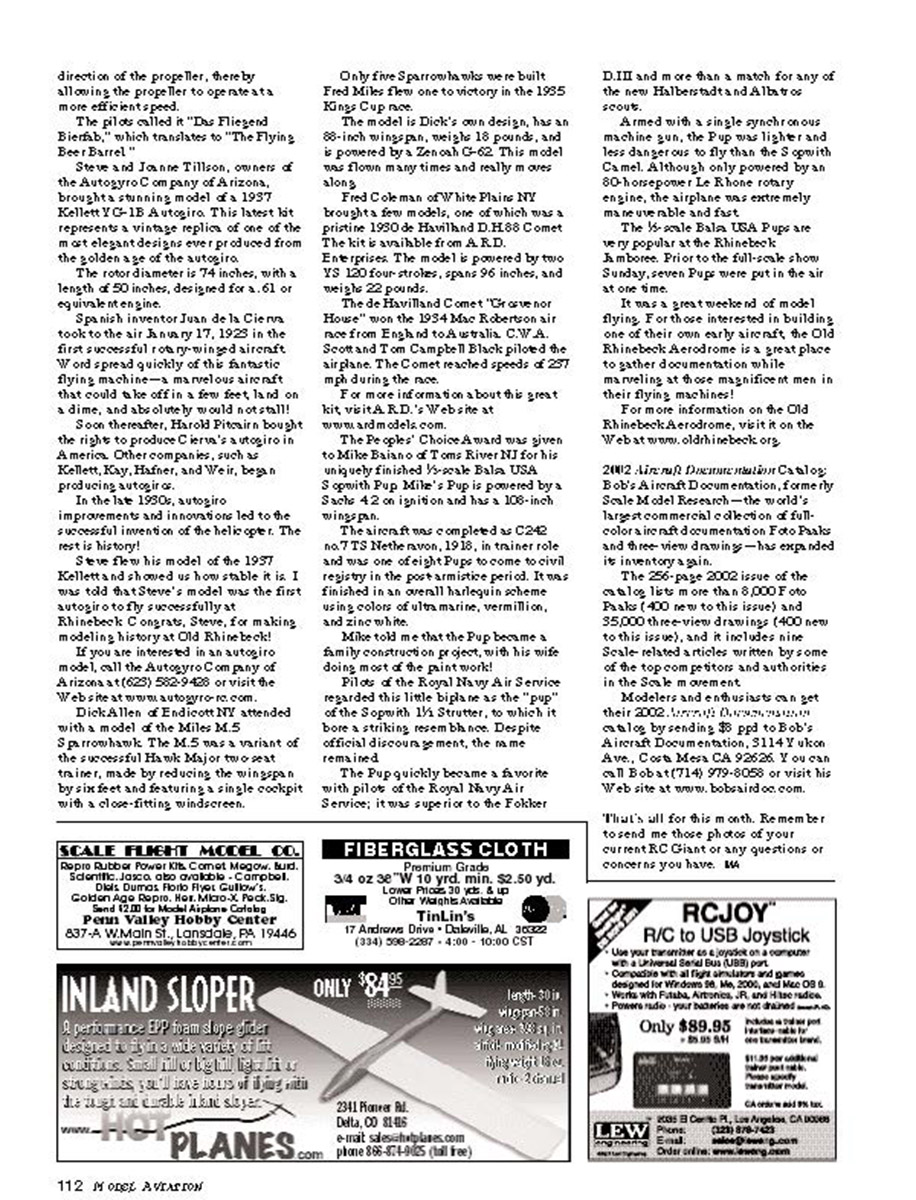
It also has a great collection of period vehicles that it uses during the show, including an authentic WW I French light tank.
The Old Rhinebeck Aerodrome has become world renown through the efforts of Cole Palen. Cole was a great visionary who devoted his life to recreating his dream of the development of early aviation and preserving it at the Old Rhinebeck Aerodrome.
Although Cole is no longer with us, his wife Rita, along with the Aerodrome staff and a great group of volunteers, keeps his vision alive and growing. It is amazing to watch the rotary-powered Sopwith Camel roar to life and take to the air.
One very special weekend each year, the Aerodrome welcomes a local Radio Control (RC) club, The Mid Hudson RC Society, which hosts the annual Rhinebeck Jamboree. The club has held this very popular event for the past 35 years and can proudly boast that it packs in the largest crowd of spectators during the season.
This year there were 115 registered model pilots with roughly 160 models. The Aerodrome staff and the Mid Hudson volunteers do a wonderful job of welcoming and assisting spectators and participants.
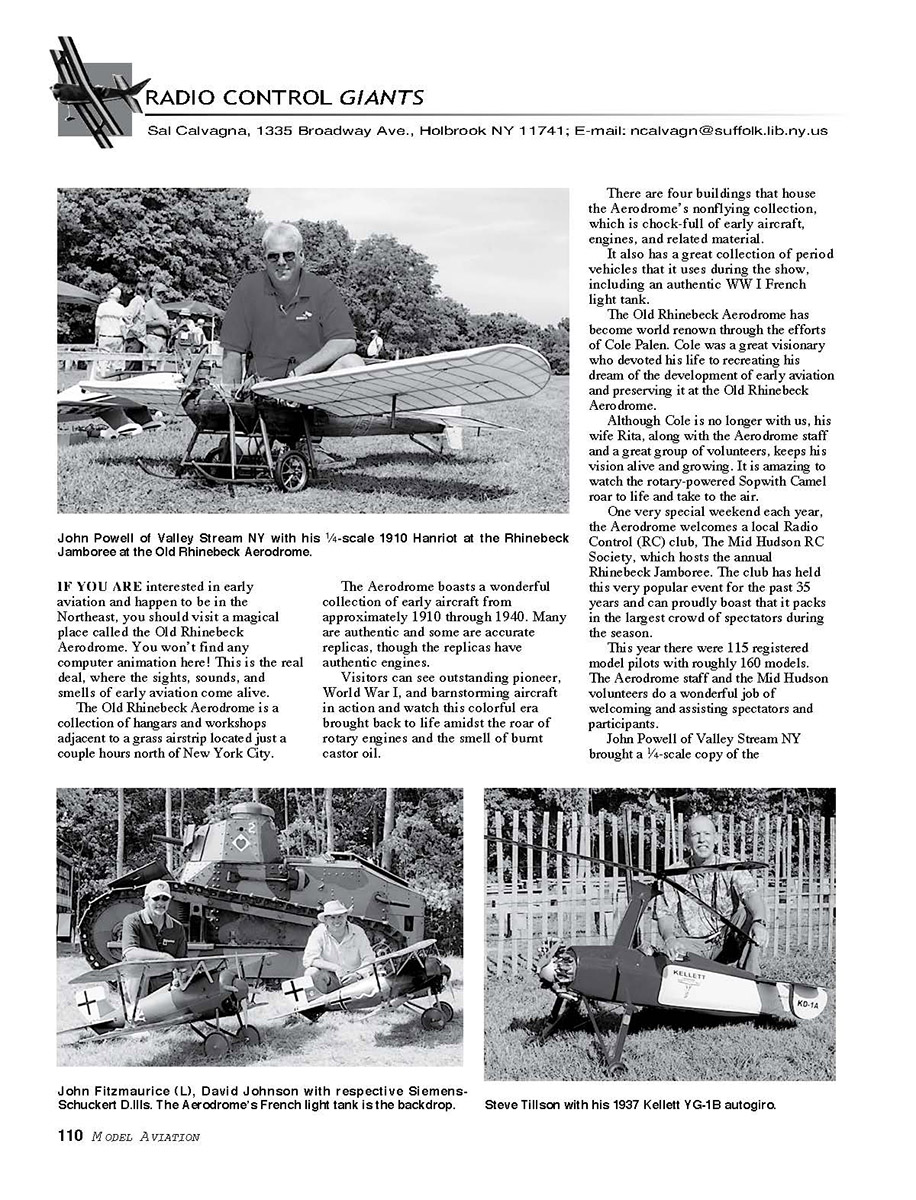
John Powell of Valley Stream NY brought a 1/4-scale copy of the Aerodrome's 1910 Hanriot. John's model spanned 84 inches, weighed 18 pounds, and was powered by an ASP 1.08.
This model was scratch-built using the Aerodrome's full-scale Hanriot for measurements. The model even uses wing warping for banking just like the full-scale aircraft.
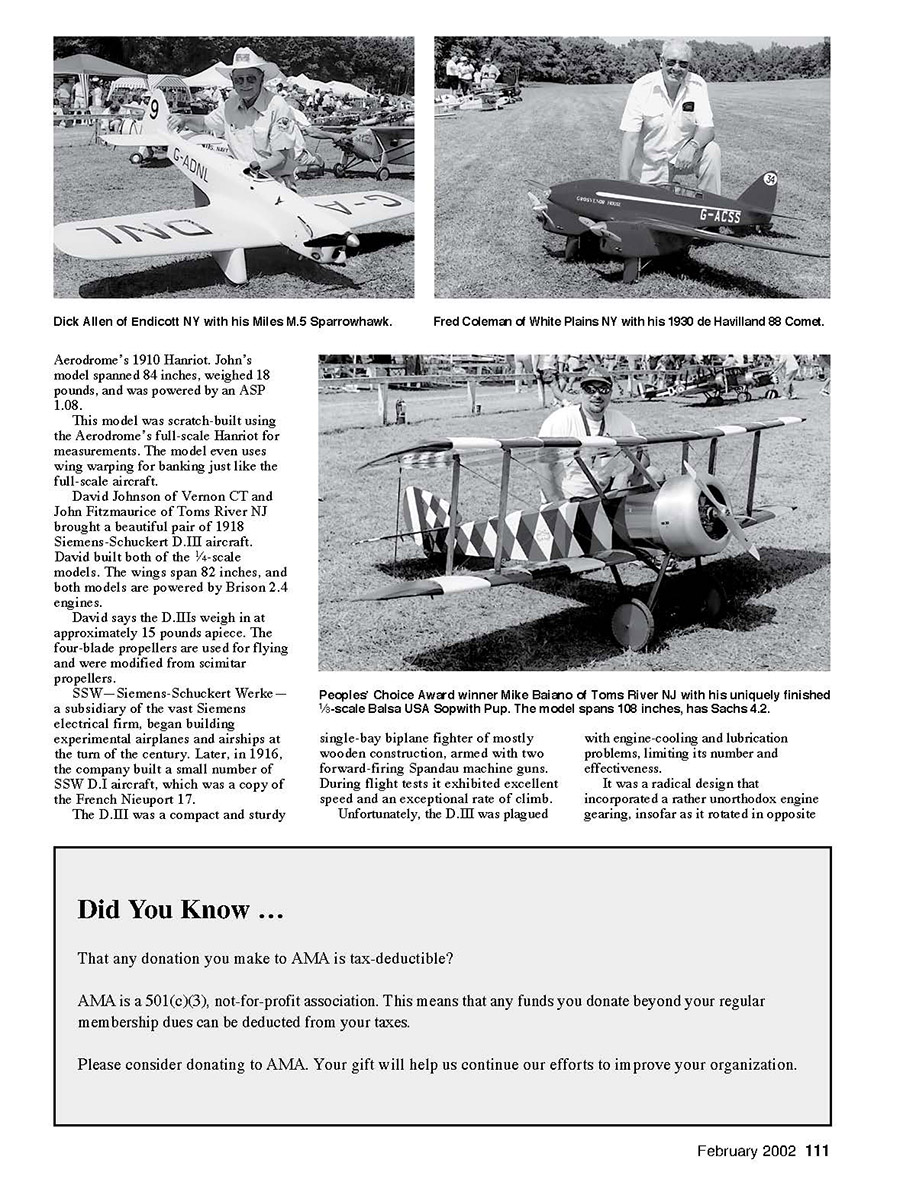
David Johnson of Vernon CT and John Fitzmaurice of Toms River NJ brought a beautiful pair of 1918 Siemens-Schuckert D.III aircraft. David built both of the 1/4-scale models. The wings span 82 inches, and both models are powered by Brison 2.4 engines.
David says the D.IIIs weigh in at approximately 15 pounds apiece. The four-blade propellers are used for flying and were modified from scimitar propellers.
SSW—Siemens-Schuckert Werke—a subsidiary of the vast Siemens electrical firm, began building experimental airplanes and airships at the turn of the century. Later, in 1916, the company built a small number of SSW D.I aircraft, which was a copy of the French Nieuport 17.
The D.III was a compact and sturdy single-bay biplane fighter of mostly wooden construction, armed with two forward-firing Spandau machine guns. During flight tests it exhibited excellent speed and an exceptional rate of climb.
Unfortunately, the D.III was plagued with engine-cooling and lubrication problems, limiting its number and effectiveness.
It was a radical design that incorporated a rather unorthodox engine gearing, insofar as it rotated in opposite directions to its ...
Transcribed from original scans by AI. Minor OCR errors may remain.

