
RC Giants
Sal Calvagna, 1335 Broadway Ave., Holbrook NY 11741; E-mail: [email protected]
I WISH YOU and your family a very happy and healthy holiday season. Yes, it's that time of year again! It's hard to believe as I write this column in late July during a weeklong heat wave here in the Big Apple.
Nevertheless, I sit here dreaming of snowy days, hot chocolate, and all those neat Radio Control (RC) goodies that should mysteriously appear under the Christmas tree because I know that I've been a really good boy this year. Please don't try to verify this with my wife; you might get a totally different story!
It's time to make out a list of all the neat hobby items you would like to have for the next building or flying season, and make sure to leave multiple copies scattered where they will be found easily. It might help to leave the telephone numbers and business names of places where these items can be purchased. That way Santa doesn't have to go crazy!
As for me, what model airplanes can be powered using coal these days?
Giant Scale Directory: There is a Web page titled "Giant Scale Radio Control." The site is sectioned into categories such as "Airplane Kits," "Kit Cutters," "Aircraft Plans," "Engines," "Propellers," "Spinners," "Mufflers," "Graphics," "Coverings," "Landing Gear," "Batteries," and more. Although somewhat dated there is a great deal of pertinent data on Giant Scale products and services. Take a look at www.fly-giant.org.
First Place Engines: Sig Manufacturing Company of Montezuma, Iowa, has been providing the highest-quality model-aircraft kits, balsa, and supplies for more than 50 years. Sig is also the exclusive distributor of First Place Engines (FPE).
According to Sig, the FPE engine line consists of four of the most beautiful, lightweight, and powerful gasoline power plants the industry has ever seen. They are designed specifically for large RC aircraft and offer huge power-to-weight ratios. The engines are available in 2.4, 3.2, 4.2, and 5.8 cubic-inch displacements.
Each FPE engine comes with its own ultralightweight TIG-welded custom aluminum muffler, which is smoke-system-capable out of the box. All four engines come with high-quality electronic ignitions, complete instructions, and a full one-year warranty.
For more information about FPE engines and all of Sig's other fine products and services, visit the company's Web site at www.sigmfg.com or call (641) 623-5154. The toll-free order line is (800) 247-5008.
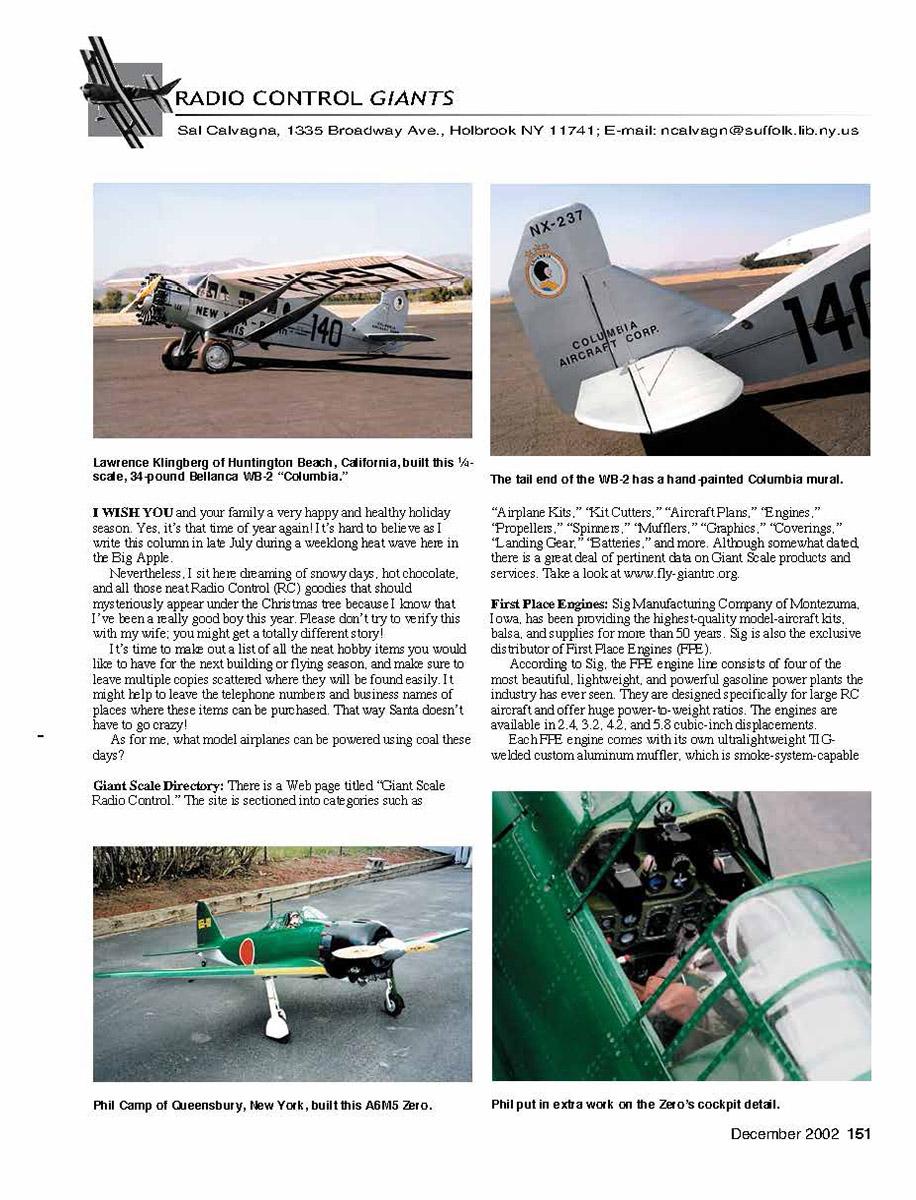
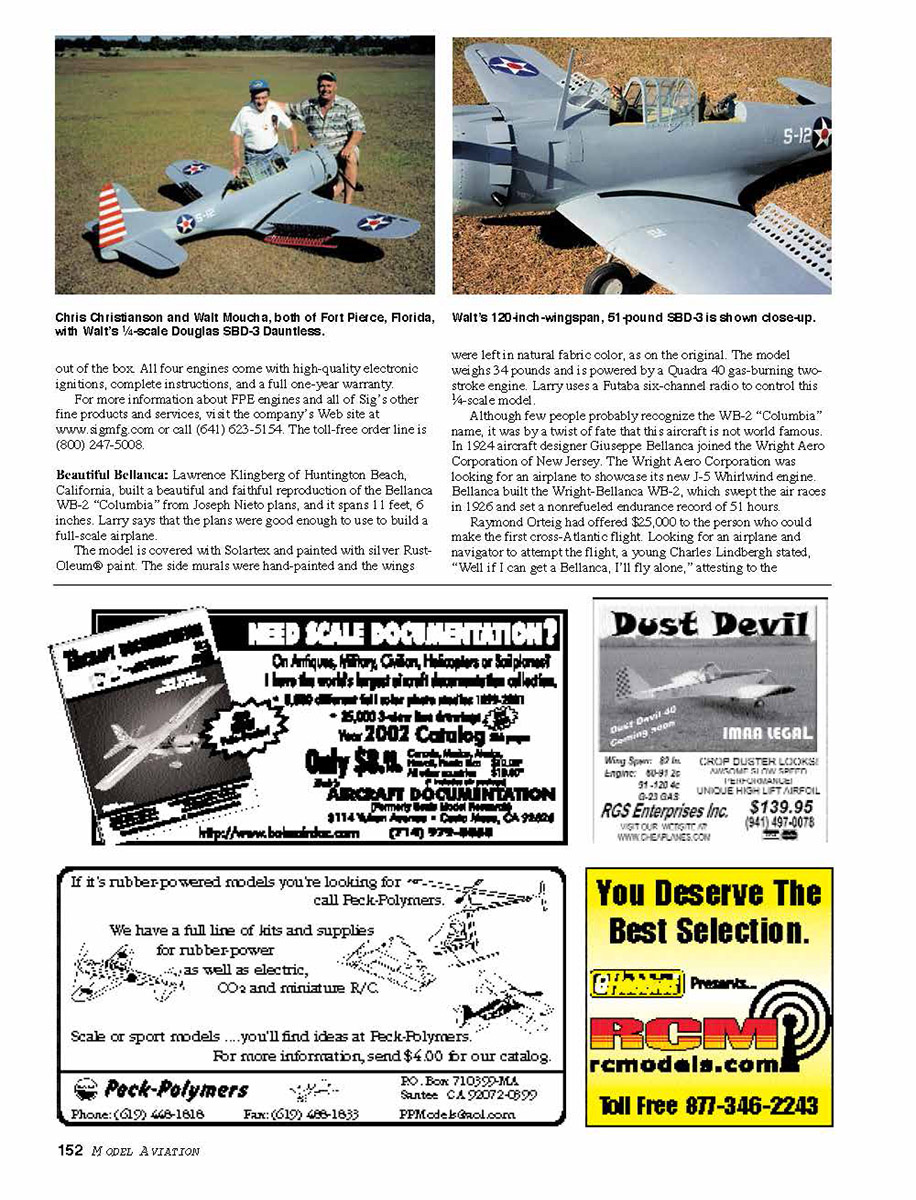
Beautiful Bellanca: Lawrence Klingberg of Huntington Beach, California, built a beautiful and faithful reproduction of the Bellanca WB-2 “Columbia” from Joseph Nieto plans, and it spans 11 feet, 6 inches. Larry says that the plans were good enough to use to build a full-scale airplane.
The model is covered with Solartex and painted with silver Rust-Oleum® paint. The side murals were hand-painted and the wings were left in natural fabric color, as on the original. The model weighs 34 pounds and is powered by a Quadra 40 gas-burning two-stroke engine. Larry uses a Futaba six-channel radio to control this 1/4-scale model.
Although few people probably recognize the WB-2 “Columbia” name, it was by a twist of fate that this aircraft is not world famous. In 1924 aircraft designer Giuseppe Bellanca joined the Wright Aero Corporation of New Jersey. The Wright Aero Corporation was looking for an airplane to showcase its new J-5 Whirlwind engine. Bellanca built the Wright-Bellanca WB-2, which swept the air races in 1926 and set a nonrefueled endurance record of 51 hours.
Raymond Orteig had offered $25,000 to the person who could make the first cross-Atlantic flight. Looking for an airplane and navigator to attempt the flight, a young Charles Lindbergh stated, “Well if I can get a Bellanca, I’ll fly alone,” attesting to the reliability and performance of Bellanca's airplanes.
When Lindbergh attempted to purchase the WB-2, renamed the Columbia from the Columbia Aircraft Company, Bellanca said "yes," but chairman of the board Levine said "no." Furious, Lindbergh went to the Ryan Aircraft Corporation to have the Spirit of St. Louis built.
In mid-May 1927 both aircraft were present at Roosevelt Field, ready to make the Atlantic crossing, but the Columbia was impounded because of a lawsuit brought by the originally intended pilot. On May 20 Lindbergh took off into destiny while the Columbia sat idle.
However, two weeks later the Columbia made a historic flight to Berlin, Germany. Not only did it fly a longer distance than the Spirit of St. Louis, but it also carried the first passenger. Bellanca was recognized for his contribution by appearing on the cover of Time magazine.
While Lindbergh is more famed for his solo flight in the small Ryan aircraft, Bellanca's Columbia flight will remain a mere footnote in history.
Larry says that the only builder of 1/4-scale model aircraft is he. He adds that at 71 years of age, there are just too many airplanes to model and not enough years left.
Transcribed from original scans by AI. Minor OCR errors may remain.

