
The Morane-Saulnier AI: a shunned World War I monoplane
Sal Calvagna
WELCOME BACK to the RC Giants column. Since last month's issue I've had little time for building models. Consequently, not much progress has been made on my 1/4-scale Polikarpov I-16—certainly not enough to report in this column. However, I do have some interesting models for your viewing pleasure.
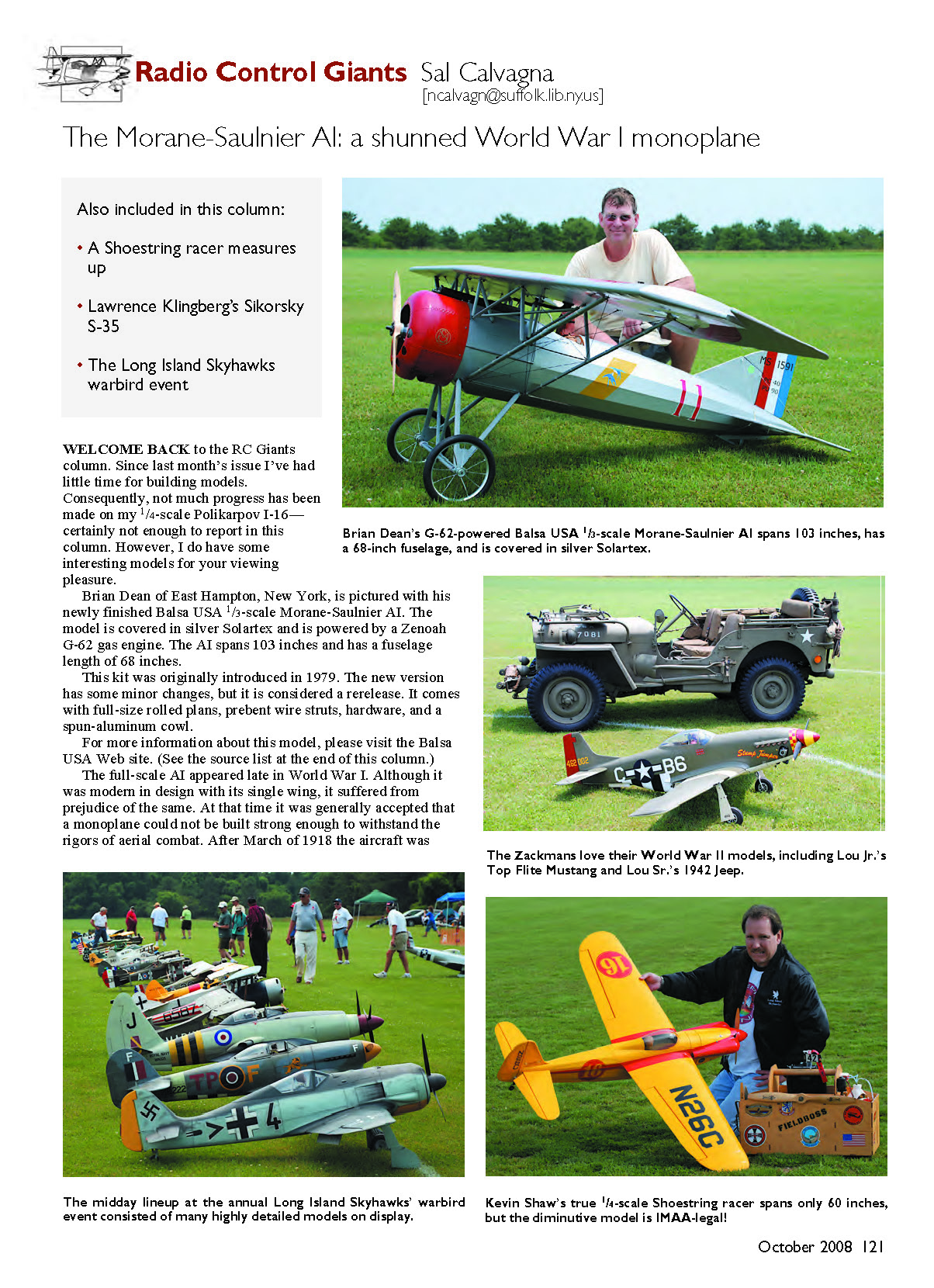
Brian Dean of East Hampton, New York, is pictured with his newly finished Balsa USA 1/3-scale Morane-Saulnier AI. The model is covered in silver Solartex and is powered by a Zenoah G-62 gas engine. The AI spans 103 inches and has a fuselage length of 68 inches.
This kit was originally introduced in 1979. The new version has some minor changes, but it is considered a rerelease. It comes with full-size rolled plans, pre-bent wire struts, hardware, and a spun-aluminum cowl.
For more information about this model, please visit the Balsa USA Web site. (See the source list at the end of this column.)
The full-scale AI appeared late in World War I. Although it was modern in design with its single wing, it suffered from prejudice of the same. At that time it was generally accepted that a monoplane could not be built strong enough to withstand the rigors of aerial combat. After March of 1918 the aircraft was relegated to pursuit training.
Pilots found the AI to be fast, maneuverable, and easy to fly; however, it was pulled from frontline service in March 1918, after only three months of duty because of structural problems and issues with the 160-horsepower Gnome engine. Of the 1,200 AIs built, the American Expeditionary Force purchased approximately 50.
The famous French aviator Charles Nungesser was known to demonstrate his aerobatic skills to the public with his own Morane-Saulnier AI after the war. In addition, in 1919, Lieutenant Temple Joyce completed 300 consecutive loops in an AI. One year later, Alfred Fronval piloted one and performed 1,111 consecutive loops in 111 minutes.
RC Giants
Sal Calvagna
It makes one wonder about the structural integrity of the Morane-Saulnier AI. Robert and Leon Morane and Raymond Saulnier would not have known at the time of their design that the monoplane was the shape of things to come.
The "Sources" list contains the address for a great site to visit a restored AI. There are plenty of detailed pictures to satisfy the discerning modeler.
What constitutes an RC Giant? I imagine that this question has many varied answers if you were to poll AMA members.
When I started writing this column roughly six years ago, I adopted the International Miniature Aircraft Association's (IMAA's) specifications as the requisite definition of an RC Giant. They are an 80-inch-wingspan monoplane, a 60-inch-wingspan biplane, and a 140-inch total length plus wingspan for a jet or true 1/4-scale model. The last specification is interesting since any model that is one-quarter the size of the full-scale aircraft would be appropriate.
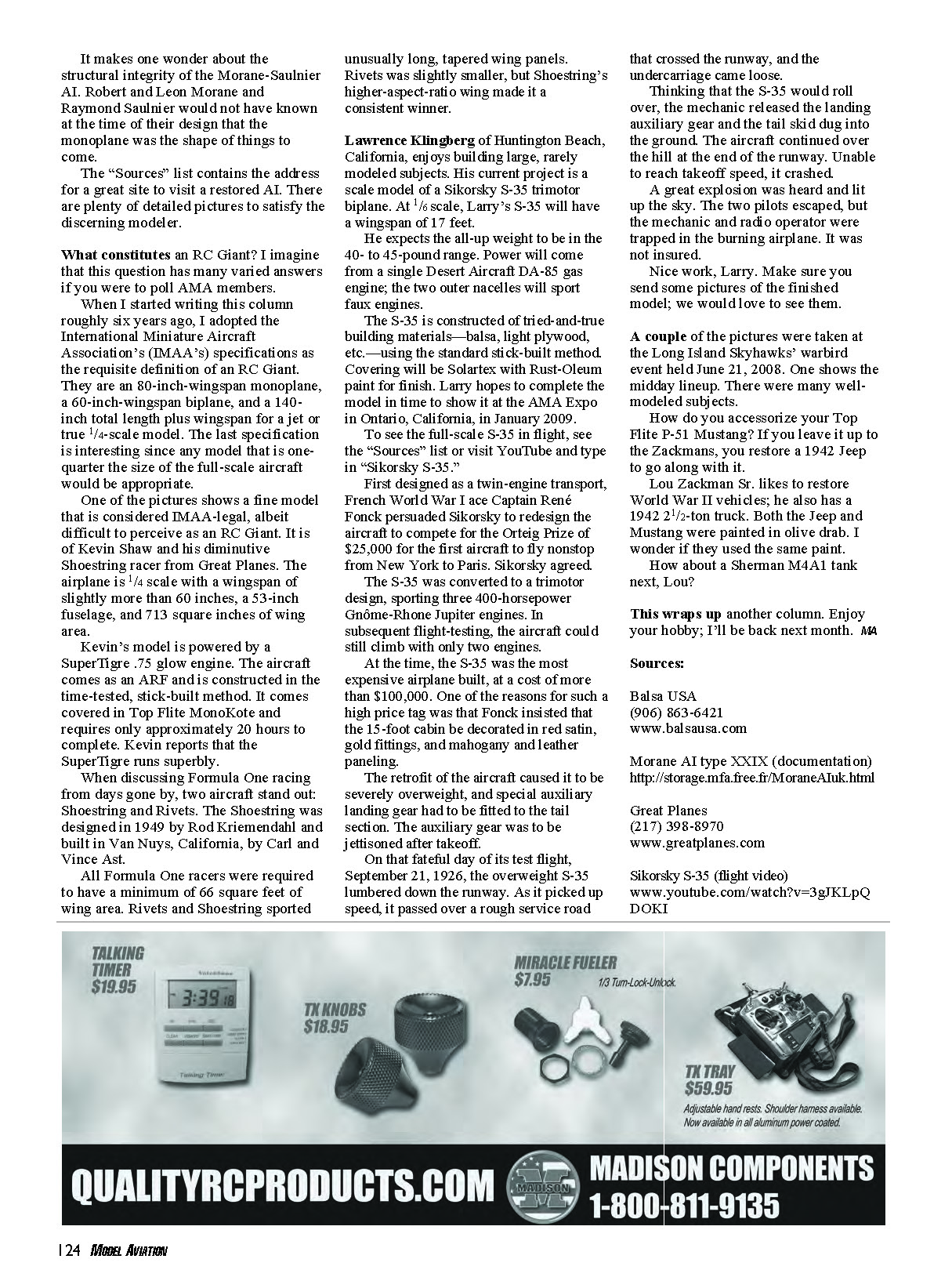
One of the pictures shows a fine model that is considered IMAA-legal, albeit difficult to perceive as an RC Giant. It is of Kevin Shaw and his diminutive Shoestring racer from Great Planes. The airplane is 1/4 scale with a wingspan of slightly more than 60 inches, a 53-inch fuselage, and 713 square inches of wing area.
Kevin's model is powered by a SuperTigre .75 glow engine. The aircraft comes as an ARF and is constructed in the time-tested, stick-built method. It comes covered in Top Flite MonoKote and requires only approximately 20 hours to complete. Kevin reports that the SuperTigre runs superbly.
When discussing Formula One racing from days gone by, two aircraft stand out: Shoestring and Rivets. The Shoestring was designed in 1949 by Rod Kriemendahl and built in Van Nuys, California, by Carl and Vince Ast.
All Formula One racers were required to have a minimum of 66 square feet of wing area. Rivets and Shoestring sported unusually long, tapered wing panels. Rivets was slightly smaller, but Shoestring's higher-aspect-ratio wing made it a consistent winner.
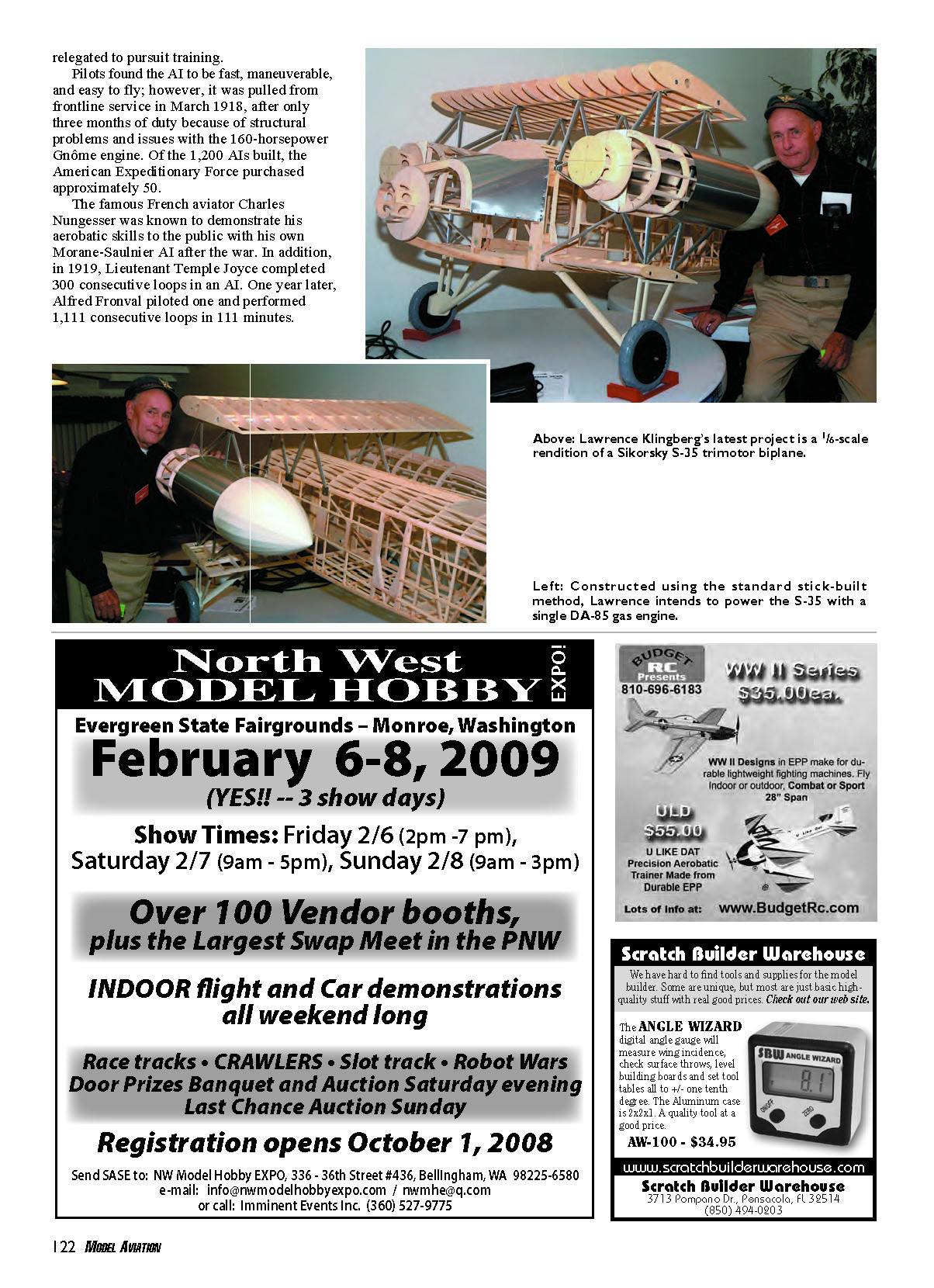
Lawrence Klinberg of Huntington Beach, California, enjoys building large, rarely modeled subjects. His current project is a scale model of a Sikorsky S-35 trimotor biplane. At 1/6 scale, Larry's S-35 will have a wingspan of 17 feet.
He expects the all-up weight to be in the 40- to 45-pound range. Power will come from a single Desert Aircraft DA-85 gas engine; the two outer nacelles will sport faux engines.
The S-35 is constructed of tried-and-true building materials—balsa, light plywood, etc.—using the standard stick-built method. Covering will be Solartex with Rust-Oleum paint for finish. Larry hopes to complete the model in time to show it at the AMA Expo in Ontario, California, in January 2009.
To see the full-scale S-35 in flight, see the "Sources" list or visit YouTube and type in "Sikorsky S-35."
First designed as a twin-engine transport, French World War I ace Captain René Fonck persuaded Sikorsky to redesign the aircraft to compete for the Orteig Prize of $25,000 for the first aircraft to fly nonstop from New York to Paris. Sikorsky agreed.
The S-35 was converted to a trimotor design, sporting three 400-horsepower Gnome-Rhone Jupiter engines. In subsequent flight-testing, the aircraft could still climb with only two engines.
At the time, the S-35 was the most expensive airplane built, at a cost of more than $100,000. One of the reasons for such a high price tag was that Fonck insisted that the 15-foot cabin be decorated in red satin, gold fittings, and mahogany and leather paneling.
The retrofit of the aircraft caused it to be severely overweight, and special auxiliary landing gear had to be fitted to the tail section. The auxiliary gear was to be jettisoned after takeoff.
On that fateful day of its test flight, September 21, 1926, the overweight S-35 lumbered down the runway. As it picked up speed, it passed over a rough service road that crossed the runway, and the undercarriage came loose.
Thinking that the S-35 would roll over, the mechanic released the landing auxiliary gear and the tail skid dug into the ground. The aircraft continued over the hill at the end of the runway. Unable to reach takeoff speed, it crashed.
A great explosion was heard and lit up the sky. The two pilots escaped, but the mechanic and radio operator were trapped in the burning airplane. It was not insured.
Nice work, Larry. Make sure you send some pictures of the finished model; we would love to see them.
A couple of the pictures were taken at the Long Island Skyhawks' warbird event held June 21, 2008. One shows the midday lineup. There were many well-modeled subjects.
How do you accessorize your Top Flite P-51 Mustang? If you leave it up to the Zackmans, you restore a 1942 Jeep to go along with it.
Lou Zackman Sr. likes to restore World War II vehicles; he also has a 1942 2 1/2-ton truck. Both the Jeep and Mustang were painted in olive drab. I wonder if they used the same paint.
How about a Sherman M4A1 tank next, Lou?
This wraps up another column. Enjoy your hobby; I'll be back next month. MA
Sources:
- Balsa USA
(906) 863-6421 www.balsausa.com
- Morane AI type XXIX (documentation)
http://storage.mfa.free.fr/MoraneAIuk.html
- Great Planes
(217) 398-8970 www.greatplanes.com
- Sikorsky S-35 (flight video)
www.youtube.com/watch?v=3gJKLpQDOKI
Transcribed from original scans by AI. Minor OCR errors may remain.

