
Radio Control Giants
Sal Calvagna
Timing suddenly off? Replace a sheared Woodruff key on a Zenoah G-38
ONE OF MY favorite gasoline-fueled engines is the Zenoah G-38, which is a two-stroke, 38cc power plant with a displacement of 2.3 cu. in. It is an excellent choice for many 1/4-scale World War I models and some of the smaller World War II kits, Golden Age models, and smaller IMAC (International Miniature Aerobatic Club) aircraft.
This wonderful engine has been powering model airplanes for at least 25 years. Its operation and reliability are second to none; however, as with all things mechanical, there are times when knowledge of small-engine operation and repair comes in handy.
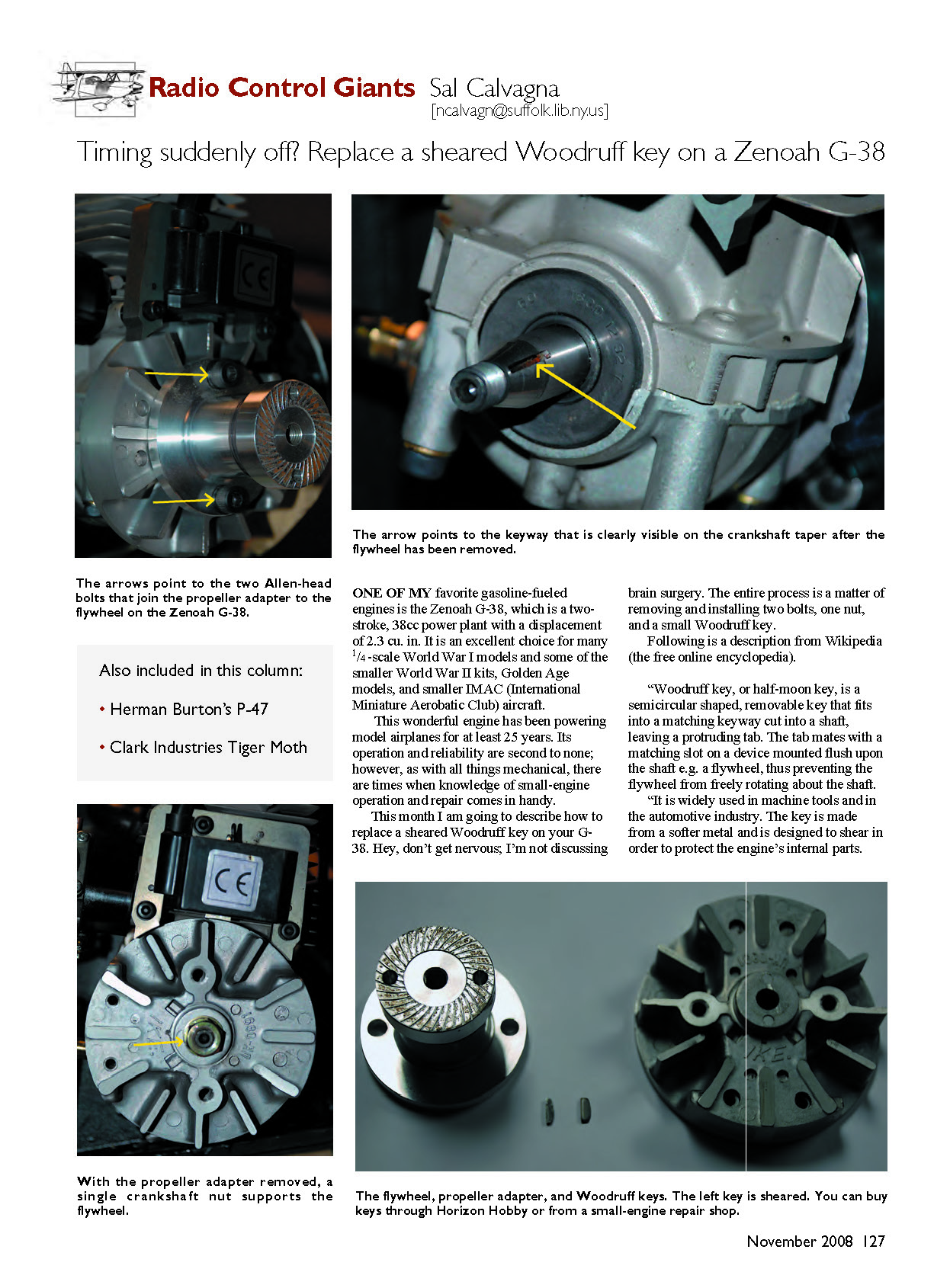
This month I am going to describe how to replace a sheared Woodruff key on your G-38. Hey, don't get nervous; I'm not discussing brain surgery. The entire process is a matter of removing and installing two bolts, one nut, and a small Woodruff key.
Following is a description from Wikipedia (the free online encyclopedia).
"Woodruff key, or half-moon key, is a semicircular shaped, removable key that fits into a matching keyway cut into a shaft, leaving a protruding tab. The tab mates with a matching slot on a device mounted flush upon the shaft e.g. a flywheel, thus preventing the flywheel from freely rotating about the shaft.
It is widely used in machine tools and in the automotive industry. The key is made from a softer metal and is designed to shear in order to protect the engine's internal parts."
How do you recognize that the Woodruff key may be the culprit of an engine that won't start?
As you rotate the propeller and start to feel resistance or compression, the piston is moving upward toward the top of the cylinder, compressing the air/fuel mixture. At the same time, the magnets recessed into the flywheel are timed to pass through the pickup coil. As the magnets pass the coil, a charge is released that produces spark during the power/exhaust stroke of the engine.
If your Woodruff key has been sheared, there's a good chance that the engine's timing is off and it will not start. This could be the result of a backfire during an engine start or as a propeller strike. Now for the fix.
The G-38's propeller adapter has two Allen or socket-head bolts. Remove these, and the propeller adapter will come off easily. Remove the single nut on the crankshaft that supports the flywheel. To do so, you must support the flywheel so it will not spin.
Once the nut is removed, detach the flywheel by using a large screwdriver to gently pry around it. Please pay attention to the word "gently"; you do not want to distort the flywheel. A better tool would be a flywheel puller, if you have one available, but I assure you that the flywheel will come off after you go around it a few times with the screwdriver.
When the flywheel has been removed, the crankshaft taper and keyway are clearly visible. If the key has been sheared, the broken half should remain in the keyway on the crankshaft, while the other part may be found in the slot on the flywheel. You can use the tip of a flat-head screwdriver to remove the broken key parts.
Make sure that the crankshaft taper and flywheel taper are clean and free of debris. The new key should be installed with the curved face down into the crankshaft keyway. Carefully slide the flywheel back onto the crankshaft, keeping the slot aligned with the key.
It's easy to tell when you have performed this assembly properly. As you rotate the flywheel, the crankshaft also rotates because the key has locked the crankshaft and the flywheel into their correct positions.
Replace and tighten the flywheel retaining nut, and then align the propeller adapter and replace the two socket-head bolts. Congratulations! The job is done.
You can purchase a Woodruff key from Horizon Hobby, which distributes the complete Zenoah engine line, or from a local small-engine repair shop.
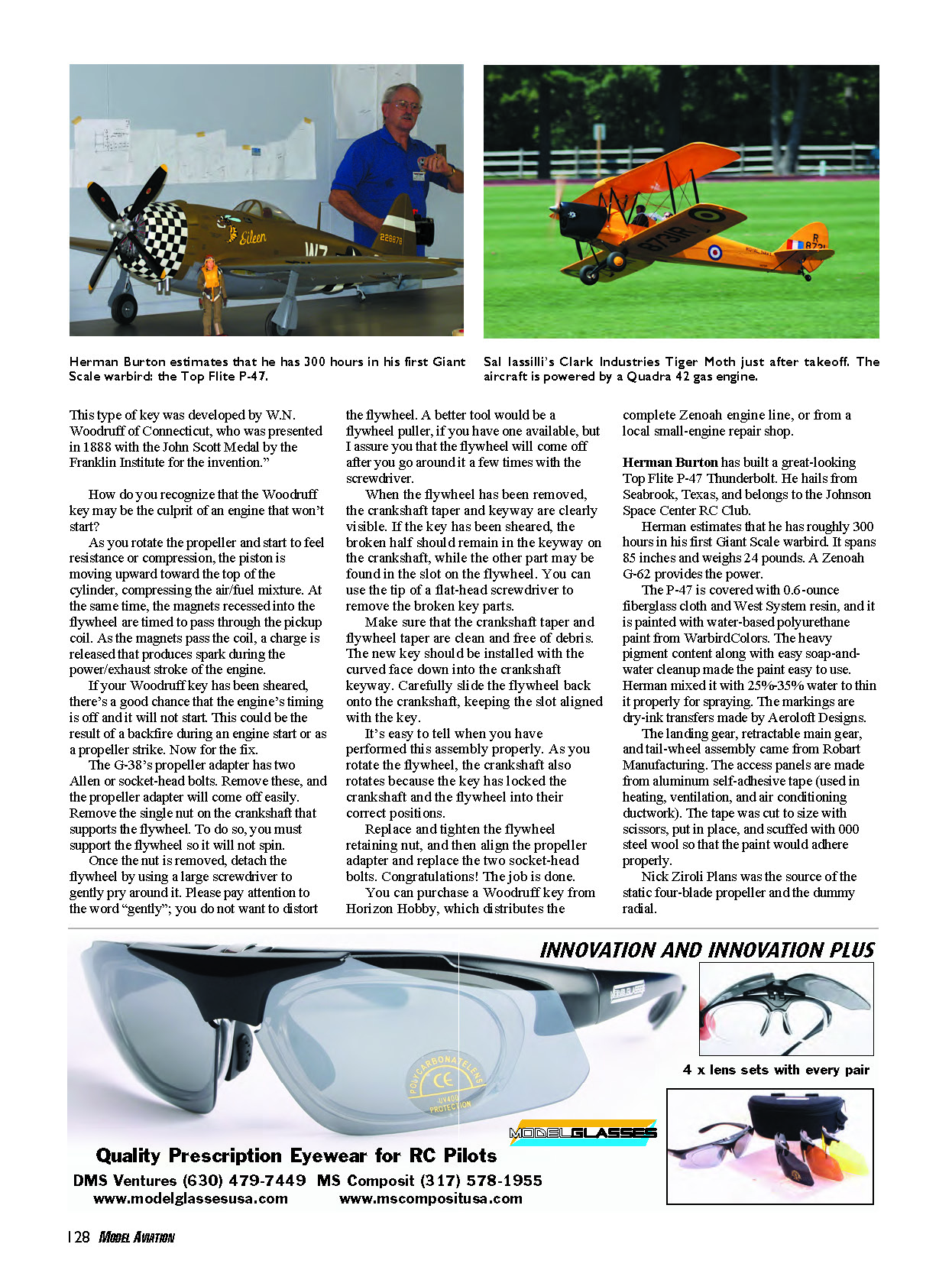
Herman Burton has built a great-looking Top Flite P-47 Thunderbolt. He hails from Seabrook, Texas, and belongs to the Johnson Space Center RC Club.
Herman estimates that he has roughly 300 hours in his first Giant Scale warbird. It spans 85 inches and weighs 24 pounds. A Zenoah G-62 provides the power.
The P-47 is covered with 0.6-ounce fiberglass cloth and West System resin, and it is painted with water-based polyurethane paint from WarbirdColors. The heavy pigment content along with easy soap-and-water cleanup made the paint easy to use. Herman mixed it with 25%-35% water to thin it properly for spraying. The markings are dry-ink transfers made by Aerolift Designs.
The landing gear, retractable main gear, and tail-wheel assembly came from Robart Manufacturing. The access panels are made from aluminum self-adhesive tape (used in heating, ventilation, and air conditioning ductwork). The tape was cut to size with scissors, put in place, and scuffed with 000 steel wool so that the paint would adhere properly.
Nick Ziroli Plans was the source of the static four-blade propeller and the dummy radial.
Herman modeled his P-47 after the aircraft that Lt. Frank Oiler flew. It was one of the first bubbletop-canopy models that came off the assembly line in late 1943.
According to Herman, Scale modeling is fun. He enjoyed researching and building his first Giant warbird.
Nice work!
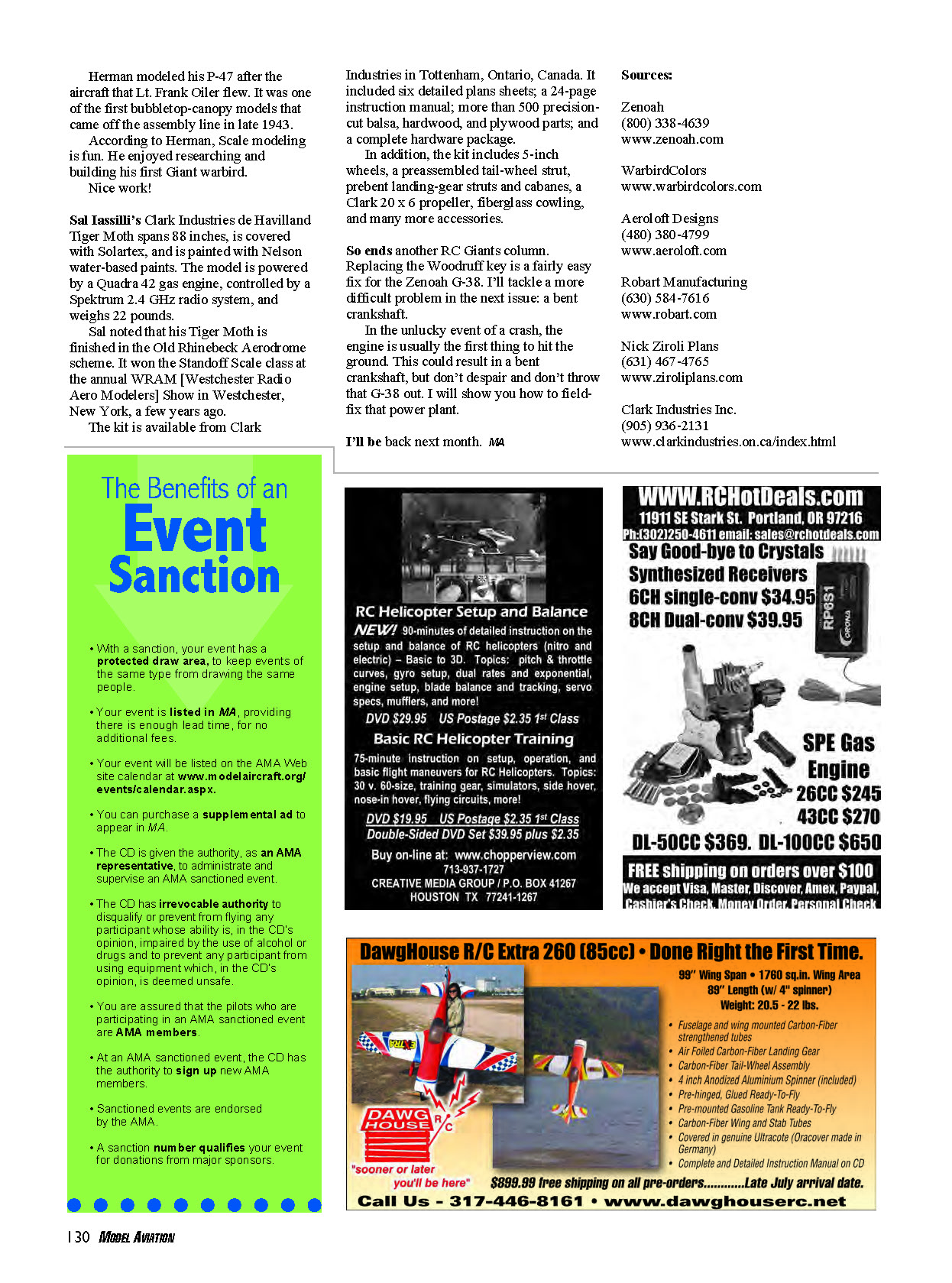
Sal Tassilli’s Clark Industries de Havilland Tiger Moth spans 88 inches, is covered with Solartex, and is painted with Nelson water-based paints. The model is powered by a Quadra 42 gas engine, controlled by a Spektrum 2.4 GHz radio system, and weighs 22 pounds.
Sal noted that his Tiger Moth is finished in the Old Rhinebeck Aerodrome scheme. It won the Standoff Scale class at the annual WRAM (Westchester Radio Aero Modelers) Show in Westchester, New York, a few years ago.
The kit is available from Clark Industries in Tottenham, Ontario, Canada. It included six detailed plans sheets; a 24-page instruction manual; more than 500 precision-cut balsa, hardwood, and plywood parts; and a complete hardware package.
In addition, the kit includes 5-inch wheels, a preassembled tail-wheel strut, pre-bent landing-gear struts and cabanes, a Clark 20 x 6 propeller, fiberglass cowling, and many more accessories.
So ends another RC Giants column. Replacing the Woodruff key is a fairly easy fix for the Zenoah G-38. I’ll tackle a more difficult problem in the next issue: a bent crankshaft.
In the unlucky event of a crash, the engine is usually the first thing to hit the ground. This could result in a bent crankshaft, but don’t despair and don’t throw that G-38 out. I will show you how to field-fix that power plant.
I’ll be back next month. MA
Sources:
- Zenoah
(800) 338-4639 www.zenoah.com
- WarbirdColors
- Aerolift Designs
(480) 380-4799 www.aerolift.com
- Robart Manufacturing
(630) 584-7616 www.robart.com
- Nick Ziroli Plans
(631) 467-4765 www.ziroliplans.com
- Clark Industries Inc.
(905) 936-2131 www.clarkindustries.on.ca/index.html
Transcribed from original scans by AI. Minor OCR errors may remain.

