
RC Giants
Sal Calvagna
From powered flight through World War II fighters
WELCOME BACK to the RC Giants column. Fall is here and it's time to start thinking about a winter project. Whether it is a kit, scratch-built, or ARF, there's something for everyone. Surf the Web and find the project that's right for you!
In this column, I have featured some interesting subjects, from the dawn of powered flight through World War II-era fighters. I hope you enjoy them.
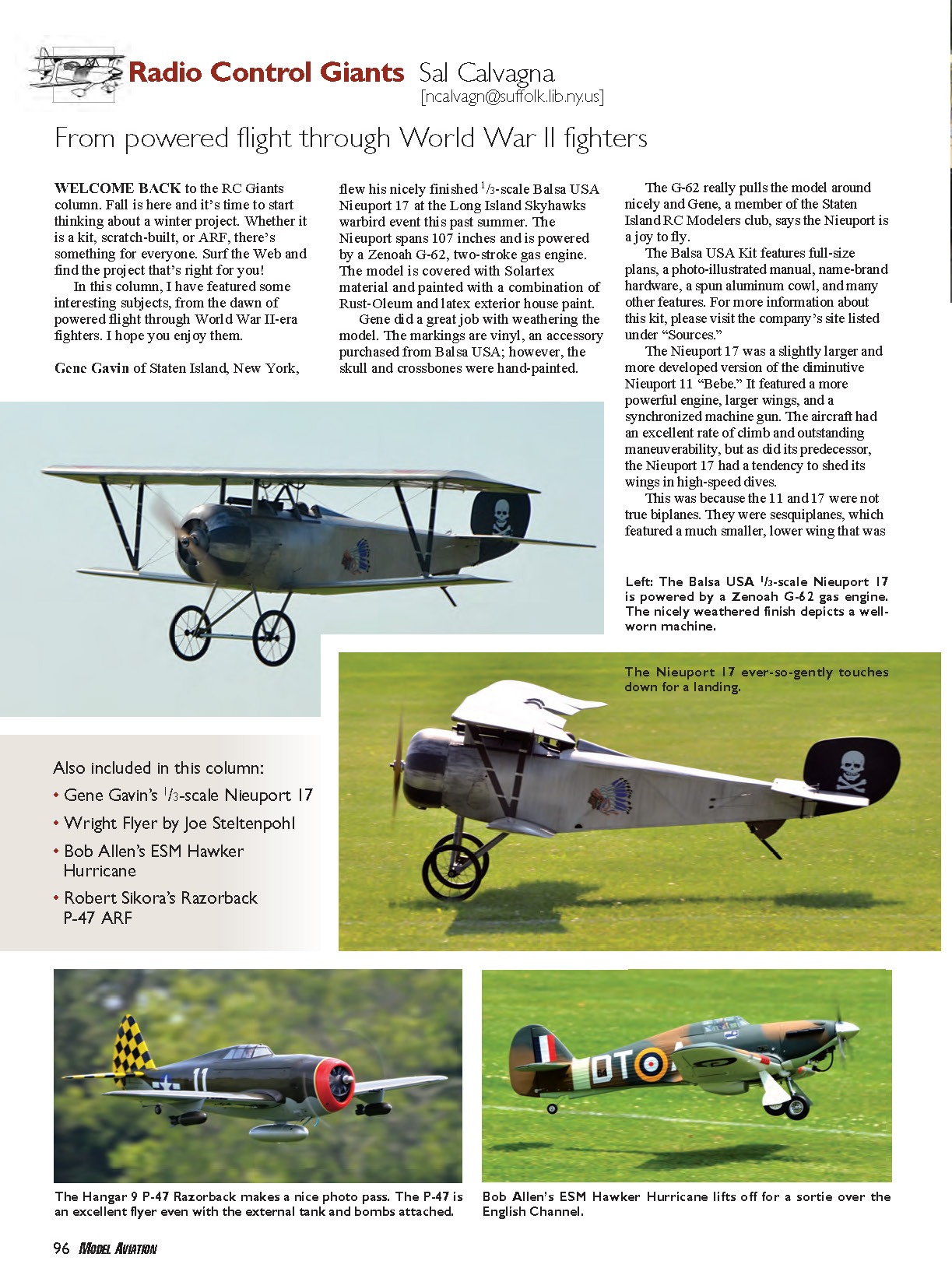
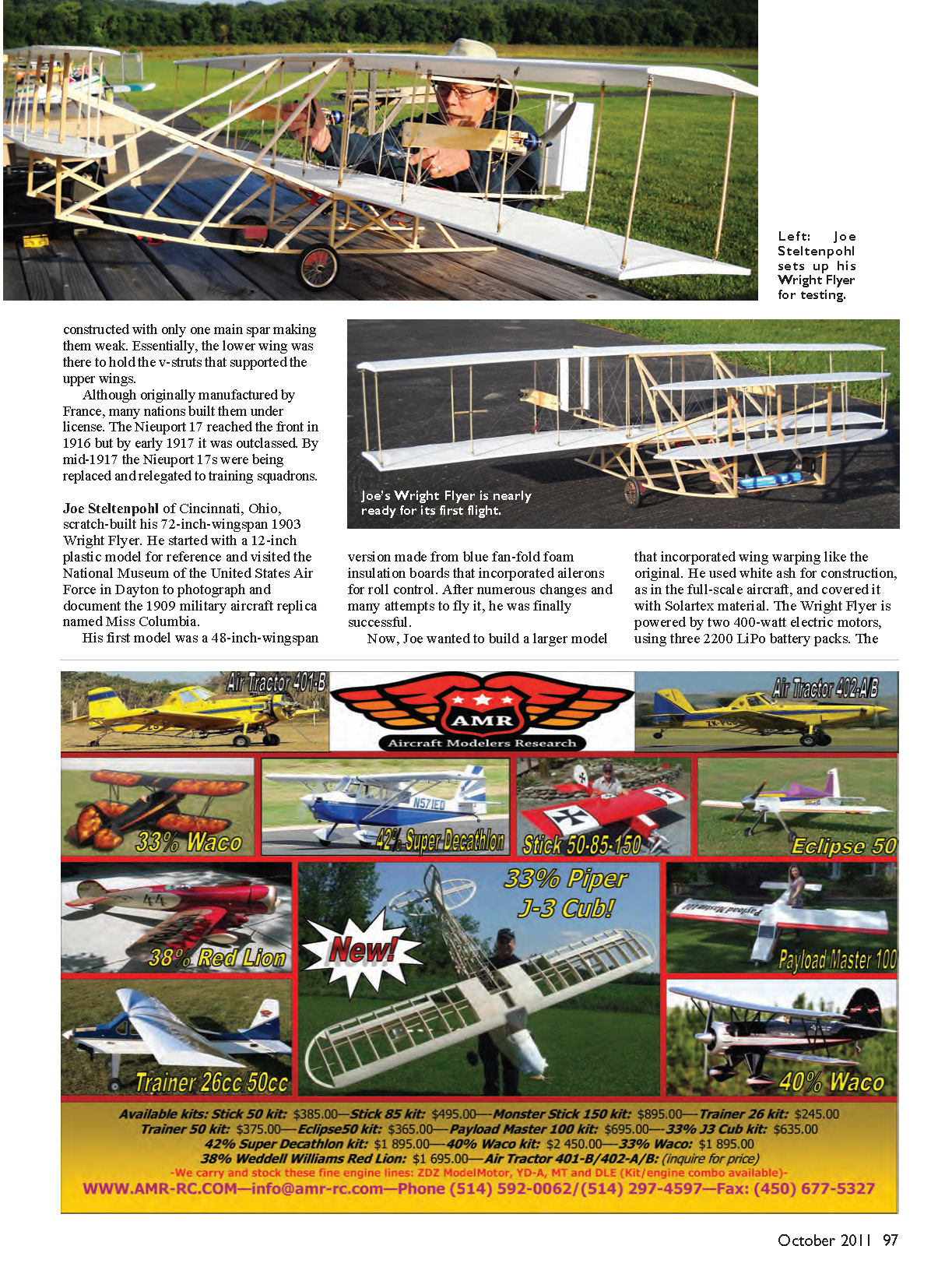
Gene Gavin of Staten Island, New York, flew his nicely finished 1/3-scale Balsa USA Nieuport 17 at the Long Island Skyhawks warbird event this past summer. The Nieuport spans 107 inches and is powered by a Zenoah G-62, two-stroke gas engine. The model is covered with Solartex material and painted with a combination of Rust-Oleum and latex exterior house paint.
Gene did a great job with weathering the model. The markings are vinyl, an accessory purchased from Balsa USA; however, the skull and crossbones were hand-painted.
The G-62 really pulls the model around nicely and Gene, a member of the Staten Island RC Modelers club, says the Nieuport is a joy to fly.
The Balsa USA kit features full-size plans, a photo-illustrated manual, name-brand hardware, a spun aluminum cowl, and many other features. For more information about this kit, please visit the company’s site listed under "Sources."
The Nieuport 17 was a slightly larger and more developed version of the diminutive Nieuport 11 "Bebe." It featured a more powerful engine, larger wings, and a synchronized machine gun. The aircraft had an excellent rate of climb and outstanding maneuverability, but as did its predecessor, the Nieuport 17 had a tendency to shed its wings in high-speed dives.
This was because the 11 and 17 were not true biplanes. They were sesquiplanes, which featured a much smaller, lower wing that was constructed with only one main spar making them weak. Essentially, the lower wing was there to hold the v-struts that supported the upper wings.
Although originally manufactured by France, many nations built them under license. The Nieuport 17 reached the front in 1916 but by early 1917 it was outclassed. By mid-1917 the Nieuport 17s were being replaced and relegated to training squadrons.
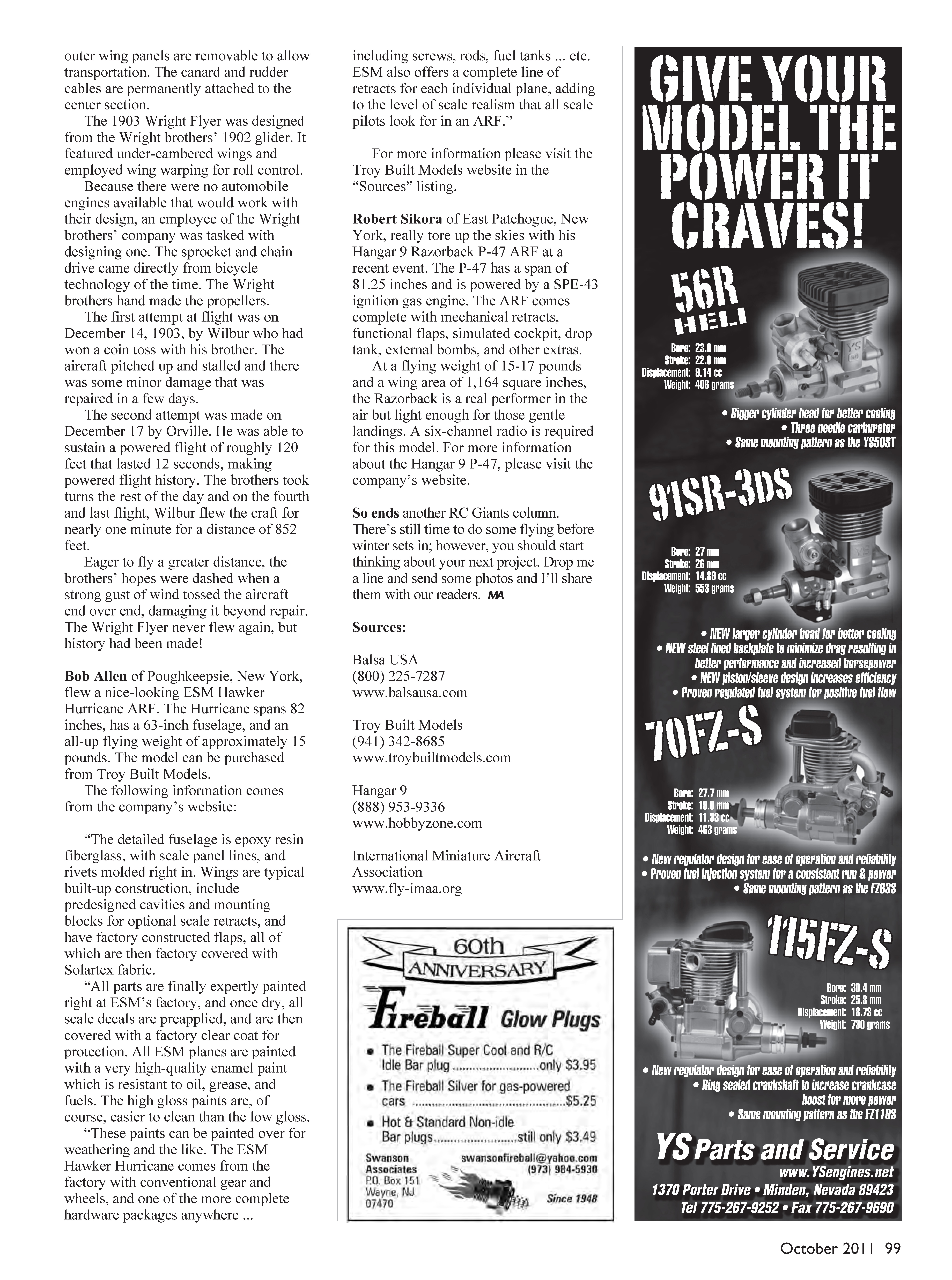
Joe Steltenpohl of Cincinnati, Ohio, scratch-built his 72-inch-wingspan 1903 Wright Flyer. He started with a 12-inch plastic model for reference and visited the National Museum of the United States Air Force in Dayton to photograph and document the 1909 military aircraft replica named Miss Columbia.
His first model was a 48-inch-wingspan version made from blue fan-fold foam insulation boards that incorporated ailerons for roll control. After numerous changes and many attempts to fly it, he was finally successful.
Now, Joe wanted to build a larger model that incorporated wing warping like the original. He used white ash for construction, as in the full-scale aircraft, and covered it with Solartex material. The Wright Flyer is powered by two 400-watt electric motors, using three 2200 LiPo battery packs. The outer wing panels are removable to allow transportation. The canard and rudder cables are permanently attached to the center section.
The 1903 Wright Flyer was designed from the Wright brothers’ 1902 glider. It featured under-cambered wings and employed wing warping for roll control.
Because there were no automobile engines available that would work with their design, an employee of the Wright brothers’ company was tasked with designing one. The sprocket and chain drive came directly from bicycle technology of the time. The Wright brothers hand made the propellers.
The first attempt at flight was on December 14, 1903, by Wilbur who had won a coin toss with his brother. The aircraft pitched up and stalled and there was some minor damage that was repaired in a few days.
The second attempt was made on December 17 by Orville. He was able to sustain a powered flight of roughly 120 feet that lasted 12 seconds, making powered flight history. The brothers took turns the rest of the day and on the fourth and last flight, Wilbur flew the craft for nearly one minute for a distance of 852 feet.
Eager to fly a greater distance, the brothers’ hopes were dashed when a strong gust of wind tossed the aircraft end over end, damaging it beyond repair. The Wright Flyer never flew again, but history had been made!
Bob Allen of Poughkeepsie, New York, flew a nice-looking ESM Hawker Hurricane ARF. The Hurricane spans 82 inches, has a 63-inch fuselage, and an all-up flying weight of approximately 15 pounds. The model can be purchased from Troy Built Models.
The following information comes from the company’s website:
“The detailed fuselage is epoxy resin fiberglass, with scale panel lines, and riveting molded right in. Wings are typical built-up construction, include predesigned cavities and mounting blocks for optional scale retracts, and have factory constructed flaps, all of which are then factory covered with Solartex fabric.
“All parts are finally expertly painted right at ESM’s factory, and once dry, all scale decals are preapplied, and are then covered with a factory clear coat for protection. All ESM airplanes are painted with a very high-quality enamel paint which is resistant to oil, grease, and fuels. The high gloss paints are, of course, easier to clean than the low gloss.
“These paints can be painted over for weathering and the like. The ESM Hawker Hurricane comes from the factory with conventional gear and wheels, and one of the more complete hardware packages anywhere — including screws, rods, fuel tanks ... etc. ESM also offers a complete line of retracts for each individual plane, adding to the level of scale realism that all scale pilots look for in an ARF.”
For more information please visit the Troy Built Models website in the “Sources” listing.
Robert Sikora of East Patchogue, New York, really tore up the skies with his Hangar 9 Razorback P-47 ARF at a recent event. The P-47 has a span of 81.25 inches and is powered by a SPE-43 ignition gas engine. The ARF comes complete with mechanical retracts, functional flaps, simulated cockpit, drop tank, external bombs, and other extras.
At a flying weight of 15–17 pounds and a wing area of 1,164 square inches, the Razorback is a real performer in the air but light enough for those gentle landings. A six-channel radio is required for this model. For more information about the Hangar 9 P-47, please visit the company’s website.
So ends another RC Giants column. There’s still time to do some flying before winter sets in; however, you should start thinking about your next project. Drop me a line and send some photos and I’ll share them with our readers. MA
Sources:
- Balsa USA
(800) 225-7287 www.balsausa.com
- Troy Built Models
(941) 342-8685 www.troybuiltmodels.com
- Hangar 9
(888) 953-9336 www.hobbyzone.com
- International Miniature Aircraft Association
Transcribed from original scans by AI. Minor OCR errors may remain.

