
RC Giants
John A. de Vries, 4610 Moffat Ln., Colorado Springs CO 80915
I've always been fascinated by finely machined metal—the kind that shows up in the better cameras, guns, imported brass model locomotives, and model airplane engines. I regret never having learned the skills that great machinists have acquired; I envy them (particularly my good friend Dick Smith of Hemet CA, who's a whiz of a metalworker).
However, the lack of an ability to machine metal hasn't kept me from acquiring grand examples of others' work. My recent acquisition, a British RCV engine, operates on a completely different principle than the usual RC engine.
The latest in the collection is another engine that defies simple description: the Erickson MCC Full Expansion Engine, which looks like a Wankel.
I had to wait about four months to get the Erickson; the company was held up in getting the Thunder Tiger RC carburetors that feed glow fuel into the engine's strange-and-wonderful innards. Although the ads don't reveal it, the Ericksons have two glow plugs (which makes it a twin 120). The reason: there are two power strokes of the engine per rotation.
The engine's instructions on how to mount it in a model are specific. The plugs have to be set up horizontally, so that neither will be extinguished by fuel collecting in their "wells." Erickson recommends that a fuel pump be added to the fuel line, and suggests that a glow plug driver be installed for a good slow-speed idle.
However, there is one point of confusion about the engine:
The instructions note that because the running engine is so quiet, the usual check as to whether it is running rich or lean doesn't apply. Instructions recommend using a tachometer to set the needle valves correctly (although the engine comes with a needle-valve-setting info card, as the result of a factory run-in!).
The factory fuel recommendations for the Erickson are specific; they suggest using 15% nitro, but no fuel that contains castor oil. The engine has a built-in flush mount. It's going to be a lot of fun cranking up the Erickson 120!
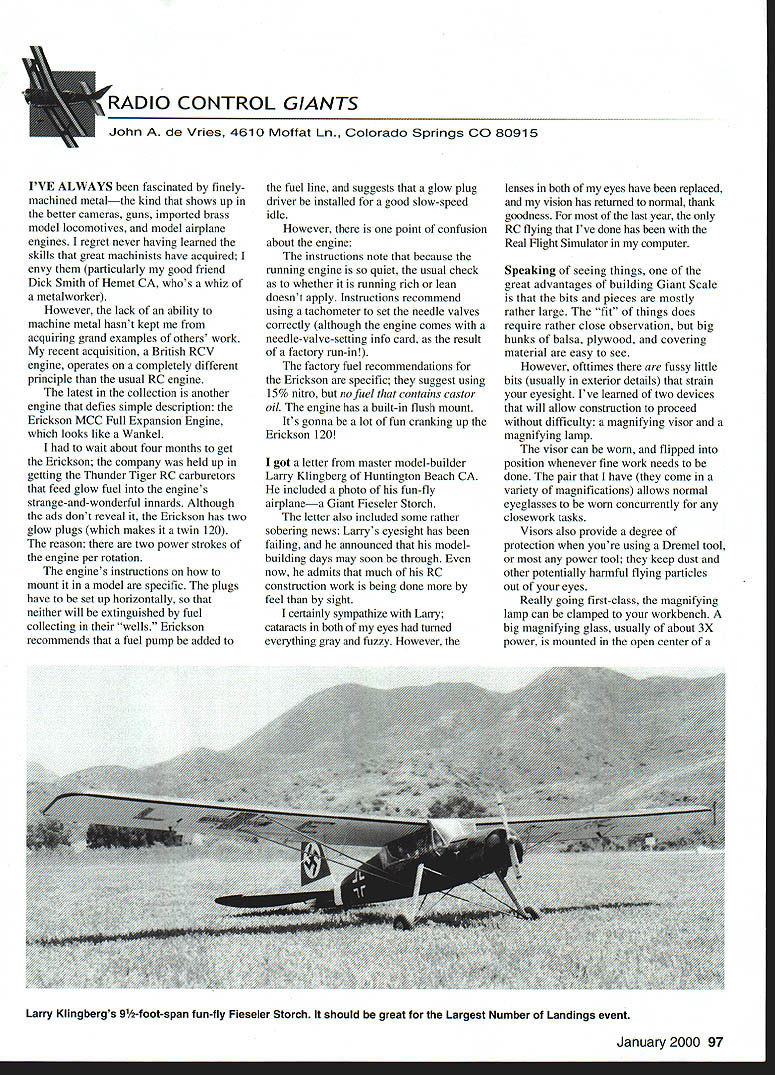
I got a letter from master model-builder Larry Klingberg of Huntington Beach CA. He included a photo of his fun-fly airplane—a Giant Fieseler Storch.
The letter also included some rather sobering news: Larry's eyesight has been failing, and he announced that his model-building days may soon be through. Even now, he admits that much of his RC construction work is being done more by feel than by sight.
I certainly sympathize with Larry; cataracts in both of my eyes had turned everything gray and fuzzy. However, the lenses in both of my eyes have been replaced, and my vision has returned to normal, thank goodness. For most of the last year, the only RC flying that I've done has been with the Real Flight Simulator in my computer.
Seeing and working on Giant Scale
Speaking of seeing things, one of the great advantages of building Giant Scale is that the bits and pieces are mostly rather large. The "fit" of things does require rather close observation, but big hunks of balsa, plywood, and covering material are easy to see.
However, oftentimes there are fussy little bits (usually in exterior details) that strain your eyesight. I've learned of two devices that will allow construction to proceed without difficulty: a magnifying visor and a magnifying lamp.
The visor can be worn, and flipped into position whenever fine work needs to be done. The pair that I have (they come in a variety of magnifications) allows normal eyeglasses to be worn concurrently for any closework tasks.
Visors also provide a degree of protection when you're using a Dremel tool, or most any power tool; they keep dust and other potentially harmful flying particles out of your eyes.
Really going first-class, the magnifying lamp can be clamped to your workbench. A big magnifying glass, usually of about 3X power, is mounted in the open center of a circular fluorescent lamp. The best part is that it provides direct illumination on the model part that you're working on.
The lamp is usually mounted on a positionable arm, which allows it to be pushed out of the way when you aren't using it. It also provides workbench illumination, even when you aren't using the magnifying feature. The price (about $30) is reasonable.
The things you can learn from watching TV
The Learning Channel ran a program that focused on what's new in the full-scale aircraft industry. One part of the program concerned strange-and-wonderful aircraft that are so unstable, they can't be flown without input from computers. The F-16 and the new F-22 require computer systems to be flown at all.
Of much greater interest was the bit about a Giant Scale model of the "blended wing transport." The model had a wingspan of 17½ feet and a tricycle landing gear. It was the prototype of the full-scale aircraft, and it had a full complement of internal computers.
Although the test model was controlled from the ground with what appeared to be a standard transmitter, its stability in all regimes of flight was dependent upon the computer. The trailing edge of the wing supported all manner of flaps and drag-producing devices; their movement responded to essentially simple inputs from the ground.
The first test flight, which was shown, was beautiful to behold—it should have been, for the $4 million or so that the project cost!
Another model featured in the program was of a potential supersonic transport. If the full-scale transport is ever built, it will be computer-controlled, with a big difference: the aircrew won't have forward visibility from the cockpit! The only contact with the outside world will be through side windows, and the crew will have to rely on television and infrared monitors to see what's in front of it.
A test of the system in a modified Boeing 737 proved the electronic display to be viable. Even landings were "easy" for the test pilots. The big idea is to eliminate the need for the drooping nose of the Concorde that is needed for forward visibility on landing and takeoff. The system thus saves the 5,000–10,000 pounds of weight that a droop-nose engenders.
After watching the complexities that may change the way full-scale aircraft are flown, it made our computer radios seem like primitive devices indeed.
Construction note for Scale high-wing monoplanes
As you may know, the wing-mounting location is the weakest part of the structure. The ubiquitous Cub, as well as Stinsons, Howards, Curtiss Robins, and Cessnas have windows and doors directly beneath the upper wing.
If your design calls for a one-piece wing, there's a lot of trouble in River City; it's difficult, if not impossible, to construct the fuselage to be strong enough for the wing hold-downs. Then most of the wing stresses are concentrated in its center section, so the wing has to be solidly attached.
I suggest that you modify the design of your model to build in the center section to the fuselage, and go with detachable outer wing panels. That will result in a much stronger center section and a stronger anchor for the wing panels. Split plywood main wing spars or the more modern system of using concentric aluminum tubes (for spars) will make assembling the model at the field a relatively painless process.
Of course, the overlapping spars should be drilled for the hefty bolts or metal pins to hold the panels in place. Access to the anchoring pins may be made through Scale panels (most high-wings have their fuel tanks out in their wing panels, and they're covered by opening panels). For the expert scale builder, access to the wing pins can be achieved inside the fuselage through the opening Scale doors—and it will be "invisible."
Yeah, I know that the Cub's fuel tank is located between the firewall and the windshield, but most other high-wing models do lend themselves to the removable panel system. Making wing struts functional also helps anchor removable wing panels in place.
Back with you in the February issue. I trust that all of you folk in the more wintry climes have already chosen your winter's Giant Scale project, and are well on the way amongst the balsa shavings.
MA
Transcribed from original scans by AI. Minor OCR errors may remain.

