
RC Helicopters
Eric Hawkinson, 319 Yellowstone Ave., Billings MT 59101; E-mail: [email protected]
WHAT A GREAT time to be involved with RC helicopters!
Heli pilots are presently enjoying the best products and lowest prices ever, and a wide-enough range of choices to allow anyone to find what he/she likes. And we have a huge number of pilots who—thanks, in part, to modern computer-based simulators—are flying maneuvers that most thought impossible just a few years ago.
If you are already a helicopter pilot, you know what I mean. If you are not yet flying helis, there has never been a better time to give it a try.
Before I go on, I suppose it's time to point out that I am the "new kid" writing the "RC Helicopters" column. No doubt Paul Tradelus has already written his signoff. (Technically, I'm the probationary new columnist, on a three-column trial. Reader reaction will determine the column's future.)
I've been flying fixed-wing RC ("planks," in the heli vernacular) for the last 3+ decades. Back in the olden days I bought, but did not have much success with, a Du-Bro Whirlybird. Later I managed brief hovers with a fixed-pitch .20-size heli, using an airplane radio and no gyro. Talk about a challenge! I decided to go back to airplanes until the helis became a bit more user-friendly.
Approximately a decade ago I tried helis again—this time with a real almost-modern Kalt Enforcer with collective, gyro, and a heli radio. What a difference!
The first time I started the engine, I hovered the entire tank. From there I made it through learning forward flight, stall turns, loops, rolls, and even a few autos before I ever broke a part on the heli. Nothing on that heli ever failed, except for a link.
I was definitely hooked—for life!
These days I still fly fixed-wings, but not nearly as much as I fly helis. It's far easier to transport and set up a heli, and in my area (as in most) there are suitable heli fields that are much quicker to reach than the local airplane field. That means that when I only have a small amount of time to go play, the heli always wins.
Besides, no matter how much I fly my helis, I never get the feeling that I have come even close to mastering them. Helis just have a great deal more capabilities than fixed-wings, which means more challenges.
I'm no threat to Curtis Youngblood or the other real hotshot fliers; most likely I never will be. I consider myself to be at the advanced intermediate level. I can do all of the basic acrobatic maneuvers, most of them inverted, and a small smattering of the 3-D type maneuvers. Backward flight still scares the pants off of me on a regular basis, and I prefer to do most of the inverted stuff at a safe bail-out altitude.
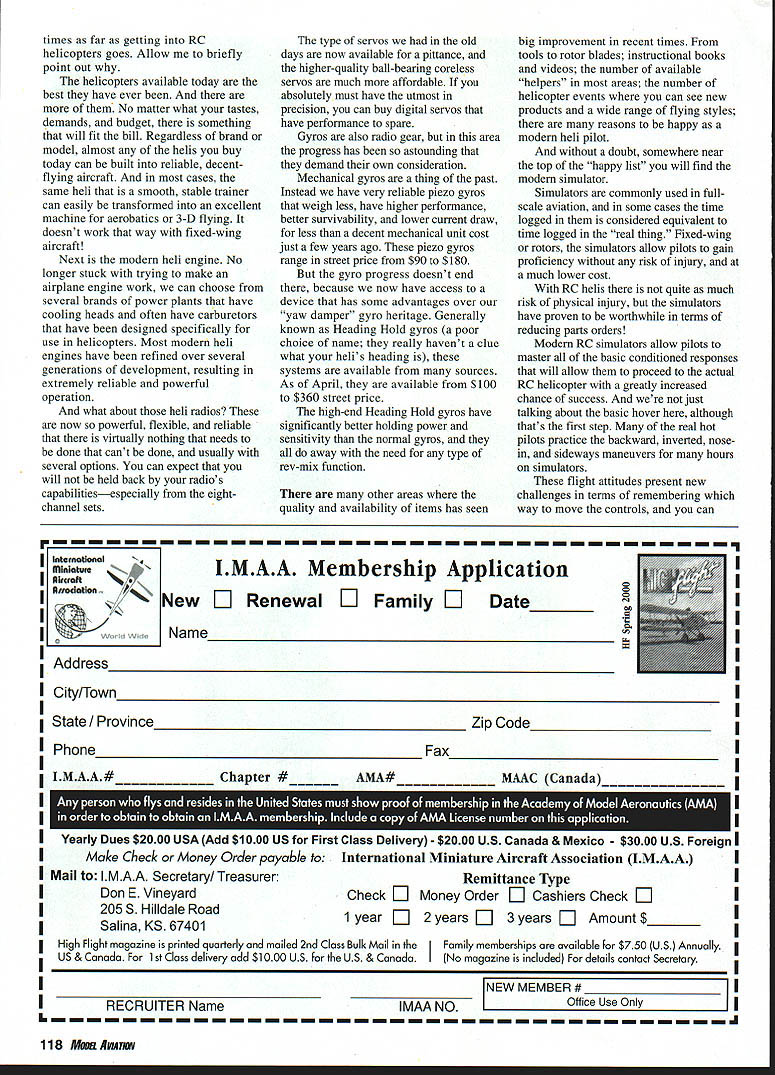
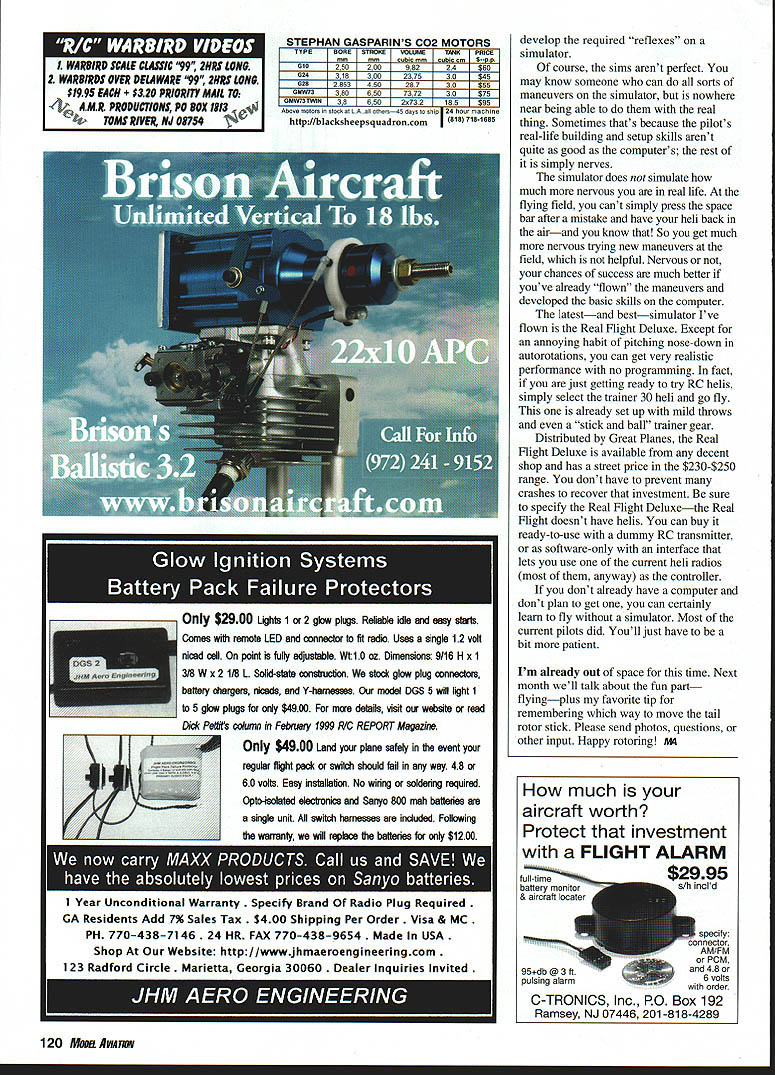
My present stable includes JR Ergo 60s, Kalt 30s, Kalt Baron 46, an old Baron Alpha II, a soon-to-fly JR Vigor, and a Piccolo Indoor Electric.
Enough about me. Let's get back to the opening premise: now is the best of times as far as getting into RC helicopters goes. Allow me to briefly point out why.
The helicopters available today are the best they have ever been. And there are more of them. No matter what your tastes, demands, and budget, there is something that will fit the bill. Regardless of brand or model, almost any of the helis you buy today can be built into reliable, decent-flying aircraft. And in most cases, the same heli that is a smooth, stable trainer can easily be transformed into an excellent machine for aerobatics or 3-D flying. It doesn't work that way with fixed-wing aircraft!
Next is the modern heli engine. No longer stuck with trying to make an airplane engine work, we can choose from several brands of power plants that have cooling heads and often have carburetors that have been designed specifically for use in helicopters. Most modern heli engines have been refined over several generations of development, resulting in an extremely reliable and powerful operation.
And what about those heli radios? These are now so powerful, flexible, and reliable that there is virtually nothing that needs to be done that can't be done, and usually with several options. You can expect that you will not be held back by your radio's capabilities—especially from the eight-channel sets.
The type of servos we had in the old days are now available for a pittance, and the higher-quality ball-bearing coreless servos are much more affordable. If you absolutely must have the utmost in precision, you can buy digital servos that have performance to spare.
Gyros are also radio gear, but in this area the progress has been so astounding that they demand their own consideration.
Mechanical gyros are a thing of the past. Instead we have very reliable piezo gyros that weigh less, have higher performance, better survivability, and lower current draw, for less than a decent mechanical unit cost just a few years ago. These piezo gyros range in street price from $90 to $180.
But the gyro progress doesn't end there, because we now have access to a device that has some advantages over our "yaw damper" gyro heritage. Generally known as Heading Hold gyros (a poor choice of name; they really haven't a clue what your heli's heading is), these systems are available from many sources. As of April, they are available from $100 to $360 street price.
The high-end Heading Hold gyros have significantly better holding power and sensitivity than the normal gyros, and they all do away with the need for any type of rev-mix function.
There are many other areas where the quality and availability of items has seen big improvement in recent times. From tools to rotor blades; instructional books and videos; the number of available "helpers" in most areas; the number of helicopter events where you can see new products and a wide range of flying styles; there are many reasons to be happy as a modern heli pilot.
And without a doubt, somewhere near the top of the "happy list" you will find the modern simulator.
Simulators are commonly used in full-scale aviation, and in some cases the time logged in them is considered equivalent to time logged in the "real thing." Fixed-wing or rotors, the simulators allow pilots to gain proficiency without any risk of injury, and at a much lower cost.
With RC helis there is not quite as much risk of physical injury, but the simulators have proven to be worthwhile in terms of reducing parts orders!
Modern RC simulators allow pilots to master all of the basic conditioned responses that will allow them to proceed to the actual RC helicopter with a greatly increased chance of success. And we're not just talking about the basic hover here, although that's the first step. Many of the real hot pilots practice the backward, inverted, and sideways maneuvers for many hours on simulators.
These flight attitudes present new challenges in terms of remembering which way to move the controls, and you can
I can't read enough of the article text from the provided image to reliably extract and correct the rest of the PRIMARY ARTICLE. Could you upload a higher-resolution scan or a close-up crop of the right-hand column (the article continuation area), so I can transcribe the text accurately?
Transcribed from original scans by AI. Minor OCR errors may remain.

