
RADIO CONTROL HELICOPTERS
Eric Hawkinson, 319 Yellowstone Ave., Billings MT 59101; E-mail: [email protected]
IT'S A GREAT month to be a Radio Control (RC) helicopter pilot!
If you want to improve your skill level, you should be "burning fuel" as often as possible. Simulators are great for bad weather, or for working on your responses to new attitudes or maneuvers, but flying your helicopter makes you a better pilot.
There are many levels of flying, and many levels of challenges with "spinning-wing" aircraft. I will outline a "typical" layout of basic flying challenges to master, in the order that you'll probably work on them. I'll go more in-depth in future columns.
The Hover
An unavoidable first challenge is the stationary hover—this is what makes helicopters harder to learn than airplanes. The hover is the most demanding part of a "normal" non-aerobatic helicopter flight, and it has to be learned first.
This is opposite of the fixed-wing experience, where the hardest part is the landing. The student doesn't usually attempt landing until he or she has had several sessions high-up, and gradually learns the controls at a safe height.
On the plus side, helicopter pilots attempt to hover at approximately six to twelve inches of altitude and zero airspeed—as long as we don't mentally "freeze" for prolonged periods, we can cut power and land while regaining orientation and composure.
At this stage, you need to learn that in order to hold the helicopter still on its "ball of air," you have to watch constantly and make very small inputs on multiple controls almost all the time.
Forward Flight
Getting into forward flight is easy—you can do it by accident, and many pilots do! The learning issues mostly involve the extra translational lift generated by the rotor disc as speed increases, which disappears when you slow back into a hover.
Technical issues include having your pitch and throttle curves "dialed in" over a broader range than you would while hovering, and needing to have a revo-mix or tail-rotor curve set up if you're flying in non-heading-hold mode.
A more distracting issue is getting used to seeing your helicopter become smaller as you fly it farther away, and realizing how quickly the helicopter gets up to speed as it leaves a hover.
Nose-In Flight
Somewhere during the preceding steps, you will find a need to become comfortable flying the helicopter with its nose pointing toward you.
There are many opinions on how and when to learn nose-in flight, although some modelers think that a simulator is the best place to start. If you have a background with RC cars or airplanes, trying brief nose-in hovers from forward flight is the way to go. If not, learn it from forward flight or strap on the trainer gear and carefully work on nose-in flights from the ground up.
The challenge is that three of the four control-stick functions (everything except throttle/collective) now work the opposite compared to what you're used to. There's no way to make it simple—you just have to work at it. It will help to remember that the rudder (tail-rotor) stick moves the far side of the helicopter when it is inverted.
Autorotations
It would also be wise to learn autorotations at this point. Every helicopter pilot eventually does autorotations, whether they are learned intentionally or practiced the first time your engine quits.
Consider learning to shoot autorotations as soon as you can, and keep practicing them—someday it will save your helicopter.
Advanced Maneuvers
From here, the list becomes more difficult and more optional. It may take you a long time to master the above challenges, and that's okay because there's no time limit involved. Even when you have mastered all of the above, you have barely started to tackle the challenges available.
Your helicopter can probably do almost all of the "airplane-style" aerobatics, except for snap rolls and prolonged knife-edge flight. You can spend a great deal of time learning these maneuvers, and you should—it's a lot of fun.
Even then you have hardly started, because all those maneuvers can be done backward, sideways, or while pirouetting. (Airplane pilots have never had to learn to control their aircraft during sideways or backward maneuvers.)
The point is twofold:
- You need to know there is never a reason to feel bored with your RC helicopter.
- You want to have a flight plan that lets you work on whatever level you are on, and pushes you toward the next level.
Work on something each flying session. Work on doing it right, and not just fumbling your way through it. Each short-cut or compromise in the learning stages makes later stages that much more difficult.
Take advantage of the help available to you. Simulators, flying buddies, magazines, and books can help you make progress, and all tend to be good investments.
Recommended Resources
Everyone who flies the RealFlight Deluxe simulator agrees that it's excellent. The graphics are exceptional and the realism is good. Still, it's not the only game in town.
One of the best investments any novice could make is a book. I like Ray's Complete Helicopter Manual (published by Radio Control Modeler and available through any good helicopter shop). Ray Hostetler's book is a goldmine of information for any new helicopter pilot, covering theory and setup, and it contains a well-thought-out basic flight-training section.
For more advanced pilots, there are other books worth a look.
October 2000
ENGINE TEMPERATURE AND INFRARED THERMOMETERS
It's not practical to have onboard gauges using telemetry to show you the readings in real time on your helicopter, but you can get the same results by flying the helicopter briefly, landing it, and checking the temperature.
If the temperature is too hot, it is too lean or carrying too much pitch (you can measure pitch to check it). If the temperature is very cool, it is using more fuel than needed and not getting optimum power. This method is simple and eminently repeatable.
The question is, how do you check the temperature?
For years, I've watched RC car drivers and some of the high-end RC aircraft competitors use expensive noncontact infrared thermometers to check their engines. I have often thought about buying one of those devices, but they have been very expensive until recently, starting at more than $200. I would borrow one now and then, but I never bought one, so I often went back to the "smoke and noise" method.
My last excuse ended this spring.
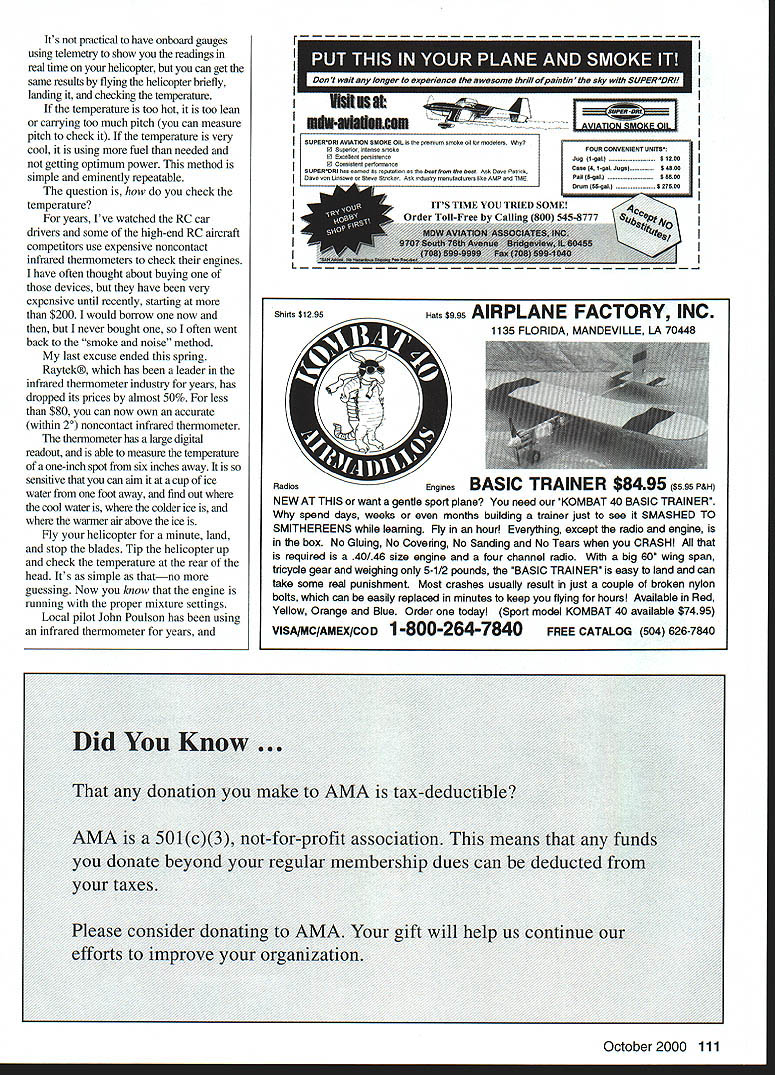
Raytek®, which has been a leader in the infrared thermometer industry for years, has dropped its prices by almost 50%. For less than $80, you can now own an accurate (within 2°) noncontact infrared thermometer. The thermometer has a large digital readout, and is able to measure the temperature of a one-inch spot from six inches away. It is so sensitive that you can aim it at a cup of ice water from one foot away, and find out where the cool water is, where the colder ice is, and where the warmer air above the ice is.
Fly your helicopter for a minute, land, and stop the blades. Tip the helicopter up and check the temperature at the rear of the head. It's as simple as that—no more guessing. Now you know that the engine is running with the proper mixture settings.
Local pilot John Poulson has been using an infrared thermometer for years, and we've learned that an optimum setting for power and smoothness (as well as for glow plug and engine life) is approximately 225° Fahrenheit.
Guidelines:
- If the temperature hits 240°, you should be concerned and should probably richen the needle a bit.
- If the temperature is below 210°, you're not getting the optimum power.
This seems to be the same for .30 and .60 engines. These are general guidelines and may vary a bit, but they seem to be universal.
Since I started borrowing John's "gun," I've been able to consistently set my engines for optimum power and smoothness. When I thought the engine was a little too rich, it was often too lean (and vice versa). It's even possible to check the main and midrange settings on my O.S. SX-H engine.
To say I'm sold on the technology would be putting it mildly.
The Raytek® thermometers should be available from some of the larger hobby shops. A national distributor that I know sells them is HeliProz, Inc. (support: [406] 245-8480; to order: [817] 453-4776). You and/or your dealer can order from HeliProz.
You will also find the units (MiniTemp 2 and MiniTemp 4) at shops that cater to heating and cooling professionals, although probably at somewhat higher prices.
Until next time, happy motoring! MA
Transcribed from original scans by AI. Minor OCR errors may remain.

