
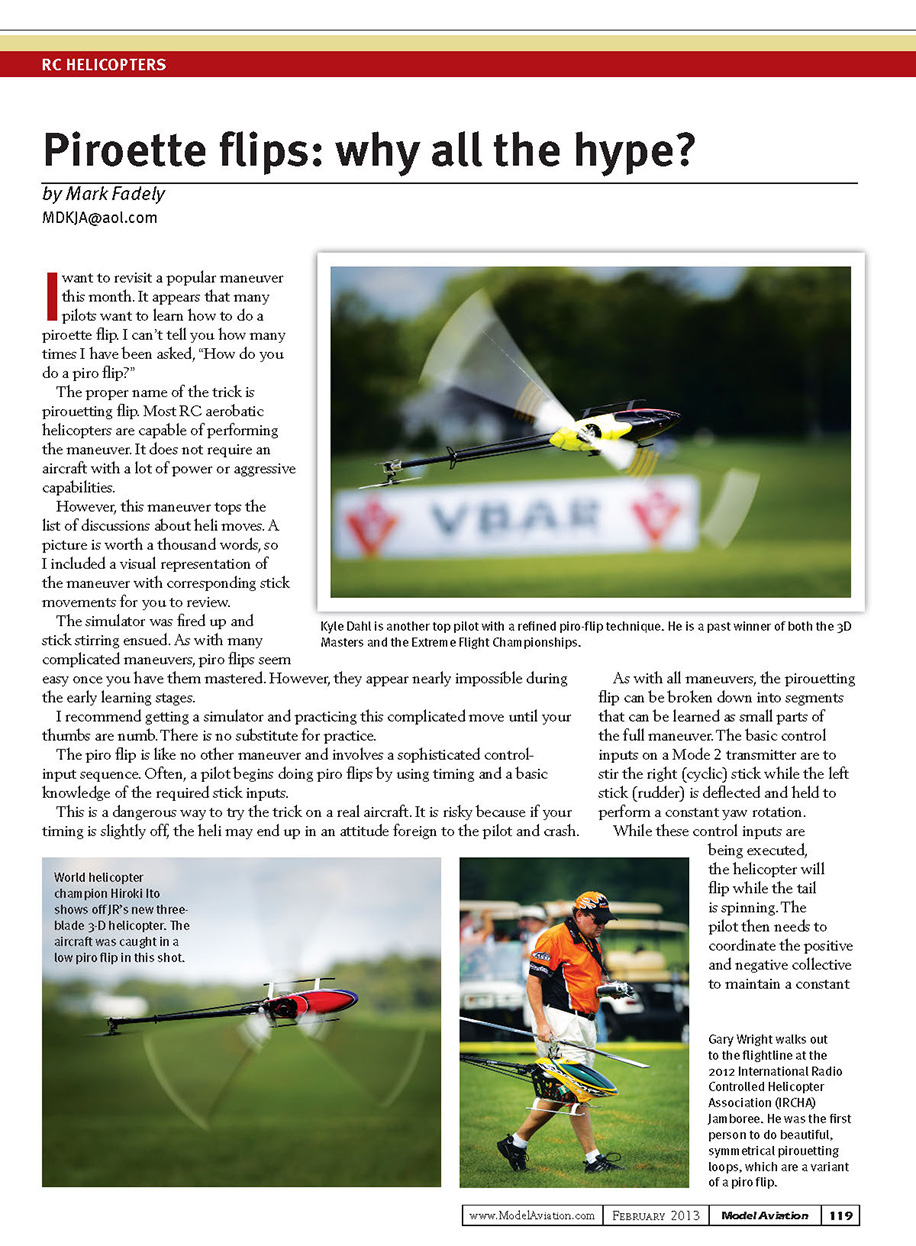

Pirouette Flips: Why All the Hype?
By Mark Fadely
Introduction
I want to revisit a popular maneuver this month. Many pilots want to learn how to do a piro flip — I can't tell you how many times I have been asked, "How do you do a piro flip?"
The proper name of the trick is the pirouetting flip. Most RC aerobatic helicopters are capable of performing the maneuver. It does not require an aircraft with a lot of power or aggressive capabilities.
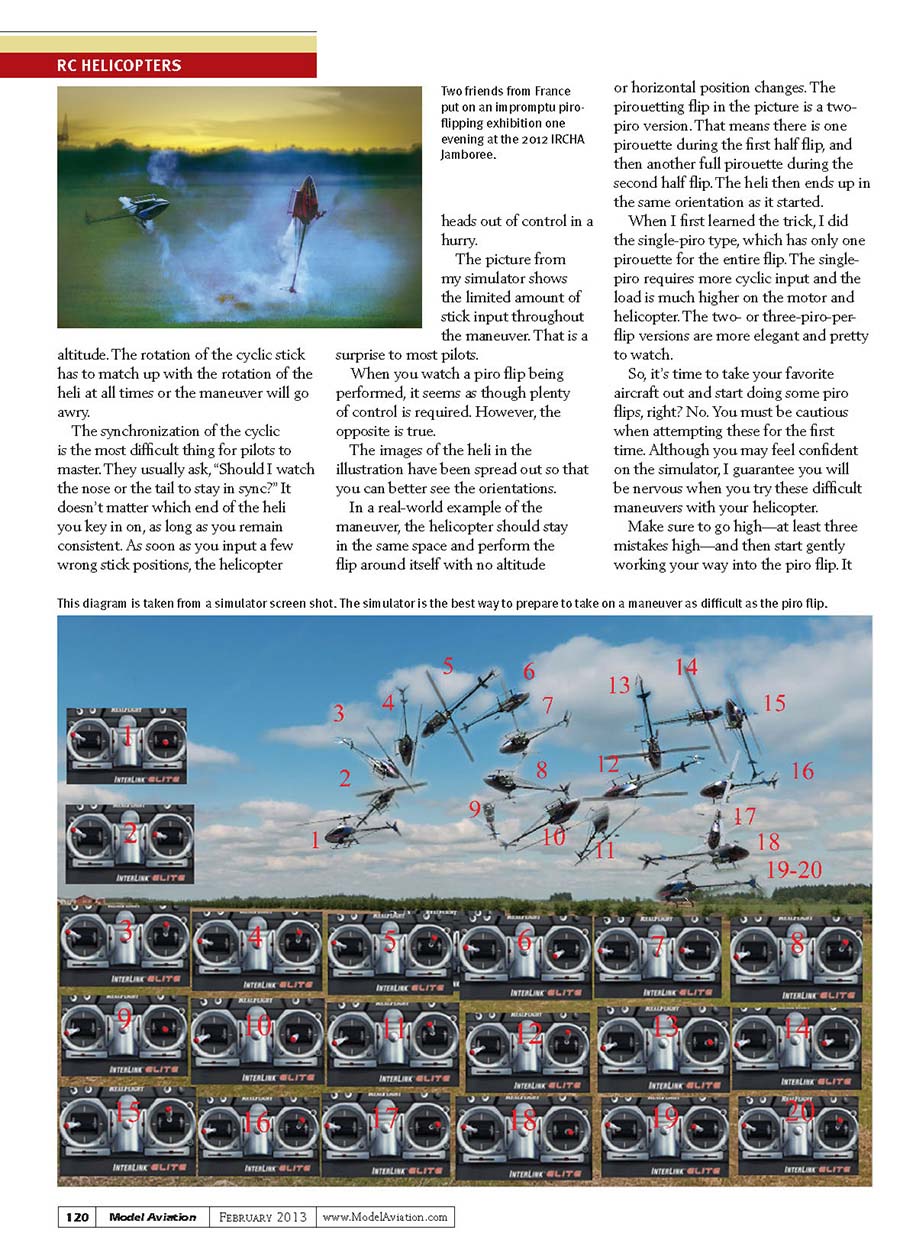
A picture is worth a thousand words, so I included a visual representation of the maneuver with corresponding stick movements for you to review. The simulator was fired up and stick stirring ensued. As with many complicated maneuvers, piro flips seem easy once you have them mastered, but they appear nearly impossible during the early learning stages.
I recommend getting a simulator and practicing this complicated move until your thumbs are numb. There is no substitute for practice.
What is a pirouetting flip?
The pirouetting flip is like no other maneuver and involves a sophisticated control-input sequence. Often, a pilot begins doing piro flips by relying on timing and a basic knowledge of the required stick inputs. This is a dangerous way to try the trick on a real aircraft — if your timing is slightly off, the heli may end up in an attitude foreign to the pilot and crash.
As with all maneuvers, the pirouetting flip can be broken down into segments that can be learned as small parts of the full maneuver.
Technique (Mode 2 transmitter inputs)
- Deflect and hold the left stick (rudder) to perform a constant yaw rotation.
- Simultaneously "stir" the right stick (cyclic) to induce the flip while the tail is spinning.
- Coordinate positive and negative collective to maintain constant altitude throughout the maneuver.
The rotation of the cyclic stick has to match up with the rotation of the helicopter at all times or the maneuver will go awry. Synchronizing the cyclic is the most difficult aspect for pilots to master. Pilots often ask, "Should I watch the nose or the tail to stay in sync?" It doesn't matter which end of the heli you focus on, as long as you remain consistent. As soon as you input a few wrong stick positions, the helicopter heads out of control in a hurry.
The simulator illustration shows a surprisingly limited amount of stick input throughout the maneuver. When you watch a piro flip being performed, it seems as though plenty of control is required. However, the opposite is true. In the illustration, the images of the heli have been spread out so you can better see the orientations. In a real-world example, the helicopter should stay in the same space and perform the flip around itself with no altitude or horizontal position changes.
Types of piro flips
- Two-piro-per-flip: The pirouetting flip in the illustration is a two-piro version. That means there is one pirouette during the first half flip and another full pirouette during the second half flip. The heli then ends up in the same orientation as it started.
- Single-piro: When I first learned the trick I did the single-piro type, which has only one pirouette for the entire flip. The single-piro requires more cyclic input and the load is much higher on the motor and helicopter.
- Three-piro (and more): Two- or three-piro-per-flip versions are more elegant and pretty to watch and generally distribute the load more evenly.
Practice and safety
So, it's time to take your favorite aircraft out and start doing some piro flips, right? No. Be cautious when attempting these for the first time. Although you may feel confident on the simulator, you will likely be nervous when you try these difficult maneuvers with your helicopter.
- Go high — at least "three mistakes high" — before attempting the maneuver.
- Start gently and work your way into the piro flip.
- Take breaks to give your mind a rest; learning this maneuver is mentally taxing at first.
- Don't be afraid to ask other pilots for help when learning something new.
- As always, be safe.
Final thoughts
The piro flip is a difficult and exciting maneuver. Practice on a simulator, break the move into smaller segments, and focus on synchronizing cyclic input with the helicopter's rotation. With patience and practice, the maneuver becomes much more manageable and impressive to watch.
That is it for this month. I hope you return to read more about RC helicopters next month.
Sources
IRCHA www.ircha.org
Transcribed from original scans by AI. Minor OCR errors may remain.

