

Safe wiring is essential
Author
Chris Mulcahy [email protected]
I've always felt that wiring a helicopter is an art form. It's the job that takes me the longest when I build a helicopter. I tend to agonize for hours about which way to route a particular wire and the best way to secure it in place, making sure it isn't rubbing against any hard corners.
I've learned—and seen—many approaches to wiring, and I am pleased at the end of a build to see it neatly finished.
Aside from the pleasing aesthetics, there is a functional side to taking that extra step with your wiring. By carefully and thoughtfully routing your wires, you can avoid chafing and faulty wires, making it easier to remove a component without getting lost in a rat's nest of unkempt wiring.
We've all experienced what can happen to a neglected wire in a helicopter. One instance springs to mind, and it happened when I was flying a 700-size electric heli. During this particular flight, I noticed a smoke trail coming from the helicopter.
After an immediate landing and a frantic run to where I had landed, I saw a flame licking out from underneath the canopy. My immediate thoughts were that either my LiPo had decided to erupt or I had fried my ESC, but I never would have guessed what had actually happened.
I carefully but quickly pulled off the canopy and my knee-jerk reaction was to blow out the flame. To my surprise, it extinguished on its own, which eased my mind about the possibility of a LiPo fire. (You would never be able to blow out a LiPo fire.)
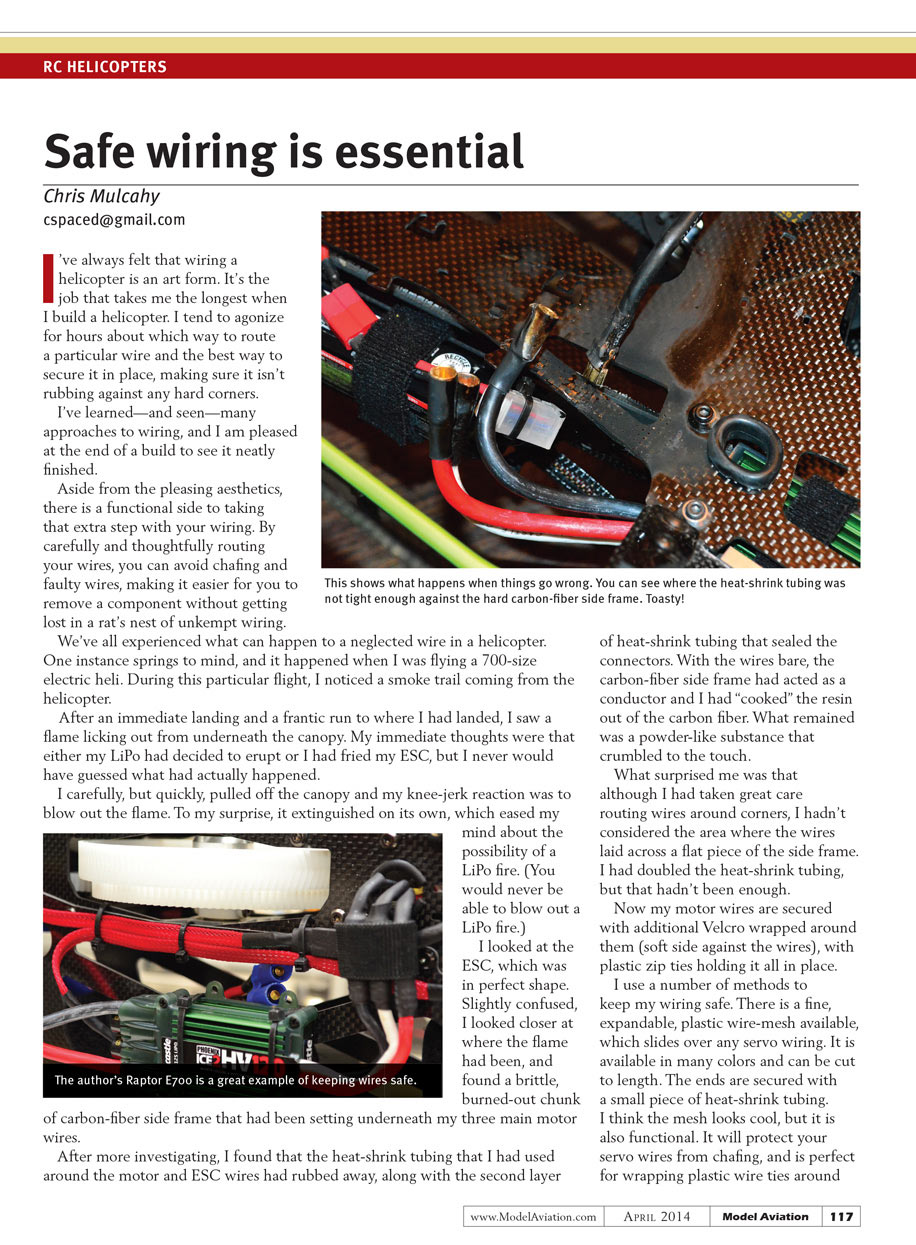
I looked at the ESC, which was in perfect shape. Slightly confused, I looked closer at where the flame had been and found a brittle, burned-out chunk of carbon-fiber side frame that had been sitting underneath my three main motor wires.
After more investigating, I found that the heat-shrink tubing that I had used around the motor and ESC wires had rubbed away, along with the second layer of heat-shrink tubing that sealed the connectors. With the wires bare, the carbon-fiber side frame had acted as a conductor and I had "cooked" the resin out of the carbon fiber. What remained was a powder-like substance that crumbled to the touch.
What surprised me was that although I had taken great care routing wires around corners, I hadn't considered the area where the wires laid across a flat piece of the side frame. I had doubled the heat-shrink tubing, but that hadn't been enough.
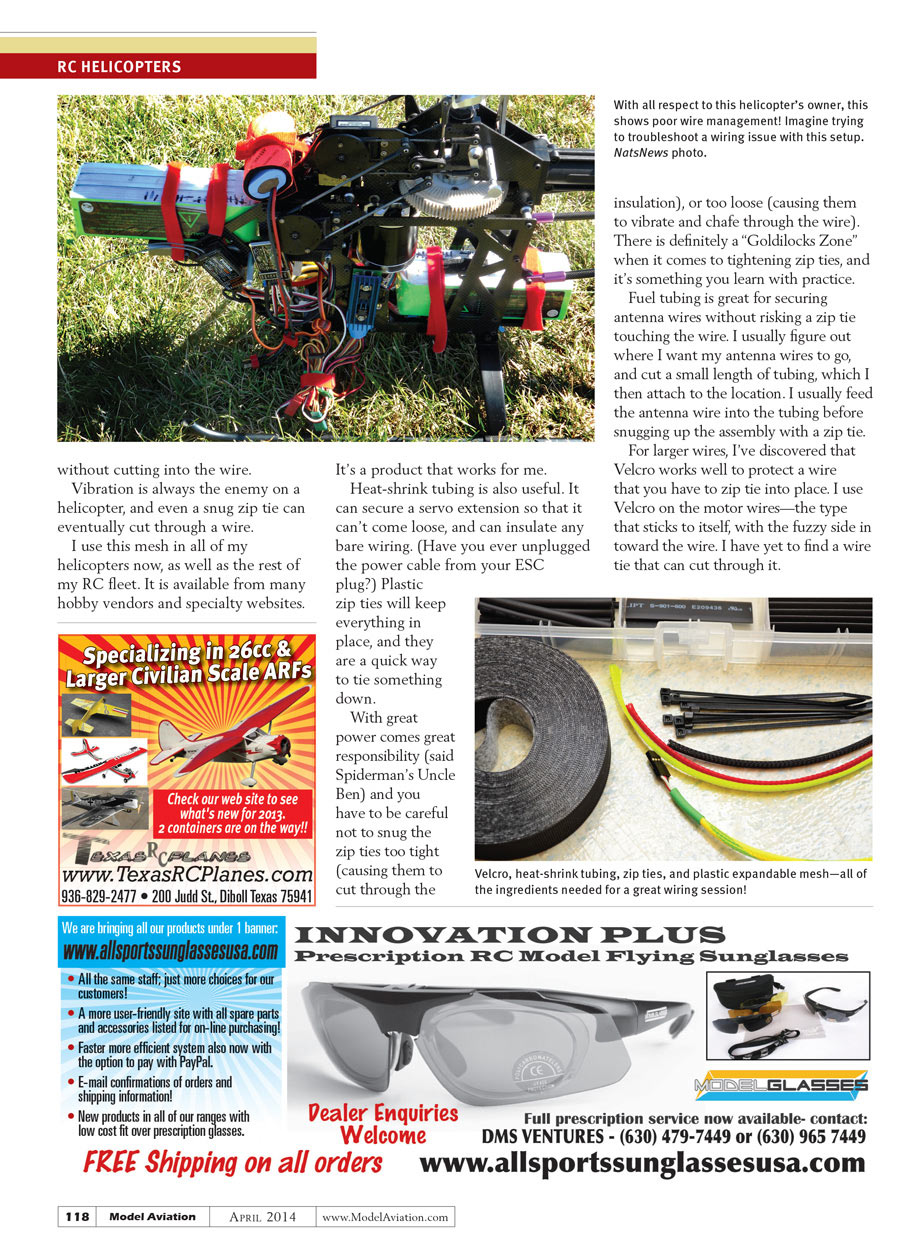
Now my motor wires are secured with additional Velcro wrapped around them (soft side against the wires), with plastic zip ties holding it all in place.
Wiring methods and materials I use
- Expandable plastic wire mesh: A fine, expandable plastic mesh that slides over servo wiring. It is available in many colors and can be cut to length. Secure the ends with small pieces of heat-shrink tubing. The mesh protects servo wires from chafing and provides a surface for zip ties without cutting into the insulation. Vibration is always the enemy on a helicopter, and even a snug zip tie can eventually cut through a wire. I use this mesh in all of my helicopters and the rest of my RC fleet.
- Heat-shrink tubing: Useful to secure servo extensions so they can't come loose and to insulate any bare wiring. (Have you ever unplugged the power cable from your ESC plug?) Heat-shrink provides a reliable seal and insulation.
- Plastic zip ties: A quick way to tie things down and keep wiring in place. Be careful not to snug them too tight (which can cut through insulation) or too loose (which allows vibration and chafing). There is a "Goldilocks Zone" when tightening zip ties that you learn with practice.
- Fuel tubing for antenna wires: Fuel tubing is great for securing antenna wires without risking a zip tie touching the wire. I usually figure out where I want the antenna wires to go, cut a small length of tubing, attach it to the location, and feed the antenna wire into the tubing before snugging up the assembly with a zip tie.
- Velcro for larger wires: Velcro works well to protect wires that must be zip-tied into place. I use the self-sticking type, with the fuzzy side against the wire; I have yet to find a wire tie that can cut through it.
It's important not to pull wires too tightly so there is no slack at either end. Tight routing, when combined with vibration, can wreak havoc on a wire, causing it to break or plugs to come loose. This is particularly important with satellite receivers, because those fragile wires easily break.
Tight wiring into a gyro can also cause erroneous flight characteristics, so it's always a good idea to leave a little slack going into sensors and gyros.
The next time you are at a fly-in or at a club field, take a look at the way your fellow fliers have wired their helicopters—it can be a learning experience!
Good wiring will never replace the need to periodically check over your helicopter, even in places where you wouldn't expect to need to look (as I found out).
Sources
- International Radio Controlled Helicopter Association (IRCHA)
Transcribed from original scans by AI. Minor OCR errors may remain.

