
RADIO CONTROL HELICOPTERS
Eric Hawkinson, 319 Yellowstone Ave., Billings MT 59101; E-mail: [email protected]
IT'S ANOTHER great month to enjoy Radio Control (RC) helicopters!
If you are a Northerner like me and don't have nice weather at the moment, perhaps you are building or maintaining RC helicopters. Either way, I hope you are enjoying your participation in the hobby.
Times like we've had in our country this fall make our hobbies more than simple pastimes; the time we spend involved in building or flying is a great break from the stress of the everyday world. Make the most of it!
In the last column I wrote about the two new "big kids" on the block: the YS 80 and the O.S. .91. At that time, I had no hands-on experience with the engines because they were not available through US distributors.
That has changed, and I have flown a lot of fuel through the O.S. .91 and a fair amount through the YS 80. Because so many of you are considering one or the other for your new projects, I'll pass on some information that may be useful.
The YS 80 and the O.S. .91 are very well-behaved engines that pack a good punch. They also have identical mounting dimensions to their .61-size precursors: the YS 61 ST-2 and the O.S. .51 SX-HWC.
This includes the muffler-mounting dimensions, but the 60-size mufflers are not large enough to handle the added exhaust-volume output of the bigger engines.
I've run the new KSJ and Hatori mufflers, and both work well. A tuned pipe is not needed and would be a poor choice for almost any application of these engines.
The YS 80 will be a very comfortable conversion for anyone who is used to the YS 61 ST-2. It is virtually identical in manners and handling to the .61, except it puts out noticeably more power.
Mine is still running at break-in settings (very rich), and I'm pulling more than 10° of pitch with ease in a Vigor CS equipped with 700mm V-Blades.
So far I've had only one tank through the YS with the optional pinion that lowers the ratio to 8.4:1, so most of my flight time has been pretty cautious. Nonetheless, the power boost is obvious in all phases of flight.
The gear ratio is something of a puzzle on the YS. Although it has a published useful range up to 16,000 rpm, the manual recommends a gear ratio of 7.5:1 or lower.
This presents a couple of quandaries, starting with the lack of availability of such a gear ratio for most current helicopters and ending with the reason for suggesting such a ratio.
If we assume that the engine is close to maximum output at 15,000 rpm, the 7.5 gearing would yield a head speed of 2,000 rpm—a big load on the mechanics.
Maybe the engine needs to run slower than 15,000 rpm or maybe YS is just being very cautious.
With the 8.4:1 ratio in my Vigor CSs and a head speed of 1,800 rpm, the engine is very happy at the resulting 15,100 rpm. It's just as smooth and consistent as the well-known and well-proven YS 61 ST-2.
The O.S. .91 SX-H is a very cool product. For years I have flown and liked the .61 SX-HWC, but it is a product of the competition rules that limit engine displacement to 100cc (cubic centimeters).
In order to get the most power possible, O.S. designed an engine with a big and complex carburetor and aggressive porting. Even with a muffler, the SX-HWC could be challenging to set up and requires minor adjustments as operating conditions change. It's a great engine, but the .91 SX-H is even better because of the basic design. Instead of complex carburetors and radical porting, the .91 gets its power the old-fashioned American way: more cubic inches! With half again as much displacement as the .61, the .91 has conventional porting and an extremely user-friendly carburetor with a main needle and idle adjustment.
It's a ringed engine, and you may need to upgrade your starter to get it running because it's tightly fit. My Sullivan HD starter has been able to start my .91 most of the time, but if you are buying the .91—and a new starter—consider the Sullivan Dynatron.
Once it's started, the O.S. really rocks! I have flown it with the standard and optional gear ratios in my Vigor CS, and either way the engine blows away any .61 setup with ease. It is noticeably happier with the 8.4 ratio, and the helicopter accelerates like a rocket.
The engine runs as smoothly and consistently as any engine I've owned, including the YS engines. Idle and transition are excellent, as they are in the new O.S. .50 SX-H.
These new powerhouses are not for everyone, but if my experiences are the norm, those looking for more power will be happy with the YS 80 or the O.S. .91.
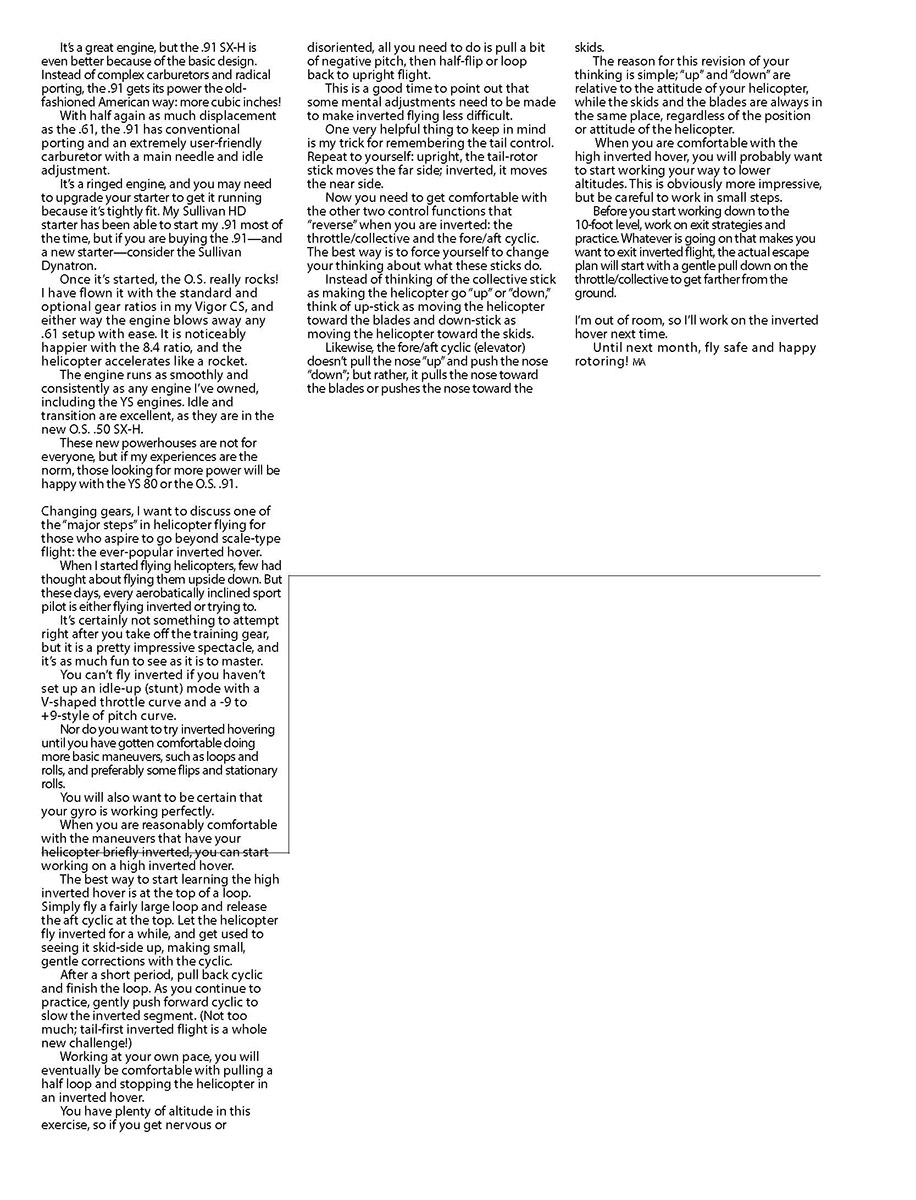
Changing gears, I want to discuss one of the "major steps" in helicopter flying for those who aspire to go beyond scale-type flight: the ever-popular inverted hover.
When I started flying helicopters, few had thought about flying them upside down. But these days, every aerobatically inclined sport pilot is either flying inverted or trying to. It's certainly not something to attempt right after you take off the training gear, but it is a pretty impressive spectacle, and it's as much fun to see as it is to master.
You can't fly inverted if you haven't set up an idle-up (stunt) mode with a V-shaped throttle curve and a -9 to +9-style of pitch curve.
Nor do you want to try inverted hovering until you have gotten comfortable doing more basic maneuvers, such as loops and rolls, and preferably some flips and stationary rolls.
You will also want to be certain that your gyro is working perfectly.
When you are reasonably comfortable with the maneuvers that have your helicopter briefly inverted, you can start working on a high inverted hover.
The best way to start learning the high inverted hover is at the top of a loop. Simply fly a fairly large loop and release the aft cyclic at the top. Let the helicopter fly inverted for a while, and get used to seeing it skid-side up, making small, gentle corrections with the cyclic.
After a short period, pull back cyclic and finish the loop. As you continue to practice, gently push forward cyclic to slow the inverted segment. (Not too much; tail-first inverted flight is a whole new challenge!)
Working at your own pace, you will eventually be comfortable with pulling a half loop and stopping the helicopter in an inverted hover.
You have plenty of altitude in this exercise, so if you get nervous or disoriented, all you need to do is pull a bit of negative pitch, then half-flip or loop back to upright flight.
This is a good time to point out that some mental adjustments need to be made to make inverted flying less difficult.
One very helpful thing to keep in mind is my trick for remembering the tail control. Repeat to yourself: upright, the tail-rotor stick moves the far side; inverted, it moves the near side.
Now you need to get comfortable with the other two control functions that "reverse" when you are inverted: the throttle/collective and the fore/aft cyclic. The best way is to force yourself to change your thinking about what these sticks do. Instead of thinking of the collective stick as making the helicopter go "up" or "down," think of up-stick as moving the helicopter toward the blades and down-stick as moving the helicopter toward the skids.
Likewise, the fore/aft cyclic (elevator) doesn't pull the nose "up" and push the nose "down," but rather, it pulls the nose toward the blades or pushes the nose toward the skids.
The reason for this revision of your thinking is simple; "up" and "down" are relative to the attitude of your helicopter, while the skids and the blades are always in the same place, regardless of the position or attitude of the helicopter.
When you are comfortable with the high inverted hover, you will probably want to start working your way to lower altitudes. This is obviously more impressive, but be careful to work in small steps.
Before you start working down to the 10-foot level, work on exit strategies and practice. Whatever is going on that makes you want to exit inverted flight, the actual escape plan will start with a gentle pull down on the throttle/collective to get farther from the ground.
I'm out of room, so I'll work on the inverted hover next time.
Until next month, fly safe and happy rotoruting! MA
Transcribed from original scans by AI. Minor OCR errors may remain.

