
RC Helicopters
Eric Hawkinson, 319 Yellowstone Ave., Billings MT 59101; E-mail: [email protected]
IT'S ANOTHER great month to enjoy the sport and hobby of Radio Control (RC) helicopters!
Whether you are building a new "Christmas" helicopter, rebuilding one that hit a gravity gust, or going out and "converting nitro into noise," please take a moment now and then to think about what a great and fascinating segment of the hobby this is.
When I ended the January 2002 column, we were getting our helicopters into a relatively high-altitude inverted hover by pausing at the top of a loop.
Remember the "tricks" of mental adjustments I wrote about: Upright, the tail-rotor stick moves the far side; inverted, it moves the near side.
Instead of thinking of the collective stick as making the helicopter go "up" or "down," think of up-stick as more helicopter toward the blades and down-stick as moving the helicopter toward the skids.
Likewise, the fore/aft cyclic (elevator) doesn't pull the nose "up" and push the nose "down;" rather, it pulls the nose toward the blades or pushes the nose toward the skids.
Luckily for us, the aileron function doesn't "reverse" its perceived response when the helicopter is inverted. Otherwise, this stuff would be hard!
The plan is to eventually become comfortable with the high and mid-height inverted hover, then work down to a low inverted hover.
It's important to proceed here only as quickly as your skills allow and not let your ego or flying buddies push you faster than you are ready to go.
Before you start working your way down to the low levels, start working on some different entry and exit strategies.
As with the higher-altitude inverted practice, whenever you want to exit inverted flight, the actual escape will always start with a gentle pull down on the throttle/collective to get farther from the ground.
At higher altitudes, you can simply finish looping back to upright flight.
The lower your model gets, the less safe it becomes to "half-loop" back to upright, and the more important it becomes to half-flip instead.
At the same time — just as in learning upright hover — you have to learn inverted hover tail-in and nose-in.
You should have learned nose-in hovering before you started on the inverted work. If you didn't, go practice that and come back to the skids-up stuff later.
The point is that you are going to try to make the inverted hover as painless as possible, and that means starting out with one attitude of practice. For simplicity, that will be tail-in.
Following is the exercise you want to work on before you get down to low-level inverted.
Enter inverted flight as usual, from a half-loop. When you have stabilized in inverted hover, use the tail rotor to turn the tail toward you.
Now work on carefully changing altitude, making adjustments a few feet upward or downward, and hold the new position. You need to develop a delicate touch on altitude control before you get down to lawn-mowing levels!
It's not any harder to maintain altitude when inverted than when upright, but if you're like most of us, you will be more nervous inverted and more occupied keeping up with all of the other control reversals.
You need to work at a safe height for a while, until you are certain you won't get excited and push the collective "up" when you want to gain altitude.
After a bit of tail-in inverted hover and altitude-adjustment practice, climb out inverted and steer the tail back to a mostly "side-on" attitude. Simultaneously pull both sticks down to "push" the helicopter up and enter a half-flip back to upright.
You should be practiced on back and front flips by this point; if you aren't, this is a good way to get started.
Eventually you will want to work on a half-flip to inverted, allowing entry at a lower altitude and with less total airspace used during entry.
You have no doubt seen the experts execute a half forward flip into inverted at low level — a maneuver that is very impressive and takes less than one helicopter length of airspace to perform. This is not the "small step" you want to take next!
Why? Because you will probably be nervous enough with a low-level entry to inverted hover without entering it nose-in. For safety reasons, you probably don't want to start out half-flipping toward yourself from nose-in upright hover so you end up tail-in inverted.
The way to take the smallest step is to simply use a half side flip (stationary roll) from tail-in upright to tail-in inverted.
I usually perform the half side flip at approximately 20 feet high. That way, if I botch it or just feel uncomfortable, I simply continue rolling back to upright with plenty of altitude to keep the nerves from being a factor.
With the tail more or less pointed at you, half-flip to tail-in hover and stabilize the altitude with a small up-collective hover. When you are comfortable, make a very small up-collective movement to establish a small descent rate.
The key is to make all your movements small and precise. If you become uncomfortable, pull the collective down gently and recompose yourself in a higher-altitude inverted hover or recover to upright in whatever manner you prefer.
Eventually you will gain a level of comfort with low-level inverted and will be able to work your way down however close to the ground you wish.
RC Helicopters
You will learn that, just as with upright hover, there is a point at which ground effect becomes a factor in stabilizing the descent rate.
It seems to happen at a higher altitude when inverted, because the blades are on the bottom of the helicopter instead of on top.
With my Mercury 50 there is one "notch" on the throttle stick that allows a stable six- to 12-inch inverted hover. But you can't just hit that stick position at 10 feet high and watch it settle, because it will settle into the dirt!
Out of ground effect, that "magic" stick position causes a descent.
The descent is arrested by going one or two "clicks" below the hover position, then moving back up slightly.
My Vigor CS feels slightly less pitch sensitive—or has more noticeable ground-effect characteristics—but still has the same feel as far as that "one notch" being perfect for a stable hover.
My final advice for now will be to pay even closer attention to everything when your model is inverted. Especially at low altitude, your autorotation options are diminished.
Don't fly with a glow plug that "should be okay for another flight," and make sure you pay attention to the fuel level.
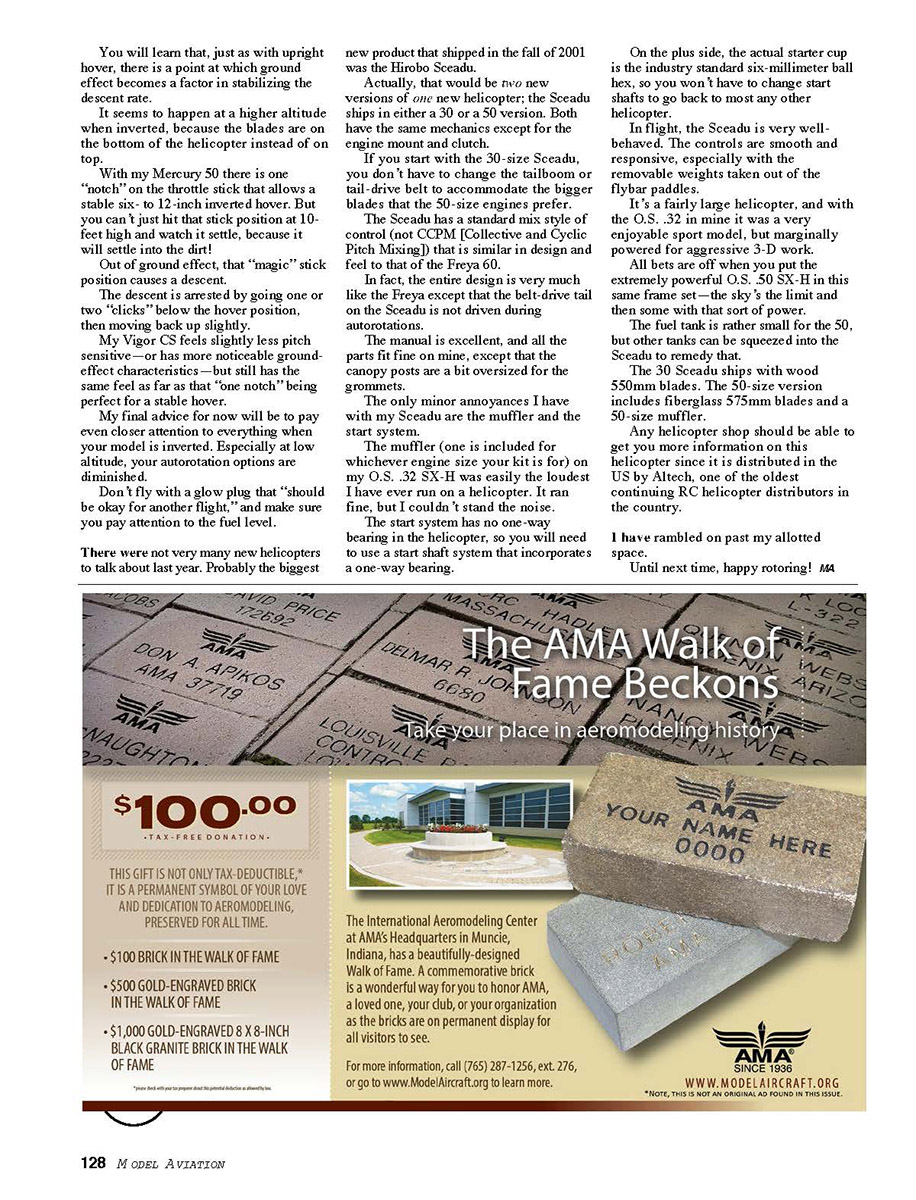
There were not very many new helicopters to talk about last year. Probably the biggest new product that shipped in the fall of 2001 was the Hirobo Sceadu.
Actually, that would be two new versions of one new helicopter; the Sceadu ships in either a 30 or a 50 version. Both have the same mechanics except for the engine mount and clutch.
If you start with the 30-size Sceadu, you don't have to change the tailboom or tail-drive belt to accommodate the bigger blades that the 50-size engines prefer.
The Sceadu has a standard mix style of control (not CCPM [Collective and Cyclic Pitch Mixing]) that is similar in design and feel to that of the Freya 60.
In fact, the entire design is very much like the Freya except that the belt-drive tail on the Sceadu is not driven during autorotations.
The manual is excellent, and all the parts fit fine on mine, except that the canopy posts are a bit oversized for the grommets.
The only minor annoyances I have with my Sceadu are the muffler and start system.
The muffler (one is included for whichever engine size your kit is for) on my O.S. 32 SX-H was easily the loudest I have ever run on a helicopter. It ran fine, but I couldn't stand the noise.
The start system has no one-way bearing in the helicopter, so you will need to use a start shaft system that incorporates a one-way bearing.
On the plus side, the actual starter cup is the industry standard six-millimeter ball hex, so you won't have to change start shafts to go back to most any other helicopter.
In flight, the Sceadu is very well-behaved. The controls are smooth and responsive, especially with the removable weights taken out of the flybar paddles.
It's a fairly large helicopter, and with the O.S. .32 in mine it was a very enjoyable sport model, but marginally powered for aggressive 3-D work.
All bets are off when you put the extremely powerful O.S. .50 SX-H in this same frame set—the sky's the limit and then some with that sort of power.
The fuel tank is rather small for the 50, but other tanks can be squeezed into the Sceadu to remedy that.
The 30 Sceadu ships with wood 550mm blades. The 50-size version includes fiberglass 575mm blades and a 50-size muffler.
Any helicopter shop should be able to get you more information on this helicopter since it is distributed in the US by Altech, one of the oldest continuing RC helicopter distributors in the country.
I have rambled on past my allotted space.
Until next time, happy rotoring! MA
Transcribed from original scans by AI. Minor OCR errors may remain.

