
RC Helicopters
Eric Hawkinson, 319 Yellowstone Ave., Billings MT 59101; E-mail: [email protected]
IT'S ANOTHER GREAT month to be enjoying the sport of Radio Control helicopters! And that's what I've been doing, thanks to two new models and an "old favorite" getting back into the sky.
The old favorite is my O.S. .91-powered Vigor CS. I'd forgotten how much a well-designed helicopter could fly like a Pattern airplane. The CS definitely has the purest rolls of any helicopter I've ever flown. Coupled with the big power of the O.S. .91 and 700mm V-Blades, the CS is a pure joy to fly.
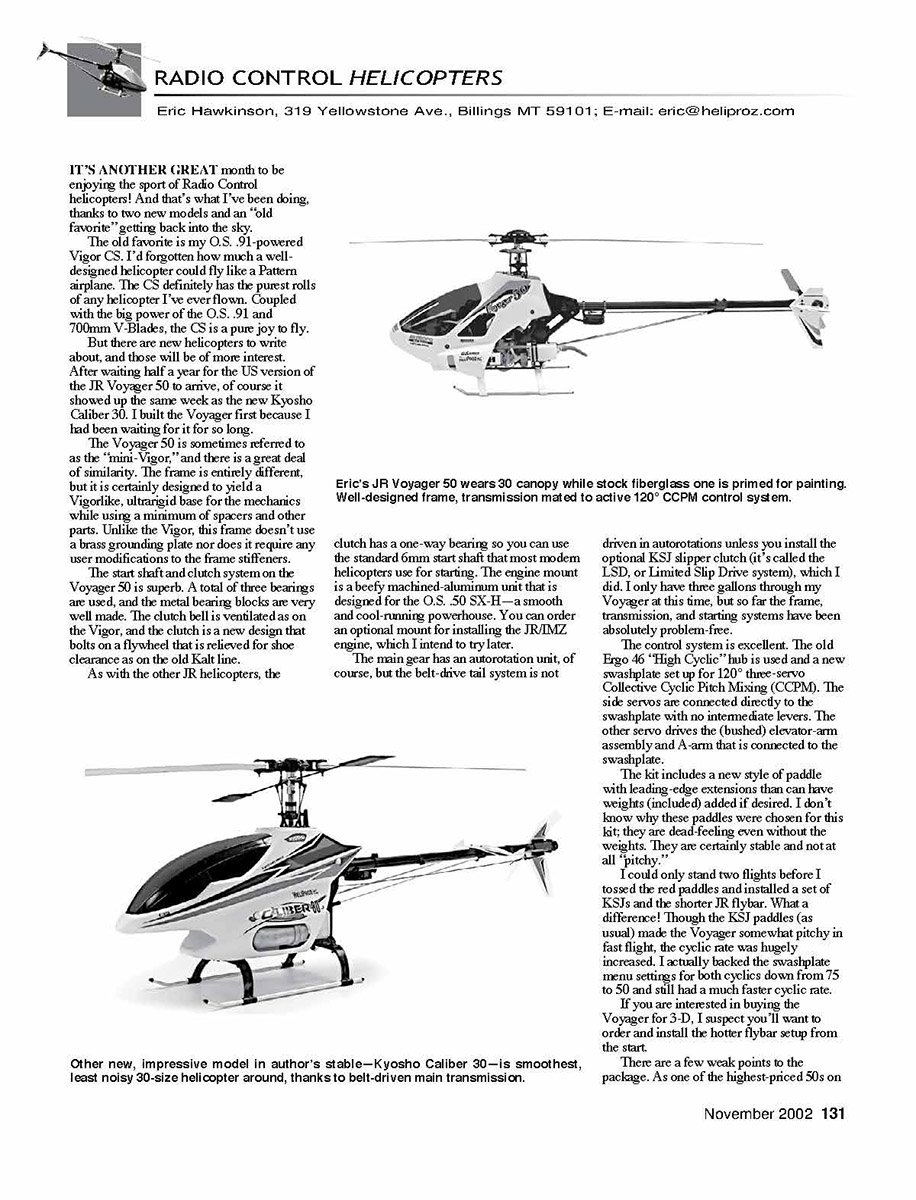
But there are new helicopters to write about, and those will be of more interest. After waiting half a year for the US version of the JR Voyager 50 to arrive, of course it showed up the same week as the new Kyosho Caliber 30. I built the Voyager first because I had been waiting for it for so long.
The Voyager 50 is sometimes referred to as the "mini-Vigor," and there is a great deal of similarity. The frame is entirely different, but it is certainly designed to yield a Vigor-like, ultra-rigid base for the mechanics while using a minimum of spacers and other parts. Unlike the Vigor, this frame doesn't use a brass grounding plate nor does it require any user modifications to the frame stiffeners, or to the shaft and clutch system. The Voyager 50 is superb. A total of three bearings are used, and the metal bearing blocks are very well made. The clutch bell is ventilated as on the Vigor, and the clutch is a new design that bolts on a flywheel that is relieved for shoe clearance as on the old Kalt line.
As with the other JR helicopters, the clutch has a one-way bearing so you can use the standard 6mm start shaft that most modern helicopters use for starting. The engine mount is a beefy machined-aluminum unit that is designed for the O.S. .50 SX-H — a smooth and cool-running powerhouse. You can order an optional mount for installing the JR/JMZ engine, which I intend to try later.
The main gear has an autorotation unit, of course, but the belt-drive tail system is not driven in autorotations unless you install the optional KSJ slipper clutch (it's called the LSD, or Limited Slip Drive system), which I did. I only have three gallons through my Voyager at this time, but so far the frame, transmission, and starting systems have been absolutely problem-free.
The control system is excellent. The old Ergo .46 "High Cyclic" hub is used and a new swashplate set up for 120° three-servo Collective Cyclic Pitch Mixing (CCPM). The side servos are connected directly to the swashplate with no intermediate levers. The other servo drives the (bushed) elevator-arm assembly and A-arm that is connected to the swashplate.
The kit includes a new style of paddle with leading-edge extensions that can have weights (included) added if desired. I don't know why these paddles were chosen for this kit; they are dead-feeling even without the weights. They are certainly stable and not at all "pitchy."
I could only stand two flights before I tossed the red paddles and installed a set of KSJs and the shorter JR flybar. What a difference! Though the KSJ paddles (as usual) made the Voyager somewhat pitchy in fast flight, the cyclic rate was hugely increased. I actually backed the swashplate menu settings for both cyclics down from 75 to 50 and still had a much faster cyclic rate.
If you are interested in buying the Voyager for 3-D, I suspect you'll want to order and install the hotter flybar setup from the start.
There are a few weak points to the package. As one of the highest-priced 50s on the market, it seems as though the washout and mixing arms could be arranged instead of bushed (though the bushings are large and work well).
The tank is too small for a .50 and, as with the Vigor, it's located well ahead of the mast, so there is significant trim change from full to empty. The trim change is not a big deal, but the short flight time is going to annoy most pilots. If you are flying hard, you won't get more than seven to eight minutes even with a header tank. I've been told that a larger tank option will be available, and I hope JR will make it standard.
The tail bellcrank could be better, again mostly in light of the kit's cost: a 2mm screw on a bushed bellcrank that moves a single point slider is acceptable on a $240 machine, but one that is sold with a steel trice bracket below $500 (with metal main blades) should probably be better equipped. Of course, you could use the metal Ergo upgrade at $11 and the superbly smooth and slop-free KSI high-grade tail lever assembly, which can be yours for roughly $180.
A minor annoyance for me, having just moved to a new house that has no paint booth, was the new fiberglass canopy that comes in the kit. This machine seems aimed and priced at the hard-core 3-D market, and that means at least one wear-and-tear on the canopy is likely.
When my pal and co-worker Larry Bennett accidentally applies the "dirt brakes" on his Scorpion Raptor, he just pops the molded canopy out, fixes the bent parts, and flies. The Voyager canopy will not survive any minor impacts, and the cover will require time and money to scuff, prime, patch, prime, paint, trim, etc. Don't get me wrong: the quality of the fiberglass work is excellent, and the "Vigor CS" shape is handsome.
As you can see in the photo, I decided to see if I could get flying a week quicker by using a canopy from the J-R Venture 30 as my maneuvering canopy. It fits perfectly. Even the position and length of the Voyager mounting posts were perfect. So for less cost than the primer and paint, I bought a Venture canopy and was ready to fly 30 minutes later, albeit with a much less "sleek" look than the standard canopy.
I am very happy with the way the Voyager 50 performs. Equipped with 600mm Mavrik carbon-fiber blades and the O.S. .50SX-H and Mavrik muffler, the helicopter has excellent acceleration, powerful cyclic, plenty of collective, very little control interaction, and it autorotates very well. Horizon Hobby has always had the best support in the industry, so parts should be no problem.
I wouldn't trade my PCVM Vigor for a Voyager, but it is my favorite 50-class machine at this time.
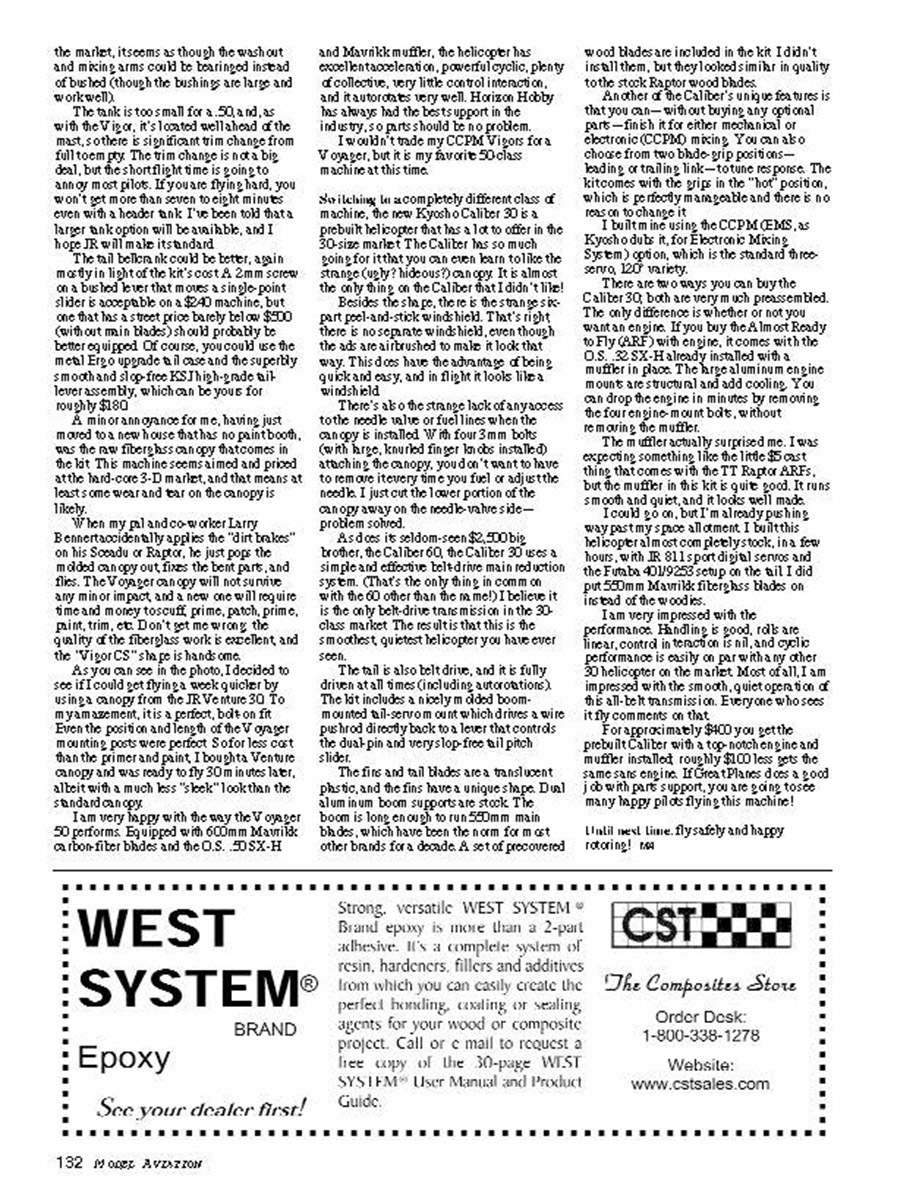
So pitching in a completely different class of machine, the new Kyosho Caliber 30 is a prebuilt helicopter that has a lot to offer in the 30-size market. The Caliber has so much going for it that you can learn to lollike the strange (yuk) hideous canopy. It is almost the only thing on the Caliber that I didn't like!
Besides the shape, there is the strange spinner-vent-pret-cool-and-stick windshield. That's right; there is no separate windshield, even though the ads are airbrushed to make it look that way. This does have the advantage of being quick and easy, and in flight it looks like a windshield.
There's also the strange lack of any access to the needle valve or fuel lines when the canopy is installed. If you fit four 3mm bolts (with large, knurled finger knobs installed) attaching the canopy, you don't want to have to remove it every time you fuel or adjust the needle. I just cut the lower portion of the canopy away on the needle-to-hinge side—problem solved.
As does its seldom-seen $2,500 big brother, the Caliber 60, the Caliber 30 uses a simple and effective belt-drive main reduction system. (That's the only thing in common with the O.S. 60 other than the name!) I believe it is the only belt-drive transmission in the 30-class market. The result is that this is the smoothest, quietest helicopter you have never seen.
The tail is also belt drive, and it is fully driven at all times (eliminating autorotation). The kit includes a nicely molded boom-mounted tail-servo mount which drives a wire pushrod directly back to a lever that controls the dual-pin and very-slop-free tail pitch slider.
The fins and tail blades are translucent plastic, and the fins have a unique bulge. Dual aluminum boom supports are stock. The boom is long enough to run 550mm main blades, which have been the norm for most other brands for a decade. A set of precovered wood blades are included in the kit. I didn't like them, but they looked similar in quality to the stock Raptor wood blades.
Another of the Caliber's unique features is that you can—without buying any optional parts—finish it for either mechanical or electronic (CCPM) mixing. You can also choose from two blade-grip positions—leading or trailing link—to tune response. The kit comes with the grips in the "hot" position, which is perfectly manageable and there is no reason to change it.
I built mine using the CCPM/EMS, as Kyosho dub it, for Electronic Mixing System (2X), which is the standard three-servo, 120 variety.
There are two ways you can buy the Caliber 30: both are very much preassembled. The only difference is whether or not you want an engine. If you buy the Almost Ready to Fly (ARF) with engine, it comes with the O.S. .52SX-H already installed with a muffler in place. The large aluminum engine mount is structural and cooling. You can drop the engine in minutes by removing the four engine-mount bolts, without removing the muffler.
The muffler actually surprised me. I was expecting something like the little 50's cast thing that comes with the TT Raptor ARFs, but the muffler in this kit is quite good. It runs smooth and quiet, and it looks well made.
I could go on, but I'm already pushing way past my space allotment. I put this helicopter almost completely stock, in a few hours, with IR 8.11 sport digital servos and the Futaba 6VY9253 setup on the tail. I did put 550mm Mavrik fiberglass blades on the front instead of the woodies.
I am very impressed with the performance. Handling is good, cyclic is linear, control feels crisp and sure, and the helicopter is easily on par with many good 3-D helicopters on the market. Most of all, I am impressed with the smooth, quiet operation of this all-belt transmission. Everyone who sees it comments on that.
For approximately $400 you get the prebuilt Caliber with a top-notch engine and muffler installed, roughly $100 less gets the same as an ARF. If Great Planes does a good job with parts support, you are going to see many happy pilots flying this machine!
Until next time, fly safely and happy roosting! RA
Transcribed from original scans by AI. Minor OCR errors may remain.

