

RC Helicopters
Ray Stacy
The author fesses up to some mistakes in his modeling
SOMETIMES THE most obvious solution to a problem eludes me. I am embarrassed to admit that I was caught two times this month.
Last year I gave my son a Raptor 90 SE for Christmas. We spent the winter months together building the helicopter.
Along the way I took the time to explain each part's function. It was a great experience as I watched Kyle learn the proper way to use the appropriate tool while assembling the helicopter.
We decided to go with the O.S. .91 C-Spec PS engine with a Muscle Pipe II, which was a change for me. For the most part I have run the YS 91 in my 90-size helicopters. The YS engines work well for me; they have a "set-and-forget" nature, which means that once they are dialed in, you don't spend your flying sessions tweaking the needle valves.
My friend Jeff Swartz convinced me to try the O.S. This is where the fun begins! He had warned me that C-Spec can have an issue with a lean idle and lean transition from idle. The same comments were turning up on the helicopter forums.
The problem appears to be with the spraybar opening and its limited eccentric adjustment assembly. There have been a few suggestions about how to modify the spraybar opening to help the problem, but I try to avoid doing that. I paid a great deal of money for the engine, and the last thing I want to do is take a file to the carburetor!
A number of fliers are replacing the stock C-Spec carburetor with the older 60K-style three-needle carburetor from the O.S. .61 WC. Not only did this carburetor work well, but it gave a much broader adjustment throughout the mixture and a third needle for the midrange mixture.
After starting our C-Spec for the first time, I could see why people are changing the carburetor! The low-end mixture was exceptionally lean, and getting the engine to return to idle was difficult. The engine wanted to "buzz" instead of returning to idle and was quick to lean out in transition.
The C-Spec also seemed to be doing poorly at the high end, but I wasn't focusing much on the top-end power since it was a new engine. Later I would realize that this was a clue.
I continued to work with the engine, but all the comments about the carburetor kept ringing in my mind. I was ready to trade the C-Spec for a worn-out .32, but I just couldn't do that to a friend.
While talking to Curtis Youngblood, he mentioned that problem engines should have the spraybars checked to make sure they were cut properly. I did remove the idle mixture assembly and all appeared to be well. There was no material left in the cat-eye opening, nor did I find any foreign material in the assembly.
I played with it some more, but I never really had much impact on the problem. I was starting to look for a three-needle carburetor when I called Curtis again, seeking any last-minute suggestions before I changed the carburetor. Anthony Jager answered the phone and listened to my woes for a few minutes, and then he suggested that I remove the main needle and take out the piece of plastic I would find there. Knowing that I had a new filter between the tank and pump, I didn't think I would find anything in the main needle assembly, but it would be easy enough to check.
I pulled the needle out and, sure enough, there was a small slice of white plastic stuck in the jet. Actually there were two pieces. Both were easy to remove with tweezers. Anthony nailed this one perfectly.
A quick trip to the field showed that I had a new engine. The first thing I noticed was the much easier start. Many symptoms pointed to this problem, but I chose to ignore them.
Now the idle is nice and consistent, and the transition is better. It is still a bit lean on the low end, but it is acceptable. Now the top end is rich and powerful, with a nice, broad range for needle adjustment.
RC Helicopters
Ray Stacy
Anthony thinks the plastic contaminants are pieces of flashing from the fuel pump. This sounds right because I have a fuel filter between the tank and pump that would not pass a piece of material this large.
According to Anthony, this debris has been known to cause a lean idle, lean midrange, and changing mixtures at full throttle. Why didn't I think to check this? It was too easy and never even entered my mind. After all, there was a fuel filter installed.
For those who want YS carburetor-type performance, you may want to go to the three-needle carburetor for that extra bit of control over the mixture. It may be a minor thing, but it's little things such as this that make the difference between a good helicopter and a great helicopter.
If you do decide to go this route, you will need a T fitting and YS one-way valve (four-stroke version) in your fuel line right before the carburetor. The T fitting and one-way valve is there for the overflow from the pump back to the fuel tank.
Unfortunately I had a hot start right as I was getting this worked out, and it took out the clutch and liner. I had my hand on the head and was quick to pull the fuel line, but the Raptor clutch liners are so thin that the clutch shoes are spread and the liner is gone with one hot start. That machine has been down for a week now, waiting for the new clutch parts.
The clutch gap on the Raptors has been too large since the birth of the machine. I'm not sure why it has never been addressed, but the problem has carried through the entire line of machines. This causes issues with the clutch slipping as well as not being able to take much abuse.
The best way to fix this problem is to remove the liner from a clutch bell and then install a new, thicker liner and turn it down to the proper size on a lathe; .006 on each side seems to be the correct number to use.
For many years Ken Willard wrote a great column for R/C Modeler magazine called "Sunday Flier." He was informative, entertaining, and never afraid to point the finger at himself. Ken had an annual "dumb dumb" award, for which he would pick the winner of the best "dumb dumb" event of the year.
I often think I could have qualified for the award, but I never submitted my stories. If it were still being presented today, I think I would have easily won it with the last mistake I made with my Hirobo X-Spec.
I have been getting some quality flying on this helicopter and having a ball with it. It is one of my favorites. The X-Spec doesn't cost a fortune, yet has all the features I want in a 90-size machine.
I decided to let my son Kyle take a whack at the helicopter. He can give it a much better workout than I can. Approximately 30 seconds into the flight he asked me if he could do a pirouetting flip. I told him to go for it!
The first one was fine. During the second flip we heard a brrrpp sound. The X-Spec kept flying, but I knew what it was. My new 710 V Blade main blades and the stock tail-rotor blades had tried to occupy the same space at the same time.
Kyle landed the model, and I saw that I was right; the last inch of the V Blades was split open. However, the plastic tail-rotor blades were unmarked! Hey Vic, how does carbon fiber lose out over plastic?
Again the obvious solution eluded me, and I assumed the problem was that the head dampeners were too soft. Anyone else would have realized that the blades were just too long, but not me. I fly 710s on all my 90-size machines. No problem here. I installed some new 80-durometer dampeners that Jeff Green from Model Rectifier Corporation (www.modelrectifier.com), or MRC, sent me for evaluation. I didn't have anymore 710 blades, so I installed a new set of NHP 700s.
We went back to the field, and Kyle immediately went for the pirouetting flip. It was much better this time and waited for the fourth or fifth flip to make that brrrp noise! Again the X-Spec kept flying, and again it was landed and we found split blades.
I really did like this helicopter, but I was going to have to consider retiring it if it was going to cost me a set of blades for each flight! (The plastic blades still won out over the carbon-fiber NHPs. Maybe I need a set of blades made from plastic!) Even I know that a set of blades should last longer than one flight.
When I examined the model closer, it was clear to see that there was going to be interference between the main blades and the tail-rotor blades. It only cost me two sets of blades to figure this out.
The reason for the interference is that the X-Spec head assembly is longer than most. The distance from main-blade bolt to main-blade bolt is 21.5 cm. For comparison, the Vigor C5 spacing is 19.0 cm. The 680 blades are the right size for this helicopter. Even though the blades are shorter, the disk size is roughly the same.
The recommended blade size was printed in big, bold letters in the manual. This was one of those many times when reading the manual would have saved me money and aggravation! This was a dumb and costly mistake caused by my not taking the time to read the manual.
Check the obvious. Mr. Willard, if you are up there watching us, I earned that award!
In case you are wondering, the 80-durometer dampeners are too hard for the X-Spec head. The helicopter picked up an oscillation that came and went. I flew the X-Spec today with 60-durometer dampeners; the oscillation was gone and the performance was solid. The X-Spec loves to fly!
Cool New Tool: If you have been in this hobby for any length of time, you have probably needed to make a custom-size pushrod or needed a pushrod for that late-night rebuild that you didn't have in your parts supply.
For years I have used a 2mm die to cut the threads in pushrods, and it works well for the most part. Sometimes I get a piece of rod that is too hard to cut, and that usually costs me a 2mm die when the rod breaks off or I get a piece of rod that is too small in diameter after cutting the threads. If I can screw the plastic ball link on with little or no resistance, I know the threaded portion of the rod is too small in diameter. This is because cutting the threads takes away material.
The solution to this problem comes from our bicyclist friends. Visit your local bike shop and purchase a bicycle-spoke thread-rolling tool. It makes threads by compressing the rod between three rollers and forcing it to conform to the threads on the rollers. There is no cutting involved—just the re-forming of the metal rod. You can adjust the tension on the rollers to control the amount of thread rolled into the rod.
Unlike cutting threads with a die, rolling them causes the threaded portion to increase in size. A 2mm rod with rolled threads increased to 2.17mm. No material was taken away, and the ball link actually fits better.
When making pushrods, I try not to leave any threaded portion of the rod exposed. Every broken pushrod I have seen has broken at the threads. Keeping this part buried in the link will give the pushrod a longer life.
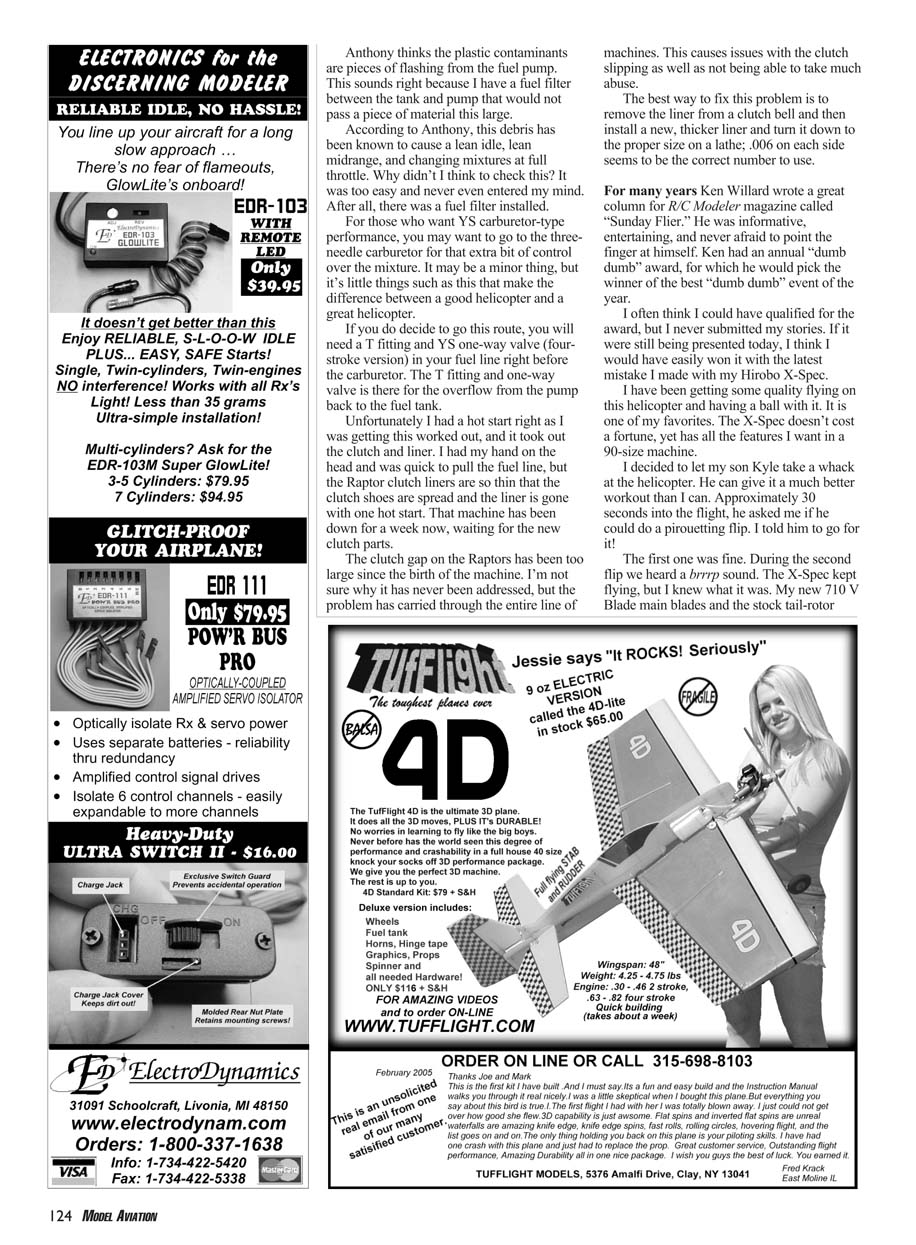
There are many different types of threading tools available. I went with the Hozan C700 Spoke Threading Machine. Its average cost is $100, but searching on the Internet will turn it up for $90.
This simple little unit clamps in a vise and works perfectly. I have tried rolling threads on most of the rods lying around the shop, and it has done all of them with ease. I have included a picture of mine in use.
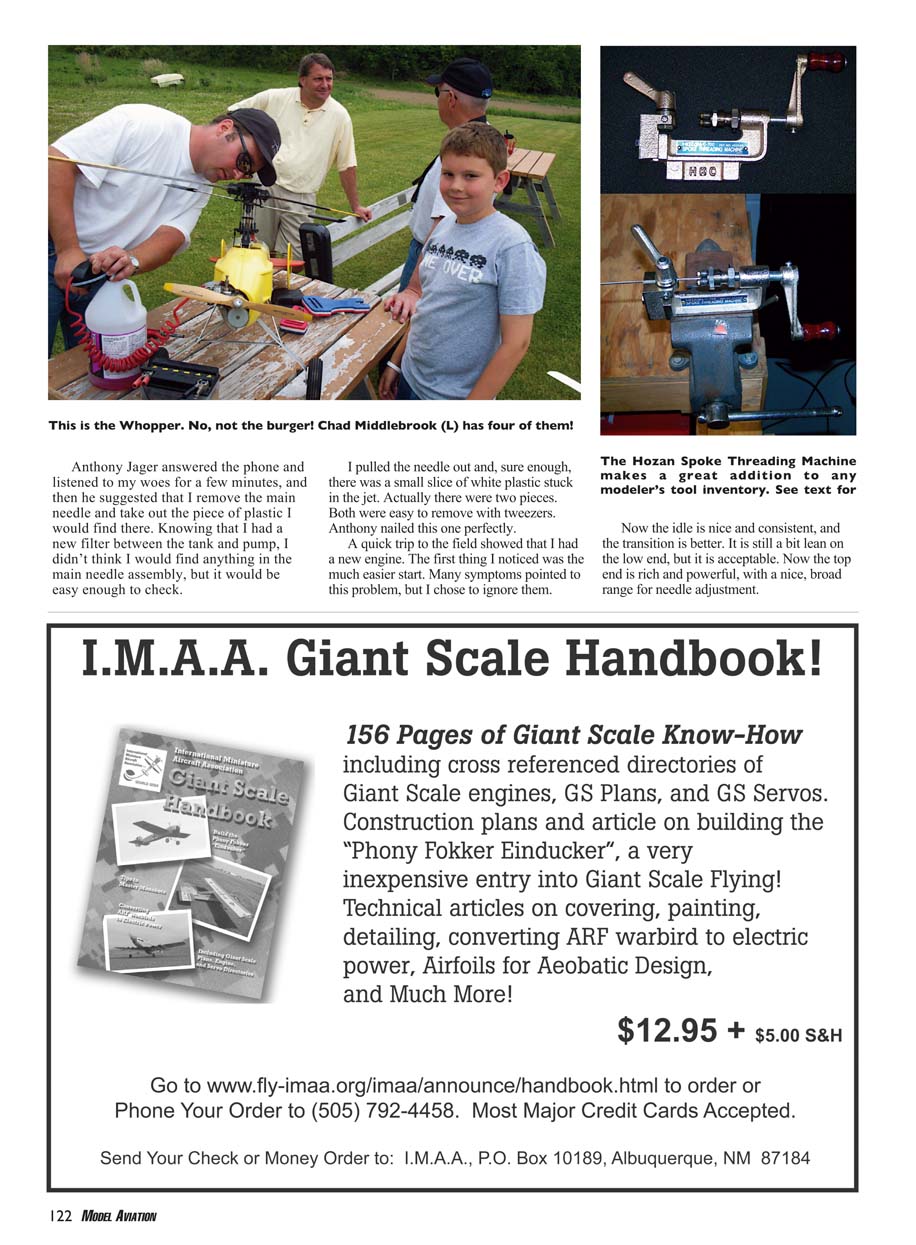
There are two machines to take a look at in the upcoming months. Chad Middlebrook will give his thoughts on the new Tiger 50 from Audacity Models (www.audacitymodels.com). It looks good and is positioned to play in the entry-level to advanced 50-size market.
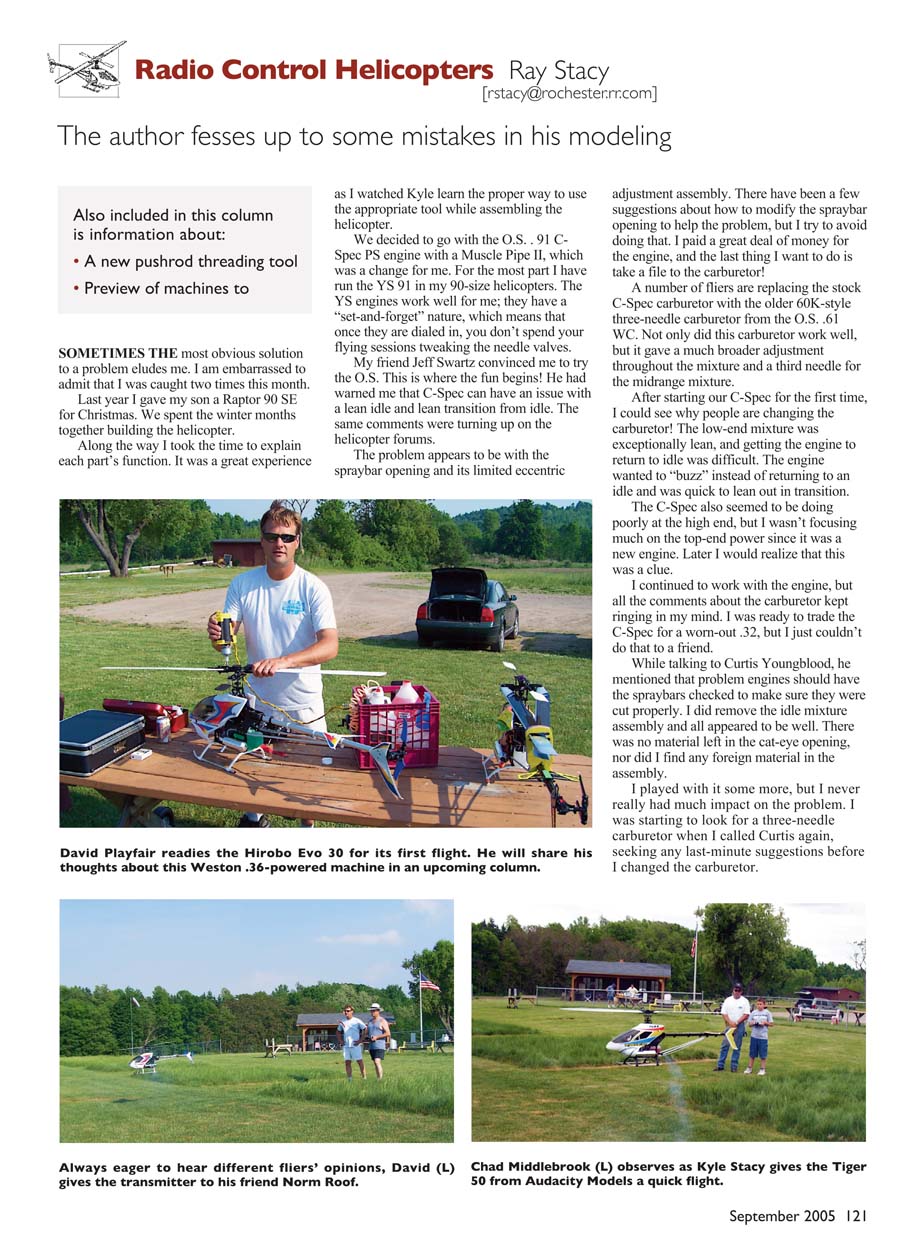
David Playfair is a new pilot who has spent all his helicopter time flying a Raptor. I was anxious to get him to look at the Hirobo Evo 30 from MRC. The entire Evo line shares the same great flying characteristics. The Evo 30 has the new Weston .36 ABC engine with Genesis pipe. I am looking forward to seeing what Dave has to say about this helicopter.
As I write this, Kyle and I have a big trip ahead of us tomorrow. We are going to the 2005 Extreme Flight Championships (www.xfc-rc.com), or XFC, in Troy, Ohio. For us, this is a one-of-a-kind, in-your-face, let-it-all-hang-out, must-see event.
The XFC brings the best 3-D helicopter and airplane pilots together from around the world to show their stuff. This invitational event promises to bring some of the best flying the people in our hobby have to offer.
By the time you read this column, the event will be long over but the excitement won't be! I wish nothing but the best to all the pilots! MA
Transcribed from original scans by AI. Minor OCR errors may remain.

