
RC HELICOPTERS
Unraveling the mystery behind flybarless gyros
Chris Mulcahy [email protected]
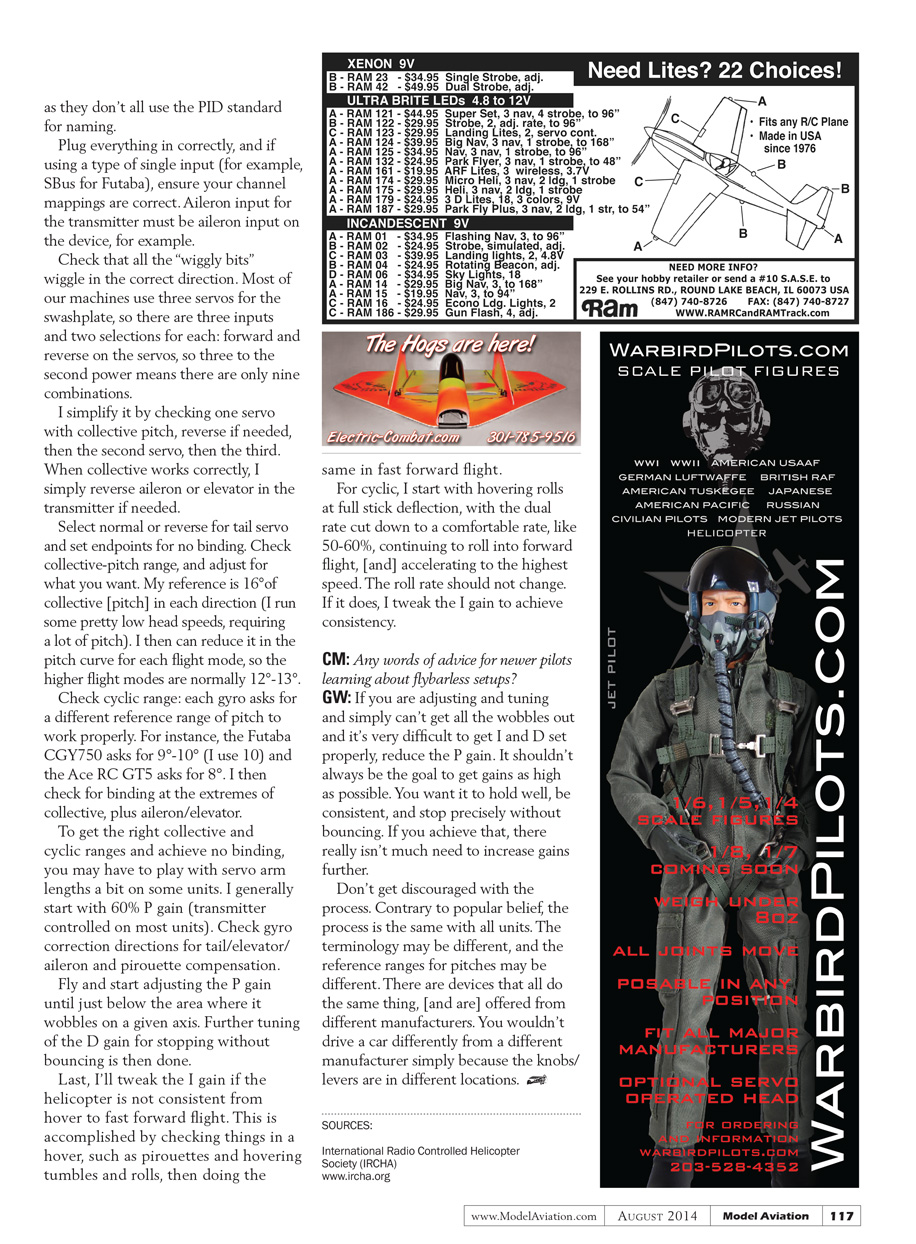
For this month's column, I talked with Team Thunder Tiger and Team Futaba pilot, the king of low head speed and old-school 3-D, Gary Wright, about flybarless gyros. I want to thank Gary for taking the time to share his knowledge with MA.
Interview
Chris Mulcahy: What is a flybar? Gary Wright: A flybar is a device whose purpose is to create unsolvable vibrations and make helicopter flying as difficult as possible. Seriously, a flybar is a type of mechanical rate gyro whose purpose is to enhance stability and controllability of a helicopter.
It is a spinning bar that wants to stay in the same plane, thus giving us a crude reference point. It generally connects to the blade grips in such a way that it imparts a pitch change in the blades in an attempt to restore stable flight due to its gyroscopic reference plane.
There are two common types of control for a model helicopter; I'll refer to them as Bell and Hiller because we've all heard the term "Bell-Hiller mixing arm" on flybar-equipped helis, so the terms are familiar.
- Bell control: Input from the swashplate is transferred directly to the blade (like our modern flybarless helicopters). Bell-type systems exhibit great initial responsiveness, but the control response tends to decay as the helicopter accelerates about an axis. The initial angle of attack increases with a cyclic pitch input, but the angle of attack decays as the helicopter starts rotating about that axis.
- Hiller control: Control is transferred to the flybar and not directly to the blades. The flybar, in turn, controls blade pitch. Hiller-type systems lag a bit in initial response but exhibit more consistency in rate — they're a bit slow to get started but good at maintaining a given rate of rotation once established.
Because of the input to the aerodynamic devices (commonly paddles on our flybars, but they can be cups, rings, or other shapes), the flybar tends to force the mechanical gyro into a new plane of rotation relative to the blades, thus assisting in maintaining rate of rotation.
As you'll see on most models with a flybar, there is a mixer arm that allows input both directly from the swashplate and from the flybar — the Bell-Hiller mixing arm. This results in a somewhat crude approximation of a PID (proportional–integral–derivative) control loop.
Chris Mulcahy: Now that we know what a flybar does, can you explain what a flybarless gyro does? Gary Wright: A flybarless gyro does the same thing as the flybar, hence the terms virtual or electronic flybar. The reference, however, is an electronic sensor rather than the mechanical sensor we had with the flybar, plus integration of a more advanced control loop, commonly a PID loop (I don't know of a flybarless gyro that doesn't use PID, but there could of course be some that use other control algorithms).
The flybarless gyro gives us a closed-loop system rather than an open-loop system, so control and stability can be more precise. To expound a bit: an open-loop system would be like an automobile cruise control that only sets the throttle. On level ground it's somewhat acceptable, but it would accelerate downhill or slow uphill because there is no feedback reference. Modern cruise controls are closed-loop: they have a sensor that feeds back the experienced speed and adjust throttle via some P/I-type algorithm to maintain that speed. Flybarless gyros give us this type of capability, but with far faster responsiveness than a mechanical flybar.
Chris Mulcahy: There are plenty of gain settings to get a grip with. What exactly is PID, and how does it affect our helis? Gary Wright: PID stands for proportional–integral–derivative. It is an equation for a closed-loop control system that can result in stability, consistency in control rates, and tunable acceleration/deceleration rates. In our control loops, the gyro sensors sense a rate of rotation, compare it to the rate being commanded by the pilot, compute an error if those rates differ, and command servo movement based on that error.
- P (proportional) control: If the system only sensed motion and fed in an amount of correction, it would be a "P" control loop — a rate gyro that simply damps unwanted movements.
- I (integral) control: Integrates error over time to maintain consistency of rate and eliminate steady-state error.
- D (derivative) control: Predicts future needs based on the rate of change, helping refine stops and reduce rebound.
Simply stated:
- If it's not stable, your P gain may be wrong.
- If it's not consistent (for example, a tail whipping when doing pirouettes in forward flight), your I gain is not right.
- If it bounces or rebounds on stops, or doesn't stop precisely, your D gain is probably incorrect.
When I and D are correct, you can often just adjust the proportional gain (the "normal" gyro gain) because it controls the overall amount of correction. Each term interacts, but think of P as the master.
Chris Mulcahy: What is your typical procedure for setting up a new flybarless heli? Gary Wright: I use a systematic procedure rather than a hunt-and-peck method. I can set up any flybarless controller quickly as long as I can determine the naming convention for each function (P, I, D might be called stability, consistency, response, etc.). Plug everything in correctly and ensure channel mappings are correct (for example, aileron input on the transmitter must be aileron input on the device).
- Check servo directions and mapping:
- Verify that all the moving parts wiggle in the correct direction.
- Most machines use three servos for the swashplate. There are three servo direction settings (forward/reverse) so there are only nine combinations. I simplify by checking one servo with collective pitch, reversing if needed, then the second, then the third. When collective works correctly, I reverse aileron or elevator in the transmitter if needed.
- Tail and endpoints:
- Select normal or reverse for the tail servo and set endpoints so there is no binding.
- Set collective pitch range:
- Adjust collective-pitch range for what you want. Gary's reference is 16° of collective in each direction (he runs low head speeds requiring a lot of pitch). He then reduces it in the pitch curve for each flight mode so higher flight modes are normally 12°–13°.
- Set cyclic range:
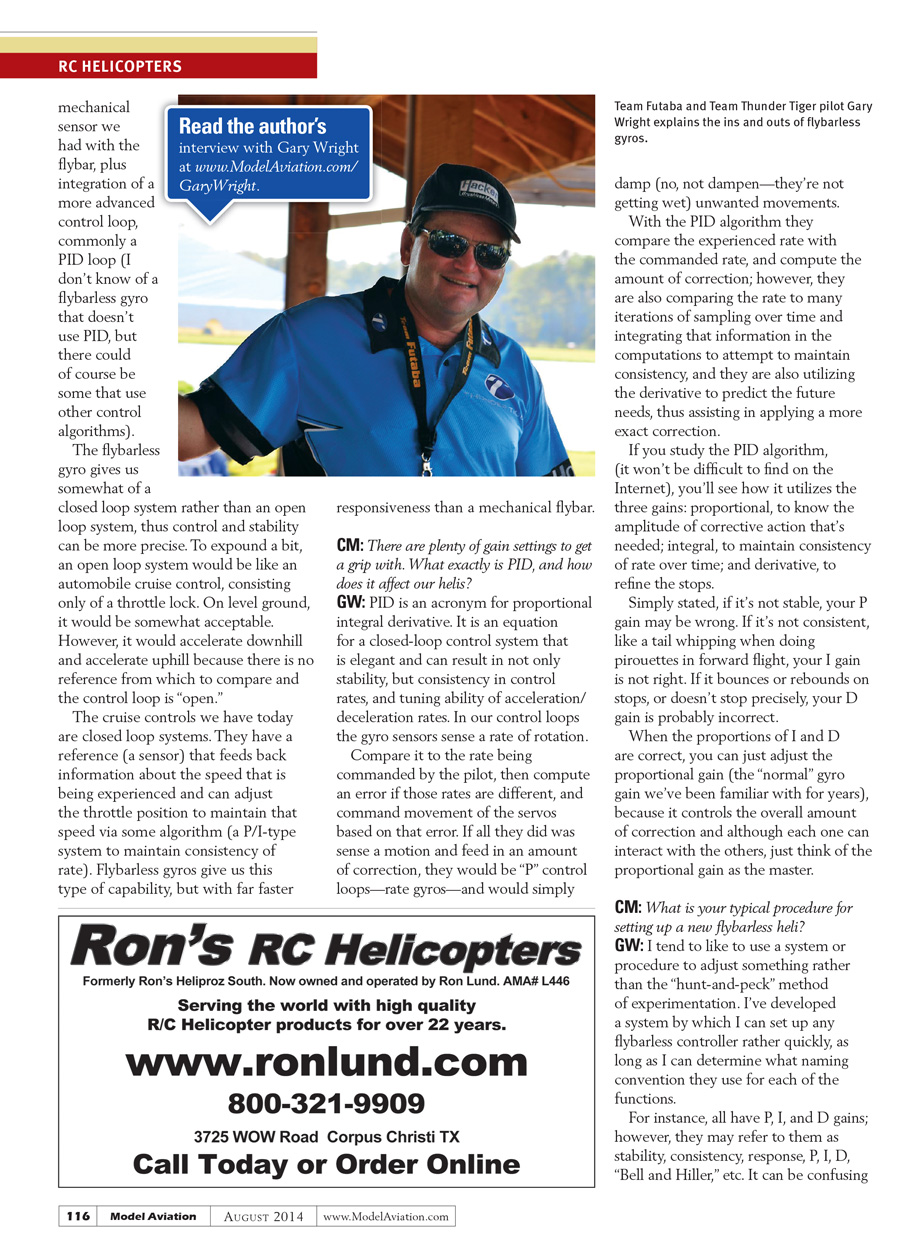
- Each gyro asks for a different reference range of pitch to work properly. For example, the Futaba CGY750 asks for 9°–10° (Gary uses 10°), and the Ace RC GT5 asks for 8°. Check for binding at extremes of collective and full aileron/elevator.
- Adjust servo arm lengths:
- To get the right collective and cyclic ranges and avoid binding, you may need to tweak servo arm lengths.
- Initial gains:
- Start with about 60% P gain (transmitter-controlled on most units). Check gyro correction directions for tail/elevator/aileron and pirouette compensation.
- Fine-tune in flight:
- Fly and increase P gain until just below where it wobbles on a given axis. Then tune the D gain to stop without bouncing.
- Finally, tweak the I gain if the helicopter is not consistent from hover to fast forward flight. Check in hover (pirouettes, hovering tumbles and rolls) and then in fast forward flight.
- For cyclic: start with hovering rolls at full stick deflection, with dual rate cut down to a comfortable rate (50–60%), continue to roll into forward flight and accelerate to the highest speed. The roll rate should not change; if it does, tweak the I gain for consistency.
Chris Mulcahy: Any words of advice for newer pilots learning about flybarless setups? Gary Wright: If you can't get all the wobbles out and it's difficult to set I and D properly, reduce the P gain. It shouldn't always be the goal to get gains as high as possible. Aim for good holding, consistency, and stopping precisely without bouncing. Once you achieve that, there's little need to increase gains further.
Don't get discouraged. The process is the same with all units; terminology and referenced pitch ranges may differ. Devices from different manufacturers all do the same basic job. You wouldn't drive one car differently from another simply because the knobs or levers are in different locations.
Sources
- International Radio Controlled Helicopter Society (IRCHA)
Transcribed from original scans by AI. Minor OCR errors may remain.

