
RC Helicopters
Columnist says goodbye
by Mark Fadely
Thanks for stopping by the helicopter column this month. I want to thank all of you for reading what I have written here during the last seven years. With regrets, this will be my last column for Model Aviation. Some of you are probably saying, "Thank goodness; our prayers have been answered!" Ha, ha. I hope that is not true.
Actually, writing this column has been so much fun, but the time has come for me to move on. My personal and business life is crazy busy right now, so it is a good time for me to take a step back. It is also nice to change things up and introduce a fresh face and voice every so often.
It has been exciting seeing the transformation of Model Aviation magazine throughout the last several years. Michael Ramsey was the editor when I started and Jay Smith currently is in charge. Both had/have a vision for the future and implemented many new ideas and techniques into the layouts.
The staff at AMA Headquarters includes many fun-loving people who also happen to love models. Their zest for the hobby shows in the work they produce. Our membership magazine holds its own against the best hobby publications on the market. The new digital edition is nice, too.
When I began writing for MA in January of 2007, most helicopters had a flybar and were powered by an internal-combustion engine. My, how times have changed. Now nearly every heli you see is flybarless and electric. It has been a blast seeing the fast-paced changes in technology that upstage each evolution of model and radio guidance systems. Writing about the models and the pilots who fly them has been interesting and fascinating.
The great part of this hobby for the pilot is that the machines have a nearly inconceivable number of flight paths and flight routine combinations. It is the pilot's responsibility to make his or her mark as a performer with each flight. That does not mean you must fly radical 3-D to perform a good show. Helicopters are so fun and cool that nearly everyone stops to watch, no matter what kind of machine is being flown. If you are in the learning stages and beginning to hover, you are still performing for the audience around you, and there will be an audience around you. That is something that heli pilots learn early.
There is something magical about a helicopter's flight. When you see a capable 3-D model flown by an expert pilot, much of the flight seems physically impossible—appearing to defy the laws of physics.
The process of understanding helicopter flight was nearly as exciting for me as actually flying one. I loved learning all the nuances of rotary flight in conjunction with discovering the mechanical and electronic components of the machines. I hope many of you will share that same experience as you continue in the hobby.
Writing for this magazine has put me close to the pilots and people who design and develop the equipment. It is a cool hobby!
Another passion of mine is photography. I have always been interested in it and when I began writing for MA, more capable digital cameras had recently entered the market. Helicopter action shots became sharper and easier to obtain.
I wrote a column in the February 2012 issue about how to photograph helis in flight. If you are interested in photography, check it out. It has plenty of tips about which cameras and lenses to use, and suggestions to give your photos more impact.
Finally, I would like to thank all of you and the MA staff. You have sent me plenty of good feedback throughout the years, and the staff at MA has been a first-class group.
These last seven years have been fun, challenging, rewarding, and exciting.
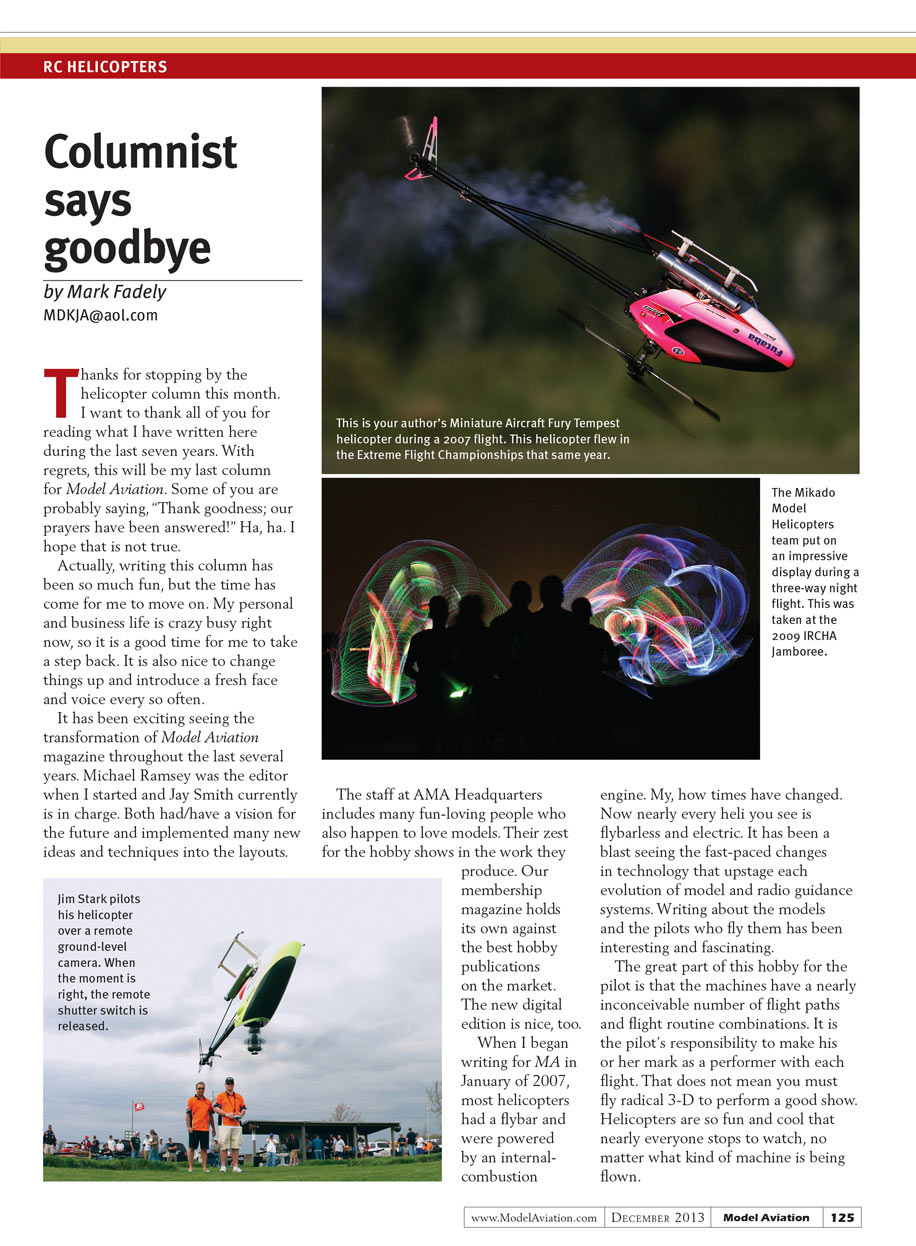
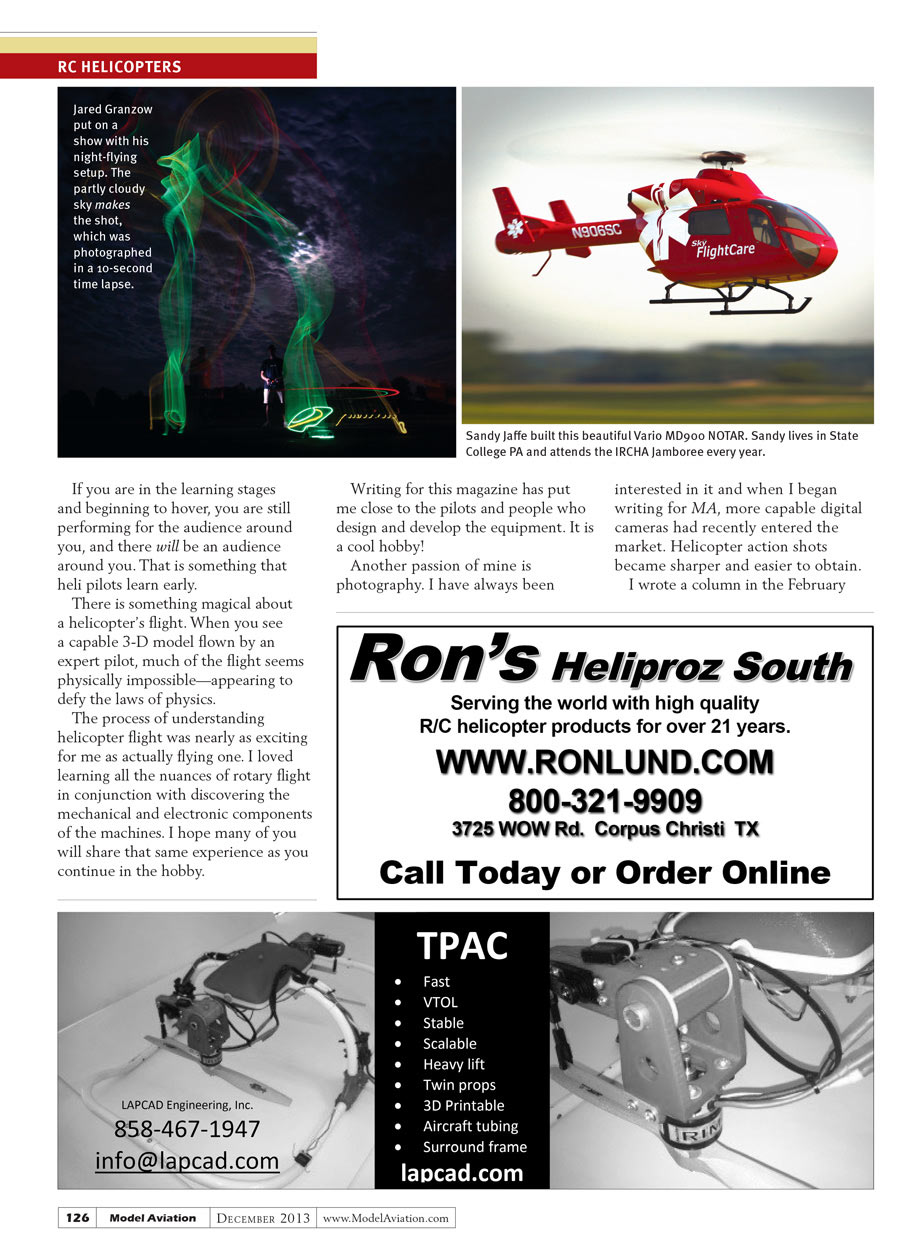
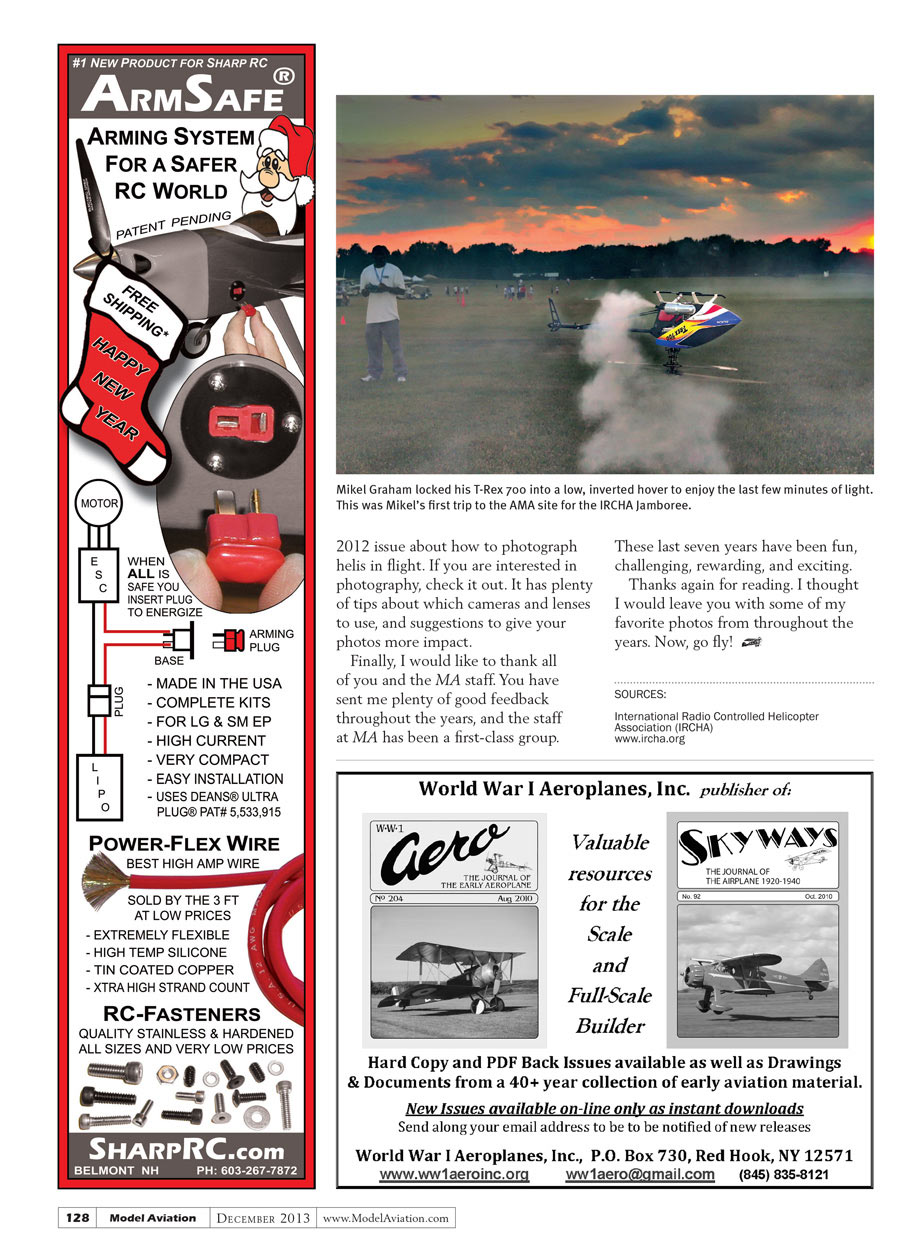
Thanks again for reading. I thought I would leave you with some of my favorite photos from throughout the years. Now, go fly!
SOURCES:
International Radio Controlled Helicopter Association (IRCHA) www.ircha.org
Transcribed from original scans by AI. Minor OCR errors may remain.

